


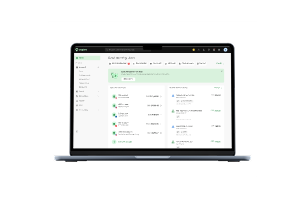
What is a business bank account?
A business bank account is a bank account designed to manage transactions for a registered business. It keeps business finances separate from personal funds.
Why businesses should open a business account
A dedicated business account can help you:
- Receive customer payments
- Pay suppliers, staff, and statutory contributions
- Maintain financial records for accounting and tax filing
- Build credibility with partners, lenders, and investors
Key benefits of a business bank account for SMEs
- Receive, hold, and send money: Accept client payments, store funds securely, pay suppliers and staff. These are the core functions that keep operations running.
- Corporate cards: Manage business spending, track employee expenses, and access short-term credit where needed.
- Digital tools: Online banking, invoicing, spend management, and integrations with accounting software can streamline operations.
- FX and cross-border support: Multi-currency accounts can help businesses manage international transactions.
- Expense tracking: Separating business transactions can make bookkeeping easier and reduce errors.
- Investor readiness: A corporate account is often used for funding or grant applications.
- Loan and credit access: Banks often review your business account history when assessing loan applications.
- Deposit safety: Eligible SGD deposits held in licensed banks are protected up to SGD $100,000 per depositor under the Singapore Deposit Insurance Corporation (SDIC) Scheme, subject to SDIC terms and conditions.
Types of business accounts in Singapore
Singapore providers offer several types of business accounts. Each type is designed for different operational needs and cash management strategies.
Current account
The current account is commonly used for daily operations. It offers cheque books, digital transfers, and access to funds. Current accounts generally do not earn interest.
Savings account
Some banks offer business savings accounts, though these function differently from personal savings accounts. They may require higher minimum balances and have restrictions on withdrawals compared to current accounts.
Money market account
A money market account is an interest-bearing account that can offer returns on excess funds. It allows businesses to place cash in a low-risk instrument while maintaining liquidity. These accounts are less commonly offered to SMEs in Singapore than traditional savings and fixed deposit accounts, but some banks offer them as short-term cash management tools.
Certificate of deposit (CD) account
A CD account allows businesses to lock in funds for a fixed period in exchange for a fixed interest rate. This can be used for long-term financial planning, but early withdrawals may incur penalties.
Merchant account
A merchant account enables businesses to accept card payments at point-of-sale (POS) systems or through online gateways. It is often used for processing customer transactions electronically.
Multi-currency account
A multi-currency account allows you to hold and transact in multiple currencies. This type of account can be useful for businesses engaged in international trade or e-commerce, as it may help manage FX exposure and facilitate cross-border payments.
Pros and cons of each account type
Business account options for SMEs and freelancers in Singapore (updated July 2026)
Important note: The information above is intended as a general guide. Banks and fintech providers may offer multiple account variations with different fee structures, FX charges or minimum balance requirements, and not all features apply to every business type. Always refer to the provider's latest documentation for precise details.
The best business account in Singapore by use case (2026)
The right account really comes down to how your business moves money, here are our choices.Check the full comparison table above for fees and minimum balances before you apply.
- Best traditional bank: OCBC. Of the big three, OCBC's Multi-Currency Business Account has the lowest barrier to entry (SGD $0 minimum balance, SGD $10 monthly fee, waivable), with full branch and relationship support. DBS and UOB suit firms that need deeper credit lines.
- Cheapest multi-currency and FX: Wise. Converts at the mid-market rate plus a small, clearly stated fee above the interbank rate, rather than an undisclosed bank spread.
- Best all-in-one account: Aspire. No monthly fees, no minimum balance, fully online onboarding, multi-currency capabilities, unlimited virtual and physical corporate cards with cashback, integrated expense management and accounting integrations with Xero and QuickBooks.
Key considerations when choosing a business account
When evaluating business accounts, consider the following factors based on your operational requirements:
Fees and monthly charges
Many banks charge a one-time account-opening fee that ranges from SGD $0 to SGD $500 or more, depending on the bank and the company profile. You should also review the ongoing costs. Initial deposits typically range from SGD $0 to SGD $1,000. Minimum balance requirements often fall between SGD 1,000 and SGD 5,000, with fees that fall below if you do not maintain this amount. Monthly maintenance fees usually range from SGD $0 to SGD $35, based on how you use the account.
Minimum deposit and balance requirements
Traditional banks may require a minimum balance of SGD $1,000–$30,000, and falling below this can trigger monthly fall-below fees.
Local transfers (FAST / GIRO)
Most accounts support FAST and GIRO, but some providers may charge after you exceed monthly transaction limits, which matters for regular payments and payroll.
FX and international transfers (SWIFT)
Compare FX markups/spreads, SWIFT transfer fees, and possible correspondent bank charges, as costs can vary by provider and destination country.
Digital features and scalability
Look for tools like accounting integrations, virtual cards, expense management, dashboards, or API access to support growing workflows.
Multi-currency support
If you pay or receive money internationally, multi-currency accounts can help you send/receive in different currencies without managing multiple bank accounts.
Transaction limits and APIs
Confirm any daily transfer limits, bulk payment restrictions, or API limitations if you handle high volumes or need custom integrations.
Customer support options
Support may be via chat, phone, email, or branches, with some providers offering 24/7 coverage and others operating only during set hours.
What you need before opening a business account
Eligibility criteria
- ACRA-registered business
- Directors and shareholders with valid identification
- No ongoing legal or insolvency issues
For foreign-owned companies, additional documentation may be required depending on the provider's policies.
Required documents
Most providers typically require:
- ACRA Business Profile
- Certificate of incorporation
- Constitution or M&AA
- Board resolution
- NRIC or Passport of directors, UBOs, and signatories
- Proof of residential address
For foreign-owned companies, additional documents such as a Certificate of Incumbency may be requested.
Physical presence requirements
Some banks require a physical visit for verification or interviews. Most fintech platforms allow complete online onboarding, which can often be completed in a shorter timeframe.
Fees and pricing associated with a business account
Beyond the stated fees, be aware of potential additional costs such as:
- Transfer fees for local or international payments.
- FX markups, which can vary significantly by provider.
- SWIFT charges for cross-border transfers.
- Fees for cheque books, statements, or other account services.
How much do bank FX markups really cost? A worked example
Here's what it actually costs to convert SGD into USD $10,000 and send it overseas, comparing a traditional bank with a fintech account.
Assumptions:
USD $10,000 converted from SGD at an indicative mid-market rate of about 1.35 SGD per USD, so roughly SGD $13,500 before costs.
The bank figures use a typical 3% FX spread plus a telegraphic transfer (SWIFT) fee of about SGD $30 to SGD $40. The fintech figure uses a 0.4% conversion fee on a near mid-market rate plus a flat outbound SWIFT fee.
Totals are illustrative and not actual quotes.
That's a saving of roughly SGD $350 to SGD $370 on a single USD $ $10,000 transfer. A business that makes even a handful of overseas payments a month can save several thousand Singapore dollars a year just by moving the FX leg to a transparent provider.
Time taken to open a business account
The time required to open a business account can vary:
- Traditional banks: Generally, a few days to several weeks, depending on the verification process and documentation requirements
- Fintech platforms: Typically, minutes to a few days, with many offering fully online onboarding
The actual timeframe depends on the provider's verification process and whether you need to visit a branch.
How SMEs and freelancers can open a business account in Singapore in 2026
If you're an SME, a startup founder, or a solopreneur in Singapore, follow this step-by-step guide to open a business account.
Research providers
Review traditional banks, international banks, and fintech/digital platforms. Compare fees, minimum balances, supported currencies, onboarding process, and digital features based on your business needs.
Choose the right account type
Decide between a current account, savings account, multi-currency account, or digital/fintech account. The right choice depends on how you receive payments, pay suppliers, and manage local vs international transactions.
Shortlist providers
Narrow down to a few options that match your requirements and operating style. Check the app features, customer support channels, and tools such as PayNow Corporate, FAST, SGD transfers, and foreign currency support.
Prepare documents (as required by the provider)
Most providers typically request:
- ACRA Business Profile and UEN
- Certificate of incorporation
- Company constitution
- Board resolution authorising the account
- IDs + proof of address (directors/shareholders/authorised signatories)
- Foreign-owned companies: may require a Certificate of Incumbency
Submit the application
Some providers allow fully online applications, while others may require an in-branch visit for verification. Ensure details match your registration records to reduce processing delays.
Make the initial deposit (if required)
Some traditional banks may require an initial deposit (e.g., SGD $1,000–$3,000), while some fintech accounts may not. If applicable, meeting the deposit requirement supports account activation and setup.
Activate and onboard
Once approved, you may need to:
- Set up user access and permissions
- Generate physical or virtual corporate cards (if applicable)
- Connect accounting software (if supported)
- Configure PayNow Corporate, FAST, or multi-currency tools
- Review security settings (e.g., 2FA, approval roles, access controls)
Best bank account for small businesses in Singapore
There is no one-size-fits-all solution for all businesses. The right business account depends on your specific operational needs and preferences.
Consider:
- Your monthly transaction volume
- Whether you need multi-currency options
- Your budget for banking fees
- Whether you prefer digital convenience or branch support
For SMEs and startups, cost efficiency and digital features may be priorities. For established companies, comprehensive banking services may be more relevant.
How to assess your business needs?
Before choosing a provider, assess your business's operational requirements:
- Do you operate locally or internationally?
- How many transactions do you process monthly?
- Do you need multi-currency support?
- Do you prefer online account management or in-person banking?
- What is your budget for banking fees?
Understanding these factors can help you identify suitable options.
Why business account requirements differ for freelancers
Most business accounts in Singapore, whether bank or fintech, require a legally registered entity (e.g., a sole proprietorship or a Pte Ltd). Freelancers operating informally may not meet this requirement.
Under MAS AML/CFT guidelines, providers must verify key details, including the UEN, business ownership, business activity, and authorised signatories. Without official registration, freelancers typically can’t provide the required documents.
Business accounts are built for business needs like invoicing, payroll, expense management, and multi-currency transactions, which generally require a recognised business structure.
Fintech providers follow the same compliance standards, but onboarding may be faster and fully online once the freelancer is registered. Registering a sole proprietorship can unlock access to business accounts and digital features such as virtual cards, tracking tools, and multi-currency support.
What should freelancers look for in a business account
When evaluating business accounts, freelancers may want to consider:
- Cost structure: Accounts with lower or zero minimum balances and monthly fees can help reduce overhead, which may be relevant for freelancers with variable income.
- Multi-currency capabilities: Freelancers with international clients may benefit from accounts that allow invoicing in foreign currencies, receiving payments, and managing FX.
- Online onboarding: A fully digital workflow can eliminate the need for branch visits, which may suit remote or location-independent freelancers.
- Expense and payment management: Tools such as virtual cards, spend tracking, and accounting integrations can help freelancers keep business and personal finances separate.
Is the Aspire business account right for you?
Aspire's multi-currency business account is a digital account solution designed for companies that prefer online setup and management. The account can be opened digitally without physical paperwork and does not require a minimum balance or monthly maintenance fees. This may be suitable for freelancers, startups and SMEs looking to manage operating expenses.
Aspire provides multi-currency functionalities, enabling businesses to make and receive international payments. The platform offers virtual corporate cards with spend controls that can be assigned to team members. These features can help businesses streamline payments and monitor spending, particularly for organisations with distributed teams or frequent cross-border transactions.
The platform integrates with accounting systems such as Xero and QuickBooks, which can support bookkeeping and reconciliation processes. Aspire offers a digital option for businesses seeking online financial management tools.
Frequently asked questions
Can a foreigner open a business bank account in Singapore?
Yes. The company has to be ACRA-registered with a valid UEN, and you need to be a director, shareholder, or authorised signatory. Singapore companies generally need at least one locally resident director (a citizen, PR, or valid pass holder), so fully overseas founders usually appoint a nominee director through an ACRA-registered corporate service provider. MAS-licensed digital providers often let you open remotely as a foreign-owned SG company, while traditional banks tend to ask for enhanced due diligence and, in many cases, an in-person visit.
What is the cheapest business account in Singapore?
Several fintech accounts charge SGD $0 in monthly fees with no minimum balance. The cheapest option overall depends on how you use it. If you make cross-border payments, FX markup matters far more than the monthly fee, so a low-FX account like Aspire, Wise, or Airwallex usually works out cheapest in total.
Do I need a minimum balance to open a business account?
Not always. Fintech providers generally have no minimum balance. Traditional banks often ask for SGD $1,000 to SGD $30,000 and charge a monthly fall-below fee if you drop below it.
How long does it take to open a business account?
Fintech accounts can be opened fully online, often within minutes to a few business days once your documents are verified. Traditional banks usually take a few days to several weeks, and foreign-owned companies should plan for around 4 to 8 weeks, plus a possible branch visit.
Which account is best for receiving payments from overseas clients?
A multi-currency account lets you hold and receive funds in foreign currencies and convert on your own terms, so you avoid forced conversions at the bank's spread. Wise, Airwallex, and Aspire all offer multi-currency receiving accounts, and OCBC's Multi-Currency Business Account is the most accessible traditional-bank option.
Can freelancers open a business account in Singapore?
Yes, but you generally need a registered entity first, most commonly a sole proprietorship. MAS AML and CFT rules require providers to verify your UEN, ownership, and business activity, and that needs official registration.
Are funds in a business account protected?
Eligible SGD deposits held with licensed full banks are insured up to SGD $100,000 per depositor under the Singapore Deposit Insurance Corporation (SDIC) scheme, subject to its terms. Fintech e-money and payment accounts aren't covered by SDIC. Instead, licensed providers are usually required to safeguard customer funds,in most instances by holding them with regulated banks.
Is a digital fintech account a real bank account?
Most fintech providers like Aspire, Wise, and Airwallex are licensed payment institutions rather than banks. They give you a business account with local and international transfers, multi-currency wallets, and cards, but not full banking products like loans or SDIC-insured deposits.





.webp)