


International payments made simple: a founder’s guide

Content Team

Summary
International payments are transactions between parties in different countries.
Businesses use them to pay suppliers, contractors, employees, vendors, and overseas entities, as well as to receive customer payments.
Common methods include bank wires, local payment rails, cards, payment platforms, FX providers, multi-currency accounts, and digital wallets.
SWIFT is a messaging network used by financial institutions. It does not itself move or hold the money.
The total cost can include transfer fees, FX margins, intermediary-bank charges, and recipient fees.
The fastest or cheapest option depends on the countries, currencies, amount, frequency, and urgency involved.
Businesses should compare the total cost and expected delivery, not just the advertised transfer fee.
One Aspire account to manage your business finances in one place.
Get a business account¹, issue corporate cards², manage expenses, and automate financial workflows, all from one powerful platform built for modern businesses.
International payments made simple: a founder’s guide
International payments allow businesses to send and receive money across borders. They are used to pay overseas suppliers and contractors, collect payments from international customers, cover expenses, and move money between entities in different countries.
A cross-border payment can involve several banks or financial institutions, different currencies, foreign exchange, payment networks, and compliance checks.
This guide explains what international payments are, how they work, the main payment methods, the costs involved, how long they can take, and what businesses should consider when choosing a payment provider.
What counts as an international payment
An international payment is a transaction where money moves between parties in different countries.
For example, a US business paying a supplier in Germany, an Australian company paying a contractor in India, or a business receiving payment from an overseas customer are all international payments.
The payment does not necessarily require currency conversion. Two parties can transact in the same currency while still being located in different countries.
International payments can involve:
- Different currencies and foreign exchange
- Banks and other financial institutions
- Correspondent or intermediary institutions
- Local and international payment networks
- Identity and compliance checks
- Different processing times and cut-off hours
The route a payment takes depends on the countries involved, the currencies being used, the provider, and the payment method.
What are international payments used for
Businesses make international payments for many routine activities, such as:
Paying overseas suppliers and vendors
Importers and other businesses often need to pay suppliers and vendors located in another country. Depending on their requirements, they may pay by bank transfer, a local payment rail, or another payment provider.
Paying international contractors and employees
Businesses with remote teams may send regular payments to workers in other countries. The appropriate method depends on factors such as the worker's location, currency, employment arrangement, and local requirements.
Receiving international customer payments
A business selling to customers in other countries may need to accept payments in foreign currencies and convert or hold those funds.
Managing overseas subsidiaries
Companies with entities in different countries may move funds between accounts to cover operating expenses, payroll, working capital, or other business needs.
Trade and other cross-border operating expenses
Businesses may make cross-border payments for taxes, professional services, insurance, loan obligations, subscriptions, and other expenses. Not just this, international employees and teams may incur expenses abroad, requiring the business to pay or reimburse costs in another currency.
The right payment method depends on the countries involved, currency, transaction size, frequency, urgency, and the requirements of the recipient.
International vs domestic payments
The main difference is that international payments cross a national border, while domestic payments remain within one country's payment system.
| Factor | Domestic payment | International payment |
|---|---|---|
| Countries | Usually one | Two or more |
| Currency | Usually one domestic currency | May involve one or more currencies |
| Payment infrastructure | Domestic rails | May involve domestic and cross-border rails |
| Intermediaries | Often fewer | May involve additional institutions |
| Foreign exchange | Usually not required | May be required |
| Compliance | Domestic requirements | May involve additional cross-border checks |
| Cost | Often lower | Can be higher depending on the route |
| Processing time | Often predictable | Can vary by route and institutions |
How international payments work
The exact process varies by payment method, but a traditional cross-border bank payment usually follows these steps:
1. The sender provides payment instructions
The sender enters details such as the recipient's name, account information, amount, currency, and payment reference.
2. The payment provider checks the transaction
The bank or payment provider may perform checks relating to the sender, recipient, sanctions, fraud, and other compliance requirements.
3. The payment is routed
The provider determines how the payment should reach the recipient. A transaction may use a local payment rail, direct bank relationship, correspondent banking, or another route.
4. Currency is converted, if necessary
If the sender and recipient use different currencies, the payment may be converted. The exchange rate used can affect the final amount received.
5. Other institutions may process the payment
A cross-border bank transfer can involve intermediary or correspondent banks. These institutions may deduct fees depending on the payment route and fee arrangement.
6. The recipient's financial institution receives the payment
The receiving institution processes the transaction and carries out any required checks.
7. The recipient receives the funds
Once processing is complete, the funds are credited to the recipient's account.
Not every international payment follows this exact sequence. Payments using local rails or other payment networks can take a different route.
Local payment rails vs correspondent banking
International payments do not always move end-to-end through a traditional correspondent-banking chain. Some payment providers route funds internationally and use domestic payment rails to complete the local payout in the destination market. Examples of domestic payment rails that may be used for the local leg of a cross-border transfer include:
- ACH in the US
- Faster Payments in the UK
- UPI in India
- Pix in Brazil
UPI is India's instant payment system, developed by the National Payments Corporation of India, while Pix is Brazil's instant payment system. Both are domestic payment systems that support fast transfers within their respective markets.
SEPA is different. It is a regional euro-payment framework covering participating countries in the Single Euro Payments Area.
Correspondent banking works differently. When two banks do not have a direct relationship, they may use an intermediary bank to facilitate the transaction.
Ways to send international payments
There are different ways to send international wire transfers, such as:
International wire transfers
International wire transfers move funds electronically from a bank account in one country to a bank account in another. They are often used for large-value business payments, supplier payments, property transactions, and other situations where a direct bank transfer is preferred.
Banks commonly use the SWIFT network to exchange payment instructions, while correspondent banks may be involved when the sending and receiving banks do not have a direct relationship. Depending on the route, the sender's bank, intermediary banks, and recipient's bank may each charge fees.
Transfer times can vary based on the currencies and countries involved, bank processing times, cut-off times, weekends and holidays, compliance checks, and the number of intermediary banks involved. Some transfers arrive within one business day, while others may take several business days.
Businesses can choose from several payment methods including:
| Method | How it works | Often useful for |
|---|---|---|
| Bank wire | Funds are transferred between bank accounts through banking networks | Large or traditional business payments |
| Local bank transfer | Payment is sent through the recipient country's local infrastructure | Supported countries and currencies |
| International ACH | ACH-based transfers can be used for certain cross-border payments | Recurring or lower-cost transfers where supported |
| Card payment | A card network processes the transaction | Customer purchases and business expenses |
| Payment platform | A provider handles the payment and may provide currency conversion | Online businesses and cross-border transactions |
| FX provider | Specialized provider converts currencies and transfers funds | Businesses making regular foreign-currency payments |
| Multi-currency account | Business can hold and transact in multiple currencies | Companies with recurring international activity |
| Digital wallet | Funds are held and transferred through a digital wallet | Certain online and cross-border payments |
| Cryptocurrency or stablecoin | Digital assets are transferred between wallets or platforms | Specific use cases where supported and appropriate |
The cheapest method is not always the most suitable. Businesses should also consider delivery time, currency availability, recipient requirements, compliance, tracking, and how easily they can process payments.
Payment networks and rails used in international payments
Several payment networks and systems support domestic and cross-border transactions.
SWIFT
SWIFT is a secure messaging network used by financial institutions to exchange financial instructions. It does not itself hold or transfer the underlying funds.
SWIFT connects more than 11,000 financial institutions and supports payment activity across more than 200 countries and territories.
SEPA
The Single Euro Payments Area, or SEPA, covers 41 European countries. It enables standardized euro payments between participating countries.
SEPA Instant Credit Transfer can make funds available in the payee's account within ten seconds of a payment order when the relevant service is supported.
Fedwire
Fedwire is a US domestic payment system operated by the Federal Reserve. It is used for time-critical, often high-value payments and settles transactions individually in real time.
The Federal Reserve has announced plans to expand Fedwire operating days to include Sundays and certain weekday holidays, with implementation planned no earlier than 2028.
CHAPS
CHAPS is the UK's high-value sterling payment system. It uses real-time gross settlement and provides same-day payment processing during its operating hours.
What international payments really cost
The advertised transfer fee is often only one part of the cost. A business may also be liable to pay:
Transfer fees
Banks and payment providers may charge a fixed fee for sending a payment.
Foreign exchange costs
When currencies are converted, the provider may apply an exchange-rate margin or spread. Even a small difference in the exchange rate can become significant for large or frequent payments.
Intermediary-bank fees
Correspondent or intermediary institutions may deduct charges while processing a payment.
Recipient fees
The recipient's bank or financial institution may also charge a fee or deduct an amount from the incoming payment.
Operational costs
Payment delays, manual reconciliation, failed transfers, and additional finance-team work can create costs that do not appear on the transaction receipt.
How to reduce international payment costs
Businesses making regular cross-border payments can reduce unnecessary costs by looking beyond the headline fee.
Compare the total cost
Check the transfer fee, exchange rate, intermediary charges, recipient fees, and final amount received.
Use local payment rails where practical
If a provider can route a payment through local infrastructure, this may reduce the number of intermediaries involved.
Hold commonly used currencies
A multi-currency account can reduce the need to convert funds for every transaction, depending on the business's payment flows and currency needs.
Review fee arrangements
For bank transfers, understand whether the sender, recipient, or both parties are responsible for payment charges. The final amount received can differ depending on the arrangement.
Compare the actual payment route
Two providers can quote different prices for the same transaction because they use different routes, currencies, institutions, or exchange rates.
Paying overseas contractors: what US businesses should know
US businesses paying contractors outside the country need to consider where the services are actually performed and the contractor's tax status.
For personal services, the IRS generally determines the source of income based on where the services are performed, rather than where the contract was signed, where payment is made, or where the payer is located.
Income from services performed outside the US is generally foreign-source income. Payments of foreign-source income to a nonresident alien generally are not subject to US withholding under Chapters 3 and 4 and are not reported on Form 1042-S, although exceptions and other rules can apply.
Businesses may encounter forms such as:
- Form W-8BEN for a foreign individual
- Form W-8BEN-E for a foreign entity
- Form 8233 in certain cases where a nonresident alien claims a treaty exemption for personal services
- Form 1042-S for certain US-source income paid to foreign persons
A W-8 form is generally provided to the payer or withholding agent rather than sent directly to the IRS.
The correct tax treatment depends on the contractor's status, where the services are performed, the type of income, applicable treaties, and other facts. Businesses should confirm their specific obligations with a qualified tax professional.
International payment checklist
Before sending a cross-border payment, check:
- Recipient's legal name
- Bank name and country
- Account number or IBAN, where applicable
- SWIFT/BIC, where applicable
- Routing or local bank code, where applicable
- Currency and payment amount
- Payment purpose or reference
- Fee arrangement
- Expected amount the recipient will receive
- Invoice or supporting documentation, if required
- Whether the destination country and currency are supported
Incorrect account details can cause delays, returned payments, or funds being sent to the wrong account. Businesses should verify payment instructions independently before sending large or unusual transactions.
How long do international payments take
There is no single processing time for every international payment.
Timing can depend on:
- Payment method
- Sending and receiving countries
- Currency
- Bank cut-off times
- Weekends and public holidays
- Intermediary institutions
- Compliance or fraud checks
- Whether the payment uses local or cross-border infrastructure
SWIFT reports that 75% of payments reach the beneficiary bank within ten minutes and more than 90% within one hour. However, SWIFT also notes that the final "last mile" after the payment reaches the beneficiary bank accounts for more than 80% of total end-to-end processing time.
That means reaching the beneficiary bank quickly does not necessarily mean the recipient has the money available in their account within the same period.
Common risks with international payments
Cross-border payments create several areas businesses need to manage.
Foreign exchange risk
Exchange-rate movements can change the cost of a payment or the value of funds received.
Payment fraud
Fraudsters may impersonate suppliers or employees and provide fraudulent bank details. Payment instructions should be independently verified, especially when account details change.
Incorrect payment information
An incorrect account number, IBAN, SWIFT/BIC, or local bank code can delay or prevent a payment.
Compliance checks
Payments may be delayed while banks or providers conduct sanctions, identity, fraud, or other regulatory checks.
Unexpected deductions
Intermediary or receiving-bank charges can reduce the amount that reaches the recipient.
Limited visibility
Some payment routes provide less information about where a payment is in the process, making tracking and reconciliation harder.
How to choose an international payment solution
Before choosing a bank or payment provider, compare it against the transactions your business actually makes. Look at:
- Currency support: Does it support the currencies you need?
- Country coverage: Can you send and receive money in the countries where you operate?
- Total cost: What will the recipient receive after fees and FX costs?
- Delivery time: How quickly can the payment reach the recipient?
- Fee transparency: Are all charges clear before you send?
- Tracking: Can your finance team see the payment's status?
- Compliance support: Does the provider have processes for required checks and documentation?
- Accounting workflow: Can transactions be easily tracked, reconciled, and recorded?
For businesses making frequent international payments, the best option is usually the one that fits the company's actual payment flows rather than the provider with the lowest advertised transfer fee.
How Aspire fits into international payments
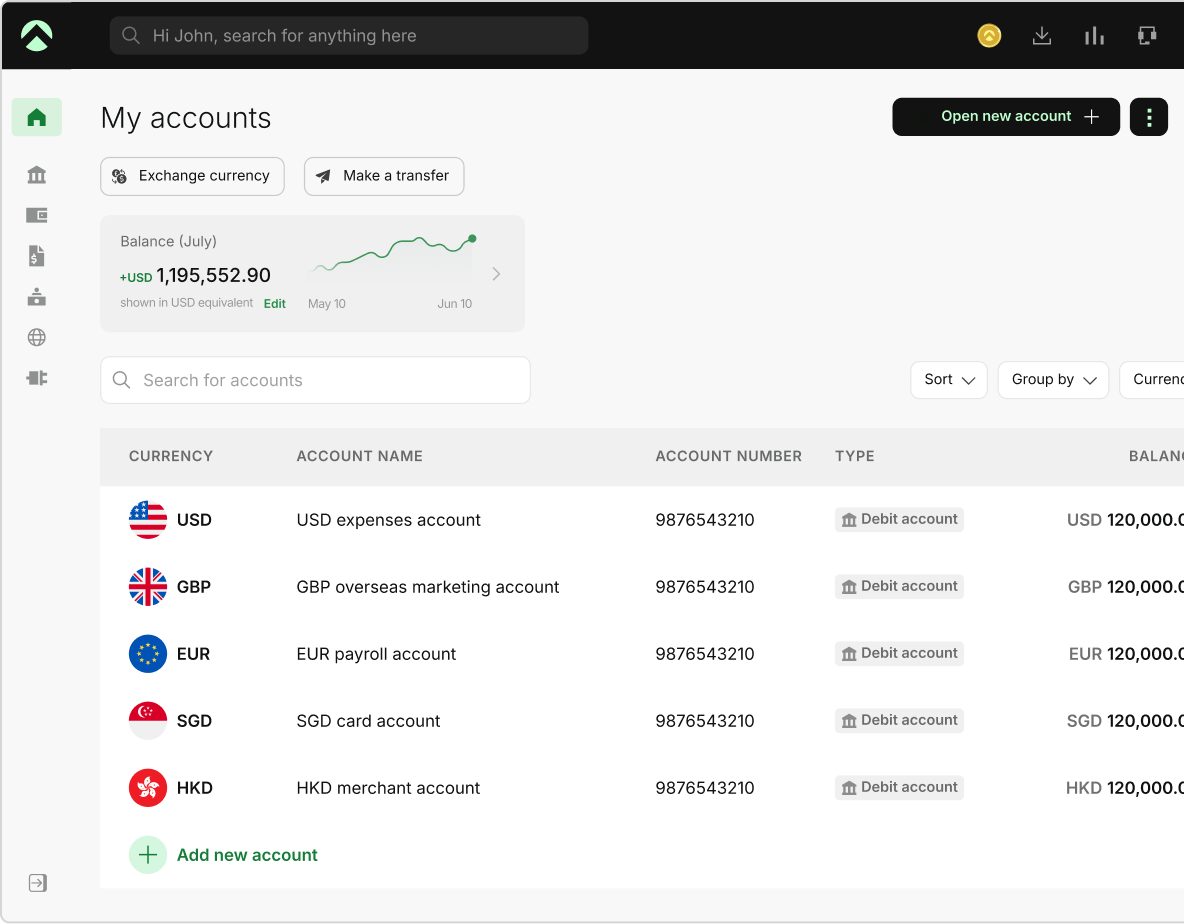
Aspire provides business accounts and international payment services that help businesses centralize multi-currency balances, FX, international transfers, approvals, and transaction visibility in one platform. Businesses can use Aspire to send, receive, hold, and convert funds across currencies.
Aspire's Global Payments service states that businesses can hold multiple currencies1, make payments in 98+ currencies across 130+ countries, and access same-day transfers to 40+ currencies where supported. It also states that fees and the amount received are shown upfront, helping businesses understand payment costs before sending funds.
Aspire's pricing also provides examples of how these services are structured. According to Aspire's US (https://aspireapp.com/us) pricing information, its Basic plan is available at $0 per month and includes multi-currency accounts across 13 currencies. Aspire lists FX pricing starting at 0.22% above the mid-market rate, with SWIFT receiving listed at $0 and SWIFT sending priced at $5 for SHA and $15 for OUR. Pricing, eligibility, and supported services are subject to Aspire's current terms.
Businesses should check Aspire's current pricing and eligibility for their specific countries, currencies, and transaction types before sending payments.
Aspire provides business accounts and international payment services for businesses that need to send, receive, hold, and convert funds across currencies.
Conclusion
International payments are a normal part of doing business across borders. The difficult part is rarely sending the payment itself; it is understanding the route, total cost, delivery time, and requirements behind it.
A useful comparison starts with more than the advertised transfer fee. FX costs, intermediary charges, recipient fees, processing time, and finance-team work can all affect the real cost.
For businesses making regular cross-border payments, compare providers using the countries and currencies you actually need. Check the total cost before sending, understand how the payment will be routed, and make sure the provider gives your finance team enough visibility to track and reconcile transactions.
That makes it easier to choose between a traditional bank wire, local payment rail, FX provider, or multi-currency payment platform based on the way your business actually operates.
Frequently Asked Questions
An international payment is a transaction between parties in different countries. It may involve currency conversion, but changing currencies is not required for a payment to be international.
It depends on the payment method, countries, currencies, institutions involved, cut-off times, holidays, and compliance checks. Some local payment rails can settle faster than traditional cross-border bank transfers.
SWIFT is a messaging network used by financial institutions to exchange financial instructions securely. It does not itself hold or transfer the underlying funds.
The recipient may receive less because of intermediary-bank charges, receiving-bank fees, currency conversion costs, or the fee arrangement used for the transfer.
International payments can be processed securely through banks and regulated payment providers, but businesses still need controls against fraud, incorrect payment details, account takeover, and payment scams.
No. A wire transfer is one method of sending money. International payments can also use local payment rails, cards, payment platforms, and other methods.
No. Some cross-border payments can use local payment systems or other payment infrastructure without using a traditional SWIFT-based correspondent-banking route.
Not simply because it is an international wire.
Form 8300 applies to certain cash payments over $10,000 received in a trade or business. The IRS states that a wire transfer does not constitute cash for Form 8300 purposes.
That does not mean large international transfers are exempt from every reporting or compliance requirement. Banks and other financial institutions may have separate obligations relating to transaction monitoring, anti-money-laundering rules, sanctions, and other regulations.
Sources
- https://www.bis.org/publications/paper-167-cross-border-payment-technologies-innovations-and-challenges (March 11, 2026)
- https://www.swift.com/payments/how-long-does-swift-payment-take (September 8, 2026)
- https://www.ecb.europa.eu/paym/retail/sepa/html/index.en.html (December 19, 2025)
- https://www.irs.gov/individuals/international-taxpayers/source-of-income-personal-service-income (February 6, 2026)
- https://www.irs.gov/forms-pubs/about-form-8300 (July 25, 2026)
- https://aspireapp.com/us/pricing (September 8, 2026)
- https://aspireapp.com/us/global-payments (September 8, 2026)
This blog is for general information only and does not constitute financial, legal, tax, or professional advice. Aspire’s services are subject to the terms outlined in our ’Terms of Service’ and ’Pricing’ pages. We make no guarantees as to the accuracy, completeness, or timeliness of the content, and past results do not indicate future performance. Always consult a qualified professional before acting on any information provided.
Content Team
Aspire editorial
Content team at Aspire is a society of seasoned writers & experts specialising in finance, technology and SaaS space. With 50+ years of collective experience, they help make business finance more profitable for readers. They write about finance tools, finance insights, industry trends, tactical guides to grow your business & also all things Aspire.
Aspire Launchpad
Supercharge your finance operations with Aspire
Find out how Aspire can help you speed up your end-to-end finance processes from payments to expense management.

Latest articles

QuickBooks vs Xero: Key differences, costs and which is better
QuickBooks vs Xero compared on features, pricing, users, reporting, and ease of use. See which accounting software is a better fit for your business.

How general liability vs professional liability insurance works in the US
Small business guide to general liability insurance. Learn about costs and coverage, if you need it, and how to choose the right policy.

Best multi-currency business accounts in the US for 2026
Compare the best multi-currency business accounts in the US for 2026. Explore fees, FX costs, currencies, holding, receiving options, and key features.