


Where should you expand in the US? A region-by-region guide for global founders

Content Team

Summary
This guide argues that US geography is a strategic decision rather than an administrative one, with each region offering distinct advantages in talent, capital, and industry specialisation. Founders can choose between the West Coast’s technical density, the Northeast’s regulatory and financial hubs, the Midwest’s industrial scale, or the South’s cost-efficient momentum. By aligning location with product complexity and customer proximity, international startups can significantly reduce operational friction and burn rates. Ultimately, selecting the right regional ecosystem ensures that your financial and human capital is optimised for your specific 2026 growth goals.
You might assume that expanding into the US means you can operate from anywhere and still succeed. In reality, the US isn’t a single, uniform market. It’s a collection of distinct regions, each with its own business culture, industry specialisation, and talent ecosystem. Choosing the wrong region can slow down hiring, drive up costs, complicate fundraising, and even shape how customers and investors perceive your company.
In this article, you’ll learn what sets each major US region apart, how regional ecosystems influence hiring, fundraising, and day-to-day operations, and how to choose a location that aligns with your business strategy and growth goals.
Why geography matters more than you expect
When global founders think about entering the US, geography is often treated as a secondary decision. The focus usually goes to incorporation, banking, hiring, or fundraising first, with location reduced to a simple question of “Which city should we start in?”
But in the US, geography isn’t just about where your office is. It shapes how you hire, how much you spend, how fast you raise capital, and how customers respond to your company.
The US isn’t a single, uniform market. Each region has its own business culture, talent dynamics, investor expectations, regulatory complexity, and cost structure. Choosing where to land can influence whether you hire locally or relocate your team, how competitive your compensation needs to be, and even how investors perceive your momentum.
For example, a region with deep venture capital and early adopters might help you raise faster, but it can also increase burn and hiring pressure. Another region may offer lower costs and stronger operational stability, but require more patience when building networks or closing deals.
That’s why geography should be a strategic decision, not a default one. The right location depends on how your business operates, what kind of customers you serve, and what risks you’re willing to take at your current stage. In the sections below, we’ll break down how different US regions support different growth paths, so you can choose a location that works with your expansion strategy, not against it.
What to consider when choosing a region
Choosing where to set up in the US isn’t about picking the most famous city or tech hub. It’s about aligning geography with what your business actually needs at this stage.
To narrow down the right region, focus on a few practical factors that directly affect growth, cost, and execution.
Start with where your customers are
Your location should support how and where your customers make buying decisions. If you’re selling to fast-moving tech startups or digital-native companies, being close to major startup hubs can help with sales conversations, partnerships, and early adoption.
If you sell to regulated industries, financial institutions, healthcare providers, or industrial buyers, it often makes more sense to be near the regions where those decision-makers and headquarters are concentrated. Proximity can speed up trust-building and complex sales cycles.
Match the region to your product complexity
Highly technical or frontier products tend to perform better in ecosystems with dense technical talent, research institutions, and early adopters. These environments make it easier to hire specialized engineers, test new ideas, and refine complex products.
More applied or operational products may gain traction faster in regions closer to real-world industries, supply chains, factories, or logistics hubs, where customers can immediately see practical value.
Consider how capital-dependent your growth is
If fundraising is a near-term priority, being close to investors, accelerators, and active founder networks can shorten fundraising cycles and increase visibility. Informal introductions and in-person meetings still matter in many US fundraising processes.
If your focus is capital efficiency, profitability, or steady expansion, lower-cost regions can extend your runway, reduce burn, and give you more room to iterate without constant fundraising pressure.
Be clear about what you’re optimizing for
Every US region comes with trade-offs. Some optimize for speed, exposure, and access to capital, while others optimize for cost, focus, and operational stability. The right choice depends on whether you’re trying to move fast, stay lean, build enterprise credibility, or scale sustainably. There’s no single “best” US region—only the one that fits your current priorities and stage of growth.
Region-by-region: choosing where to set up in the US
The US isn’t a single market. It’s better understood as a collection of distinct regions, each with its own specialization, business culture, cost structure, and competitive edge.
Broadly speaking, founders entering the US tend to encounter 4 major regions, each optimized for different types of companies and growth paths.
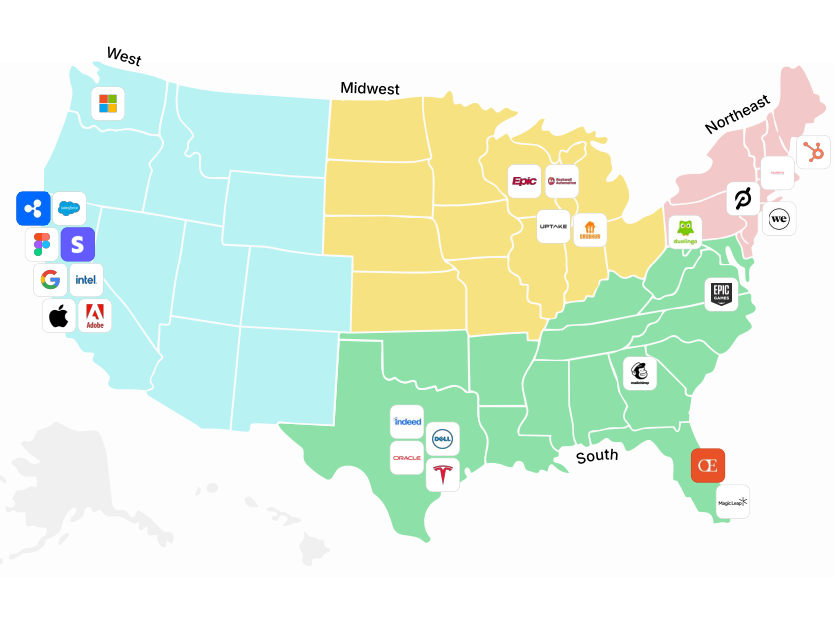
West Coast: Where ambitious products find scale
From San Francisco to Los Angeles to Seattle, the West Coast offers an unmatched density of venture capital, technical talent, and early adopters.
That’s largely because Silicon Valley and its surrounding hubs concentrate experienced founders, repeat investors, and senior operators, creating an ecosystem where ideas move rapidly from concept to capital to execution. This makes the region especially strong for frontier technology, developer-first platforms, and venture-backed startups aiming to scale fast.
Other cities contribute their own strengths: Seattle thrives in Cloud and SaaS, while Los Angeles leads in aerospace, media, and large-scale physical and digital infrastructure projects.
The trade-off is cost and competition. Salaries are high, hiring is competitive, and expectations move fast. If your company is optimizing for speed, fundraising, and access to top-tier talent, the West Coast can be a powerful launchpad, but it demands capital and focus.
| The West Coast | |
|---|---|
| What makes it unique? | It offers an unmatched density of venture capital, technical talent, and early adopters. |
| Notable companies | Apple, Google, Salesforce, Adobe, Intel, Microsoft, Stripe, Airbnb |
| Business culture | Founders are expected to think big, move quickly, and iterate in publicCompetition is intense, and speed often matters more than perfectionFailure is widely accepted as part of the innovation process |
Northeast: Where capital meets complex decisions
The Northeast, especially New York and Boston, is a hub for finance, healthcare, and education because decision-makers, institutions, and regulators are concentrated in one region.
New York remains the center of US finance, home to major banks, asset managers, insurers, stock exchanges, and regulators. It has also grown rapidly in cybersecurity and media-tech, making it ideal for fintech and enterprise software targeting compliance-heavy buyers.
Meanwhile, Boston anchors one of the world’s strongest healthcare and life sciences ecosystems, combining top hospitals, research institutions, biotech startups, and close ties to regulators and academia.
In this region, you should expect a more transactional culture and higher operating costs. That said, if your business depends on trust, compliance, or proximity to large organizations making high-stakes decisions, the Northeast often shortens sales and partnership cycles.
| The Northeast | |
|---|---|
| What makes it unique? | Its proximity to regulators, capital markets, and top-tier education centers—an excellent hub for finance, healthcare, education, and regulated industries. |
| Notable companies | Goldman Sachs, JPMorgan Chase, Moderna, HubSpot, Duolingo |
| Business culture | Direct communication with an emphasis on facts and resultsMeetings tend to be efficient and transactionalFounders are expected to know their numbers and articulate value clearly |
Midwest: Where industry meets real-world scale
The Midwest is a hub for applied technology because many of the US physical economy operates here. Even in recent years, Ohio has increasingly positioned itself as a center for operational tech.
The region’s strength lies in its concentration of manufacturing, logistics, healthcare systems, and industrial workflows, making it easier to test, deploy, and scale technology in real-world environments. Instead of selling abstract ideas, founders often sell measurable operational improvements—efficiency, reliability, and cost reduction—making the region ideal for applied and systems-driven products.
| The Midwest | |
|---|---|
| What makes it unique? | It sits at the center of US supply chains, connecting raw materials, manufacturing, distribution, and end customers. |
| Notable companies | Grubhub, Epic Systems, Rockwell Automation, Caterpillar, Uptake |
| Business culture | Practical, relationship-driven, and trust-focusedStraightforward communicationPeople often engage in small talk before getting down to business |
The South: Where the next industrial shift is happening
The South is the fastest-growing region for relocation and new operations. Austin, for example, has been dubbed “Silicon Hills,” which is home to Tesla, Oracle, and a thriving startup ecosystem. In addition, Raleigh-Durham also excels in R&D, healthcare, and biotech.
This region offers a compelling mix of cost efficiency and growth momentum, though its ecosystems are often more fragmented than on the coasts. For founders seeking to extend runway while accessing strong talent and customer networks, the South is quickly becoming a top choice.
| The South | |
|---|---|
| What makes it unique? | Many major US ports and freight corridors, energy networks, and data centers are concentrated in this region. |
| Notable companies | Tesla, Oracle, Dell, Mailchimp |
| Business culture | Entrepreneurial, pragmatic, and relationship-orientedBusiness often moves at a more relaxed pace, allowing time for personal connectionsPoliteness is highly valued |
Where should you operate in the US?
There’s no single best place to set up in the US. The right region depends on your product, your customers, your team strategy, and the constraints you’re working with right now.
Some founders choose regions that make hiring local talent easier. Others prioritize proximity to investors or ecosystems that support relocating key team members. Many successful companies don’t get it “perfect” on day one—they start in one region and expand as their needs evolve.
What matters most isn’t choosing the most famous hub. It’s choosing intentionally—based on where you can hire effectively, operate smoothly, and grow with fewer surprises at your current stage. The best expansion decisions are the ones that reduce friction today while keeping your options open tomorrow.
Want a detailed, step-by-step playbook for starting in the US?
For global founders, choosing the right location is just one piece of the puzzle. To help you expand confidently, we’ve created the ultimate startup guide to entering the US, covering hiring, compliance, company setup, and team relocation—all in one resource.
Inside, you’ll find:
- A step-by-step checklist for choosing the right US region and business structure
- How visa options affect relocating your team or hiring locally
- Insights on what US investors look for when evaluating teams, traction, and operational readiness
- Real-world lessons from founders who’ve successfully scaled in the US
If this article helped you think through where to operate and why, the guide will help you execute with confidence as you build, hire, and scale in the US.
Sources
- International Monetary Fund - https://www.imf.org/en/publications/fandd/issues/2025/09/the-shifting-geography-of-startups-swati-bhatt
- MyNZTE - https://my.nzte.govt.nz/article/Business-culture-and-etiquette-in-the-US
- Foothold America - https://www.footholdamerica.com/blog/mastering-us-business-culture-a-guide-for-international-managers/
- Berlitz - https://www.berlitz.com/blog/american-work-business-culture-etiquette
This blog is for general information only and does not constitute financial, legal, tax, or professional advice. Aspire’s services are subject to the terms outlined in our ’Terms of Service’ and ’Pricing’ pages. We make no guarantees as to the accuracy, completeness, or timeliness of the content, and past results do not indicate future performance. Always consult a qualified professional before acting on any information provided.
Content Team
Aspire editorial
Content team at Aspire is a society of seasoned writers & experts specialising in finance, technology and SaaS space. With 50+ years of collective experience, they help make business finance more profitable for readers. They write about finance tools, finance insights, industry trends, tactical guides to grow your business & also all things Aspire.
Aspire Launchpad
Supercharge your finance operations with Aspire
Find out how Aspire can help you speed up your end-to-end finance processes from payments to expense management.

Latest articles

Best multi-currency business accounts in the US for 2026
Compare the best multi-currency business accounts in the US for 2026. Explore fees, FX costs, currencies, holding, receiving options, and key features.

How to start an LLC in Ohio: Step-by-step guide
Starting an LLC in Ohio costs $99 and clears in two business days if expedited. The filing steps, real year-one costs, and the municipal tax to plan for.
Divvy credit card: Features, fees, eligibility
Explore Divvy credit card eligibility, fees and reward tiers, plus how its credit limits are set dynamically, and how you can boost yours.