



Top 5 Travel Corporate Cards for HK Companies

Galih Gumelar

Summary
Comparison basis: The 5 cards are Aspire's Corporate Card, the HSBC Business Mastercard, the American Express Gold Business Card and 2 Cathay Pacific American Express corporate cards. Rewards and fees come from the issuers' own pages.
Reward structures differ: Some cards earn Asia Miles directly, some earn Membership Rewards points, and 1 earns RewardCash that converts to cash credit.
FX is the hidden cost: The HKMA says overseas card spend usually triggers a foreign currency fee of about 0% to 2.5%, plus the exchange rate applied.¹
Real pain points: Controlling who spends what, coding spend to the right project and avoiding FX cost matter more than the headline rewards rate.
Multi-currency approach: Paying from a balance in the right currency can remove the conversion step that rewards cards charge for.
A corporate travel card sounds like a solved problem: give employees a card, let them book flights and hotels, and move on. In practice, Hong Kong finance teams meet a specific, recurring set of frictions that a rewards-focused comparison rarely addresses.
This guide compares 5 corporate cards available to Hong Kong businesses, using each issuer's published terms. It then covers the pain points that travel spend creates, and what solves each one.
How do the 5 cards compare?
The 5 cards differ most in reward type, annual fee and travel perks. The table uses each issuer's own published terms, and the figures can change.
| Card | Rewards | Annual fee | Notable perk |
|---|---|---|---|
| Aspire Corporate Card | 1.2% cashback on eligible spend | Zero card activation and transaction fees | Virtual and physical cards, 13 currencies, optional credit line |
| HSBC Business Mastercard | 1 RewardCash per HKD 250, or 2 per HKD 250 overseas and online on the World card² | First 2 years waived on promotion, later fee not stated | Up to 4 Plaza Premium Lounge visits a year, up to 56 days interest-free |
| American Express Gold Business Card | Up to 3 Membership Rewards points per HKD 1 of foreign currency spend³ | HKD 980, first year waived | Business travel accident cover up to HKD 2,000,000, no pre-set spending limit |
| Cathay Pacific Elite Corporate Card | 1 Asia Mile per HKD 7⁴ | Not stated | Earns Asia Miles directly, no conversion step |
| Cathay Pacific Corporate Card | 1 Asia Mile per HKD 10⁴ | Not stated | Up to 51 credit-free days |
Foreign currency fees are set in each issuer's own card agreement, and none of the pages above state them. Check the Key Facts Statement before you apply, and confirm eligibility, because HSBC offers this card to its Commercial Banking customers.²
For a wider view of the card market, see Aspire's guides to travel credit cards for Hong Kong businesses and the corporate credit card.
What are the main travel spend pain points?
A rewards comparison answers which card earns the most, but 4 recurring problems cost finance teams more time. The sections below take them in turn.
Who gets a card, and who removes it?
Physical cards for every traveller create an administrative tail. Each card must be requested, approved, shipped and cancelled when an employee leaves or changes role.
A lost card in transit is a recurring risk. Virtual cards solve the issuance half, because a card can be issued in minutes for a trip or project. See Aspire's complete guide to virtual cards in Hong Kong.
How does spend reach the right project?
A shared company card forces someone to sort charges by client, department or cost centre at month-end. That sorting consumes finance hours every month.
Issuing 1 card per project or employee solves this at the point of spend, because each transaction already carries its card's context. Aspire's guide on how to track expenses for a small business covers the follow-up steps.
What does an overseas booking cost in FX?
A foreign currency booking on a bank card can cost more in fees than the rewards it earns. The HKMA says paying in a foreign currency usually triggers a handling fee of about 0% to 2.5%, charged by the card issuer.¹
The Consumer Council's survey of 21 issuers found fees varied widely, with the highest at 2.45%, and used 1.95% in its own example.⁵ Both sources date from 2015, so check current fee schedules.
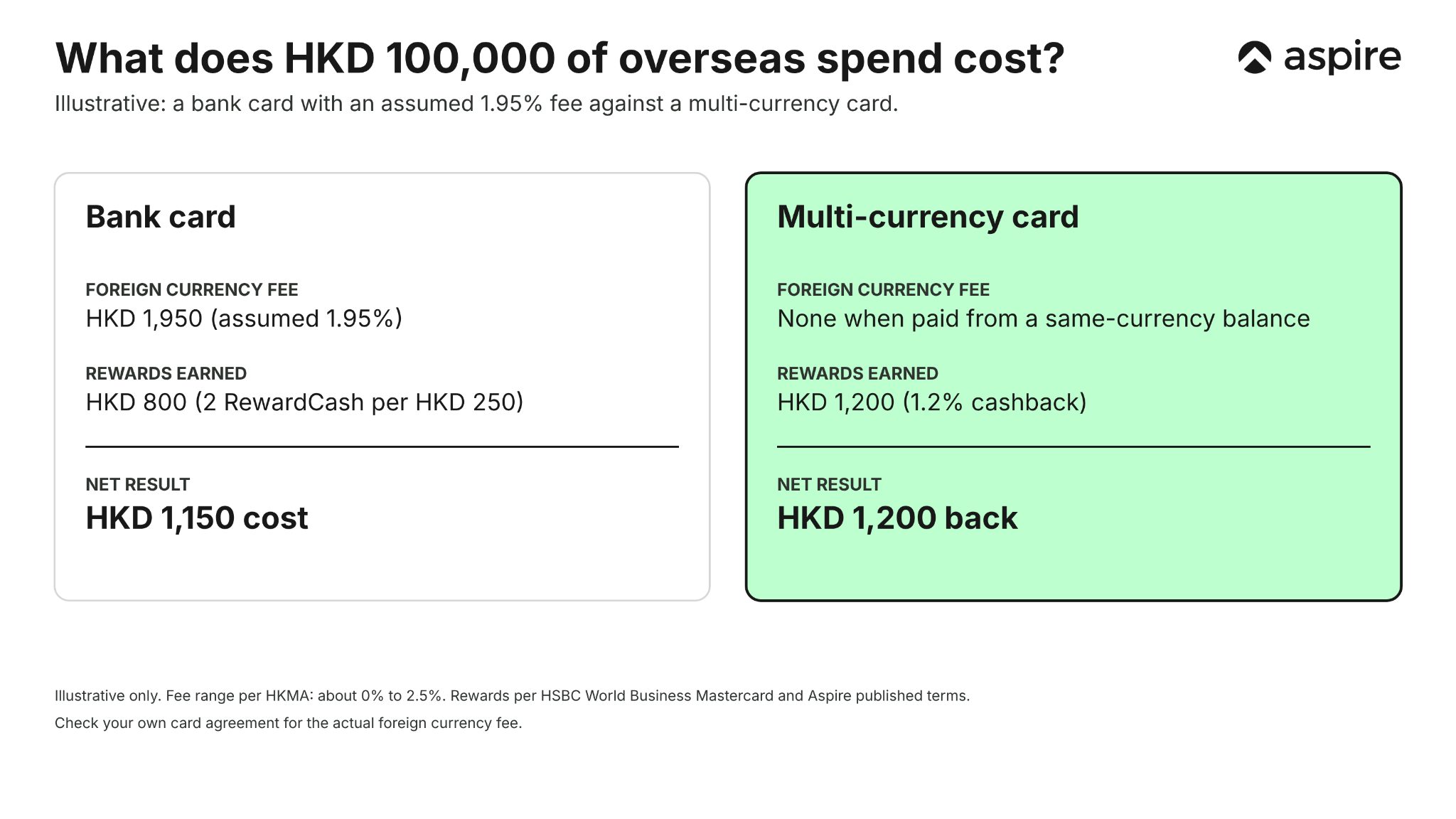
Take a Hong Kong consulting firm that spends HKD 100,000 a year overseas on a card with an assumed 1.95% fee. The comparison is illustrative, and it uses the HSBC World card's published reward rate.
| Item | Bank card, assumed fee | Multi-currency card |
|---|---|---|
| Foreign currency fee | HKD 1,950 | No conversion when paid from a same-currency balance |
| Rewards earned | HKD 800 (2 RewardCash per HKD 250) | HKD 1,200 (1.2% cashback) |
| Net result | HKD 1,150 cost | HKD 1,200 back |
The fee is also charged on top of the exchange rate applied.¹ Rewards are earned on the amount spent, so they do not refund the fee.
How do you enforce travel policy live?
A policy document is a weak control, because employees must remember it. Cards with real-time limits do the work automatically.
- Merchant category restrictions block out-of-policy spend at the point of transaction
- Instant notifications flag unusual activity as it happens
- Per-card limits stop a single trip going over budget
This beats an expense report that catches a breach after the money has gone. See Aspire's spend limits and budgets features.
What actually solves each pain point?
The recurring theme is granularity and real-time visibility, not any single feature.
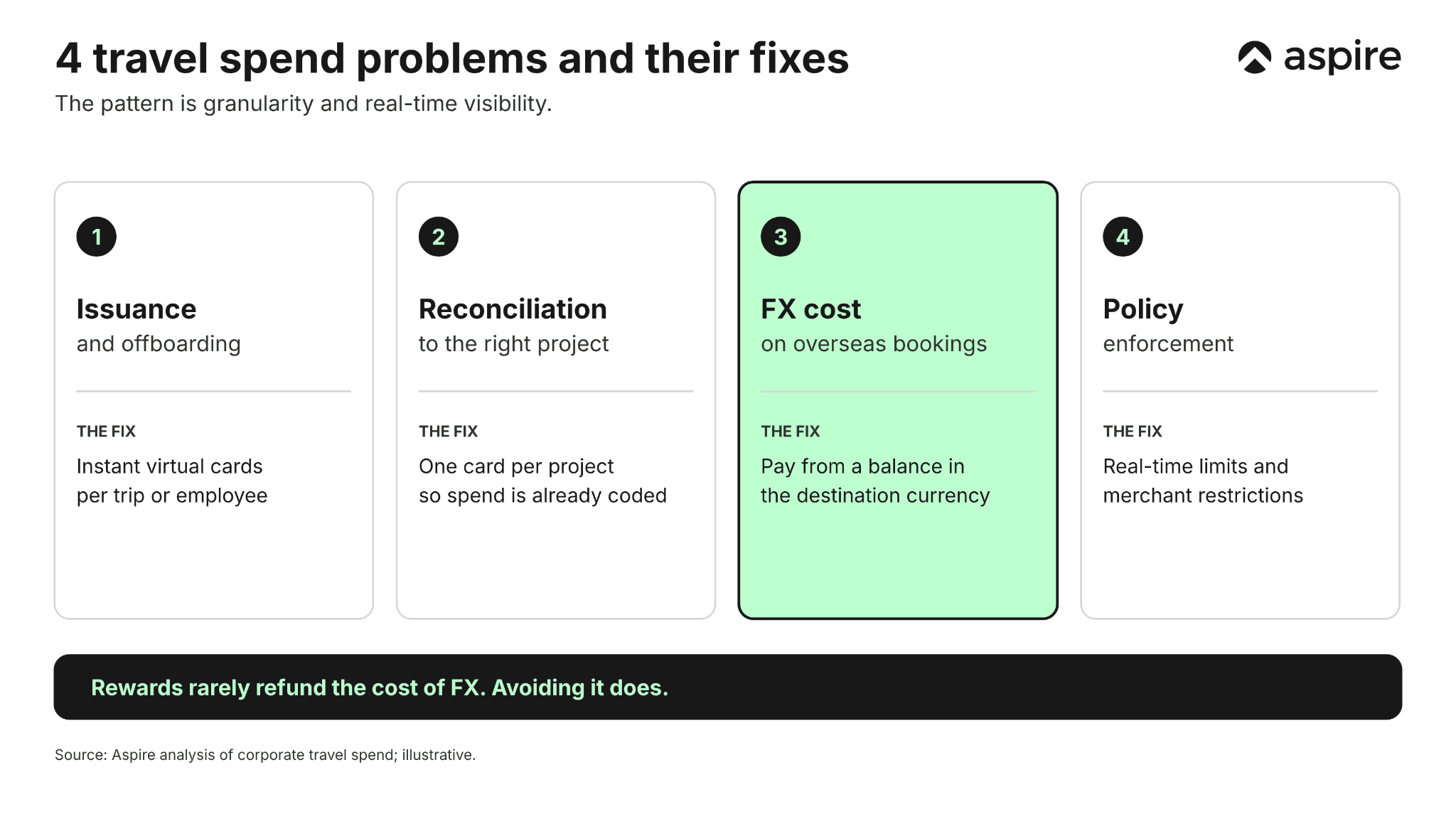
| Pain point | What solves it |
|---|---|
| Issuance and offboarding overhead | Virtual cards issued per trip or employee and cancelled when no longer needed |
| Reconciliation to the wrong cost centre | Per-project or per-employee cards, so spend is attributable at the point of transaction |
| FX cost on overseas bookings | A multi-currency account that pays from the destination currency, avoiding the conversion |
| Policy enforcement | Real-time limits and merchant restrictions set per card |
What does this look like in practice?
The fixes play out differently depending on how a business travels. 2 common scenarios show the pattern.
How does a consulting firm handle China trips?
A Hong Kong consulting firm can hold RMB and issue 1 virtual card per client engagement. Its consultants travel to mainland client sites on rotation, and each trip bills to a different engagement. The scenario is invented for illustration.
Hotels are often billed in RMB, so paying from an RMB balance avoids a conversion on each booking. Every flight, hotel and meal charge already carries the engagement's card, so month-end coding is quick.
How does a trade show team control spend?
A temporary virtual card per attendee, with a fixed cap, controls a short burst of spend. A trade show concentrates costs such as booth fees, flights, hotels and ground transport into a few days.
The finance team sees total event spend build in real time on 1 dashboard, instead of waiting for expense claims. See Aspire's expense management page for how the dashboard works.
When does a rewards card make sense?
A rewards card suits moderate, mostly domestic travel, where fees and FX exposure are limited. The points or cashback then outweigh the costs.
Check the annual fee after any waiver, such as the 1-year waiver on the Amex Gold card.³ Once overseas spend is substantial and predictable, the FX fee becomes a larger line item than the reward rate returns.
How does Aspire handle travel spend?
Aspire approaches travel spend through control and currency, not points and miles.
- Currency handling. Aspire’s spending in USD or HKD avoids FX fees, and the card works in 13 currencies.
- Virtual cards. Multiple virtual cards can be issued alongside a physical card.
- Cashback. Aspire lists business travel among cashback-eligible spend at 1.2%, so confirm the cashback policy.
- Real-time visibility. Spending limits, category locks and a freeze option are available per card.
Why Hong Kong Businesses Choose Aspire
Corporate travel spend is one part of running an efficient business, and Aspire is built to remove the friction around all of it, not just the card itself.
💱 FX spreads from 0.18%, up to 3x cheaper than traditional banks. This applies across 130+ countries and 40+ currencies through Aspire's multi-currency account. It's useful for anything from booking overseas travel in the local currency to settling international payments without losing margin to markup.
💰 1.2% unlimited cashback applies on every corporate card transaction, with no monthly cap. It kicks in automatically on eligible spend, with no minimum threshold to hit first. Over time, it quietly turns routine business spend into working capital.
🌐 Local transfer network, not multi-hop SWIFT chains, is how Aspire routes most payments. This means faster settlement and fewer intermediary fees eating into your payment before it reaches the recipient. It also reduces the chance of funds being held up for review at a correspondent bank along the way.
💸 Fixed USD 8 inbound SWIFT fee, tracked end-to-end with SWIFT GPI, applies when SWIFT is the right rail for your payment. There are no surprise deductions from correspondent banks along the way, so the amount you're quoted is the amount that arrives. You can also download payment confirmation instantly from the app, without calling the bank.
⚡ Approved in as little as 1 business day, with no branch visits and no paperwork stacks. Applications are completed entirely online, from document upload to approval. There's no waiting weeks on a relationship manager to call you back.
Open a free multi-currency business account built for Hong Kong SMEs, or explore how Aspire's corporate card fits into your day-to-day travel spend.
Frequently Asked Questions
It depends on how much spend is overseas. For substantial, regular overseas spend, the foreign currency fee tends to outweigh the rewards, so compare the fee with the reward rate for your own volume.
A shared card needs manual sorting after the fact. Per-employee or per-project virtual cards carry that context from the moment of the transaction.
No. The HKMA describes a range of about 0% to 2.5%, so read the issuer's fee schedule.¹
Not at face value. The Cathay Pacific Amex cards earn Asia Miles directly, while other cards earn points or cash credit that follow different conversion rules.⁴ ²
A physical card takes days to arrive by post. A virtual card can often be issued within minutes of approval, depending on the provider.
Sources
- HKMA, "Hong Kong Dollars or Foreign Currencies? Making the Smart Choice when Using your Credit Cards Overseas" (December 2015)
- HSBC Hong Kong, "Business Mastercard" product page (issuer terms, accessed November 2026)
- American Express Hong Kong, "Gold Business Card" product page (issuer terms, accessed November 2026)
- American Express Hong Kong, "Business and Corporate Cards" (issuer terms, accessed November 2026)
- Consumer Council, "Credit card transaction fees" (press release, 15 December 2015)
This blog is for general information only and does not constitute financial, legal, tax, or professional advice. Aspire’s services are subject to the terms outlined in our 'Terms of Service' and 'Pricing' pages. We make no guarantees as to the accuracy, completeness, or timeliness of the content, and past results do not indicate future performance. Always consult a qualified professional before acting on any information provided.
Galih Gumelar
Writer
Galih is a seasoned writer specialising in macroeconomics, business, finance and politics. With a writing history at CNN Indonesia, The Jakarta Post, and various other reputed organisations, Galih leverages his broad range of experiences to create insightful resources for those wanting to start a business.
Aspire Launchpad
Start Your Business with Aspire Launchpad
From incorporation to venture capital, we connect you with trusted service providers to make your entrpreneurial journey seamless.

Latest articles
Corporate Card •
Top 5 Corporate Cards for Agencies in HK
Compare 5 corporate cards for HK agencies on funding model, rewards and FX. See how per-client virtual cards protect cash flow and margin on ad spend.
Corporate Card •
Top 4 Business Cards for Freelancers in HK
Compare 4 business cards for HK freelancers and sole proprietors. See eligibility, personal liability, irregular income and multi-currency controls.

Corporate Card •
Top 4 Corporate Cards for E-commerce in HK
Compare 4 corporate cards for HK e-commerce on rewards and credit terms, and see how virtual cards and multi-currency tools help ad and inventory spend.
Start your journey with Aspire
Open your free account