



Current vs. Savings Account in Hong Kong: Key Differences

Galih Gumelar

Summary
A current account pays no interest. It lets you pay by cheque and suits frequent payments.¹
A savings account pays interest. You can withdraw at any time without penalty.¹
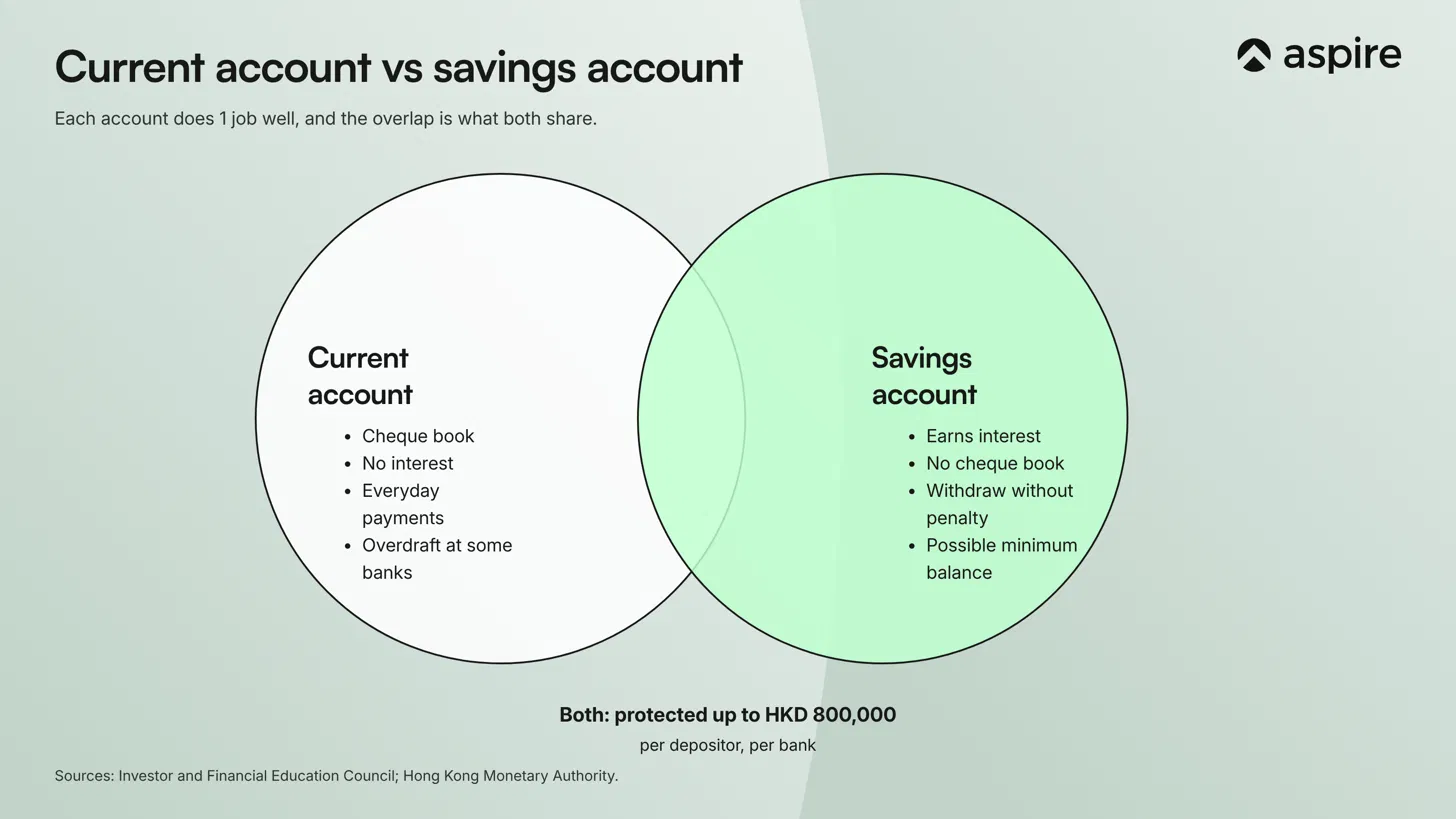
Both are protected up to HKD 800,000. The Deposit Protection Scheme covers each depositor at each member bank.²
Fees differ by bank. Watch for monthly account fees and minimum balance fees.¹
Businesses often hold both. The current account runs payroll and suppliers, and the savings account holds surplus cash.³
A time deposit usually pays more. The cost is a fixed term and early redemption penalties.¹
Current account vs savings account comes down to 1 trade-off. A current account is built for paying and getting paid, and a savings account is built for holding money and earning interest.¹
This guide compares the 2 on interest, cheques, fees, minimum balances and deposit protection. It also covers how businesses use each, and how to run day-to-day payments from an Aspire business account.
What is a current account?
A current account is a day-to-day transaction account that pays no interest but lets you pay by cheque.¹ Banks position it for salaries, bills and supplier payments, where flexibility matters more than yield.
The usual features are:
- Cheque books for paying individuals and companies.¹
- Online, phone and branch banking, plus an ATM card.¹
- Autopay setup for recurring bills.⁴
- Overdraft protection at some banks, to help cheques and autopays clear.⁴
Some banks set a minimum opening balance. Standard Chartered, for example, lists HKD 1,000 for its HKD current account.⁴
What is a savings account?
A savings account pays interest and lets you withdraw at any time without penalty, unlike a fixed or time deposit.¹ It is designed to hold money you do not need today.
Banks often attach conditions, so check these before opening one:
- Monthly account keeping fees.¹
- Minimum balance fees.¹
- ATM fees for using another bank's machines.¹
- Over-the-counter withdrawal fees.¹
Opening thresholds vary too. Hang Seng, for instance, lists HKD 5,000 to start earning interest on its savings account.⁵
What is the difference between them?
The core difference is interest versus payment flexibility. A savings account earns interest and a current account does not, while a current account supports cheques that a savings account does not.¹
| Feature | Current account | Savings account |
|---|---|---|
| Main purpose | Everyday payments and receipts | Holding money and earning interest |
| Interest | None¹ | Yes, at the bank's rate¹ |
| Cheque book | Yes¹ | Generally no |
| Withdrawals | Flexible | Anytime, no penalty¹ |
| Overdraft | Available at some banks⁴ | Generally no |
| Typical fees | Account and cheque fees | Account, minimum balance and ATM fees¹ |
| Deposit protection | Covered² | Covered² |
How do interest rates compare?
Savings interest is small at many banks and varies by balance tier. Public Bank listed 0.050% a year on its standard savings account, and 0.125% on balances up to HKD 100,000 in its Maxi-Interest account, as at 18 April 2026.⁶
Rates change often, so read the bank's current rate page before choosing. A current account earns nothing, so idle cash in it loses to even a modest savings rate.
How do fees and balances compare?
Fees depend on the bank and the account tier. The IFEC advises asking about account types, minimum balance requirements and fees before you open either account.¹
Keep a short list of questions for the bank:
- What is the minimum opening balance?
- What is the monthly fee, and how is it waived?
- What does a cheque book cost?
- What are the ATM and counter withdrawal charges?
Are both accounts protected by the DPS?
Yes. The Deposit Protection Scheme protects deposits in savings and current accounts, and time deposits with a term of up to 5 years, up to HKD 800,000 per depositor per bank.² The limit rose from HKD 500,000 on 1 October 2024.⁷
Protection covers deposits held by individuals, including joint accounts, and by companies.² Joint account holders are deemed to have an equal share in the affected deposits.⁸
Some money sits outside the scheme. Bonds, stocks, funds, unit trusts, insurance policies and virtual assets are not covered, and neither are offshore deposits.² Deposits at restricted licence banks and deposit-taking companies are also not protected.⁹
What are the pros and cons of each?
Each account trades convenience against return. The table sets the strengths and limits side by side.
| Account | Strengths | Limits |
|---|---|---|
| Current account | Cheque payments, flexible day-to-day use, overdraft at some banks⁴ | No interest¹ |
| Savings account | Interest, with withdrawals at any time without penalty¹ | No cheque book, and fees or minimum balances at some banks¹ |
The right choice is rarely either-or. Most people and companies use a current account for flow and a savings account for stock.
Do interest and fees cancel each other out?
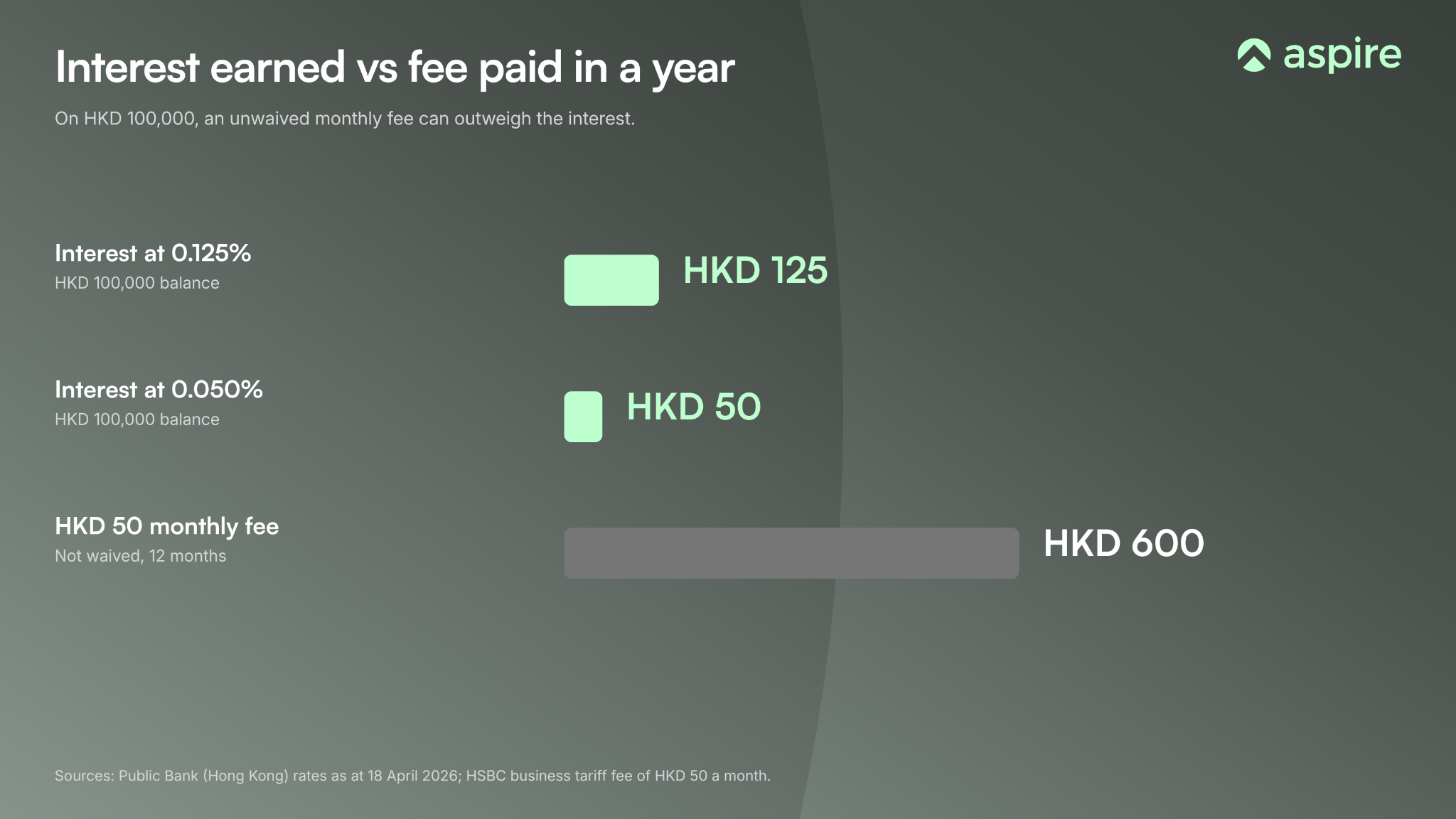
They can. A small interest rate on a modest balance may earn less than a monthly account fee costs, so the fee matters as much as the rate.
The table below uses the rates and fee quoted earlier to show the arithmetic.
| Item | Calculation | Result per year |
|---|---|---|
| Interest on HKD 100,000 at 0.125% | 100,000 × 0.125% | HKD 125 |
| Interest on HKD 100,000 at 0.050% | 100,000 × 0.050% | HKD 50 |
| A HKD 50 monthly fee, not waived | 50 × 12 | HKD 600 |
Rates and fees come from different banks, so this shows the scale of the trade-off rather than a like-for-like offer. Ask each bank how the fee is waived before assuming interest is a gain.¹⁰
What other bank accounts exist in Hong Kong?
Banks generally group accounts into savings, current, time deposits, non-HKD, integrated and investment accounts.¹ The first 2 are the everyday pair, and the rest add term, currency or bundling.
| Account type | What it adds |
|---|---|
| Savings | Interest with no withdrawal penalty¹ |
| Current | Cheques and payment flexibility¹ |
| Time deposit | Higher rate for a fixed period¹ |
| Non-HKD deposit | Holding money in another currency¹ |
| Integrated | HKD savings, current accounts and more in 1 account¹ |
| Investment | Access to investment products, which are not deposits |
Investment products sit outside deposit protection, so the scheme does not cover them.²
Which account fits which need?
Match the account to what the money has to do. The table gives a quick guide.
| Need | Better fit | Why |
|---|---|---|
| Paying bills and autopay | Current account | Built for frequent payments |
| Issuing cheques | Current account | Cheques are a current account feature¹ |
| Emergency fund | Savings account | Earns interest, with no withdrawal penalty¹ |
| Idle cash for a few months | Savings account | Interest on money you will not spend soon |
| Locking money for a fixed term | Time deposit | Usually a higher rate, with early redemption penalties¹ |
| Payroll and suppliers (business) | Current account | High volume of payments |
How do businesses use each account?
Businesses use a current account to run operations and a savings account to park surplus cash. Payroll, supplier payments and cheque payments belong in the current account, and money not needed for a few months can sit in savings.
The types of bank accounts for business guide covers the wider menu, and how to choose a business account helps narrow it down.
What do banks charge businesses?
Business tariffs add their own thresholds. HSBC lists a HKD 50 monthly fee on its HKD business savings account, which is waived at a balance of HKD 25,000 or more.¹⁰
UOB charges a maintenance fee when the average monthly balance of a current or savings account is below HKD 1,000,000.³ See bank charges in Hong Kong for a wider comparison.
Why do cheques still matter?
Cheques remain a current account feature, so a company that pays some landlords or suppliers by cheque needs one. The guide on how to write a cheque shows the format step by step.
How should a company split its cash?
A common approach is to size the current account to cover 1 to 2 payroll and supplier cycles, and move the rest to savings. The split depends on how predictable your inflows are.
| Cash pool | Purpose | Typical home |
|---|---|---|
| Operating buffer | Payroll, rent, suppliers | Current account |
| Tax and statutory reserve | Profits tax, MPF, insurance premiums | Savings account |
| Surplus | Cash beyond 3 months of needs | Savings or time deposit |
Review the split each quarter against your cash flow forecast.
Is a time deposit a better option?
A time deposit usually pays a higher rate than a savings account, but the money is locked for a set period. The IFEC lists set time periods, minimum deposit levels and early redemption penalties as the trade-offs.¹
For cash with a known idle window, a certificate of deposit is a related option to understand. Keep operating cash in an account you can reach on demand.
Can you hold both account types?
Yes. Many Hong Kong banks offer integrated accounts that combine HKD savings and current accounts, and some add foreign currency savings and time deposits.¹
Holding both lets you keep spending money in the current account and a reserve in savings. For companies, the number of accounts depends on how many currencies and cost centres you run, and segregated accounts can keep tax and payroll reserves apart.
How can Aspire support daily business banking?
Aspire gives you an operating account for the payments side, so day-to-day money moves from 1 place. You can run payroll, MPF and contractor payments from 1 account, and local HKD transfers over FPS are free. See the payroll use case for how it works.
Holding foreign currency is also simple, with a Multi-Currency Card in 13 local currencies and a multi-currency account for suppliers abroad. Corporate card limits can be set by department or project.
Businesses weighing the options can read about bank account alternatives for businesses and opening a company bank account in Hong Kong. Approval is in as little as 1 business day.
Why Hong Kong Businesses Choose Aspire
Choosing the right account type is the first step, and Aspire supports the accounts, cards and payments that sit on top of it.
💱 FX spreads from 0.18%, up to 3x cheaper than traditional banks. This applies across 130+ countries and 40+ currencies through Aspire's multi-currency account. It's useful for anything from paying overseas suppliers to settling international payments without losing margin to markup.
💰 1.2% unlimited cashback applies on every corporate card transaction, with no monthly cap. It kicks in automatically on eligible spend, with no minimum threshold to hit first. Over time, it quietly turns routine business spend into working capital.
🌐 Local transfer network, not multi-hop SWIFT chains, is how Aspire routes most payments. This means faster settlement and fewer intermediary fees eating into your payment before it reaches the recipient. It also reduces the chance of funds being held up for review at a correspondent bank along the way.
💸 Fixed USD 8 inbound SWIFT fee, tracked end-to-end with SWIFT GPI, applies when SWIFT is the right rail for your payment. There are no surprise deductions from correspondent banks along the way, so the amount you're quoted is the amount that arrives. You can also download payment confirmation instantly from the app, without calling the bank.
⚡ Approved in as little as 1 business day, with no branch visits and no paperwork stacks. Applications are completed entirely online, from document upload to approval. There's no waiting weeks on a relationship manager to call you back.
Open a free multi-currency business account built for Hong Kong SMEs, or explore how Aspire's corporate card fits into your day-to-day spend.
Frequently Asked Questions
No. A current account does not pay interest, while a savings account does.¹
Cheques are a current account feature. Some integrated accounts link the 2 types so you can move money between them.¹
Yes. Both are covered up to HKD 800,000 per depositor per bank under the Deposit Protection Scheme.²
A current account suits daily payments and payroll. A savings account suits surplus cash.³
Often. Typical charges include monthly account fees, minimum balance fees and ATM fees.¹
No. A time deposit locks money for a set period, usually for a higher rate, with early redemption penalties.¹
Sources
- Investor and Financial Education Council, Bank accounts (public education body)
- Hong Kong Monetary Authority, Deposit Protection Scheme (regulator page)
- UOB Hong Kong, Current Account (bank product page)
- Standard Chartered Hong Kong, HKD Current Account (bank product page)
- Hang Seng Bank, Savings and current accounts (bank product page)
- Public Bank (Hong Kong), Deposit rates (bank rate page, as at 18 April 2026)
- Hong Kong Monetary Authority, Implementation of first phase of enhancement measures of Deposit Protection Scheme (regulator press release)
- Hong Kong Deposit Protection Board, DPS information leaflet (statutory body)
- Investor and Financial Education Council, Deposit Protection Scheme (public education body)
- HSBC Hong Kong, Business tariff A (bank tariff)
This blog is for general information only and does not constitute financial, legal, tax, or professional advice. Aspire’s services are subject to the terms outlined in our 'Terms of Service' and 'Pricing' pages. We make no guarantees as to the accuracy, completeness, or timeliness of the content, and past results do not indicate future performance. Always consult a qualified professional before acting on any information provided.
Galih Gumelar
Writer
Galih is a seasoned writer specialising in macroeconomics, business, finance and politics. With a writing history at CNN Indonesia, The Jakarta Post, and various other reputed organisations, Galih leverages his broad range of experiences to create insightful resources for those wanting to start a business.
Aspire Launchpad
Start Your Business with Aspire Launchpad
From incorporation to venture capital, we connect you with trusted service providers to make your entrpreneurial journey seamless.

Latest articles

Starting a Business •
Business Phone Line Hong Kong: Landline, Virtual or SIM?
Compare landline, virtual +852 and business SIM options for your Hong Kong company, with documents, setup times and costs.

Guides •
Dependant Visa Hong Kong: Requirements and Process
Learn who can sponsor a dependant visa in Hong Kong, the documents, fees, processing time, work rights and how to extend stay.

Starting a Business •
Virtual Office Hong Kong: Cost and Top Providers
Learn what a virtual office in Hong Kong costs, which providers publish prices, and how to use one for company and business registration.
Start your journey with Aspire
Open your free account