



Payroll Management (HK): MPF, Wage Rules & Tax Filings

Galih Gumelar

Summary
Payroll management runs as a monthly cycle: collect inputs, calculate pay, pay staff, remit MPF and keep records.
Wages must be paid no later than 7 days after the wage period ends, and willful default can carry a fine of up to HK$350,000 and 3 years in jail.
MPF is 5% from employer and employee, capped at HK$1,500 each, and the contribution day is the 10th of the following month.
The statutory minimum wage is HK$43.1 an hour from 1 May 2026, and 15 statutory holidays apply in 2026.
Year-end filing of the employer's return is due within 1 month of the IRD issuing it in April.
Payroll management is the monthly routine of calculating pay, paying staff on time, remitting MPF contributions and keeping the records and filings that go with them. In Hong Kong, a mistake in any of those steps can mean penalties and filing problems, not just an unhappy employee.
This guide walks through the full payroll cycle for a small Hong Kong team. It covers deadlines, MPF maths, a worked payslip, leave and minimum wage rules, and the year-end employer's return, with each rule tied to the government source.
What is payroll management?
Payroll management is the process of working out what each employee is owed, paying it correctly and on time, and meeting every legal duty that comes with it. It sits between HR, finance and the people who run the business.
For a small Hong Kong business, that means 4 jobs: paying wages, paying MPF, issuing records and filing with government. The cycle below shows how they fit together each month.
How does the payroll cycle run?
A payroll cycle has 5 repeating steps, from collecting inputs to filing records. Running them in the same order every month makes errors easy to spot.
- Collect inputs: hours, leave, overtime, new joiners and leavers.
- Calculate pay: gross pay, MPF, any agreed deductions and net pay.
- Approve and pay: check the batch, then pay staff by the wage deadline.
- Remit MPF: pay each trustee by the contribution day.
- Record and file: keep payslips and records, and prepare for the annual return.
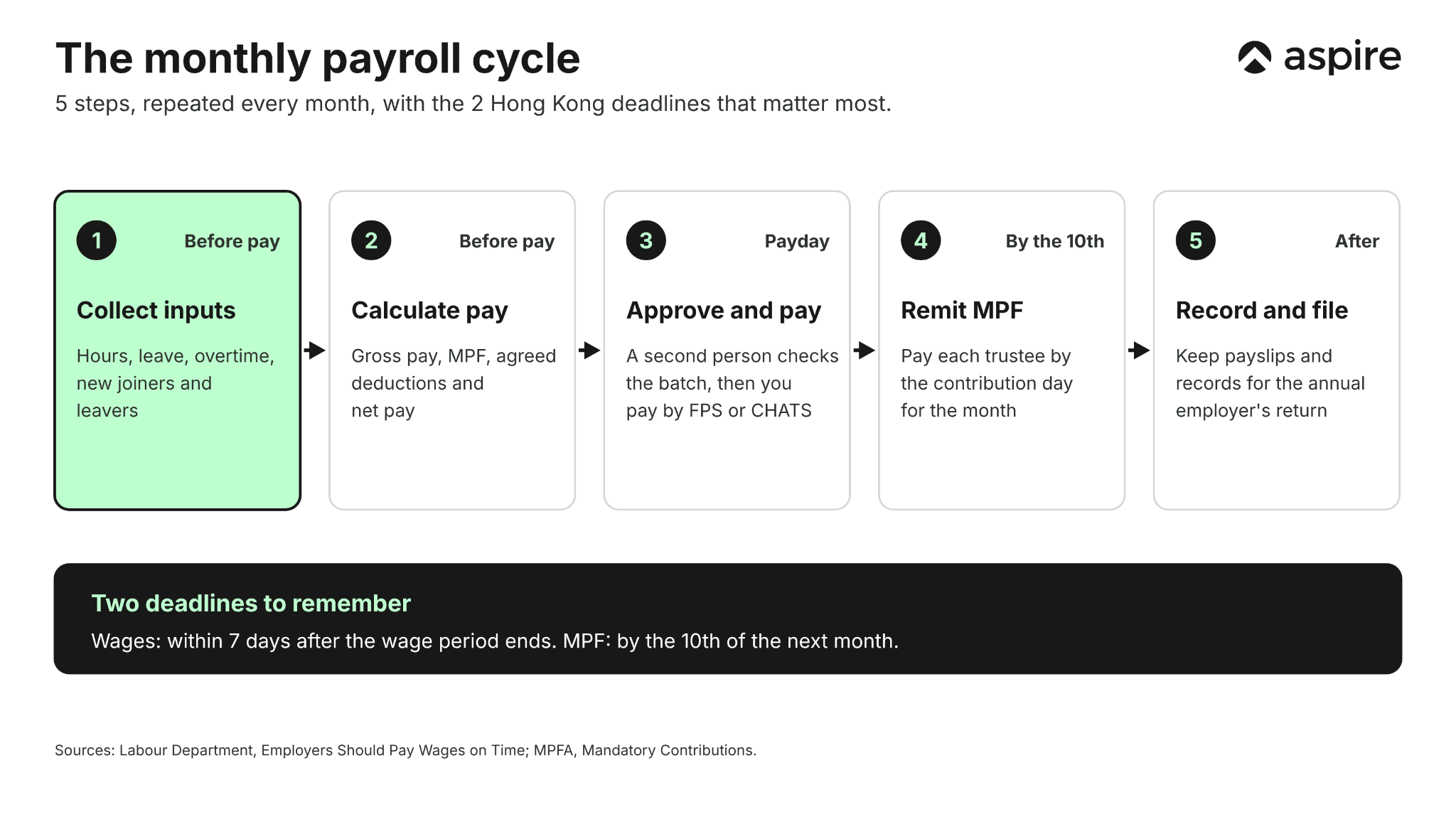
Here is the same cycle as a calendar.
| When | Task |
|---|---|
| Before payday | Confirm headcount, leave, overtime and new joiners, then run the calculations |
| Before payday | A second person reviews the batch against last month |
| On payday | Pay by FPS or CHATS and send each employee a payslip |
| After payday | Reconcile bank debits to the payroll register and pay MPF by the 10th |
What controls does payroll need?
Payroll needs 3 basic controls: a second approver, restricted access and a monthly reconciliation.
One person should prepare the batch and a different person should approve it, so a typo or a fraud attempt needs 2 failures to get through.
Limit who can see salary data to the people who need it. Aspire lets teams restrict salary visibility to selected members and assigns payroll batch rights by user role.
After payment, match the bank debits to the payroll register. Any difference points to a missing employee, a duplicate payment or a wrong amount.
How should you run payroll?
Most SMEs run payroll through a spreadsheet, payroll software or an outsourced provider, and the right choice depends on headcount and complexity. The table compares the 3 options.
| Method | Best for | Main trade-off |
|---|---|---|
| Spreadsheet | Teams of a few people with simple pay | Cheap, but formulas and MPF caps are easy to get wrong |
| Payroll software | Growing teams that want calculations and reports automated | You still own setup, review and payment |
| Outsourced payroll or employer of record | Teams hiring across borders or with no HR staff | Higher cost, and less direct control |
Aspire's guide to the top payroll systems in Hong Kong compares software options. If you hire in countries where you have no entity, Aspire's employer of record service is another route.
When should you move off spreadsheets?
Move to software when the file takes more than a few hours a month or errors start to appear. Other triggers are staff on different pay structures, overseas hires, or the person who built the file leaving.
A spreadsheet has no audit trail and no built-in MPF cap, so every formula is a place for an error. Even teams that stay on spreadsheets should lock formulas and archive each month's file.
What are the key payroll deadlines?
The 3 deadlines that matter most are the 7-day wage window, the MPF contribution day and the annual employer's return. The table lists each with its source.
| Obligation | Deadline |
|---|---|
| Wages | As soon as practicable, and no later than 7 days after the wage period ends¹ |
| MPF contributions | The 10th of the following month for monthly-paid staff² |
| Employer's return (BIR56A with IR56B forms) | Within 1 month of the IRD issuing it, normally in April³ |
| New employee notice (IR56E) | Within 3 months of the employee starting work³ |
| Leaving or termination notice (IR56F) | 1 month before employment ends³ |
If the contribution day falls on a weekend or public holiday, the MPFA moves it to the next working day.²
What if wages are late?
Willful and unjustified failure to pay wages on time can lead to a fine of up to HK$350,000 and up to 3 years in prison. Directors, managers and similar officers can face the same penalties if the default happened with their consent, connivance or negligence.⁴
A short delay caused by a payment error is still a risk. Build a buffer by running payroll a few days before the deadline.
How do MPF contributions work?
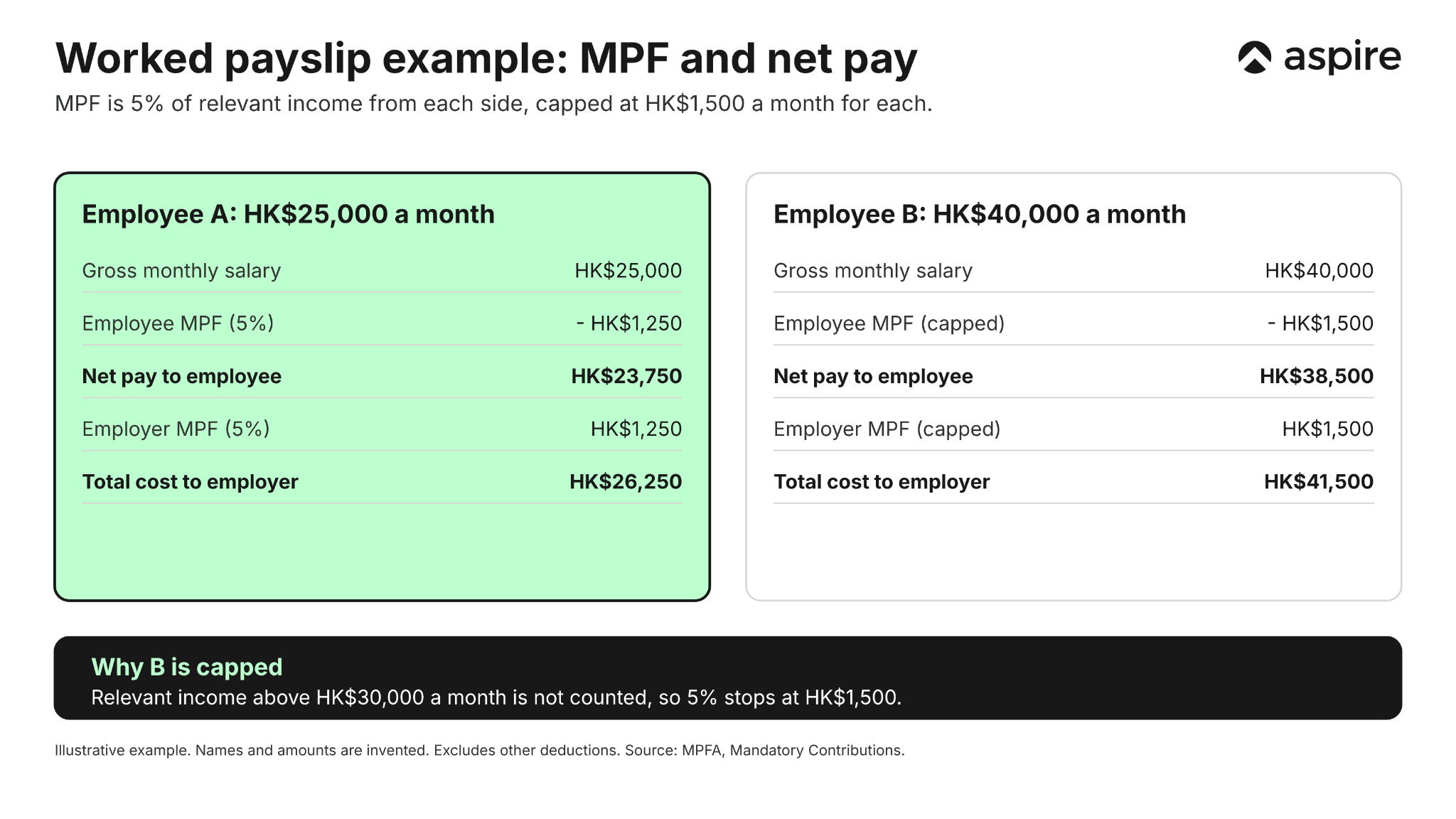
The employer and employee each pay 5% of the employee's relevant income, up to a maximum of HK$1,500 a month each.
The MPFA sets the minimum relevant income for monthly-paid staff at HK$7,100.²
The maximum relevant income is HK$30,000.²
Employers pay from the first day of employment. Employee contributions are waived for the first 30 days, plus any remaining part of that wage period.²
How do you pay MPF?
Pay each trustee by the contribution day, and check how that trustee accepts payment first. Aspire's help guide on paying salaries and MPF says it supports MPF payment by FPS from a Hong Kong dollar account to the trustee's bank account. Not all trustees accept FPS, and cheque and autopay options are not available in the Aspire app.
Aspire's MPF calculator helps you check each amount before you pay.
What does a payslip example look like?
A payslip shows gross pay, deductions and net pay for the wage period, and the figures must match your records. The Labour Department lists the wage period, amount paid, payment date, how wages were calculated and any deductions with their reasons as records employers must keep.⁵
The example below uses 2 invented employees, one under the MPF cap and one over it.
How do you prorate pay?
Prorating is needed when an employee joins or leaves mid-month, and your contract should state the method. A common calendar-day method divides monthly pay by the days in that month and multiplies by the days worked.
For example, take a HK$30,000 monthly salary in a 31-day month.
The daily rate is about HK$968.
An employee who starts on the 21st and works 11 days is paid about HK$10,645 before MPF.
How do leave and holidays affect pay?
Employees on a continuous contract of at least 3 months are entitled to holiday pay for statutory holidays, and there are 15 statutory holidays in 2026. Holiday pay equals the employee's average daily earnings over the previous 12 months, according to the Labour Department.⁶
Payroll must also track annual leave and sick leave, because each affects the amount paid in a wage period. Check the Labour Department's guidance for the pay rules on each type of leave.
What is the 468 rule?
From 18 January 2026, an employee generally meets the continuous contract test by working at least 68 hours for the same employer over a 4-week period. It replaced the older 418 rule, which counted weekly hours and could exclude a worker with 1 short week.⁷
This matters for payroll because continuous contract status unlocks Employment Ordinance benefits such as holiday pay.
What is the minimum wage?
The statutory minimum wage rises to HK$43.1 an hour from 1 May 2026. If 1 May falls within a wage period, the new rate applies only to hours worked on or after that date.⁸
Employers must also record hours worked in each wage period for lower-paid staff, and the monthly pay threshold for that rule rises to HK$17,600 from 1 May 2026.⁸
How do you onboard and offboard staff?
Onboarding and offboarding each trigger payroll, MPF and tax steps, and missing them causes most payroll errors. The checklist below covers the main ones.
- Insure the employee: employers must hold employees' compensation insurance covering all employees, and failure can bring a fine of up to HK$100,000 and 2 years' imprisonment.⁹
- Enrol in MPF: employer contributions start on the first day of employment.²
- Notify the IRD: file IR56E within 3 months of the start date.³
- At exit, prorate final pay and include any holiday pay or leave pay owed.
- Notify the IRD with IR56F 1 month before employment ends, or IR56G at least 1 month before the employee leaves Hong Kong for a substantial period.³
What year-end filings apply?
The IRD normally issues the employer's return (BIR56A) on the first working day of April, and you must file it with an IR56B for each employee within 1 month. The IRD encourages e-filing through eTAX.³
Failing to meet these duties, or filing an incorrect return, may lead to heavy penalties, according to the IRD.³ Keep payroll records tidy through the year, since the IR56B figures come straight from them.
How long should you keep records?
Keep business records for at least 7 years. The IRD cites section 51C of the Inland Revenue Ordinance for this duty, and records must be in English or Chinese.¹⁰ Payroll files, bank statements and receipts all belong in that paper trail.
How do you pay the team?
Pay local staff by FPS or CHATS, and pay overseas staff by cross-border transfer. Aspire's payroll tools support FPS payments to local employees at no charge, according to its help guide, and the payments are tagged as salary.
CHATS is available for same-day, high-volume batches and costs HK$55 per transfer, according to the same guide. Check current limits and fees before you rely on them.
What can software handle for you?
Aspire's platform can import or sync employee data from Talenox, Payboy and HReasily, schedule payouts and duplicate past transfers. Salary visibility can also be limited to selected team members.
Aspire covers the payment side, so most teams calculate pay in payroll software or a spreadsheet first. For recurring bulk payments, see Aspire's bulk payments, and for contractors, see contractor management.
How does payroll connect to expenses?
Keep payroll and reimbursements separate, so claims do not get mixed into salary. Aspire's employee claims and expense management handle reimbursements outside the salary run.
Teams can also track pay against budgets, and startups can see Aspire's options for startups.
Which mistakes cost the most?
The costliest payroll mistakes are late payment, wrong MPF and missing filings. Watch for these 5:
- Paying after the 7-day window, which exposes directors and officers to penalties.
- Ignoring the MPF cap, which overpays or underpays contributions for higher earners.
- Missing the contribution day, since late payment can trigger surcharges (check the MPFA for current rules).
- Skipping the IR56E, IR56F or IR56B notices, which the IRD can penalise.
- Forgetting insurance, which is an offence under the Employees' Compensation Ordinance.
Why Hong Kong Businesses Choose Aspire
Payroll is one of several recurring money flows a growing business has to run smoothly, and Aspire supports the payments, cards and spend tools around it.
💱 FX spreads from 0.18%, up to 3x cheaper than traditional banks. This applies across 130+ countries and 40+ currencies through Aspire's multi-currency account. It's useful for anything from paying overseas suppliers to settling international payments without losing margin to markup.
💰 1.2% unlimited cashback applies on every corporate card transaction, with no monthly cap. It kicks in automatically on eligible spend, with no minimum threshold to hit first. Over time, it quietly turns routine business spend into working capital.
🌐 Local transfer network, not multi-hop SWIFT chains, is how Aspire routes most payments. This means faster settlement and fewer intermediary fees eating into your payment before it reaches the recipient. It also reduces the chance of funds being held up for review at a correspondent bank along the way.
💸 Fixed USD 8 inbound SWIFT fee, tracked end-to-end with SWIFT GPI, applies when SWIFT is the right rail for your payment. There are no surprise deductions from correspondent banks along the way, so the amount you're quoted is the amount that arrives. You can also download payment confirmation instantly from the app, without calling the bank.
⚡ Approved in as little as 1 business day, with no branch visits and no paperwork stacks. Applications are completed entirely online, from document upload to approval. There's no waiting weeks on a relationship manager to call you back.
Open a free multi-currency business account built for Hong Kong SMEs, or explore how Aspire's corporate card fits into your day-to-day spend.
Frequently Asked Questions
As soon as practicable and no later than 7 days after the wage period ends.¹
HK$43.1 an hour from 1 May 2026.⁸
Within 1 month of the IRD issuing it, normally in April.³
No. A spreadsheet can work for very small teams, but software reduces calculation errors as headcount grows.
HK$1,500 a month each from the employer and the employee.²
Yes, in practice. Employers must hold employees' compensation insurance for all employees.⁹
Sources
- Labour Department, "Employers Should Pay Wages on Time"
- MPFA, "Mandatory Contributions" (employees and employers)
- Inland Revenue Department, "Employer's Return of Remuneration and Pensions"
- Hong Kong Government, "LCQ17: Default on payment of wages to employees" (8 October 2025)
- Labour Department, employment record-keeping guide (Appendix 1)
- Labour Department, "Statutory Holidays for 2026"
- Hong Kong Government, press release on the "468" continuous contract rule (13 January 2026)
- Labour Department, "Statutory Minimum Wage" flyer 2026
- Labour Department, "Employers Must Take out Employees' Compensation Insurance"
- Inland Revenue Department, "Record Keeping"
This blog is for general information only and does not constitute financial, legal, tax, or professional advice. Aspire’s services are subject to the terms outlined in our 'Terms of Service' and 'Pricing' pages. We make no guarantees as to the accuracy, completeness, or timeliness of the content, and past results do not indicate future performance. Always consult a qualified professional before acting on any information provided.
Galih Gumelar
Writer
Galih is a seasoned writer specialising in macroeconomics, business, finance and politics. With a writing history at CNN Indonesia, The Jakarta Post, and various other reputed organisations, Galih leverages his broad range of experiences to create insightful resources for those wanting to start a business.
Aspire Launchpad
Start Your Business with Aspire Launchpad
From incorporation to venture capital, we connect you with trusted service providers to make your entrpreneurial journey seamless.

Latest articles

Finance Tools •
Top 4 Bulk Payment Solutions in HK for SME
Compare 4 top bulk payment solutions in HK: rails, limits, approvals and costs, plus a worked example of paying 200 payees and a safety checklist.

Finance Tools •
Payroll Processing in HK: A Monthly Run Guide
Learn payroll processing in HK: the monthly run, pay and MPF deadlines, IRD filings, a worked net-pay example and how to pay staff in bulk.

Guides •
eBay for Hong Kong Sellers: Setup, Fees, Payouts
A step-by-step eBay tutorial for Hong Kong sellers: register, set up payouts, list items, understand fees and tax, and move your earnings into a business account.
Start your journey with Aspire
Open your free account