



What Is COBO (Collection on Behalf Of) & Stablecoin Uses?

Galih Gumelar

Summary
COBO means Collection on Behalf Of. A central entity receives customer payments for other group companies, usually through 1 account per currency.
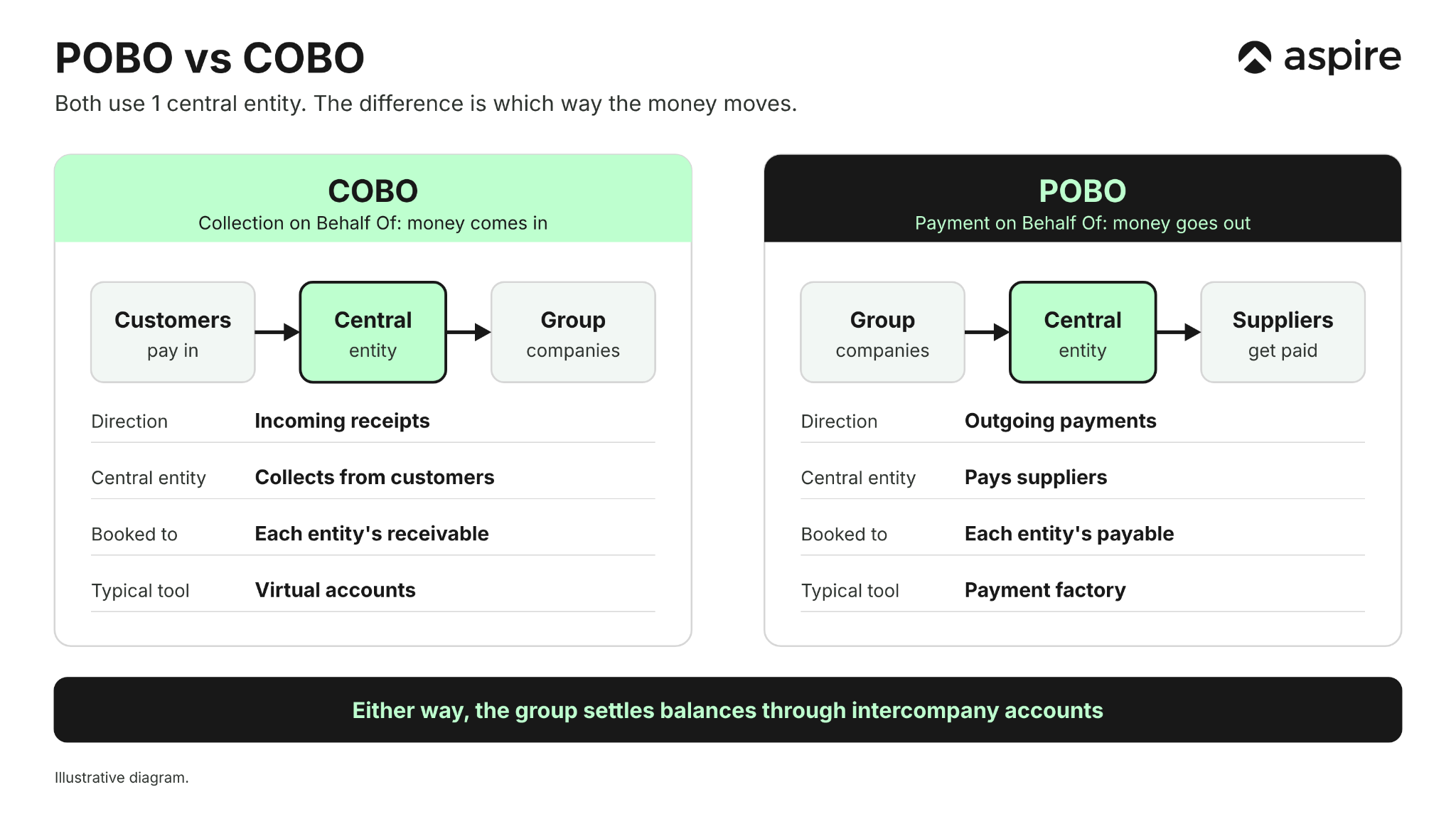
It is the receivables mirror of POBO. Payment on Behalf Of centralises outgoing payments, and COBO centralises incoming ones.
Stablecoin COBO swaps accounts for wallets. A central wallet replaces the bank account, and deposit addresses replace virtual accounts.
Hong Kong licenses stablecoin issuers, not users. The first issuer licences were granted on 10 April 2026, and businesses still need regulated channels, KYC and records.
It suits larger groups. Smaller groups usually get most of the benefit from lighter alternatives.
COBO, short for Collection on Behalf Of, is a treasury model in which 1 central company collects customer payments for several group companies through a shared account.¹ The customer pays once, and the money is allocated to the right entity in the books behind the scenes.
Banks have offered COBO for years, and the same logic now appears on stablecoin rails. This guide explains how COBO works, how a crypto version maps onto it, and what Hong Kong's stablecoin regime means for a group that wants to try it.
What is COBO (collection on behalf of)?
COBO is a centralised collection structure in which 1 legal entity receives incoming payments for multiple group companies.¹ A treasury centre or shared service centre normally runs it, and the cash is booked to each entity through intercompany accounts.²
The structure usually relies on 1 bank account per currency instead of separate accounts for every subsidiary.² Customers see 1 set of payment details, and the treasury team does the allocation.
How do POBO and COBO differ?
POBO handles payments going out, and COBO handles payments coming in. Some banks use ROBO (Receivables on Behalf Of) as another name for the collection side.²
| Term | Full name | Direction | What the central entity does |
|---|---|---|---|
| COBO | Collection on Behalf Of | Incoming | Receives customer payments for group companies |
| POBO | Payment on Behalf Of | Outgoing | Pays suppliers for group companies from a central account |
| ROBO | Receivables on Behalf Of | Incoming | Same idea as COBO, used by some banks² |
Why do groups use COBO?
Groups use COBO to replace a sprawl of local accounts and manual matching with 1 central collection point.⁴ The gains are mostly operational and grow with the number of entities and currencies.
- Fewer accounts. 1 account per currency replaces separate accounts across entities, which also cuts bank fees.¹
- Better cash visibility. Treasury sees collections in real time and has a single view of liquidity.⁴
- Faster reconciliation. Structured references let incoming payments be matched and posted automatically.²
- Easier growth. A new entity can be added without opening new external accounts.²
How does COBO work?
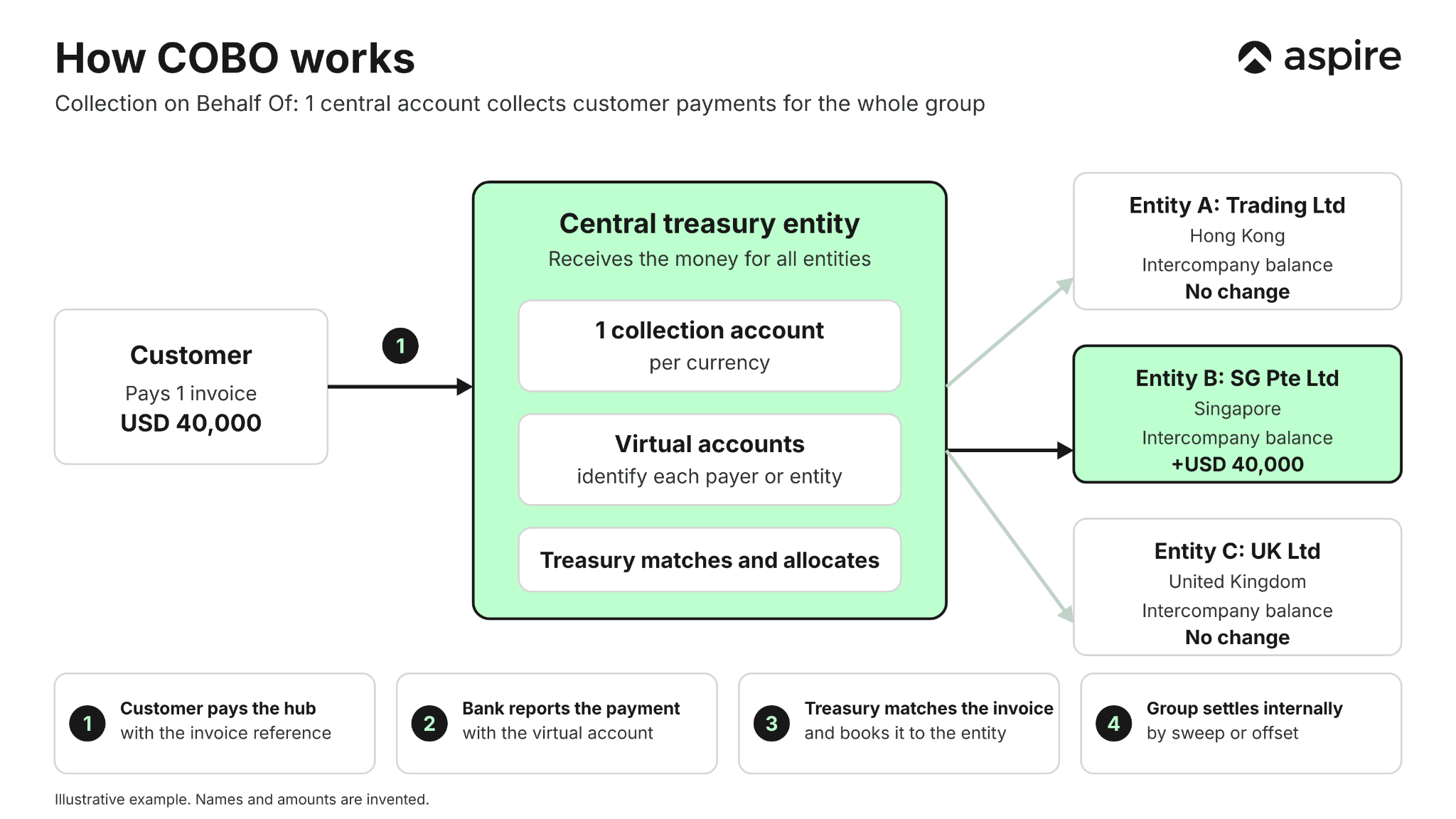
COBO works by pointing every customer payment at 1 central account and allocating the money to the right entity in the group's books. The steps below describe a typical bank set-up.
- Set up the legal basis. Intercompany agreements authorise the central entity to collect for subsidiaries.²
- Open the central account. The bank opens 1 collection account per currency in the central entity's name.¹
- Create virtual accounts. The bank issues unique account numbers that route to the central account, so each payer or entity can be identified.¹
- Invoice with the central details. Each subsidiary shows the central account and the correct reference.
- Match and allocate. Treasury matches each receipt to the open invoice and books it to the subsidiary's intercompany account.²
- Settle internally. The central entity passes the money on, or keeps it and offsets balances, under group policy.
How do virtual accounts help?
Virtual accounts are non-physical account numbers that route incoming funds to 1 physical account.¹ They let a bank tell customers apart without opening a new real account for each one.
Matching still depends on the reference data. ISO 20022 payment messages carry a structured field for the entity on whose behalf a payment is made, while older formats can drop it.²
What does COBO look like in Hong Kong?
This illustrative example shows how 1 USD payment moves through a COBO set-up. All names and figures are invented and are not drawn from a real company.
Harbour Gadgets Ltd is a Hong Kong electronics distributor. Harbour Treasury Ltd, its central entity, collects USD for 3 trading entities.
A Texas customer owes USD 40,000 on an invoice from Harbour SG Pte Ltd. The invoice shows a virtual account that routes to the treasury entity's USD account, and the bank reports the payment with that reference.
| Entity | Collected in the month (USD) | Intercompany balance |
|---|---|---|
| Harbour Trading Ltd | 85,000 | Treasury owes 85,000 |
| Harbour SG Pte Ltd | 40,000 | Treasury owes 40,000 |
| Harbour UK Ltd | 25,000 | Treasury owes 25,000 |
| Total | 150,000 | 150,000 |
Treasury can then sweep the money to each entity or hold it under written policy. Tax and accounting advisers should approve the intercompany treatment and any interest or pricing on these balances.
Can COBO run on stablecoins?
Yes, in principle: a central wallet can play the role of the collection account, and a deposit address can play the role of a virtual account. Stablecoin COBO is a design pattern, not a product, and each part of it needs checking against local rules.
How does stablecoin COBO work?
Receiving a stablecoin payment needs only a wallet address, much like giving an IBAN.⁵ Custody platforms use the same pattern as virtual accounts: each client gets its own deposit address, and funds are swept into a central omnibus wallet.⁶
- Create the central wallet. The treasury entity holds it in-house or with a regulated custodian.⁵
- Issue a deposit address per entity or customer. An internal ledger maps each reference to its address.⁶
- Customer sends the stablecoin. The transfer settles on-chain and can be confirmed at any hour.⁵
- Sweep to the central wallet. Sweeps run on a schedule or at a balance threshold, and each one pays a network fee.⁶
- Book the intercompany balance. Treasury credits the right entity, exactly as in the bank version.
- Convert to fiat if needed. Conversion runs through regulated providers or banks.⁵
| Step | Bank COBO | Stablecoin COBO |
|---|---|---|
| Collection point | 1 account per currency | 1 wallet per stablecoin and network |
| Payer identification | Virtual account and reference | Deposit address and internal ledger |
| Availability | Bank cut-off times | Round the clock⁵ |
| Cost per movement | Bank fees | Network fees on each sweep⁶ |
| Conversion | Usually none | On- and off-ramp to fiat⁷ |
What does Hong Kong's regime say?
Hong Kong requires an HKMA licence to issue a fiat-referenced stablecoin, and that rule applies to issuers, not to the companies that use them.⁸ The Stablecoins Ordinance took effect on 1 August 2025.⁸
The HKMA granted the first 2 issuer licences on 10 April 2026, to Anchorpoint Financial Limited and The Hongkong and Shanghai Banking Corporation Limited.⁹ It also advises people to acquire and use stablecoins only through regulated channels.⁹
Licensed issuers must fully back their coins with reserve assets and are treated as financial institutions under Hong Kong's anti-money laundering rules, including the travel rule for transfers.⁸ The sources reviewed set out no specific rules for corporate COBO, so confirm the structure with your legal and tax advisers.
What if the group collects in stablecoins?
This illustrative example reuses Harbour Gadgets with a payer who settles in a USD stablecoin. The figures are invented, and no fees or rates are stated.
- Invoice. Harbour SG Pte Ltd invoices a Texas customer for USD 40,000 and shows a deposit address tied to that invoice.
- Payment. The customer sends 40,000 units of the stablecoin, and the ledger matches it to the Singapore entity.
- Sweep and book. The coins move to the central wallet, and treasury credits Harbour SG with a USD 40,000 intercompany balance.
- Off-ramp. A regulated provider converts the coins to USD in the treasury bank account, and the group settles internally as usual.
What are the risks of stablecoin COBO?
The extra risks sit in the coin, the ramps and the controls. The table below groups them.
| Risk | What can go wrong | How groups manage it |
|---|---|---|
| Coin quality | Backing and regulatory status differ by issuer⁷ | Due diligence on each coin before use |
| On- and off-ramps | Converting between fiat and stablecoins is a major source of friction⁷ | Trusted regulated partners |
| Compliance | Customer checks, sanctions screening and monitoring still apply⁵ | KYC and transaction monitoring on every counterparty |
| Accounting | Treatment depends on the coin's terms⁷ | Auditor sign-off, since HKAS 7, HKAS 38 or HKFRS 9 may apply, as Aspire's stablecoin guide explains |
| Wallet control | Keys and approvals need governance⁵ | Whitelists, segregation of duties, approval policies |
Treasury commentary also suggests starting with small pilots and documenting the outcome before scaling.⁷
What are the risks of COBO?
The main risks of COBO are regulatory, tax and operational, and most depend on the countries involved.¹ ⁴ Groups usually find them during design, not after launch.
| Risk area | What can go wrong | How groups manage it |
|---|---|---|
| Regulatory | Some countries restrict on-behalf-of structures² ⁴ | Country-by-country legal review |
| Tax | Tax implications differ across markets¹ | Tax adviser sign-off on intercompany treatment |
| Legal | Customer contracts may not recognise payment to another entity² | Contract wording and customer communication |
| Operational | Payments arrive without references¹ | Virtual accounts and structured references |
| Banking | Not every bank supports the set-up⁴ | Bank selection and testing |
Local payment instruments and tax payments are the 2 most common blind spots. Instruments such as Spanish pagarés and Italian RiBA fragment collection, and tax payments generally have to be made locally.¹ ⁴
Where is COBO restricted?
There is no single global rule, and some countries restrict on-behalf-of structures.⁴ None of this replaces local legal advice.
| Market | What the sources say | Practical step |
|---|---|---|
| Hong Kong | Named as a regional treasury centre location²; a profits tax concession exists for qualifying centres¹⁰ | Confirm the entity qualifies |
| Singapore | Named as a regional treasury centre location² | Local legal and bank review |
| Mainland China, India, Malaysia | Named as markets with obstacles; a China entity may need to register as a financial institution² | Specialist counsel and bank advice |
How does Hong Kong tax treasury centres?
Hong Kong offers a concessionary profits tax rate of 8.25% for qualifying corporate treasury centres. It has applied since 1 April 2016, with a rule that lets intra-group financing businesses deduct interest under specified conditions.¹⁰
The sources reviewed identify no Hong Kong rule that bans COBO, but that is not legal advice. See Aspire's guides to the corporate tax rate in Hong Kong and Hong Kong withholding tax.
Can COBO work in China?
For mainland entities, COBO is not a plug-and-play structure. The closest legal route is the cross-border cash pooling regime, and a notice dated 13 August 2026, effective 14 September 2026, lists centralised current-account receipts and payments among covered scenarios.¹¹
2 cautions apply. The source describes cash pooling, not COBO, so it does not confirm that collecting on behalf of members is permitted.¹¹
Thresholds are high and reported differently across sources, so verify the current text with SAFE. This guide does not cover crypto rules in mainland China.
Can an SME group use COBO?
COBO is mainly a large-group tool, but a small multi-entity group can borrow parts of it. The Global Treasurer says collection factories are typically considered by companies operating in more than 10 countries with substantial turnover.⁴
Is COBO worth it?
The signals below suggest a group has outgrown separate accounts. Treat them as a checklist, not a rule.
- 4 or more legal entities invoicing customers in the same currencies.
- Frequent wrong-entity payments that finance teams fix by hand.
- Several accounts per currency across banks, with rising fees.
- An accounting system that can handle intercompany postings.
Are there lighter alternatives?
| Option | What it solves | Limit |
|---|---|---|
| Keep entity accounts, tighten references | Cuts wrong-entity payments | Does not reduce account count |
| Bank virtual accounts | Faster matching | May not attribute funds to separate entities |
| Multi-currency account per entity | Holds and pays in several currencies | No central collection or entity attribution |
Ask any provider for written confirmation before assuming it supports central collection with entity-level attribution. For groundwork, see Aspire's guides to cash flow management, the invoice management process and outstanding invoices.
What do you need to set up COBO?
A COBO programme is a cross-functional project, not a banking form. The checklist below covers the main workstreams.
- A capable bank. The Global Treasurer suggests consolidating to roughly 5 to 10 master banks first.⁴
- Intercompany agreements that authorise collection and set settlement terms.²
- Tax and legal review in each country, signed off before any customer moves.⁴
- Customer communication, with new payment details and clear references.²
- Reporting formats. Confirm banks can deliver ISO 20022 data with the "on behalf of" field.²
- A phased rollout. Start with a few entities or currencies.⁴
Which rails and checks matter?
Rail choice affects speed and cost. Aspire explains SWIFT versus local bank transfers, how CHATS, FPS and SWIFT work in Hong Kong, and the wider landscape of international payments and cross-border payments.
Central accounts trigger bank due diligence, and the KYC guide lists the usual documents. The guide to foreign exchange risk covers collected currency that differs from an entity's reporting currency, and the B2B payment methods overview helps map what customers use.
Why Hong Kong Businesses Choose Aspire
COBO is a bank-structured treasury model that Aspire does not offer, but Aspire supports the payments, cards and spend that surround any group's day-to-day finance operations.
💱 FX spreads from 0.18%, up to 3x cheaper than traditional banks. This applies across 130+ countries and 40+ currencies through Aspire's multi-currency account. It's useful for anything from paying overseas suppliers to settling international payments without losing margin to markup.
💰 1.2% unlimited cashback applies on every corporate card transaction, with no monthly cap. It kicks in automatically on eligible spend, with no minimum threshold to hit first. Over time, it quietly turns routine business spend into working capital.
🌐 Local transfer network, not multi-hop SWIFT chains, is how Aspire routes most payments. This means faster settlement and fewer intermediary fees eating into your payment before it reaches the recipient. It also reduces the chance of funds being held up for review at a correspondent bank along the way.
💸 Fixed USD 8 inbound SWIFT fee, tracked end-to-end with SWIFT GPI, applies when SWIFT is the right rail for your payment. There are no surprise deductions from correspondent banks along the way, so the amount you're quoted is the amount that arrives. You can also download payment confirmation instantly from the app, without calling the bank.
⚡ Approved in as little as 1 business day, with no branch visits and no paperwork stacks. Applications are completed entirely online, from document upload to approval. There's no waiting weeks on a relationship manager to call you back.
Open a free multi-currency business account built for Hong Kong SMEs, or explore how Aspire's corporate card fits into your day-to-day spend.
Frequently Asked Questions
COBO stands for Collection on Behalf Of. It describes a central entity receiving customer payments on behalf of other companies in the same group.¹
In principle, yes: a central wallet and per-entity deposit addresses can mirror a collection account and virtual accounts.⁶ The sources reviewed set out no specific Hong Kong rules for corporate COBO, so take legal advice first.
The sources reviewed identify no Hong Kong rule that bans COBO, and Hong Kong is named as a regional treasury centre location.² This is not legal advice, so confirm the structure with your bank and tax adviser.
It depends on the structure, and an entity may need to register as a financial institution.² The cross-border cash pooling regime is the closest framework, but the source reviewed does not confirm that it permits collecting on behalf of members.¹¹
No, but they are widely used. Virtual accounts let a bank identify each payer and route funds to 1 physical account, which supports automatic reconciliation.¹
No. COBO is the treasury model, while Cobo is a digital asset custody company.³
Sources
- BNP Paribas, "The Role of COBO as Part of a Centralisation Strategy", Treasury Management International
- DBS Corporate Insights, "POBO and ROBO: Channel Flows for Group-Wide Value"
- Cobo, "Cobo Launches Stablecoin Payment Solution for Cross-Border Business Growth"
- The Global Treasurer, "The Benefits and Challenges of POBO and COBO"
- Deloitte Netherlands, "Stablecoins and corporate treasury"
- Fireblocks Developer Portal, "Sweep to Omnibus"
- Taulia, "Harnessing stablecoins in corporate treasury"
- Slaughter and May, "Hong Kong launches stablecoin regime"
- HKMA, "Granting of stablecoin issuer licences" (10 April 2026)
- Inland Revenue Department, press release on corporate treasury centre tax measures (3 June 2016)
- Allen & Gledhill, "China Expands Cross-Border Cash Pooling Regime for Multinationals"
This blog is for general information only and does not constitute financial, legal, tax, or professional advice. Aspire’s services are subject to the terms outlined in our 'Terms of Service' and 'Pricing' pages. We make no guarantees as to the accuracy, completeness, or timeliness of the content, and past results do not indicate future performance. Always consult a qualified professional before acting on any information provided.
Galih Gumelar
Writer
Galih is a seasoned writer specialising in macroeconomics, business, finance and politics. With a writing history at CNN Indonesia, The Jakarta Post, and various other reputed organisations, Galih leverages his broad range of experiences to create insightful resources for those wanting to start a business.
Aspire Launchpad
Start Your Business with Aspire Launchpad
From incorporation to venture capital, we connect you with trusted service providers to make your entrpreneurial journey seamless.

Latest articles
Newsroom •
Aspire launches Yield in Hong Kong to help businesses earn more from idle cash
Learn how your business can earn more from idle cash
Business Account •
Corporate Banking vs Commercial Banking: What's the Difference?
These terms get used inconsistently across banks. Here's what actually separates them, and which one your Hong Kong business fits.

E-commerce •
Ecommerce Fulfillment in HK: Top 5 3PL Providers
Compare HK ecommerce fulfillment & 3PL providers. Evaluate pricing, integrations, and shipping to scale your brand with Aspire.
Start your journey with Aspire
Open your free account