


Assets vs liabilities: what they mean for business owners

Content Team

Summary
Assets are resources your business owns with economic value, including cash, receivables, inventory, equipment, and patents.
Liabilities are financial obligations you owe, like debt, accounts payable, deferred revenue, and accrued taxes.
The accounting equation underpins every balance sheet: Assets = Liabilities + Equity.
Assets break into 3 types: current, fixed, and intangible. Liabilities break into current, long-term, and contingent.
Expenses are neither assets nor liabilities. They reduce equity directly through the income statement.
3 ratios tell you where you actually stand: debt-to-asset ratio, current ratio, and quick ratio.
Most small businesses don’t get rejected by banks randomly. In 2026, nearly half of loan applications are denied, and lenders look straight at your liquidity, especially your quick ratio.
At the same time, many businesses are carrying overdue invoices. With the US average at USD USD $17,500, your balance sheet can look healthy while your cash position tells a different story.
That’s the gap this guide closes. By understanding assets vs liabilities, you can see how your balance sheet actually moves and make decisions with clarity.
What is meant by assets and liabilities
The assets of your business include things like cash, inventory, equipment, and accounts receivable that have economic value. Your company's debts to third parties, such as loans, outstanding vendor invoices, credit card balances, and deferred revenue, are referred to as liabilities.
You can calculate your business's equity by deducting total liabilities from total assets. That single number is the clearest measure of your business’ financial health when discussing assets vs liabilities.
What are assets
An asset is anything your business owns or controls that has economic value and is expected to generate future benefit. That benefit might be direct, like cash you can spend today or indirect, like equipment that produces inventory you'll eventually sell.
Types of assets
- Current assets of your company are what keep it running on a daily basis. Cash, inventories, receivables, and prepaid expenses that increase in value within a year are all included in this.
- Fixed assets sustain the operations of your company over time. Instead of instantly turning into cash, property, machinery, cars, and equipment support the business over a number of years.
Under Section 179 of the Internal Revenue Code, you can often deduct the full purchase price (max deduction up to USD $2,560,000 as of 2026) of qualifying equipment in the year it’s placed in service. This effectively increases the capital of your business by converting a non-current asset into a sizable immediate deduction.
- Intangible assets do not exist physically, but they still carry value. Patents, trademarks, copyrights, and goodwill shape how your business competes and grows over the long term.
Examples of assets
The asset mix looks different depending on how your business operates. For example, a SaaS company's most valuable assets are often intangible, like proprietary software, patents, and goodwill. A manufacturer is weighted toward fixed assets: machinery, equipment, and property. An e-commerce business lives on current assets, including inventory and receivables. A marketing agency, however, holds almost no physical assets; its balance sheet is built on receivables and prepaid tools.
What are liabilities
A liability is a financial obligation, something your business owes to another party. To put it simply, when you take out a loan, carry a credit card balance, or receive payment from a client before delivering the service, you've created a liability.
Types of liabilities
- Current liabilities are obligations due within 12 months. These include accounts payable, credit card balances, accrued expenses, and short-term loans. They directly affect your day-to-day liquidity.
One current liability US founders consistently underestimate is their IRS quarterly tax obligation. Unlike salaried employment, where tax is withheld automatically, LLCs and S-Corps owe estimated payments every quarter. If you're not tracking that figure as a running liability throughout the quarter, your equity looks healthier than it actually is.
This is where real-time visibility matters; using a platform like Aspire that tracks your profit-to-date helps you estimate that liability accurately before the IRS deadline hits.
- Long-term liabilities extend beyond 12 months. Loans, mortgages, and notes payable sit on your balance sheet for years and shape how leveraged your business is over time.
- Contingent liabilities depend on future events. Lawsuits, warranties, or guarantees may never materialize, but they still represent potential risk.
Examples of liabilities
The liability mix is equally industry-specific. The typical current liabilities for a SaaS company are usually accumulated salary and deferred revenue. Short-term inventory finance and accounts payable are carried by an eCommerce company. A consulting firm may appear to have plenty of cash on hand, but it still has a sizable amount of deferred revenue to meet. A construction company bears the most long-term burden, such as long-term bond commitments, mortgages, and equipment finance.
Assets vs liabilities: at a glance
The difference between assets and liabilities in accounting terms determines your equity, your borrowing capacity, and your ability to absorb a bad quarter.
| Aspect | Assets | Liabilities |
|---|---|---|
| Definition | Resources owned by the business with economic value | Financial obligations owed to creditors or third parties |
| Purpose and function | Generate future economic benefit or support operations | Fund operations or acquisitions and represent claims against the business's assets |
| Revenue vs. obligation | Represent value the business can use, sell, or convert | Represent amounts the business must pay or settle |
| Liquidity | Can be converted to cash; current assets faster than non-current | Due for settlement on a schedule; current liabilities within 12 months |
| Timeframe | Current (under 12 months) or non-current (over 12 months) | Current (under 12 months) or long-term (over 12 months) |
| Risk factor | Declining asset value weakens equity and borrowing capacity | Rising liabilities increase financial risk and reduce equity |
| Assets vs liabilities examples | Cash, accounts receivable, equipment, inventory, patents | Business loans, accounts payable, credit card balances, deferred revenue |
One thing worth noting: when you take out a loan, it appears as both a current asset (the cash lands in your account) and a liability (the repayment obligation). The asset and liability are created simultaneously in the balance sheet.
Are expenses assets or liabilities
Expenses are neither assets nor liabilities.
Expenses flow through your income statement and reduce equity directly. They're costs your business has incurred in the course of generating revenue. A liability, by contrast, is an obligation you still owe. An expense is something already recognized.
For example, say you subscribe to a USD $2,000 accounting software package. The moment you use it, it becomes an expense. But if you haven't yet paid the invoice, that unpaid bill is a current liability (accounts payable) until you settle it.
Tip: If you're trying to get a clean read on your true liability position before a board meeting or a loan application, unpaid expenses are the first place to look. They're quietly inflating your obligations while sitting in a category most founders don't monitor closely enough.
Assets vs liabilities vs equity: the accounting equation
When discussing assets vs liabilities vs equity, the accounting equation that sits under every balance sheet:
Assets = Liabilities + Equity
Assets equal liabilities plus equity because everything a business owns (assets) was paid for either by borrowing (liabilities) or by owner investment and retained earnings (equity). The equation always balances; those are the only 2 sources of funding.
Rearrange it, and you get: Assets − Liabilities = Equity. That's your net worth as a business.
Healthy equity
A business with USD $120,000 in assets and USD $45,000 in liabilities has USD $75,000 in equity. That’s a position with room, assets cover obligations, and there's value left over.
Change the equation, and the picture shifts quickly.
A business at this position can typically access credit, take on new liabilities to fund growth, and absorb a bad quarter without structural damage.
Negative equity
When liabilities exceed assets, equity becomes negative. This can happen in early-stage businesses investing aggressively in growth or in businesses experiencing sustained losses.
Negative equity limits your ability to borrow, signals elevated risk to investors, and requires careful cash flow management to navigate.
For example, if assets are USD $60,000 and liabilities are USD $85,000, equity drops to negative USD $25,000. Liabilities now exceed what the business owns.
Founder’s insight: The assets and liabilities balance sheet doesn’t tell you whether liabilities are good or bad. If you’ve ever wondered what are liabilities on a balance sheet, they’re simply what the business owes. It shows how much room the business actually has when things shift. Most businesses track revenue closely. Far fewer track how their asset–liability gap is moving over time. That gap, your equity, is what determines how much flexibility the business has when conditions change.
Assets vs liabilities: assets and liabilities on the balance sheet
A healthy balance sheet shows current assets comfortably exceeding current liabilities. It shows long-term liabilities proportionate to the non-current assets they funded. And it shows equity that's growing over time.
Below is a real-life assets and liabilities example from NVIDIA’s Q4 fiscal 2025 balance sheet.
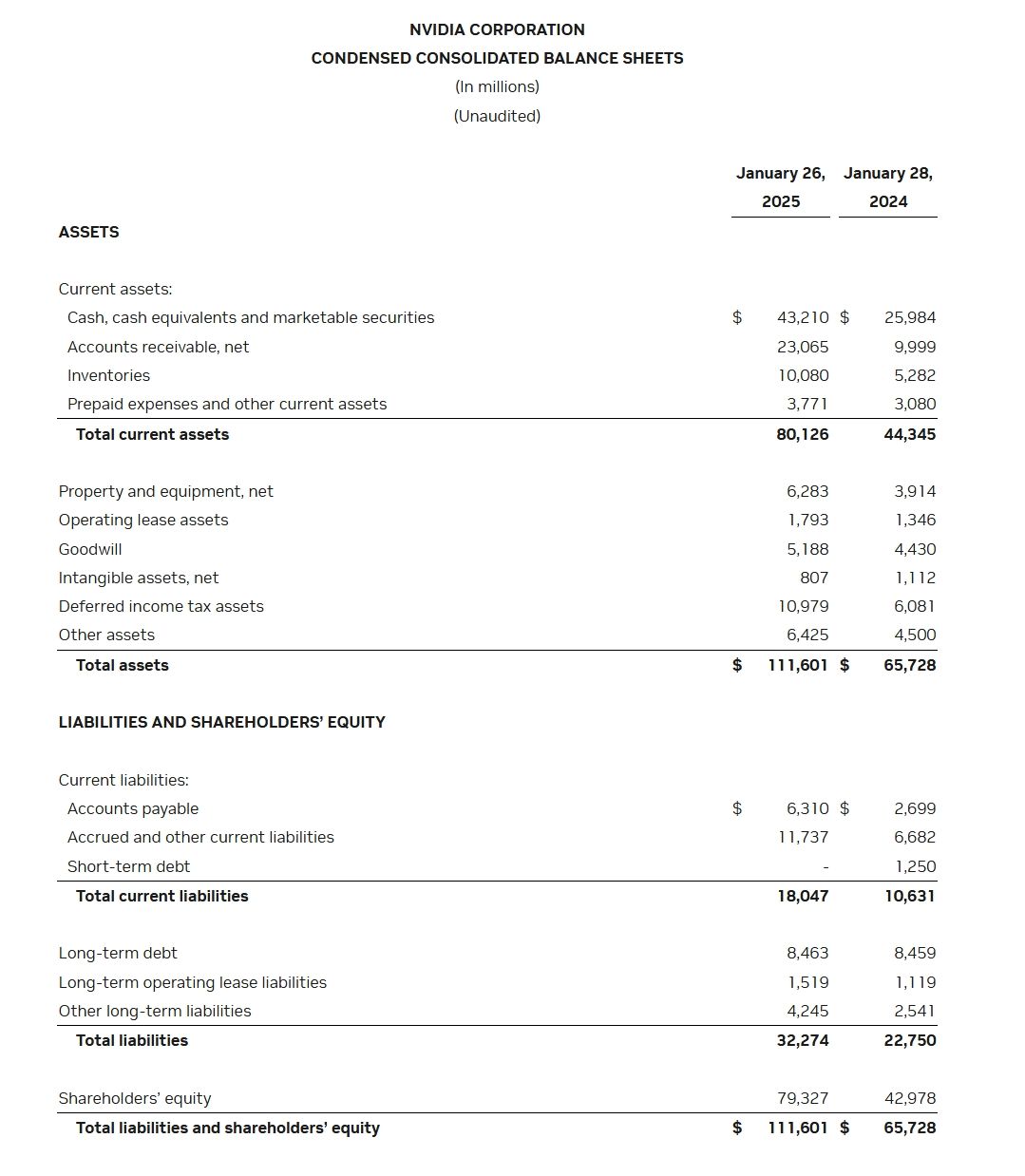
A warning-sign balance sheet: Current liabilities higher than current assets (a current ratio below 1.0). Accounts receivable aging past 60–90 days. Long-term debt that's grown without a corresponding asset increase.
Key financial ratios: Using assets and liabilities to make smarter decisions
These 3 calculations are what lenders run when you apply for credit and what you should be running before they ask.
| Ratio | Definition | Formula | What it signals | Example |
|---|---|---|---|---|
| Debt-to-asset ratio | The percentage of your assets financed by debt | Total Liabilities ÷ Total Assets | < 0.5 is healthy; > 0.8 signals high risk | A business with USD $300K in assets and USD $120K in liabilities has a ratio of 0.40, which is healthy. Add USD $150K in new debt, and it jumps to 0.90. |
| Current ratio | Your ability to cover short-term obligations using all short-term assets | Current Assets ÷ Current Liabilities | 1.5–2.0 is a general benchmark; varies by industry | USD $80K in current assets, USD $40K in current liabilities, a ratio of 2.0, solid. Drop current assets to USD $35K, and you're below 1.0, meaning short-term obligations now exceed what you can cover. |
| Quick ratio | Your ability to pay short-term liabilities using only your most liquid assets (excluding inventory) | (Current Assets − Inventory) ÷ Current Liabilities | > 1.0 means you can cover short-term obligations without selling stock | Same business, but USD $25K of those assets are inventory. The quick ratio falls from 2.0 to 1.375. If inventory climbs to USD $50K, it drops to 0.75. You're now relying on selling stock to stay liquid. |
Stop managing your balance sheet in arrears
Aspire removes the lag by keeping both sides of your balance sheet current in real time.
With Aspire’s business account1, your cash position updates as transactions happen across accounts and currencies. At the same time, Aspire’s expense management captures and categorizes every vendor invoice and team spend as it happens, so your liabilities stay current.
Final words
Assets and liabilities aren't just accounting entries. They're a live map of where your business stands, from what you have and what you owe to what's left over for you.
Whether you're a US-based startup watching burn rate or an international business managing multi-currency liabilities, when your balance sheet is current and your ratios are clear, you stop reacting to your financial position. You start managing it.
Frequently Asked Questions
Cash, equipment, receivables, inventory, and other financial resources that your company owns or controls are examples of assets. Financial commitments you have to third parties, such as loans, overdue debts, and deferred income, are known as liabilities. The most obvious indicator of your company's financial health is equity, which can be calculated by subtracting total liabilities from total assets.
Cash is a current asset. It's the most liquid asset a business holds; it requires no conversion to be used. The only scenario where cash creates a liability is if it was received as an advance payment for services not yet delivered, in which case a separate deferred revenue liability is recorded alongside it.
When you receive a loan, the cash received is an asset. The repayment obligation, the loan itself, is a liability. Both are recorded simultaneously. Short-term loan repayments (due within 12 months) are current liabilities; longer-term portions are classified as non-current liabilities on the balance sheet.
Inventory is a current asset. It sits on the balance sheet at cost until sold, at which point it shifts to the income statement as cost of goods sold. It is never classified as a liability, though high levels of slow-moving inventory can signal a liquidity risk that shows up in your quick ratio.
Owner's capital, sometimes referred to as "equity" or "owner's equity," is neither a liability nor an asset. On the balance sheet, it is located in a separate area. It stands for the owner's claim to the company upon the settlement of all debts. According to the accounting formula, capital is equal to assets minus liabilities.
Current liabilities are short-term debts that are due within a year. The most common ones are accounts payable, short-term loans, credit card balances, accumulated costs (including wages), taxes payable, delayed revenue, and the present share of long-term debt.
Common business assets include cash, accounts receivable, inventory, equipment, and property. These are resources your business owns or controls and expects to generate value from.
This blog is for general information only and does not constitute financial, legal, tax, or professional advice. Aspire’s services are subject to the terms outlined in our ’Terms of Service’ and ’Pricing’ pages. We make no guarantees as to the accuracy, completeness, or timeliness of the content, and past results do not indicate future performance. Always consult a qualified professional before acting on any information provided.
Content Team
Aspire editorial
Content team at Aspire is a society of seasoned writers & experts specialising in finance, technology and SaaS space. With 50+ years of collective experience, they help make business finance more profitable for readers. They write about finance tools, finance insights, industry trends, tactical guides to grow your business & also all things Aspire.
Aspire Launchpad
Supercharge your finance operations with Aspire
Find out how Aspire can help you speed up your end-to-end finance processes from payments to expense management.

Latest articles

Finance Tools •
Quicken vs QuickBooks: Key differences, costs, and which is better
Compare Quicken vs QuickBooks on features, pricing, accounting tools, and more. See which option fits your small business and financial needs.

Business Advice •
Marketing agency profit margins: A founder's guide
Calculate real agency profit margins and compare benchmarks. Learn cash flow vs. margins, identify margin leaks, and improve pricing, delivery, and cash flow.

Business Account •
How to open a US bank account from India for your business
Learn how to open a US bank account from India, including requirements, remote options, fees, and the process for Indian vs. US-incorporated companies.