


Best business bank account for Shopify: 8 options compared for 2026

Bintang Lestada

Summary
Shopify Balance is not a bank account. Shopify uses Stripe Payments Company for money transmission, Fifth Third Bank N.A. holds the deposits, and Celtic Bank issues the card. Three companies, none of them Shopify
Balance pays out in as little as 1 business day; up to 7 days faster than a traditional bank, which is the single strongest argument for using it
Its 2% cashback is capped at $2,000 a year and covers eligible Shopify purchases and named ad platforms, not general business spend. At $30,000 a month in ads the cap is reached in month four
Novo's business checking page still lists Shopify as an integration while Novo's help center says the connection is closed. Check it before you pick Novo for that reason
Relay's advertised APY sits on savings accounts, Bluevine's sits on the checking balance. The rates look comparable, and the products are not
Stated FDIC coverage runs from $250,000 at a single bank (Novo and Chase) to $100 million across a sweep network (Aspire). Airwallex isn't FDIC insured on the account itself
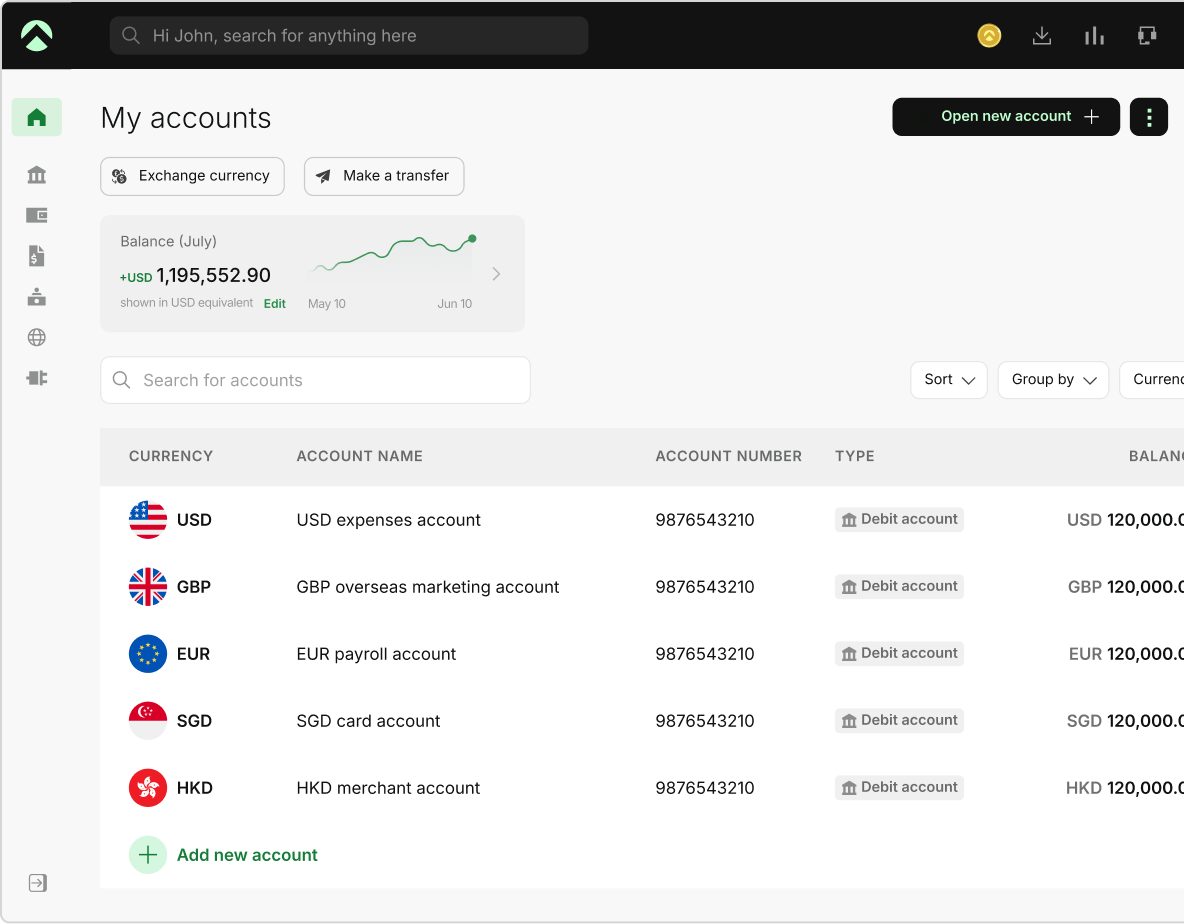
One Aspire account to manage your business finances in one place.
Get a business account¹, issue corporate cards², manage expenses, and automate financial workflows, all from one powerful platform built for modern businesses.
Shopify pays out to any US checking account that can receive ACH transfers, so you're not stuck with a platform default. You do have to clear Shopify's rules: its bank account requirements page excludes savings accounts, flex-currency accounts, and "money-transferring services that mimic bank accounts." Shopify also notes that non-Shopify virtual accounts are supported but fail more often.
Each provider below issues an ACH-eligible bank account, but confirm the account type with the provider before you switch payout details. There's no single best business bank account for Shopify.
Below are eight, scored against the things that actually cost a store money, with the figure and the source for each.
How we compared these accounts
Most business account roundups score on monthly fee, app quality, and support. Those apply to every business equally, but we scored each account on six factors specific to running a Shopify store:
1. Payout speed. How fast Shopify Payments revenue becomes spendable cash
2. Fee floor. Monthly fee, minimums, and the wire and ACH charges that appear once you start moving money
3. Card cashback. The rate, and more importantly the cap and the exclusions
4. Yield. What idle cash earns, whether that sits on checking or somewhere else, and what conditions apply
5. Deposit structure. Which bank holds the money and what coverage is stated
6. Eligibility. Entity types, residency, and industry restrictions, since a store can be rejected after it has already switched
Which business bank account for Shopify fits your store
- Getting Shopify Payments revenue in hand fastest: Shopify Balance
- Paying overseas manufacturers: Aspire¹
- Splitting tax, inventory, and owner pay across accounts: Relay
- Earning on cash held between purchase orders: Bluevine
- Non-US founder with a US-registered store: Mercury
- First account, sole proprietor, no cash handling: Novo
- Best for international/multicurrency Shopify sellers: Airwallex
- Depositing cash from pop-ups, markets, or a storefront: Chase
Best business bank account for Shopify compared
| Platforms | Monthly fee | Domestic wire (out) | Cashback | Deposits held at |
|---|---|---|---|---|
| Shopify balance | $0 | $10 | 2%, capped $2,000/yr | Fifth Third Bank N.A., Member FDIC |
| Aspire¹ | $0 | $0 | 1.5% on eligible card2 spend^ | Column N.A., Member FDIC¹ |
| Relay | $0 / $30 / $90 | $8 / $5 / $5 | 1% to 1.5%, credit card | Thread Bank, Member FDIC |
| Bluevine | $0 / $30 / $95 | $15 / $12 / $7.50 | 4% via Mastercard Easy Savings | Coastal Community Bank, Member FDIC |
| Mercury | $0 / $29.90 / $299 | $0 | 1.5%, IO card | Choice Financial Group and Column N.A. |
| Novo | $0 | Up to $30.00 | 2% above $5,000 balance | Middlesex Federal Savings, Member FDIC |
| Airwallex | $0 / $12 per user / custom | Domestic USD transfers free, wire fee not published | Up to 2% on local USD spend | Evolve Bank & Trust, Member FDIC, for some US customers |
| Chase | $15, waivable | $25 online, $35 in branch | None | JPMorgan Chase Bank, N.A., Member FDIC |
Figures verified Aug 25, 2026. Rates are variable. Please confirm current pricing with each provider before applying.
Best business bank account for Shopify reviews
1. Shopify Balance
Built into the Shopify admin and available only to US merchants already using Shopify Payments. It is the fastest route from sale to spendable cash, and it is not a bank account.
What you get:
- Payouts arrive in Shopify Balance in as little as 1 business day, up to 5 for new merchants.
- Free ACH transfers, typically 1 to 3 business days
- One main account and up to five balance accounts, with sales tax transferred automatically from each payout
- Mobile check deposit up to $50,000, and cash deposits at Walgreens, CVS, and Walmart
- 2% cashback on eligible purchases, plus a separate 1% tier on ad payments made by ACH
Pros:
- Fastest payout timing here. Shopify states Balance delivers store payouts "up to 7 days faster than a bank"
- No monthly fee, no minimum balance, and no ACH transfer fee
- Automatic sales tax segregation, which turns a habit into a default
- Earnings rate accrues daily and is paid on each account individually, not just the main one
Cons:
- The cashback cap is the catch. $2,000 a year across all eligible purchases, and it covers Shopify purchases and named ad platforms rather than general spend. ACH purchases earn nothing under the card program
- $10 per domestic wire, a fee that appears in the help center but not on the Balance marketing page
- The earnings rate is explicitly "a reward provided by Shopify" and "not interest," variable and changeable without notice
- One Balance account can only serve as payout account for the store it is attached to
- Phone and email support are limited to Plus and Retail plans. Everyone else gets chat
Eligibility: US or Puerto Rico residential address, a valid SSN or ITIN, an active Shopify plan, and Shopify Payments set up. Shopify doesn't publish which entity types it accepts. Beneficial owners at 25% or more must supply ID.
Best for: sellers whose main constraint is how fast revenue turns into ad budget.
2. Aspire
Aspire¹ is a financial technology company, not a bank, with banking services provided by Column N.A., Member FDIC. It lists Shopify among its marketplace and ecommerce integrations, and the account is built around cross-border payment costs rather than domestic banking.
What you get:
- $0 platform fee, no minimum balance, no setup fee
- Free local transfers: ACH, domestic wire, check, and real-time all at $0
- International payments in 98+ currencies* across 130+ countries, with FX from 0.22% above the mid-market rate
- Multi-currency accounts* across 13 currencies and 1.5% cashback^ on eligible card spend
- Deposits FDIC-insured up to $100 million¹ through Column N.A. and Column's Sweep Program Network Banks, the highest stated coverage in this comparison
- Integrations with Xero, QuickBooks, Stripe, PayPal, Square, and Shopify
Pros:
- The only account here charging $0 for outgoing domestic wires and $5 for an outgoing SHA international wire, against $15 to $25 elsewhere
- FX from 0.22% above mid-market, which matters more than any monthly fee once supplier volume builds
- Aspire1 publishes no cashback^ cap, against Shopify Balance's $2,000 annual ceiling
- 24/7 English support
Cons:
- Sole proprietorships are excluded. Aspire's terms require "a legal business entity, excluding a sole proprietorship," which rules out a large share of newer Shopify sellers
- The corporate card² is a secured charge card. It requires a funded collateral account and the balance is due in full daily
- Cashback^ excludes spend at non-US merchants, ATM withdrawals, wire transfers, and payments to Walmart and Sam's Club, so it does not apply to a card payment made directly to an overseas supplier
- No cash deposits and no ATM deposits
- Non-USD balances* are held by a separate Hong Kong entity and carry no FDIC coverage
Eligibility: US-registered business entity with a physical US presence. No sole proprietors, no individual consumers. Marketplaces are listed as a restricted activity, so sellers operating across Amazon or eBay as well as Shopify should confirm eligibility before applying.
Best for: incorporated sellers paying manufacturers or contractors outside the US, where FX spread and wire fees outweigh domestic convenience.
3. Relay
Relay is built around splitting money rather than holding it in one place. Twenty checking accounts on the free plan is the product.
What you get:
- 20 checking accounts per business on Starter and Grow, 50 on Scale, plus 2 savings accounts on every tier
- Unlimited users across 7 permission levels
- Free incoming wires, domestic and international, on every tier
- Fee-free cash deposits at Allpoint+ ATMs
- QuickBooks Online, Xero, Gusto, and Plaid on all tiers
Pros:
- Cheapest outgoing domestic wire in this comparison at $8 on the free tier, dropping to $5 on paid plans
- Sub-account structure makes tax and inventory allocation automatic rather than something you remember to do
- No overdraft fees and no minimum balance on any tier
- Local-network international wires from $5, well under SWIFT pricing
Cons:
- The advertised APY applies to savings accounts, not checking, and you get two of them. Money sitting in your operating account earns nothing
- Green Dot cash deposits cost up to $4.95 each, where Allpoint+ deposits are free
- Same-day ACH costs $5 on the free tier
- The $90 Scale price is flagged "discounted for a limited time" against a $120 list price, so it may not hold
- Live chat and phone run weekdays 9am to 8pm ET only
Eligibility: US corporations, LLCs, general partnerships, and sole proprietors, with owners resident in over 200 countries provided the business has a US operating presence. Excludes crypto, firearms, credit repair, privately owned ATMs, money services, gambling, and cannabis.
Best for: sellers who want tax money physically separated from operating money without paying for the privilege.
4. Bluevine
Bluevine pays interest on the checking balance itself, which is unusual among the accounts here.
What you get:
- 1.3% APY on the free Standard tier, 1.75% on Plus, 3.0% on Premier
- Up to 5 sub-accounts on Standard
- 4% cashback on business purchases through Mastercard Easy Savings
- Cash deposits at Green Dot retailers and Allpoint+ ATMs, and 37,000+ fee-free MoneyPass ATMs
- QuickBooks Online sync
Pros:
- The only free tier among these eight here paying interest on the checking balance rather than a separate savings account
- Deposits FDIC-insured up to $3,000,000 through Coastal Community Bank and program banks
- No overdraft or NSF fees on any tier
- Paid-tier monthly fees are waivable on balance and card spend, so an established seller may pay nothing for the higher rate
Cons:
- The free tier's 1.3% is conditional. You must spend $500 a month on the debit card or receive $2,500 a month in customer payments. Miss the condition and the rate doesn't apply
- Interest on Standard and Plus is capped at balances up to $250,000. Only Premier pays on all balances
- Outgoing domestic wires cost $15 on the free tier, the most expensive here after Novo
- International wires in foreign currency add 1.5% on top of a $25 fee on Standard
- Foreign-currency international wires cost $25 plus a 1.5% conversion fee on the free tier
Eligibility: US-based sole proprietorships, corporations, partnerships, and nonprofit corporations. Non-US residents with US-registered businesses may qualify from supported countries. An EIN is required. Excludes gambling, firearms, controlled substances including hemp and cannabis, crypto exchanges, and political campaigns.
Best for: domestic sellers holding inventory cash between purchase orders who can clear the monthly activity condition.
5. Mercury
Mercury accepts founders who do not live in the US, which rules Mercury in for founders who incorporated in the US but live elsewhere.
What you get:
- Free ACH and free domestic wires, incoming and outgoing
- Free outgoing international wires on the SHA route, or $15 flat for OUR
- 1.5% unlimited cashback on the IO card, issued by Patriot Bank N.A.
- Deposits spread across a sweep network for up to $5,000,000 in FDIC coverage
- QuickBooks Online, NetSuite, and Xero integrations, and compatibility with Stripe, Square, Shopify, and PayPal
Pros:
- Only account here with free outgoing domestic wires and a free international option
- Highest stated FDIC coverage in this comparison at $5 million across up to 20 banks
- Accepts non-US-resident founders with a US-registered company
- Cashback is 1.5% with no published cap
Cons:
- Treasury requires a $250,000 minimum balance across your Mercury accounts, so the headline yield is irrelevant to most stores
- No APY published on checking or savings at all
- No cash deposits, stated plainly: "We don't currently support cash deposits"
- No phone support. Channels are in-app message, email, and web form
- Non-USD international wires carry a 1% conversion fee
- SHA international wires can arrive short. Mercury's own example: send $1,000 with $50 in intermediary charges and the recipient gets $950
Eligibility: US-registered companies, including those founded by people living outside the US. No money services businesses and no trusts. Excludes adult entertainment, cannabis, and internet gambling. A registered agent address or PO box will not do.
Best for: sellers incorporated in the US but operating from elsewhere, and anyone sending frequent domestic wires.
6. Novo
Free with no conditions, and built for stores that never touch cash. One thing to check first.
Did you know: Novo's business checking page still names Shopify among its integrations. Novo's own help center says the opposite: "The Novo Shopify Integration is indefinitely suspended. Novo is currently unavailable in the Shopify App Store." A separate Novo help article states that new Shopify connections aren't being offered. Both are live as of Aug 25, 2026. If a Shopify integration is why you are choosing Novo, confirm current status with Novo before you apply.
What you get:
- No monthly fee, no minimums, no transaction limits
- Up to 20 Reserves, sub-buckets inside the checking account
- Free mobile check deposit and free mailed paper checks, up to 10 a day
- Up to $7 a month in third-party ATM fees reimbursed, worldwide
- 2% cashback on the Novo credit card above a $5,000 balance, 1% below
Pros:
- Genuinely free with nothing to maintain
- No foreign transaction fee on the credit card, and no Novo fee on debit card purchases or ATM withdrawals abroad
- Accepts sole proprietors, freelancers, and unregistered businesses, which most accounts here do not
- Reserves give you sub-account structure at no cost
Cons:
- No interest on any balance. Novo publishes no APY on any product
- No cash deposits at all. Novo's published workaround is buying a money order and depositing it by app
- FDIC coverage is $250,000 through a single partner bank, with no sweep network, against $3 million at Relay and Bluevine and $5 million at Mercury
- Outgoing domestic wires cost up to $30.00, against $0 at Aspire and Mercury
- Express ACH costs 1.5% of the transfer, minimum $0.50 and maximum $20
- Phone support requires at least $5,000 in incoming credits in 3 of the trailing 6 months
Eligibility: US-resident owners only, with an SSN, US address, and US cell number. Sole props, LLCs, corporations, partnerships, and existing 501(c)(3) nonprofits. No trusts. Excludes crowdfunding, crypto, cannabis, firearms, gas stations, MSBs, and lending.
Best for: sole proprietors and first-time store owners who want a free account and never handle cash.
7. Airwallex
Airwallex is a financial technology company, not a bank. Airwallex US, LLC is licensed as a money transmitter (NMLS #1928093) and partners with Evolve Bank & Trust, Member FDIC, to provide payment services for some US customers. The account is built for collecting and holding foreign currency.
What you get:
- Explore at $0 per user a month, Grow at $12 per user a month plus a platform fee based on team size, Accelerate at custom pricing
- Global Accounts to collect and hold in 20+ currencies
- Free domestic transfers in USD and CAD, and local transfers to 120+ countries
- FX at 0.5% above interbank for major currencies, 1.0% for all others
- Up to 2% cash rebates on local USD spend, on unlimited multi-currency corporate cards
- Yield on USD balances at 3.21% on Explore, 3.36% on Grow, 3.48% on Accelerate
- Bank feed sync with Xero and QuickBooks on every plan, NetSuite on Grow and above
Pros:
- Holds 20+ currencies natively, so a supplier invoice in EUR or CNY doesn't force a conversion at payout
- The free plan covers up to 10 Spend users before per-user pricing starts
- Payment acceptance is built in at 2.8% + $0.30 on domestic cards, so it can sit on both sides of the transaction
- Local rails to 120+ countries avoid SWIFT on routine supplier runs
Cons:
- Not a payout destination you can rely on. Shopify requires a USD checking or current account located in the US, and warns that non-Shopify virtual accounts see more payout failures
- High FX rates at 0.5%
- SWIFT transfers cost $15 to $25 per transfer on SHA and OUR
- Yield sits in money market funds. Airwallex states plainly that it isn't a bank account and isn't FDIC insured
- Grow's platform fee isn't published, so the real monthly cost isn't knowable before you talk to sales
Eligibility: US-registered business entity. Airwallex is licensed as a money transmitter state by state, so confirm coverage for your state before applying.
Best for: sellers collecting revenue in several currencies who want to hold it, running alongside a US checking account that takes the Shopify payout.
8. Chase
The only traditional bank on this list of the best business bank account for Shopify options, and it's here for one reason: it takes cash across a counter. Every other account in this comparison is online-only.
What you get:
- Business Complete Checking at $15 a month, with no minimum deposit to open
- $5,000 of in-branch cash deposits at no additional charge every statement period, then $3.00 per $1,000
- Up to 20 checks and banker deposits and withdrawals per period, then $0.50 each, plus unlimited electronic and debit card transactions
- No additional charge on cash deposits made at a Chase ATM
- Outgoing domestic wires at $25 online and $35 in branch, incoming wires at $15 or $0 if the sender used Chase
- Card acceptance through Chase QuickAccept at 2.6% + $0.10 tapped, dipped, or swiped, and 3.5% + $0.10 keyed or by payment link
Pros:
- Branch access, which is the entire argument for opening it
- Five ways to waive the monthly fee, including a $2,000 minimum daily ending balance, $2,000 in Chase QuickAccept or Chase Payment Solutions deposits, or $2,000 in eligible Chase for Business card purchases
- Chase is a bank, so deposits are insured directly by JPMorgan Chase Bank, N.A., Member FDIC, without a partner in between
- Card acceptance and banking sit in one account, useful if you sell in person as well as on Shopify
Cons:
- $15 a month against $0 at seven other accounts here, if you miss the waiver
- The account does not earn interest, where Bluevine pays on the checking balance and Relay pays on savings
- $25 for an outgoing domestic wire online and $35 in branch
- 20 banker transactions a period is tight for a store depositing regularly, and overages run $0.50 each
- FDIC coverage is the standard $250,000, with no sweep network
- Cash past $5,000 a period costs $3.00 per $1,000 on night drop and verified deposits
- Same-day ACH and real-time payments cost 1% of the transfer or $25, whichever is less
Eligibility: US businesses. You can open online if your business is a sole proprietorship, corporation, or an LLC managed by a single member or manager. Other structures apply at a branch.
Best for: sellers taking cash at pop-ups, markets, or a storefront, run alongside one of the accounts above for the online side.
What to check before you open a business bank account for Shopify
Every account here has a $0 tier. They separate on what happens once money moves.
- Confirm you're eligible before you apply, because entity and residency rules vary more than pricing does. Aspire excludes sole proprietorships, Novo requires US-resident owners, and Mercury accepts non-residents
- Price your wires and supplier payments against real volume. Domestic wires run from $0 at Aspire and Mercury to $15 at Bluevine
- Read the cashback cap, not the cashback rate. The cap decides the outcome at any meaningful spend level
- Check whether the APY sits on checking or savings. Relay's rate applies to savings, Bluevine's to the checking balance
- Identify which bank holds your deposits and what coverage is stated, from $250,000 at a single institution to $5 million across a sweep network
- Match the accounting integration to the stack you run. Aspire, Relay, and Mercury publish QuickBooks Online and Xero, Bluevine publishes QuickBooks Online
- Check the acceptable use policy if you sell beyond Shopify
- Ask whether multi-currency means a local account or conversion at payout
- Check transaction, deposit, and cash limits. Shopify Balance caps mobile check deposits at $50,000, and Novo reimburses ATM fees worldwide while taking no cash deposits
- Keep payment acceptance separate from where money lands. Shopify Payments processes the sale, and every account here is only the payout destination
How to open the best business bank account for your Shopify store
1. Gather documents first. EIN confirmation letter, formation documents, personal ID for every owner at 25% or more, and your business address, website, and expected monthly volume
2. Apply and verify. Give accurate information about your expected transaction volume and business activity. Large discrepancies can trigger additional verification.
3. Fund the account. ACH from an existing account typically takes 1 to 3 business days
4. Link it in Shopify and test. Add it under payout settings, send one small payout, and keep the previous account open until the first full payout clears
Shopify notes that changing your payout account "might cause delays in your Shopify Payments payouts," and switching from Balance to a third-party account can pause payouts for a security review.
Picking the best business bank account for Shopify
Everything after the monthly fee is where the best business bank account for Shopify is actually decided.
Three questions get you most of the way. Does your money move across borders or only domestically? Is your largest card expense ads or inventory? And are you incorporated, or still operating as a sole proprietor?
Some established sellers may benefit from using two accounts: one optimized for Shopify payouts and another for supplier payments, reserves, or international transfers. If your suppliers invoice you in another currency, Aspire¹ is the stronger candidate for that second account: $0 platform fee, $0 domestic wires, FX from 0.22%* above mid-market, with a direct integration to your Shopify account.
Frequently Asked Questions
There is no single answer. Shopify Balance wins on payout speed, Aspire on cross-border costs, Relay on sub-accounts, Bluevine on checking interest, Mercury on wires and coverage, Novo on being free for sole proprietors. Rank the six factors above against your own store.
No. Shopify states plainly that "Shopify Balance is not a bank account." Shopify partners with Stripe Payments Company for money transmission, deposits are held at Fifth Third Bank N.A., Member FDIC, and the card is issued by Celtic Bank.
Any USD checking account in the US that is eligible for ACH transfers. Shopify explicitly excludes savings accounts, flex-currency accounts, and services that mimic bank accounts, and notes that non-Shopify virtual accounts may see more payout failures.
Into Shopify Balance, as little as 1 business day from the processing date, and up to 5 business days for new merchants. Shopify says balance payouts can arrive up to seven days faster than a bank. To a third-party bank account, usually 3 to 7 days depending on the regional delay period.
Not always. Novo, Relay, and Bluevine accept sole proprietors. Aspire's terms exclude sole proprietorships and require a registered entity.
Mercury states up to $5,000,000 across a sweep network of up to 20 banks. Relay and Bluevine each state up to $3,000,000. Novo states $250,000 through a single partner bank.
Shopify Balance accepts cash at Walgreens, CVS, and Walmart. Relay and Bluevine accept it at Green Dot and Allpoint+ locations, with fees. Aspire, Mercury, and Novo accept no cash deposits at all.
Sources
- https://www.shopify.com/balance (https://www.shopify.com/balance) Aug 24, 2026
- https://help.shopify.com/en/manual/finance/shopify-balance/managing-account/transfers (https://help.shopify.com/en/manual/finance/shopify-balance/managing-account/transfers) Aug 25, 2026
- https://help.shopify.com/en/manual/finance/shopify-balance/rewards/cashback-rewards (https://help.shopify.com/en/manual/finance/shopify-balance/rewards/cashback-rewards) Aug 25, 2026
- https://help.shopify.com/en/manual/finance/shopify-balance/eligibility (https://help.shopify.com/en/manual/finance/shopify-balance/eligibility) Aug 25, 2026
- https://help.shopify.com/en/manual/payments/shopify-payments/onboarding/bank-account-requirements (https://help.shopify.com/en/manual/payments/shopify-payments/onboarding/bank-account-requirements) Aug 25, 2026
- https://help.shopify.com/en/manual/finance/shopify-balance/payouts/payout-accounts (https://help.shopify.com/en/manual/finance/shopify-balance/payouts/payout-accounts) Aug 25, 2026
- https://relayfi.com/pricing (https://relayfi.com/pricing) May 1, 2026
- https://relayfi.com/faqs (https://relayfi.com/faqs) Aug 25, 2026
- https://www.bluevine.com/business-checking/plans-and-pricing (https://www.bluevine.com/business-checking/plans-and-pricing) Aug 25, 2026
- https://www.bluevine.com/business-checking/interest-rate (https://www.bluevine.com/business-checking/interest-rate) Aug 25, 2026
- https://www.bluevine.com/business-checking/fdic-protection (https://www.bluevine.com/business-checking/fdic-protection) Aug 25, 2026
- https://www.bluevine.com/faq (https://www.bluevine.com/faq) Aug 25, 2026
- https://mercury.com/pricing (https://mercury.com/pricing) Aug 25, 2026
- https://mercury.com/io (https://mercury.com/io) Aug 25, 2026
- https://mercury.com/treasury (https://mercury.com/treasury) Aug 21, 2026
- https://mercury.com/faq (https://mercury.com/faq) Aug 25, 2026
- https://www.novo.co/business-checking (https://www.novo.co/business-checking) Aug 25, 2026
- https://www.novo.co/business-banking (https://www.novo.co/business-banking) Aug 25, 2026
- https://www.novo.co/help/how-do-i-connect-or-disconnect-shopify (https://www.novo.co/help/how-do-i-connect-or-disconnect-shopify) Aug 25, 2026
- https://www.novo.co/help/does-novo-charge-transaction-fees (https://www.novo.co/help/does-novo-charge-transaction-fees) Aug 25, 2026
- https://www.irs.gov/businesses/small-businesses-self-employed/get-an-employer-identification-number (https://www.irs.gov/businesses/small-businesses-self-employed/get-an-employer-identification-number) Aug 25, 2026
- https://www.airwallex.com/en-us/pricing (https://www.airwallex.com/en-us/pricing), Aug 29, 2026
- https://www.chase.com/business/banking/checking/business-complete-banking (https://www.chase.com/business/banking/checking/business-complete-banking), Nov 16, 2025 https://www.chase.com/business/disclosures (https://www.chase.com/business/disclosures), Aug 29, 2026
- https://www.chase.com/business/banking/checking (https://www.chase.com/business/banking/checking), Aug 29, 2026
This blog is for general information only and does not constitute financial, legal, tax, or professional advice. Aspire’s services are subject to the terms outlined in our ’Terms of Service’ and ’Pricing’ pages. We make no guarantees as to the accuracy, completeness, or timeliness of the content, and past results do not indicate future performance. Always consult a qualified professional before acting on any information provided.
Bintang Lestada
Writer
Bintang is a seasoned writer specialising in fintech, agtech, politics, and pop culture. With a writing history at VICE ASIA, Letterboxd, Whiteboard Journal and other reputable organisations, Bintang leverages their broad range of experiences to resources that educate audiences, build trust, and support business growth.
Aspire Launchpad
Supercharge your finance operations with Aspire
Find out how Aspire can help you speed up your end-to-end finance processes from payments to expense management.

Latest articles

QuickBooks vs Xero: Key differences, costs and which is better
QuickBooks vs Xero compared on features, pricing, users, reporting, and ease of use. See which accounting software is a better fit for your business.

How general liability vs professional liability insurance works in the US
Small business guide to general liability insurance. Learn about costs and coverage, if you need it, and how to choose the right policy.

Best multi-currency business accounts in the US for 2026
Compare the best multi-currency business accounts in the US for 2026. Explore fees, FX costs, currencies, holding, receiving options, and key features.