


Delaware Flip: Definition, methods, and working process

Bintang Lestada

Summary
A Delaware Flip is the legal restructuring process of making your foreign company a wholly owned subsidiary of a US parent entity. It is typically a requirement when you are raising funds from US investors.
Startups do a Delaware Flip because US investors require it before funding them. Also, it gives the company a US parent entity, making it more accessible and familiar to institutional investors or VCs.
The flip isn’t always necessary for companies selling to US customers without any local operations, or those who are still in pre-traction stages, where the tax and legal complexity isn’t yet justified.
The process of a Delaware Flip generally involves restructuring the foreign company, making it a wholly owned subsidiary of the new Delaware entity.
Startup founders can register several entity types in Delaware, with a C-Corporation being the most common choice if you are planning an IPO or seeking VC funding.
The common Delaware flip structures include a stock-for-stock exchange, a cross-border merger, an asset purchase, and a partial stock acquisition. Each of them has different implications for taxation and ownership.
One Aspire account to manage your business finances in one place.
Get a business account¹, issue corporate cards², manage expenses, and automate financial workflows, all from one powerful platform built for modern businesses.
Non-US founders raising funds from US investors, angels, or VCs generally need a Delaware Flip. However, some angels or smaller syndicates, especially at the earliest stages, may also be comfortable investing directly in the local foreign company.
In simple terms, a Delaware Flip is the legal restructuring process that moves the ownership of your assets, equity, and intellectual property into a US entity.
A Delaware Flip transaction changes your corporate structure and creates a holding company in Delaware owning your existing company. This creates a group structure with the Delaware parent company.
The US investors usually require it as they want to invest in entities owning valuable parts of the business under US law. If you are new to the concept, here’s everything about it for you to streamline the restructuring process.
What is a Delaware Flip
A Delaware Flip is a legal reorganization where your foreign business becomes a wholly owned subsidiary of a newly formed US parent company. Structurally, this restructuring will look like this:
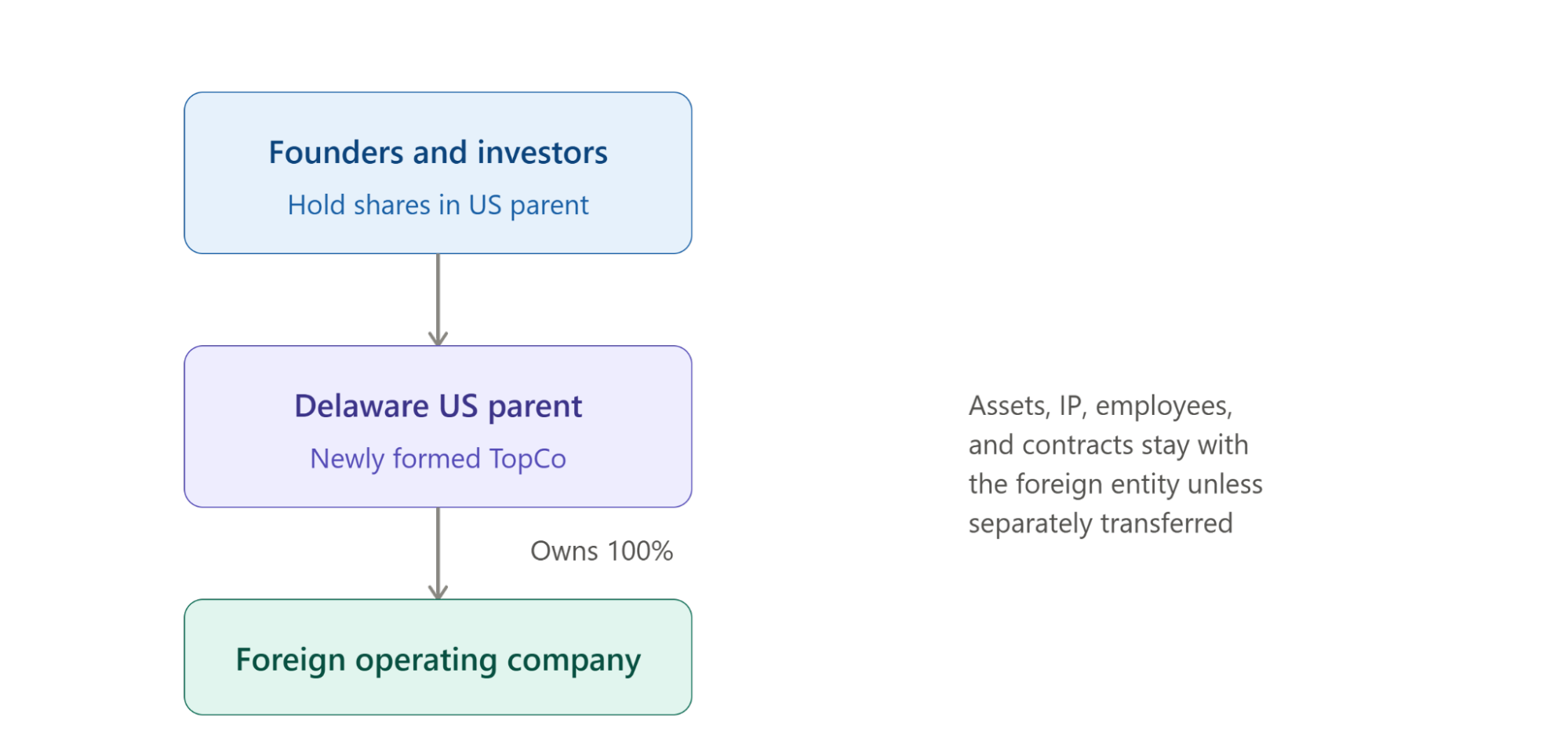
Typically, your shareholders exchange their equity for shares in the new US company, but there are also other ways to execute a Delaware Flip. Due to this, the US company then owns 100% of your foreign operating entity, and original founders and investors then hold shares in the US parent.
Importantly, a Delaware Flip doesn’t automatically move all your assets, employees, contracts, operations, and IP to the US. They generally stay with the foreign entity unless a separate transfer is carried out.
In other words, a Delaware Flip isn’t about relocating your business to the US. Instead, your foreign company can continue to operate as a subsidiary of the US parent. This setup makes your company more accessible and attractive to US investors, as it aligns with their investment structure.
This forms a Delaware corporation that meets seed, Series A, or institutional investor expectations.
Why should you consider a Delaware Flip
Beyond seeking US investors, you may choose to flip for several other reasons such as:
- Complying with a US investor’s preference or requirement for investing through a Delaware entity
- Meeting the requirements of a US accelerator, such as Y Combinator
- Expanding into the US market and hiring local employees to be part of your workforce strategy
- Setting up a US-compliant equity structure for employee equity grants and stock options
- Streamlining the legal structure of your company for a US-based exit or M&A strategy
- Streamlining the legal structure of your company for IPO plans or future acquisitions
- Establishing an IP ownership structure that complies with US law
- Aiding your long-term plans for running US-centric operations
When you may not need a Delaware Flip?
A Delaware Flip is not always necessary for non-US founders to conduct operations in the US. For instance:
| Situation | Likely structure |
|---|---|
| US customers only; no local operations | Keep the foreign entity, and no US entity required. |
| US hiring or sales presence required | Foreign entity remains as the parent, and a US subsidiary is formed for hiring or holding the US assets. |
| US investors requiring a Delaware C-Corporation | Form a Delaware corporation from the outset and treat your foreign business as its subsidiary. This will help you avoid a full share exchange. |
| Very early-stage startup, mostly in pre-traction or pre-product stage | Form a Delaware corporation from the outset and treat your foreign business as its subsidiary. This will help you avoid a full share exchange. |
| Primarily non-US fundraising or operations | Keep your foreign entity as the parent company rather than flipping. |
What type of entities can be registered in Delaware
1. Corporation or C-Corp:
A Delaware C-Corp is the most common entity for a Delaware Flip. Founders typically flip into it through a stock-for-stock exchange, asset purchase, or cross-border merger. This structure gives you access to multiple stock classes and the Court of Chancery, making it the preferred choice for companies seeking an IPO or VC funding.
2. LLC
Members of the LLC trade their membership interests for stock in a newly formed Delaware C-Corp via an exchange agreement. Apart from that, LLCs can also execute a statutory conversion directly into the Delaware entity, if permitted by local and state laws. With fewer corporate formalities, this route is generally simpler. However, LLCs are often converted early since VCs typically prefer investing in a C-Corp structure.
3. General Partnership or GP
In this case, partners contribute their partnership interests to a newly formed Delaware corporation in exchange for shares. This effectively converts the GP into a corporate structure. As a GP offers no liability protection, this flip is often paired with legal steps to formally dissolve the partnership and transfer contracts and assets to the new entity.
4. Public Benefit Corporation or PBC
If you run a foreign mission-driven company, you can flip into a Delaware PBC through a stock-for-stock exchange or a merger, similar to a standard C-Corporation flip. You can also adopt a specific public benefit purpose in the charter. This will let your company preserve all the social or environmental mission under Delaware’s legal framework, while making you eligible to access VC funding.
5. LLP and LP
A contribution agreement is proposed in this route, enabling partners to exchange their partnership interests for shares in the newly formed Delaware entity. Since LPs and LLPs cannot directly convert into a corporation in most cases, a contribution agreement stands effective. This flip is less common and is mostly preferred only if your business is transitioning from a professional services or multi-owner partnership model towards an outside equity investment.
In what ways can a company make a flip
There are multiple ways you can structure a flip, and the most common approaches include:
Stock-for-stock exchange
In this, the Delaware company owns all shares of your non-US company. As founder of the company, you exchange your foreign shares for Delaware shares, making the transaction simple.
- Impact: Your foreign company becomes a 100% owned subsidiary. Founders and investors hold shares in the Delaware parent, instead of the original entity.
- When is it preferred: It is preferred when you want a clean and straightforward flip with full ownership transfer and minimal complexities.
Asset purchase
Delaware company purchases your business assets and intellectual properties. The payment may be in cash or as Delaware company stock.
- Impact: Only the selected IP and assets move to the Delaware entity rather than the whole company. This may trigger separate tax treatment on the sale.
- When to prefer: If you want to transfer selective assets or IP without carrying over all liabilities of the foreign entity.
Cross-border merger
In this approach, your non-US foreign company and Delaware firm merge, and the latter survives the merger.
- Impact: Foreign entity legally ceases to exist, and Delaware company absorbs all its assets, operations, and liabilities.
- When to prefer: If you want full consolidation of your foreign company into a single US entity, and are prepared to navigate through the added cross-border regulatory and legal compliance.
Partial stock acquisition
The Delaware company buys some of your stock, while you or your existing investors get to keep some of the shares.
- Impact: The ownership is split between the Delaware parent and existing shareholders, rather than being fully consolidated.
- When to prefer: If founders or investors intend to retain a direct stake in the foreign entity while still gaining a US structure for a considerable portion of ownership.
These are not the only methods to execute a Delaware Flip, but are the most common and simplest methods among all others.
Advantages and disadvantages of Delaware Flip
Before you decide whether to move forward with a Delaware Flip, it’s worth weighing the advantages and disadvantages carefully. This is because a Delaware Flip may bring real benefits for accessing US capital, but it also comes with added tax exposure, costs and compliance obligations. The disadvantages can quickly outweigh the benefits, depending on your stage and business goals:
| Advantages | Disadvantages |
|---|---|
| Makes your company more attractive and accessible to US investors, as it aligns your foreign entity with the structure they expect. | May trigger local capital gains tax, stamp duty charges in the home country, and exit tax, depending on the structure. |
| You can qualify for the tax-deferred treatment under the US federal tax rules if structured properly. | May cause you to omit the home-country tax incentives, such as R&D credits or startup exemptions that are mostly tied to the domestic entity. |
| It simplifies the legal structure ahead of a US-based IPO, M&A, or exit. | Adds up ongoing costs and compliance hurdles, including Delaware franchise tax, intercompany transfer pricing requirements, and others. |
| Enables a US-compliant equity structure for employee grants or stock options. | Requires assistance of legal and tax advisors across both jurisdictions, which adds up to more time and cost to the overall process. |
| It supports long-term plans that you have for US-centric hiring and operations. | It is not always necessary, especially for early-stage companies without significant US operations. |
What are the key considerations for making a Delaware Flip
Here are some of the priority considerations that need your attention before you move ahead with a Delaware Flip:
Taxation
It is paramount to understand the tax implications in both the US and the home country before executing the flip. Depending on the structure you choose, this can trigger costs like capital gains tax on exchanged shares, exit taxes from the home country, and tax questions around moving IP to a Delaware entity.
Check whether your home country offers tax incentives, such as R&D credits or startup exemptions. This is because these benefits are tied to a domestic entity and may be lost if you don’t handle the Delaware flip carefully. The rules vary a lot depending on the country and preferred structure. So, it is best to work with tax or legal advisors who can guide you throughout the approach.
Corporate structure
Before going forward with the flip, you must review share capital, subsidies, contracts, debts, and other existing financial commitments. This assessment identifies the potential pitfalls for an exchange and allows proper planning to avoid them.
For instance, some contracts may have clauses that require third-party consent for structural changes, requiring careful handling before the flip transition.
Costs
Take into consideration the Delaware flip costs, which can vary depending on the method you choose for the transition. There will be legal and tax costs involved in the process, but that won’t be all.
You also need to budget for the operational expenses of maintaining the business structures in both jurisdictions during the transition.
How does the Delaware Flip work
Delaware Flip may be a complex and lengthy process, and here’s a step-by-step representation for a better understanding of how it works:
Convert multiple share classes into one
If your foreign entity has multiple share classes, it will make the overall exchange process complicated. Converting those shares into one standard share class beforehand is often recommended, as it tends to make the flip easier in the further steps.
Updating the shareholders’ agreement
It’s crucial to seek legal advice when updating your share classes, as the transaction may require amendments to shareholder arrangements, option arrangements, corporate approvals, and other documents. All of it needs to be handled and documented lawfully.
Appointing a US legal team
By this step, you’ve prepared your foreign company and its share classes for the Delaware Flip.
You must then appoint a US legal team to carry out the steps involved in establishing the new holding company in Delaware. They will initiate the incorporation process, involving drafting and signing the company formation documents.
Alongside the US legal team, most flips also require a Delaware-registered agent for handling statutory filings, a home-country tax or legal advisor, and a US tax advisor to manage tax implications of the new structure. They ensure the flip complies with all the local laws and doesn’t violate any existing regulatory or tax obligations.
Execute the share exchange
Now, the US holding corporation has its equity ready for the share exchange. You must then transfer the shares of your foreign company to the new US holding corporation. In return, you receive shares of the US parent, resulting in your company being a wholly owned subsidiary of the US parent corporation.
Coordinate the international tax clauses
A Delaware Flip transaction can often be structured to be tax-neutral or tax-free for US federal income tax purposes. However, this isn’t automatic because the tax treatment depends on your transaction structure, shareholder circumstances, applicable rules, and entities involved.
Therefore, proper planning is essential as rules vary widely depending on the home country. For instance, the UK does not tax the exchange, but Ireland imposes stamp duty on such share transfers, even in flips.
| Tax area | Foreign or local tax considerations | US or Delaware tax considerations |
|---|---|---|
| Capital gains | May apply on transfer or exchange of shares, depending on the local law. | Often qualifies for tax-deferred treatment under the IRC rules if structured correctly. |
| Existing shareholders | May face local tax on the gains from exchanging shares. | Generally receive Delaware parent company shares without immediate taxes if the exchange qualifies as tax-free. |
| IP treatment | Local exit or transfer taxes may apply if IP is moved to the US entity. | Requires IP valuation and may trigger US tax on transfers, depending on your structure. |
| Employee equity | It may affect local payroll tax, vesting, or equity plan compliance. | US equity plans may need adjustments or to be set up for the new parent corporation. |
| Stamp duty | Applicable in some countries. | Not applicable federally. However, Delaware franchise tax may be applicable. |
| Rollover or deferral | Available in some countries for qualifying deals | Common under tax-free reorganization rules. For instance, Section 351 |
| Intercompany transactions | Local transfer pricing may apply | Must follow the US transfer pricing rules, as per IRC 482 |
As the country-wise rules vary, you must involve both the US as well as your foreign counsel or tax advisors in the Delaware Flip process.
Finalizing the exchange agreement
This becomes the legal contract, outlining how your foreign stakeholders exchange their shares for shares in the Delaware company. It will have details such as the exchange ratio, associated transfer mechanisms, shareholder approvals, and how existing options, SAFEs, or convertible notes will be treated in the new structure.
Following that, the agreement also includes any potential founder vesting terms that need to carry over. It has all the representations and warranties from both parties, along with closing conditions for finalizing the exchange.
It is crucial to ensure that the exchange agreement and the way it’s carried out are compliant with the regulations of foreign countries. This involves notifying the relevant bodies in the country and updating the share register.
Establish your intercompany agreements or operational structure
Once the flip is secured, the US and foreign companies must work together to set a streamlined working process. For this, you must:
- Decide on the IP ownership, which the US parent often owns. However, this still depends on the business needs and tax planning.
- Structure your cash flow between the entities via intercompany loans, capital contributions, stock purchases, or service agreements, keeping the transfer pricing rules in mind. This way, the intercompany dealings can be priced at arm’s length.
- Set up intercompany services agreements for formalizing the support clauses for each entity, such as shared admin, management functions, or engineering.
- Clarify the payroll and employment arrangements, including which of the entities will be responsible for employing staff in each country, and how to maintain local payroll compliance.
- Determine which of the two entities contracts with customers, since this directly affects the revenue. Also, determine which entity bears the related liabilities.
- Decide where the expenses and revenue sit across the group, as this shapes the tax position and financial reporting of each entity.
What to do after the Delaware Flip
Once your Delaware Flip is completed successfully, here are the next steps you must adopt for wrapping up the entire process:
- Obtain an EIN, where applicable, to identify your new US entity for banking and tax purposes.
- Open a US business bank account for the Delaware entity to start operating in the country.
- Appoint or maintain a registered Delaware agent to handle all legal notices and statutory filings.
- Set up tax compliance and accounting processes for your new US entity, including any state or federal filings.
- Establish your intercompany agreements for formalizing how the foreign and US entities can work together, both operationally as well as financially.
- Update your equity administration to reflect the new share structure, and ensure all the stakeholders are properly recorded.
- Review the US state registrations in any state where your business has operations, employees, or physical presence.
Streamline US banking for your Delaware entity with Aspire
Opening a compliant US business account is often more complex than founders expect, especially if they don’t have an SSN or US credit history. Aspire1 is built to help you overcome these hurdles.
Founders can open a US business account1 remotely, using passport verification, and without an SSN. The business account1 works for you, starting from day one of your entity’s life, and pairs with a corporate card2 that requires no personal credit check or minimum balance.
For all global founders juggling cross-border operations, Aspire offers multi-currency accounts* to help you manage funds in USD alongside other currencies without the need for managing multiple banking relationships.
To learn more, explore Aspire1 today.
Frequently Asked Questions
Not always. If your company is still in the early stage, it’s often more cost-effective to simply form a US company that holds or acquires stock in the foreign company. A full Delaware Flip makes more sense when there’s existing value, intellectual property, and investors’ interest.
If your company has existing debts on the books, has issued multiple stock classes, or has custom shareholder rights that need mirroring in the US structure, the overall Delaware Flip process can be complicated.
If your entire team is international and based out of the home country, the US parent company issues equity incentives. You may have to create a foreign sub-plan under the US equity plan to comply with local tax and employment laws while continuing to offer equity in the US company.
In practice, these flips usually go one way, i.e., foreign company to US parent. The US companies don’t typically go into a foreign parent structure unless for specific tax or legal reasons, which are uncommon as far as startup fundraising is concerned.
Delaware Flip is best suited to startups looking for early-stage investments, such as preseed funding or Series A. However, there are substantial costs involved in the process, especially the legal expenses, and startups must have a healthy budget to opt for it.
Sources
- What Is a Delaware Flip? Be Ready for US Investors- What Is a Delaware Flip? Be Ready for US Investors. | Caribou (https://www.usecaribou.com/blog/how-to-do-a-delaware-flip) - Jul 2025
- The Delaware Flip: How & Why Startups Reincorporate- The Delaware Flip: How & Why Startups Reincorporate (https://spzlegal.com/blog/the-delaware-flip) - Sep 2026
- What a Delaware flip actually means for non-US founders raising from US investors- What a Delaware flip actually means for non-US founders raising from US investors (https://story.law/knowledge/delaware-flip) - Sep 2026
- What is the Delaware Flip and how does it work for startups? - What is the Delaware Flip and how does it work for startups? (https://wise.com/gb/blog/delaware-flip) - Aug 2025
This blog is for general information only and does not constitute financial, legal, tax, or professional advice. Aspire’s services are subject to the terms outlined in our ’Terms of Service’ and ’Pricing’ pages. We make no guarantees as to the accuracy, completeness, or timeliness of the content, and past results do not indicate future performance. Always consult a qualified professional before acting on any information provided.
Bintang Lestada
Writer
Bintang is a seasoned writer specialising in fintech, agtech, politics, and pop culture. With a writing history at VICE ASIA, Letterboxd, Whiteboard Journal and other reputable organisations, Bintang leverages their broad range of experiences to resources that educate audiences, build trust, and support business growth.
Aspire Launchpad
Supercharge your finance operations with Aspire
Find out how Aspire can help you speed up your end-to-end finance processes from payments to expense management.

Latest articles

QuickBooks vs Xero: Key differences, costs and which is better
QuickBooks vs Xero compared on features, pricing, users, reporting, and ease of use. See which accounting software is a better fit for your business.

How general liability vs professional liability insurance works in the US
Small business guide to general liability insurance. Learn about costs and coverage, if you need it, and how to choose the right policy.

Best multi-currency business accounts in the US for 2026
Compare the best multi-currency business accounts in the US for 2026. Explore fees, FX costs, currencies, holding, receiving options, and key features.