


How many business bank accounts do you need?

Bintang Lestada

Summary
There is no legally prescribed or universally ideal number of business bank accounts. However, you may need a five-account structure for your business finances, covering operational, tax savings, business savings, payroll, and owner’s pay aspects. This offers clear separation of different financial obligations, supporting your growing business.
New founders can start with just one dedicated business account, kept separate from their personal account. This establishes a legal and financial separation required for liability protection of your business.
Add a new business bank account only when a genuine or recurring expense category and obligation emerges, not just for the sake of having multiple accounts.
Multiple accounts make bookkeeping easier, not harder. This is because the transactions are all pre-sorted based on purpose, giving your bookkeepers a cleaner source of documents to reconcile.
One Aspire account to manage your business finances in one place.
Get a business account¹, issue corporate cards², manage expenses, and automate financial workflows, all from one powerful platform built for modern businesses.
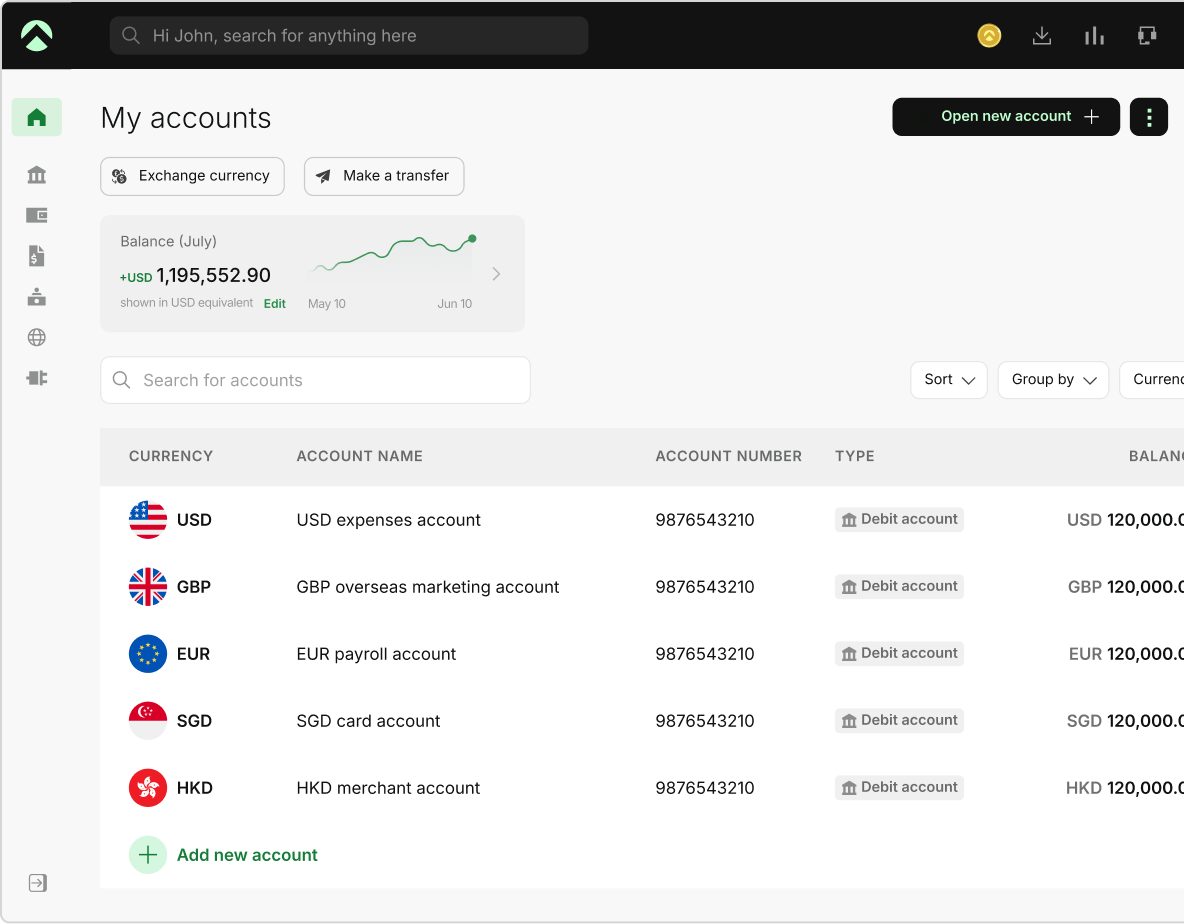
There is no fixed number of business bank accounts every business may need. Most small businesses can operate with just a single dedicated business account, while the growing organizations may need separate accounts for payroll, taxes, reserves and other purposes. Add another account when a potential separation seems to solve a specific cash-management, control or risk problem.
That said, running everything from a single business bank account has its limits. Whether it’s inventory purchases, bill payments, owner’s cut, or tax payments, when everything goes in and out of a single account, you can’t tell what money is safe for you to spend. Spreadsheets alone won’t fix that.
Robust financial management is essential for any business founder, and choosing the right number of business bank accounts plays a crucial role in the process. A single business account may be sufficient for some, but there are scenarios where opening more than one account can benefit your business finances.
For instance, you may need additional bank accounts for tax savings, budgeting, payroll management, or handling operational expenses. Keeping those aspects in mind, this article helps you figure out how many business bank accounts you need and what factors you must consider.
5 types of business bank accounts you need to streamline your finances
Depending on your cash flow, team size, tax obligations, and operating complexity, you may choose to separate some of the following purposes into different types of business accounts.
1. Operational account
With an operational account, you gain visibility into your incoming revenue and outgoing business expenses. This account allows founders or accounting professionals to track and manage rent, mortgage, contractor costs, subscription expenses, and other such recurring payments.
This business bank account helps you set aside money for these unavoidable purposes, improving your visibility into what’s allocated and reducing the risk of being caught by surprise when costs come due. It separates ownership from business transactions, making it easier to track.
2. Tax-saving account
A wise business strategy is to plan for tax time in advance. Talk to your tax advisor and decide on a set percentage of every deposit, and save it in this account. This way, you minimize the overall impact on your operations during the tax season, as you are already prepared.
Some founders may combine this with a separate reserve account for other committed funds, like insurance premiums or loan repayments, rather than mixing it with tax provisions or profit distributions. However, it is important to track this split internally to avoid confusion.
3. Business savings account
Keeping a business savings account separate from your operational accounts offers you financial safety. This account acts as a financial cushion when you experience financial hurdles such as revenue shortfalls or sudden expenses.
With high-yield savings accounts, you can benefit from higher interest rates when compared to standard accounts. Thus, you get a higher return on your reserved business funds. Savings of at least 6-9 months of profit may allow your business to pivot during downtimes, and you can buy yourself some time during the leaner seasons.
4. Payroll account
Having a dedicated payroll bank account helps you ensure timely and accurate compensation for your employees. Keeping aside the payroll funds from other finances streamlines one of the most important financial processes, just like taxes. This also improves overall cash flow management.
With a separate business bank account for payroll, you simplify your bookkeeping efforts and reduce the possibility of payroll processing errors. Due to this, you strive to boost employee satisfaction while keeping your payroll organized and easy to reconcile against your obligations under employment laws and regulations.
5. Owner distribution account, where appropriate
This account is specifically for you to separate your pay from the competing vendor or other operational bills. You deposit your designated salary, profit allocations, and distributions to this account, separating it from your daily working capital.
This way, you avoid accidentally spending your own earnings for business overheads. Make a thorough assessment of how much you must pay yourself, based on the market rates, financial goals, company structure, tax obligations, and reinvestment strategies.
Separate your business and personal finances
If you are a very new startup and don’t want to engage in managing 5 business bank accounts right from day one, it’s better to start with a minimum of at least 2 to separate your personal and business expenses.
Mixing your business expenses and personal finances may create confusion and complicate accounting. It becomes difficult to track business expenses accurately, makes tax time miserable, and it can weaken your case in ways that matter the most. For LLCs and corporations, keeping personal and business funds separate can support legal distinction between owners and the entity.
Commingling funds may create accounting problems in the long run, and weaken the separation in potential legal disputes, depending on the entity structure, state law and how consistent you are in maintaining other corporate formalities.
Open a business bank account to keep track of every dollar your business brings in or spends. Some of the other benefits of separating your personal and business finances include:
- Simplifies tracking of your business cash flow and its financial performance over time
- Speeds up accounting and tax preparation
- Supports the separation between business and personal finances that the limited liability protections rely on. This helps keep your personal assets such as deposit accounts or retirement investments safe in any business-related legal dispute.
- Gain more credibility for your business by using a dedicated account that goes by the company’s name and address
- Identifying tax write-offs becomes easier with a separate business bank account
How many bank accounts do you need at each stage of your business
The simple rule is, add a business account whenever a new category of commitment money appears in your operational expenses. As you scale, these categories show up, and you may need different accounts to swiftly handle them all.
Here’s a stage-wise recommendation on how many business bank accounts you may need at different points of conducting operations, though the right number depends on your industry, business model and complexity. So, treat these as your general benchmarks rather than a fixed rule.
| Business stage | Types of bank accounts you must have | Trigger to create one |
|---|---|---|
| Early stage | Operating account Tax-saving account Business savings account | When you experience the first quarterly estimated tax shortfall, or find your personal and business finances colliding. |
| Growing team | Operating account Tax savings account Business savings account Payroll account Owner’s pay or profit account | When you add employees on a payroll processor, or owner’s pay is being skipped or becoming irregular. |
| Complex business | Add reserves per revenue stream or major obligation. | If your balances are nearing the standard FDIC coverage limits at a single bank, or there are multiple people spending the company money. |
Will multiple business bank accounts complicate bookkeeping
No, having multiple business bank accounts often makes bookkeeping easier. Each account is faster to reconcile because transactions are already sorted by purpose. Five accounts do mean five statements instead of one, but each one is shorter and more focused. So, the total reconciliation effort for multiple bank accounts is often lower than sorting through one long statement.
Your tax account receives the allocations and sends the payments instantly, letting your bookkeeper have fewer instances to categorize. Similarly, separate business checking accounts allow your bookkeepers to have more details on the inflow and outflow of cash than the sub-accounts, which group balances under one account number.
Separate business bank accounts provide your bookkeeper with clear source documents to work from, though a well-designed ledger sub-account or ledger structure can at times be simpler to manage, as it implies fewer external statements for reconciliation. The right choice depends on your bookkeeping system.
Beyond that, the right setup for multiple accounts at a bank won’t cause you any pain. You must pick a bank that allows you to open multiple business accounts or sub-accounts without any per-account fees, and supports instant internal fund transfers.
If your bank charges for opening extra accounts or has a daunting process, it is a sign you must make a switch. To streamline the effort of managing multiple accounts, you must automate the fund transfers on two dates of the month, maybe the 10th and 25th that’s commonly preferred, or any other dates that align best with your business revenue cycle. Automation can reduce repetitive transfers, but allocation rules should be reviewed as cash flow and obligations change.
Benefits of having multiple business bank accounts
The United States Small Business Administration recommends that founders open one or more business bank accounts to keep business funds separate from personal funds. This recommendation is based on practical benefits that follow, which include:
Be financially organized
Multiple bank accounts with specific purposes can bring ease to business savings, profits, and cash flow. You may have one account established for paying taxes or payroll, and another for funding upcoming projects. It helps your business finances stay organized and keeps you aware of where your money stands at any point in time.
Reduce concentration and access risk
Security matters just as much for business finances, and you can’t afford to ignore it. Spreading business funds across more than one account helps shield your capital from cyber threats. Let your bank know you require added protection features in all of your accounts, ensuring your funds and business are safer.
Cleaner cash allocation and records
When you seek business financing or loans, your track record becomes the most crucial document any institution or investor asks for. So, maintaining multiple bank accounts shows financial institutions or investors that you manage your business finances responsibly. In fact, many lenders won’t even consider approving loans if you don’t have a proper business checking account in place.
Planning for future
With a business savings account, you can plan ahead for your future projects or investments. This capital, kept in a separate account, protects you against urgent financial demands of your business, such as equipment failure or an unexpected incident.
Should your business use accounts at more than one bank
Using accounts at more than one bank is an entirely separate decision from the number of accounts you may hold, and here are some factors to help you decide:
Operational redundancy
Having a second bank allows you to have a fallback strategy if your primary bank has some outage, restricts access for some reason, or freezes your account pending review. If payment continuity matters for your business, this reason itself is critical for you to have accounts at multiple banks.
FDIC coverage
The standard FDIC insurance covers up to USD $250,000 per depositor, per bank and per ownership category. When you hold accounts at multiple banks, you extend your coverage beyond that limit.
That being said, this isn’t the only path to attaining higher FDIC coverage, as some business accounts, including Aspire’s1 offering, extend FDIC insurance coverage of up to USD $100 million, through a banking partner program, spreading deposits across multiple networks of banks.
If your existing account already offers such an extended coverage, you may not have to open accounts at multiple banks just to protect your larger balances.
Concentration risk
Keeping all the operating capital with a single bank ties your liquidity to the institution’s stability and underlying policies. When you spread your funds across multiple banks, this reduces the dependency. Though for most of the early-stage businesses, this risk is manageable within one bank.
Additional admin
With every extra account at a different bank, you add up separate logins, statements, KYC and compliance checks. This eventually increases your reconciliation work. So, multi-bank account setups make sense only when they solve a specific problem, and aren't a default practice.
For most small or growing businesses, one bank with the right number of purpose-driven accounts is enough. Consider a second bank only when you need redundancy, or when your balances exceed the coverage protection of the existing account.
Build an ideal business bank account structure
No fixed number of business bank accounts works for every founder. The right setup depends entirely on your business stage, level of complexity, and the financial obligations you are currently handling through a single account.
You can initially start with just two accounts to separate your business and personal finances. However, as you scale, having five different accounts brings more clarity on taxes, payroll, and business reserves.
Having multiple business bank accounts is one thing, but designating each of them with a specific purpose is what matters the most. This way, you ensure minimal overlap between the accounts and simplify your financial management.
Platforms like Aspire1, a FinTech platform for growing businesses, makes it easier by letting you open multiple currency accounts* and pair them with built-in budgeting tools. This way, you can organize your funds by category, without the need for juggling multiple logins across separate banks.
Frequently Asked Questions
Yes, you can have multiple business bank accounts. The legal minimum requirement is to have at least one dedicated business account that keeps your business and personal finances separate. However, having just one account won’t distinguish your profit, spendable cash, or tax money. Therefore, having multiple business bank accounts can solve this problem.
No, multiple business bank accounts don't affect credit and help you streamline bookkeeping and tax preparation because your money is pre-categorized in specific accounts.
There is no legal limit on how many business bank accounts you can have. You can open as many accounts as your bank allows. However, consider adding accounts only for crucial obligations, as each one adds a line for your accounting team to reconcile.
Yes, sometimes. A second banking institution adds continuity for your business in case one of the accounts gets frozen or is under review. It can also extend deposit insurance coverage. However, there is a trade-off, you have to handle more logins and extensive reconciliation work.
Sub-accounts balance your groupings under a single account number, whereas separate business checking accounts carry their own numbers and statements. Separate business bank accounts can also send or receive transfers independently.
Sources
This blog is for general information only and does not constitute financial, legal, tax, or professional advice. Aspire’s services are subject to the terms outlined in our ’Terms of Service’ and ’Pricing’ pages. We make no guarantees as to the accuracy, completeness, or timeliness of the content, and past results do not indicate future performance. Always consult a qualified professional before acting on any information provided.
Bintang Lestada
Writer
Bintang is a seasoned writer specialising in fintech, agtech, politics, and pop culture. With a writing history at VICE ASIA, Letterboxd, Whiteboard Journal and other reputable organisations, Bintang leverages their broad range of experiences to resources that educate audiences, build trust, and support business growth.
Aspire Launchpad
Supercharge your finance operations with Aspire
Find out how Aspire can help you speed up your end-to-end finance processes from payments to expense management.

Latest articles

Business Account •
Best business bank account for Shopify: 8 options compared for 2026
Shopify pays out to any ACH-eligible US checking account. Compare eight options on payout speed, wire and FX costs, cashback caps, FDIC coverage, and eligibility.

Expense Management •
Best accounts payable software for small businesses guide
Compare accounts payable tools for small businesses. Choose based on your friction, approval chaos, cash flow blindness, and vendor issues.

Business Account •
Best business bank accounts for landlords
Compare bank accounts for landlords by fees, property-level organization, rent collection, accounting tools, cash deposits, yield, and FDIC structure.