



Business Insurance Hong Kong: Types and Costs

Galih Gumelar

Summary
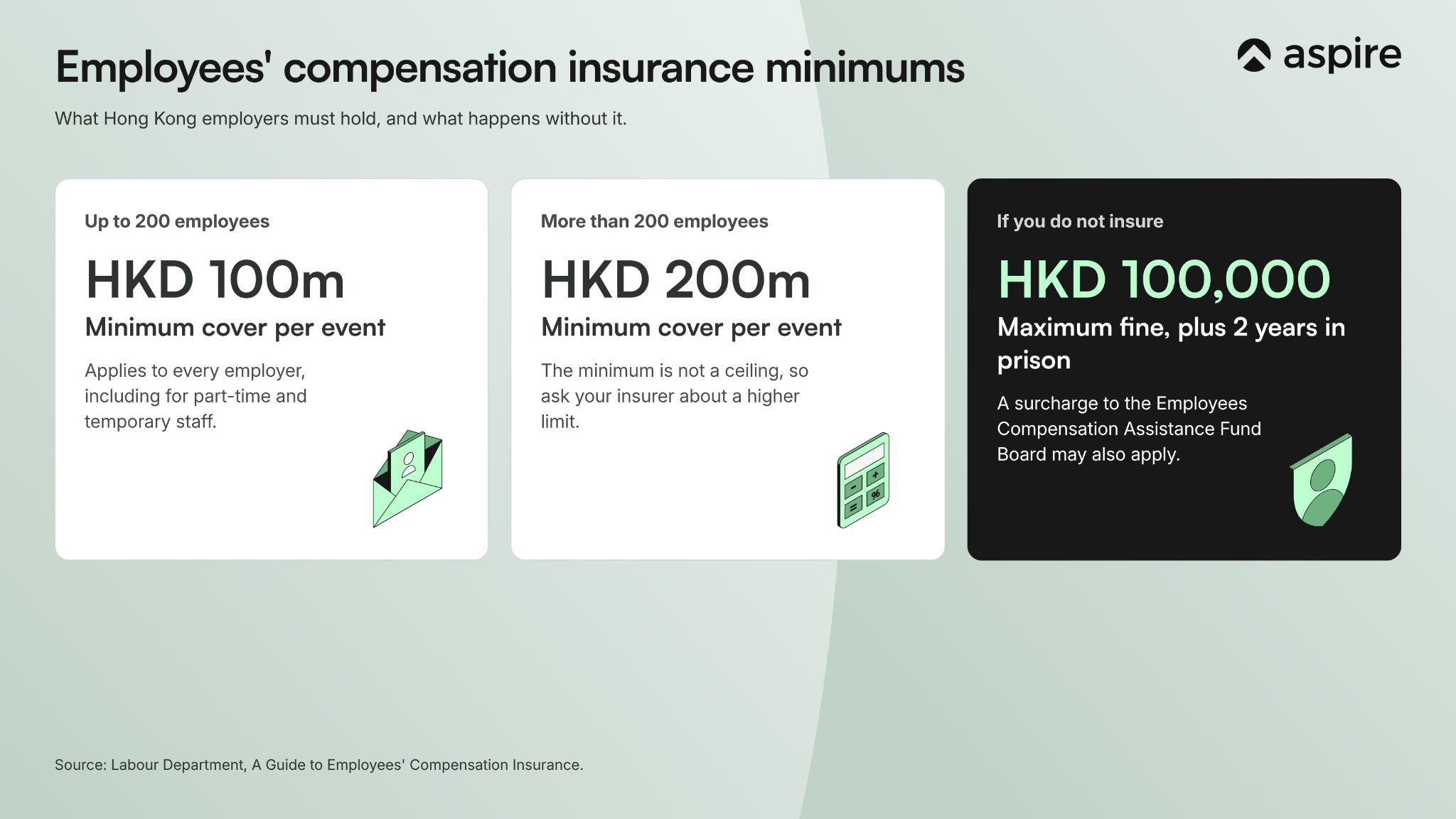
Employees' compensation insurance is mandatory. Under the Employees' Compensation Ordinance, an employer must insure every employee, including part-time and temporary staff.¹
Minimum cover is HKD 100 million per event. Employers with more than 200 employees need at least HKD 200 million.¹
Motor third-party cover is also compulsory. It applies to any business that uses a motor vehicle on the road.²
Everything else is optional. Property, business interruption, public liability and professional indemnity depend on your risks.³
Premiums depend on your risk profile. Business type, location, headcount and claims history all move the price.⁴
Buy through a licensed provider. The Insurance Authority publishes registers of authorised insurers and licensed intermediaries.⁵
Business insurance in Hong Kong is a mix of 1 legal requirement and several optional covers. Any employer must insure its employees against work injury, and every other cover is a choice based on what your business could lose.¹
This guide separates the mandatory covers from the optional ones, shows which optional covers suit which type of business, and explains what drives the premium. It also covers how to buy from a licensed provider and how to budget and track premiums with Aspire's business account.
What is business insurance in Hong Kong?
Business insurance is a group of policies that pay for losses your company would otherwise absorb, such as work injuries, third-party claims and damage to property.
Hong Kong has no single "business insurance" policy required by law. Instead, each cover is a separate class of insurance.
The Insurance Authority lists liability classes such as employers' liability, products liability, professional indemnity, directors' and officers' liability and public liability.⁶
Chubb's SME guidance groups the basics into 3 headings: business property, liability and business interruption.³
| Cover | What it pays for | Legal status |
|---|---|---|
| Employees' compensation | Work injury and occupational disease claims by employees | Mandatory for employers¹ |
| Motor third-party | Injury or death of third parties from vehicle use on the road | Compulsory for vehicle users² |
| Property | Loss or damage to contents, stock and cash⁷ | Optional |
| Business interruption | Lost income and ongoing costs such as rent and wages when operations halt³ | Optional |
| Public liability | Bodily injury to a third party on your premises⁷ | Optional |
| Professional indemnity | Claims arising from errors in the services you provide⁴ | Optional |
Which business insurance is mandatory?
Only 2 covers are compulsory for most companies: employees' compensation insurance and motor third-party insurance. The first applies to every employer, and the second only to businesses that use vehicles on the road.
What does employees' compensation insurance require?
Section 40 of the Employees' Compensation Ordinance bars an employer from employing anyone unless a valid policy is in force.¹ The Labour Department's guide sets out the main rules in the table.
| Requirement | What the Labour Department says |
|---|---|
| Who must be covered | All employees, whether full-time, part-time, permanent or temporary, and domestic helpers¹ |
| Minimum cover, up to 200 employees | HKD 100 million per event¹ |
| Minimum cover, over 200 employees | HKD 200 million per event¹ |
| Scope | Liability under the Ordinance and at common law¹ |
| Insurer | A company authorised to carry on accident insurance business in Hong Kong¹ |
| Headcount changes | Tell the insurer as soon as the number of employees rises¹ |
| Renewal | Renew before expiry so cover does not lapse¹ |
The minimum amount is not a ceiling on liability, so the Labour Department advises employers to ask insurers whether a higher limit is needed.¹
What happens if you do not insure?
An employer who fails to insure faces a maximum fine of HKD 100,000 and 2 years' imprisonment on conviction.¹ The employer may also owe a surcharge to the Employees Compensation Assistance Fund Board.¹
The Labour Department says it takes enforcement action and refers suspected false policies to the police.⁸ An employer who cannot find cover can contact the Employees' Compensation Insurance Residual Scheme Bureau.⁸
Is motor third-party insurance compulsory?
Yes, if your business uses a motor vehicle on the road. Under the Motor Vehicles Insurance (Third Party Risks) Ordinance, the user must insure liability for death or bodily injury of third parties with an authorised insurer.²
The Transport Department may refuse or cancel the licence of a vehicle without valid third-party cover.⁹ A delivery van, a company car and a driver on the payroll all fall under this rule.
Which optional covers suit your business?
Optional covers should follow the specific ways your business could lose money. The 4 factors that insurers weigh show where risk sits: what you do, where you operate, the type of space you use and your claims history.⁴
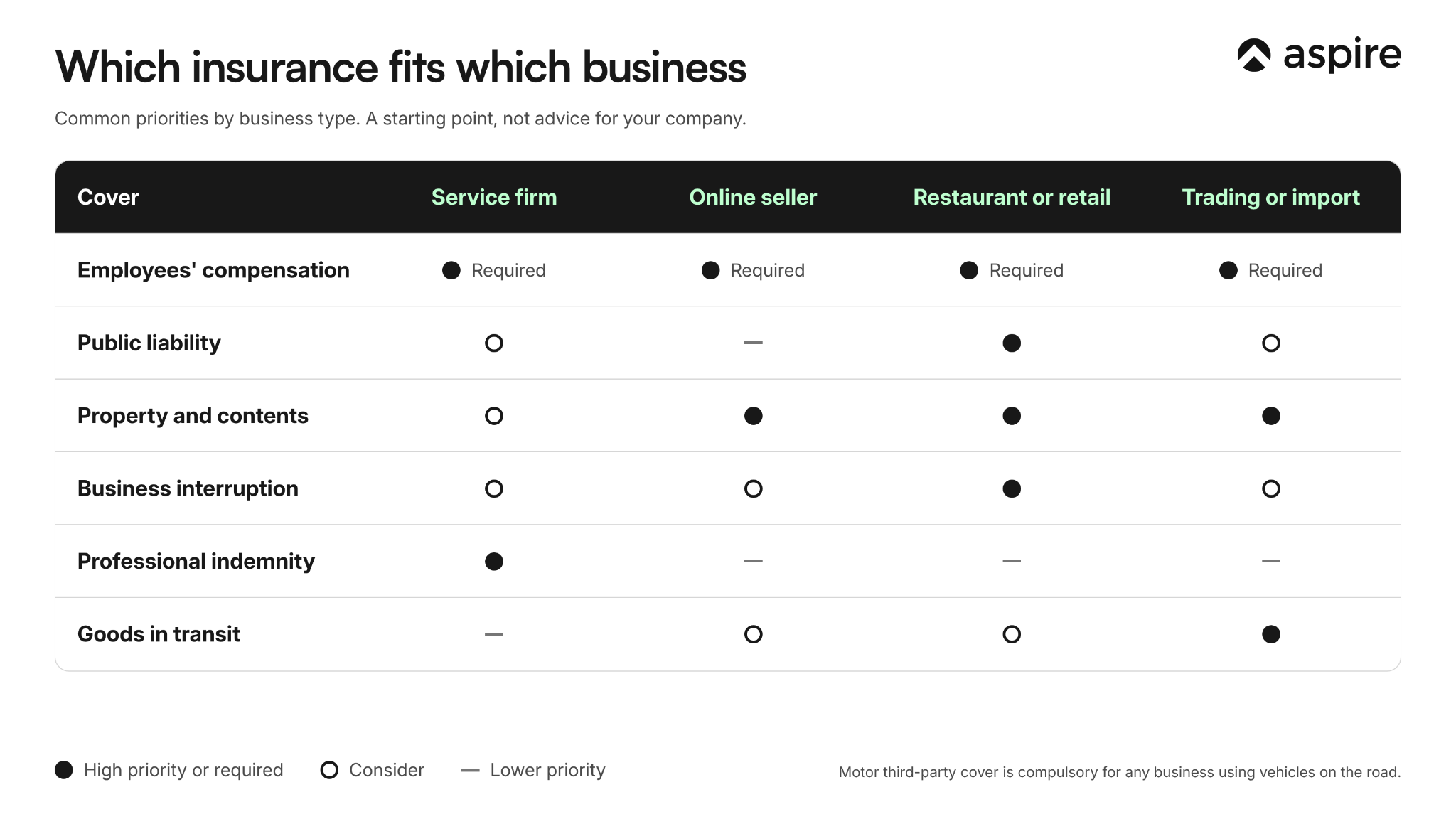
The table shows common priorities by business type. It reflects typical exposures and is a starting point, not a recommendation for your company.
| Cover | Office-based service firm | Online seller | Restaurant or retail | Trading or import |
|---|---|---|---|---|
| Employees' compensation | Required | Required | Required | Required |
| Public liability | Consider, if clients visit | Lower priority | High priority | Consider |
| Property and contents | Consider | High priority, for stock | High priority | High priority |
| Business interruption | Consider | Consider | High priority | Consider |
| Professional indemnity | High priority | Lower priority | Lower priority | Lower priority |
| Goods in transit | Not needed | Consider | Consider | High priority |
| Motor third-party | If vehicles are used | If vehicles are used | If vehicles are used | If vehicles are used |
What does property insurance cover?
Property insurance covers loss or damage to your contents, stock and cash. MSIG's guidance cites break-ins and theft among the causes, and notes that equipment such as a server can be damaged by events like a sprinkler activation.⁷
Chubb's guidance lists fire, flood and water damage as the main property perils.³ Location and occupancy matter, since a restaurant with heavy equipment carries more property risk than an office.⁴
What do business interruption and liability add?
Business interruption pays for lost income and fixed costs, such as rent and wages, when a disaster halts operations.³ Public liability covers bodily injury to a third party on your premises.⁷
Professional indemnity responds to claims over errors in the services you deliver.⁴ Consultants, agencies and accountants usually weigh it first, because their product is advice and not stock.
How much does business insurance cost?
Premiums are quoted per business and no standard price applies, so the honest answer is a range of drivers and not a single figure.
| Driver | How it moves the premium |
|---|---|
| What you do or sell | Riskier work usually costs more. Security services carry more injury-related liability risk than accounting services⁴ |
| Where you operate | High-hazard areas raise property insurance costs⁴ |
| Type of occupancy | A restaurant generally pays more property premium than an office⁴ |
| Claims history | Past lawsuits or repeated property claims can raise premiums⁴ |
| Number of employees | A larger headcount increases exposure³ |
| Extent of cover | Wider limits and add-ons cost more³ |
| Risk management | Steps you take to manage risk can lower the rate³ |
| Bundling | A bundled policy can cost less than separate policies³ |
An agent's fee is not an extra charge, because agents earn commission from insurers and the quote is the total you pay.³ Ask 2 or 3 providers to quote on the same limits so that you compare like with like.
How do you buy business insurance?
You buy through an authorised insurer, either directly, through a licensed agent or through a licensed broker. The Insurance Authority regulates insurers and intermediaries under the Insurance Ordinance.¹⁰
Should you use an agent or a broker?
An agent sells for the insurers that appoint it, and a broker searches across insurers on your behalf.¹⁰ The table sets out the difference.
| Point | Licensed agent | Licensed broker |
|---|---|---|
| Acts for | Its appointing insurer or insurers¹⁰ | You, the client¹⁰ |
| Product range | Products of the appointing insurers¹⁰ | Products from different insurers¹⁰ |
| Licence | Insurance Authority licence | Insurance Authority licence¹¹ |
| Best when | You know the cover you want | You need to compare several insurers |
What are the steps to buy cover?
Start with the mandatory policy, then add optional covers based on your biggest risks. These 6 steps work for most SMEs.
- Count your employees, including part-time, temporary and domestic staff, because all must be covered.¹
- List your biggest losses in 3 groups: people, property and claims from others.
- Choose an agent or broker and check the licence on the Insurance Authority's register.¹¹
- Confirm the insurer is authorised on the Insurance Authority's register of authorised insurers.⁵
- Compare quotes on the same limits. Chubb advises looking past the lowest premium and confirming the insurer can pay claims.³
- Diarise the renewal and notify the insurer when headcount rises.¹
How should you budget and pay for premiums?
Treat insurance as a fixed operating cost with its own budget line, and track every policy renewal date.
Premiums often come due at different times of the year, which makes them easy to miss in cash flow planning. The guides to cost control and overhead costs show where insurance sits among recurring costs.
Aspire's expense management lets you set budgets by client, project or department, and its corporate card sets limits by department or project. Where your insurer or broker accepts card payment, premiums can run through the card and earn 1.2% unlimited cashback.
| Task | How Aspire helps |
|---|---|
| Budget each policy | Budgets by client, project or department |
| Pay premiums | Corporate card with 1.2% unlimited cashback, where card payment is accepted |
| Record the cost | Automatic categorisation and sync to Xero, QuickBooks or NetSuite |
| Pay staff covered by the policy | Payroll, MPF and contractors from 1 account |
| Review recurring costs | Spend visible in 1 dashboard |
The guide to accrued expenses explains how to book a premium that spans several months. The guide to accounting software covers the tools that receive the synced data.
Which insurers sell each type of cover?
Several authorised general insurers sell each cover, and the table lists providers that publish a Hong Kong product for it. Check any provider on the Insurance Authority's register before you buy.⁵
| Cover | Providers with a Hong Kong product | What their pages show |
|---|---|---|
| Employees' compensation | QBE¹² | A standalone employees' compensation product, also offered as an option inside QBE's SME package¹² ¹³ |
| Property and business interruption | QBE, MSIG and Chubb | QBE's SME package includes property all risks with a business interruption option.¹³ MSIG sells an SME Protection Bundle and Shop Insurance.¹⁴ Chubb offers bundled policies such as Enterprise Guard Plus³ |
| Public liability | QBE, MSIG and Chubb | QBE's SME packages list a public liability limit of HKD 10,000,000.¹³ MSIG and Chubb include liability in their SME covers³ ⁷ |
| Professional indemnity | Chubb and MSIG | Chubb's plan is distributed through Hang Seng Bank.¹⁵ MSIG lists professional indemnity with cyber and directors' and officers' liability¹⁶ |
| Commercial motor | QBE | Covers company vehicles and drivers for accidental damage, loss and third-party liability¹² |
The Labour Department points employers to the Hong Kong Federation of Insurers for the full list of insurers authorised to write employees' compensation insurance.⁸ Use that list if you want to compare more than 1 provider for the mandatory cover.
How does insurance fit your wider finances?
Premiums sit alongside people costs and funding, so plan for them with both. The guides to payroll, payroll methods, employment contracts and hiring overseas employees cover the people side.
The guides to business loans, SME funding and cash flow management show how to fund them.
Founders who are setting up should also read the guides to registering a company and business registration, since an employer duty starts with the first hire.
Why Hong Kong Businesses Choose Aspire
Insuring the business is 1 part of running it, and Aspire supports the accounts, cards and payments around it.
💱 FX spreads from 0.18%, up to 3x cheaper than traditional banks. This applies across 130+ countries and 40+ currencies through Aspire's multi-currency account. It's useful for anything from paying overseas suppliers to settling international payments without losing margin to markup.
💰 1.2% unlimited cashback applies on every corporate card transaction, with no monthly cap. It kicks in automatically on eligible spend, with no minimum threshold to hit first. Over time, it quietly turns routine business spend into working capital.
🌐 Local transfer network, not multi-hop SWIFT chains, is how Aspire routes most payments. This means faster settlement and fewer intermediary fees eating into your payment before it reaches the recipient. It also reduces the chance of funds being held up for review at a correspondent bank along the way.
💸 Fixed USD 8 inbound SWIFT fee, tracked end-to-end with SWIFT GPI, applies when SWIFT is the right rail for your payment. There are no surprise deductions from correspondent banks along the way, so the amount you're quoted is the amount that arrives. You can also download payment confirmation instantly from the app, without calling the bank.
⚡ Approved in as little as 1 business day, with no branch visits and no paperwork stacks. Applications are completed entirely online, from document upload to approval. There's no waiting weeks on a relationship manager to call you back.
Open a free multi-currency business account built for Hong Kong SMEs, or explore how Aspire's corporate card fits into your day-to-day spend.
Frequently Asked Questions
Only employees' compensation insurance and motor third-party insurance are compulsory, and the first applies to every employer.¹ ²
At least HKD 100 million per event for up to 200 employees, and HKD 200 million for more than 200.¹
A maximum fine of HKD 100,000 and 2 years' imprisonment on conviction, plus a possible surcharge.¹
Yes, because the policy must cover all employees regardless of contract length or working hours.¹
Most SMEs weigh property, public liability and business interruption, and service firms add professional indemnity.³ ⁴
Authorised general insurers such as QBE, MSIG and Chubb publish SME covers, and the Insurance Authority's register shows every authorised insurer.³ ⁵ ¹³ ¹⁴
Use the Insurance Authority's register of authorised insurers and its register of licensed insurance intermediaries.⁵ ¹¹
It depends on the insurer or broker, and Aspire's corporate card earns 1.2% unlimited cashback where card payment is accepted.
Sources
- Labour Department, A Guide to Employees' Compensation Insurance (government guide)
- Hong Kong Federation of Insurers, Motor insurance (industry body page)
- Chubb Hong Kong, SME insurance: 8 things every business owner must know (insurer guidance, March 2023)
- Chubb Hong Kong, 4 factors that affect how much you pay for business insurance (insurer guidance)
- Insurance Authority, Register of authorized insurers (regulator page)
- Insurance Authority, Study notes on general insurance (regulator publication)
- MSIG Hong Kong, Protecting your enterprise with business insurance (insurer guidance, April 2026)
- Labour Department, Employers must take out employees' compensation insurance (government page)
- Transport Department, Important notice on motor vehicle insurance (government notice)
- Investor and Financial Education Council, Regulation of insurance companies and intermediaries (public education body)
- Insurance Authority, Register of Licensed Insurance Intermediaries (regulator page)
- QBE Hong Kong, Business insurance (insurer product page)
- QBE Hong Kong, SME insurance (insurer product page)
- MSIG Hong Kong, Commercial insurance (insurer product page)
- Hang Seng Bank, Professional indemnity insurance (bank distribution page for a Chubb plan)
- MSIG Hong Kong, Financial Lines sales highlights (insurer flyer)
This blog is for general information only and does not constitute financial, legal, tax, or professional advice. Aspire’s services are subject to the terms outlined in our 'Terms of Service' and 'Pricing' pages. We make no guarantees as to the accuracy, completeness, or timeliness of the content, and past results do not indicate future performance. Always consult a qualified professional before acting on any information provided.
Galih Gumelar
Writer
Galih is a seasoned writer specialising in macroeconomics, business, finance and politics. With a writing history at CNN Indonesia, The Jakarta Post, and various other reputed organisations, Galih leverages his broad range of experiences to create insightful resources for those wanting to start a business.
Aspire Launchpad
Start Your Business with Aspire Launchpad
From incorporation to venture capital, we connect you with trusted service providers to make your entrpreneurial journey seamless.

Latest articles
Guides •
Postal Code in Hong Kong: What to Enter?
Learn why Hong Kong has no postal code, what to enter in online form fields and how to write a Hong Kong address correctly for mail and shipping.

Incorporation •
What Is IR56B? HK Employer's Return Explained
Learn what IR56B is, who must file it, which related forms apply and how to e-file the Hong Kong employer's return within 1 month.

Expense Management •
Petty Cash Management: A Guide for HK Businesses
Learn how petty cash works in Hong Kong, how to set up and control a fund, which records to keep and when cards work better.
Start your journey with Aspire
Open your free account