



Petty Cash Management: A Guide for HK Businesses

Galih Gumelar

Summary
Petty cash is a fixed float for small, routine costs. Under the imprest method, cash plus vouchers always equals the authorised balance.¹
1 custodian and a locked box keep the fund safe. Smaller funds are preferred because of theft risk.¹
Every payment needs a voucher. Record the amount, purpose, date and employee name.²
Hong Kong businesses must keep records for at least 7 years. Section 51C of the Inland Revenue Ordinance covers vouchers and receipts.³
Recurring bills and larger purchases belong outside the cash box. Cards and transfers leave a digital trail.
Aspire swaps cash floats for controlled cards. Teams get spend limits, automatic categorisation and accounting integrations.
Petty cash is a small, fixed float of physical cash that a business keeps for minor, routine expenses such as taxis, courier fees and office supplies. It works best under the imprest system, where every payment is backed by a voucher and the fund is topped up to its original amount.¹
We wrote this guide for Hong Kong business owners and finance leads who run a cash float or are deciding whether to keep one. It covers setup, controls, the 7-year record-keeping rule and when cards are the better tool.
What is petty cash?
Petty cash is a reserve of physical cash kept for minor, routine business expenses that are not worth a formal payment. It gives staff quick access to small amounts without raising an invoice or waiting for a bank transfer.²
A petty cash system is the set of policies, procedures, controls and forms a company uses to dispense that cash and record each payment.¹
How does the imprest system work?
Under the imprest method, a business sets a fixed fund balance and tops it up to that amount after each round of spending. Cash in the box plus vouchers for money paid out always equals the authorised balance.¹
The table walks through 1 cycle on a HKD 3,000 fund.
| Step | Cash in box | Vouchers in box | Total |
|---|---|---|---|
| Open the fund from the bank | HKD 3,000 | HKD 0 | HKD 3,000 |
| Pay a taxi (HKD 180) and a courier (HKD 120) | HKD 2,700 | HKD 300 | HKD 3,000 |
| Pay office supplies (HKD 350) and pantry items (HKD 450) | HKD 1,900 | HKD 1,100 | HKD 3,000 |
| Replenish: withdraw HKD 1,100 and hand the vouchers to the bookkeeper | HKD 3,000 | HKD 0 | HKD 3,000 |
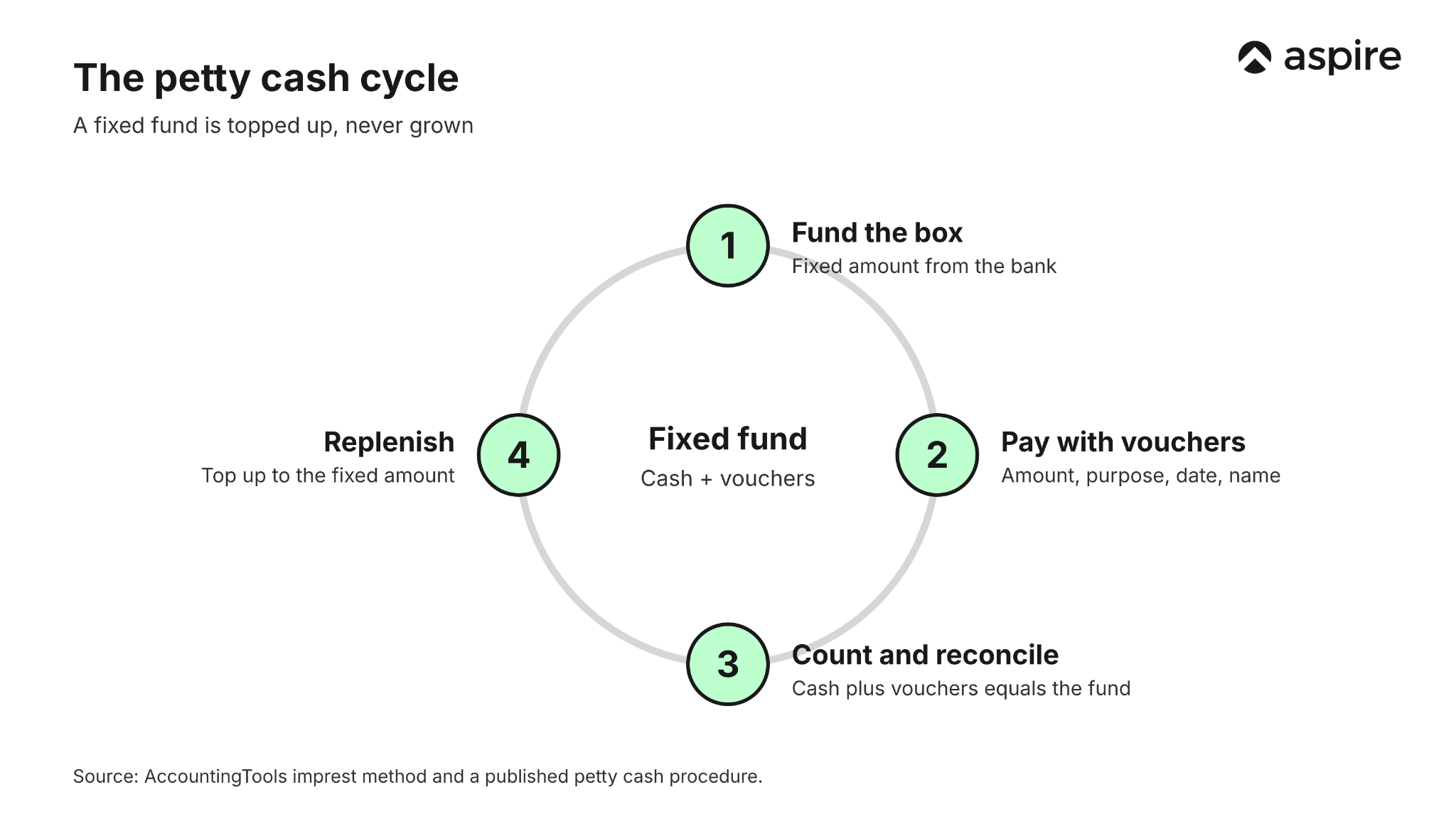
The opening entry debits petty cash and credits the bank.² At replenishment, the bookkeeper records the vouchers against the expense accounts and credits the bank for the same amount.
How do you replenish a petty cash fund?
Replenish only after reconciling the box, so cash and vouchers match the fund amount first. A standard petty cash procedure reconciles the register to cash on hand whenever a replenishment is requested.⁴ These steps apply:
- Collect the vouchers. Gather every voucher and receipt since the last top-up.
- Count the cash. Add cash and vouchers and compare the total with the fund amount.
- Investigate any gap. Re-add the receipts first, then record any unexplained difference.²
- Withdraw the top-up. Draw only the amount the vouchers total.
- Record the entries. Post the vouchers to expense accounts and update the petty cash book.
How do you set up a petty cash fund?
A fund needs a size, 1 custodian, a locked box, numbered vouchers and a written policy. The Xero guide suggests sizing it to cover roughly 2 to 4 weeks of small spending.²
- Set the fund size. Keep it small, because smaller funds are preferred due to theft risk.¹
- Appoint 1 custodian. The person should have exclusive access and control of the fund.⁴
- Lock the box. Keep cash in a secured location, never mixed with personal or other company funds.⁴
- Use numbered vouchers. Each voucher records the amount, purpose, date and employee name.²
- Record the opening entry. Debit petty cash and credit the bank.²
- Write the policy. State the per-item limit, who approves claims and when the fund is counted.
Which petty cash controls matter most?
5 controls prevent most petty cash losses: a fixed float, 1 custodian, per-item limits, receipts and independent checks.¹ The table shows each control with a Hong Kong institutional example.
| Control | How it works | Example |
|---|---|---|
| Per-item limit | Caps any single purchase | Example cap: HKD 1,000 per purchase⁴ |
| No splitting | Stops staff dodging the limit | Splitting receipts to get under the limit is prohibited⁴ |
| Reimbursement only | No advances or IOUs | The fund cannot be used for advances, and IOUs are prohibited⁴ |
| Independent checks | Someone other than the custodian counts | Occasional spot checks² |
| Regular reconciliation | Cash and vouchers match the fund | Weekly, or more often with high volume² |
A common control is to stamp each voucher "PAID". Some procedures do not accept Octopus top-up receipts as evidence of payment.⁴
How do audits and year-end counts work?
A fund should be ready for a count or an audit at any time. A petty cash register is subject to internal and external audits at any time, and finance teams commonly ask units to certify the cash on hand each year.⁴
The custodian keeps a petty cash book with every transaction and a running balance, ideally updated daily.⁴ When a fund closes, the remaining balance is banked, and the deposit slip, a memo and the original receipts must reconcile to the fund balance.⁴
What records must HK businesses keep?
Anyone carrying on a business in Hong Kong must keep records of income and expenditure for at least 7 years. Section 51C of the Inland Revenue Ordinance requires records sufficient to ascertain assessable profits readily.³
The IRD lists vouchers, bank statements, invoices and receipts among the required records.³ Petty cash vouchers and receipts are the documents that tie each cash payment to the ledger.
Non-compliance without reasonable excuse may lead to a fine of up to HKD 100,000.³ Our guides to bookkeeping and accounting and how to track expenses for a small business show how to keep that trail clean.
How can Aspire cover petty cash spend?
Aspire takes the place of the cash box with company cards for small spend and bank transfers for bills, so every payment leaves a digital record. The chart matches 4 common expense types to the route that fits.
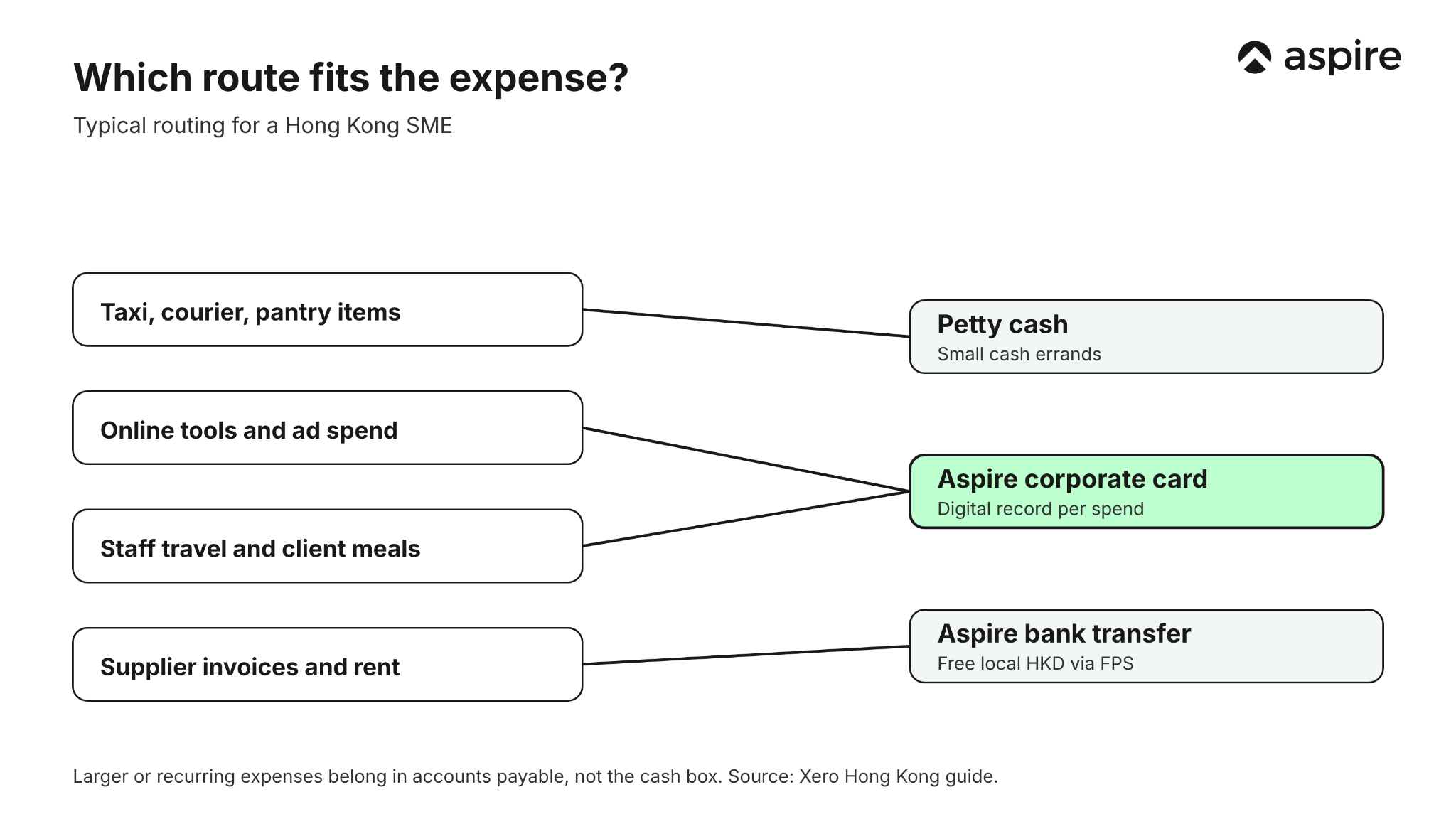
- Taxis, couriers and pantry items. Staff pay with an Aspire corporate card instead of drawing cash, and Aspire categorises the spend automatically.
- Online tools and ad spend. Aspire lets you issue unlimited cards and adjust limits by department or project, so each team has its own controlled budget.
- Staff travel and client meals. Employees submit claims and managers approve them in 1 dashboard through Aspire expense management, with budgets by client, project or department.
- Supplier invoices and rent. Xero advises routing larger or recurring expenses through accounts payable rather than the cash box.² Aspire handles these as bank transfers from your business account, and local HKD transfers over FPS are free.
Aspire card spend syncs with Xero, QuickBooks and NetSuite, so there are no vouchers to chase at month-end. The Aspire corporate card also earns 1.2% unlimited cashback on eligible spend.
Aspire's guides to disbursement vs reimbursement, 5 expense management mistakes and managing employee reimbursement expenses show where each payment type belongs. The comparisons of expense tracking apps and virtual credit card pros and cons cover the alternatives, and the travel expense control guide suits frequent travellers.
Why Hong Kong Businesses Choose Aspire
Replacing cash floats with controlled cards is 1 step, and Aspire supports the accounts, cards and payments behind the rest of a Hong Kong business's day-to-day spend.
💱 FX spreads from 0.18%, up to 3x cheaper than traditional banks. This applies across 130+ countries and 40+ currencies through Aspire's multi-currency account. It's useful for anything from paying overseas suppliers to settling international payments without losing margin to markup.
💰 1.2% unlimited cashback applies on every corporate card transaction, with no monthly cap. It kicks in automatically on eligible spend, with no minimum threshold to hit first. Over time, it quietly turns routine business spend into working capital.
🌐 Local transfer network, not multi-hop SWIFT chains, is how Aspire routes most payments. This means faster settlement and fewer intermediary fees eating into your payment before it reaches the recipient. It also reduces the chance of funds being held up for review at a correspondent bank along the way.
💸 Fixed USD 8 inbound SWIFT fee, tracked end-to-end with SWIFT GPI, applies when SWIFT is the right rail for your payment. There are no surprise deductions from correspondent banks along the way, so the amount you're quoted is the amount that arrives. You can also download payment confirmation instantly from the app, without calling the bank.
⚡ Approved in as little as 1 business day, with no branch visits and no paperwork stacks. Applications are completed entirely online, from document upload to approval. There's no waiting weeks on a relationship manager to call you back.
Open a free multi-currency business account built for Hong Kong SMEs, or explore how Aspire's corporate card fits into your day-to-day spend.
Frequently Asked Questions
The sources set no fixed amount. Xero suggests a fund that covers roughly 2 to 4 weeks of small spending, and smaller funds reduce theft risk.² ¹
1 custodian with exclusive access and control, ideally someone other than the person who approves claims.⁴
Weekly, or more often with high volume, and always before replenishing.²
At least 7 years under section 51C of the Inland Revenue Ordinance.³
No, under a typical procedure the fund works on a reimbursement basis only.⁴
Aspire gives teams corporate cards with adjustable limits and automatic categorisation, so small purchases leave a digital record instead of a voucher.
Sources
- AccountingTools, What is a petty cash system (accounting reference, accessed November 2026)
- Xero Hong Kong, Petty cash explained: how to set up, track and top up (accounting software guide, accessed November 2026)
- Inland Revenue Department, Record keeping requirements for businesses (government page, accessed November 2026)
- Hong Kong Baptist University, Petty cash procedure (institutional finance policy, accessed November 2026)
This blog is for general information only and does not constitute financial, legal, tax, or professional advice. Aspire’s services are subject to the terms outlined in our 'Terms of Service' and 'Pricing' pages. We make no guarantees as to the accuracy, completeness, or timeliness of the content, and past results do not indicate future performance. Always consult a qualified professional before acting on any information provided.
Galih Gumelar
Writer
Galih is a seasoned writer specialising in macroeconomics, business, finance and politics. With a writing history at CNN Indonesia, The Jakarta Post, and various other reputed organisations, Galih leverages his broad range of experiences to create insightful resources for those wanting to start a business.
Aspire Launchpad
Start Your Business with Aspire Launchpad
From incorporation to venture capital, we connect you with trusted service providers to make your entrpreneurial journey seamless.

Latest articles

Incorporation •
Business Insurance Hong Kong: Types and Costs
Learn which business insurance Hong Kong companies must buy, which optional covers suit SMEs, what drives the cost and how to buy from a licensed provider.

Guides •
Postal Code in Hong Kong: What to Enter?
Learn why Hong Kong has no postal code, what to enter in online form fields and how to write a Hong Kong address correctly for mail and shipping.

Incorporation •
What Is IR56B? HK Employer's Return Explained
Learn what IR56B is, who must file it, which related forms apply and how to e-file the Hong Kong employer's return within 1 month.
Start your journey with Aspire
Open your free account