



Top 4 Corporate Cards for E-commerce in HK

Galih Gumelar

Summary
Spend profile: E-commerce spend concentrates in ad platforms, inventory and overseas suppliers, which many generic cards do not reward or protect well.
Comparison basis: The cards are Aspire's Corporate Card, the HSBC Business Mastercard, the American Express Gold Business Card and the Cathay Pacific Elite Corporate Card.
Fraud and freezes: A frozen card pauses every campaign charging that card number, so 1 card per ad platform limits the impact.
Chargebacks: Mastercard estimates about 261 million chargebacks in 2025, with global costs of USD 33.79 billion.¹
Currency: Paying suppliers from a balance in their currency removes the conversion fee that bank cards add.
An e-commerce business does not spend like a typical company, and a generic corporate card comparison misses most of what matters. Ad budgets are paid before an order arrives, inventory is bought weeks ahead of a sales rush, and overseas suppliers are often paid in a currency that is not yours.
This guide compares 4 corporate cards for Hong Kong e-commerce businesses, using each issuer's published terms. It then covers the pain points that ad-heavy, inventory-heavy and cross-border businesses face, and what solves each one.
How do the 4 cards compare for e-commerce?
The cards differ most in reward type, credit terms and how they treat overseas and online spend. The table uses each issuer's published terms, and the figures can change.
| Card | Rewards | Credit terms | Overseas and online angle |
|---|---|---|---|
| Aspire Corporate Card | 1.2% cashback on eligible spend | Optional credit line, up to 51 days interest-free | Virtual and physical cards, and spending in USD or HKD avoids FX fees |
| HSBC Business Mastercard | 1 RewardCash per HKD 250, or 2 per HKD 250 overseas and online on the World card² | Up to 56 days interest-free | RewardCash converts to cash credit |
| American Express Gold Business Card | Up to 3 Membership Rewards points per HKD 1 of foreign currency spend³ | Up to 51 credit-free days, no pre-set limit | Points bonus on foreign currency spend |
| Cathay Pacific Elite Corporate Card | 1 Asia Mile per HKD 7⁴ | Not stated | Miles, not cash |
The bank card pages reviewed do not describe issuing a separate virtual card per ad platform. Confirm that with each issuer, along with the foreign currency fee in the card agreement.
Aspire's cashback page lists digital marketing, SaaS, e-commerce and business logistics as eligible spend, so check the cashback policy for exclusions. For the wider market, see Aspire's guides to the corporate credit card and cashback cards for Hong Kong businesses.
What are the main e-commerce spend pain points?
E-commerce spend creates 4 problems that most corporate cards were not built to solve. The sections below take them in turn.
What happens when ad spend is flagged?
A frozen card pauses every campaign that charges that card number. Card risk models can decline legitimate ad charges, and a freeze hits all ad accounts on the shared card at once.
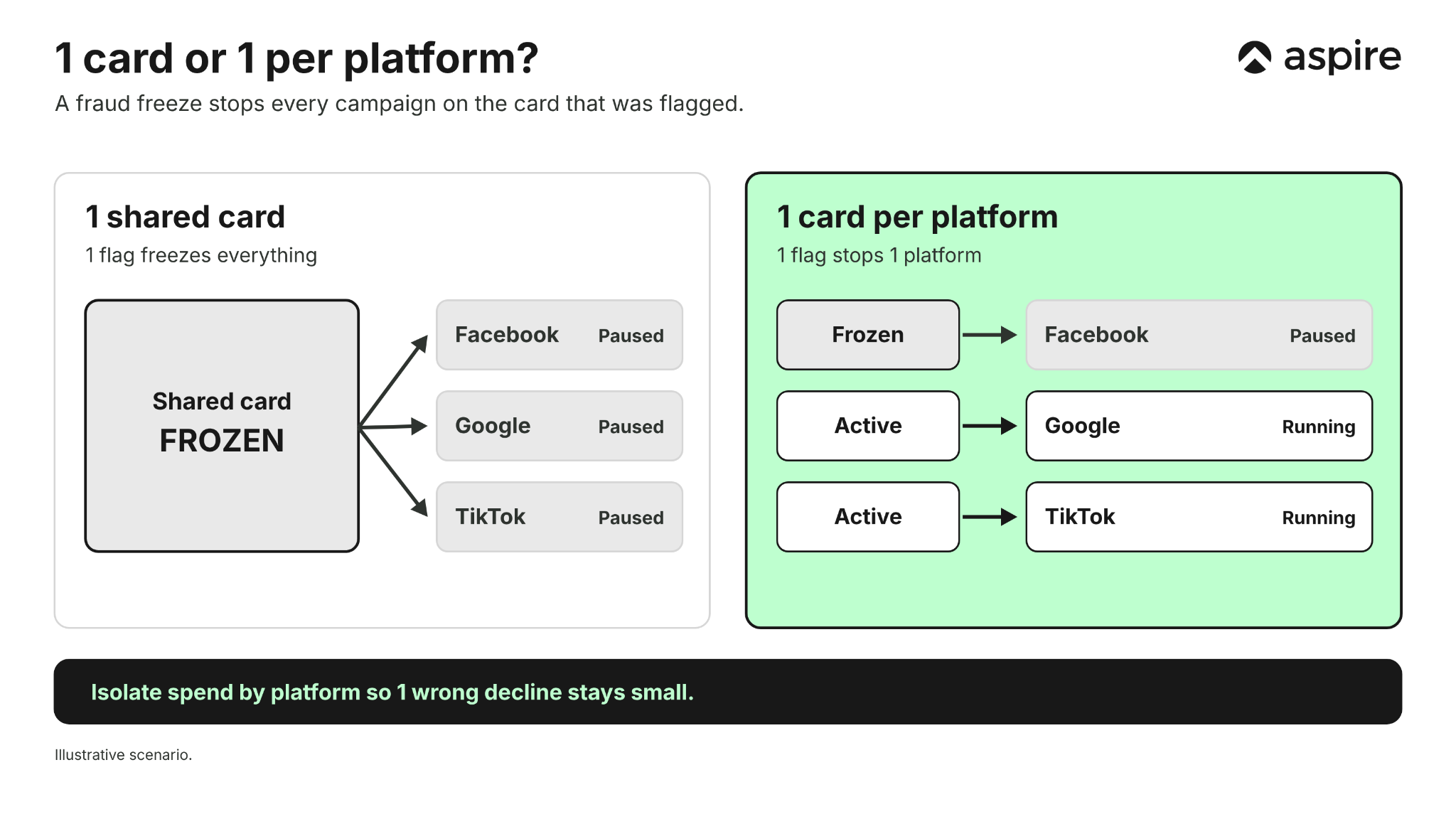
Consider a direct-to-consumer brand that runs Facebook, Google and TikTok ads on 1 card. A single wrong decline stops all 3 platforms, and reinstating the card and restarting campaigns costs time on top of lost ad delivery.
How does inventory float work?
E-commerce businesses often pay suppliers weeks before customers pay them. A seller ordering ahead of a seasonal rush spends the cash first, then waits for sales to recover it.
A repayment window extends that float without draining cash reserves. The published windows differ, with up to 56 days for the HSBC card and up to 51 days for Aspire's optional credit line.² Credit lines are subject to approval, so check the terms before you rely on them.
What does a chargeback actually cost?
A chargeback costs more than the disputed amount, and the volume is rising. Mastercard estimates about 261 million chargebacks in 2025, rising 24% by 2028.¹
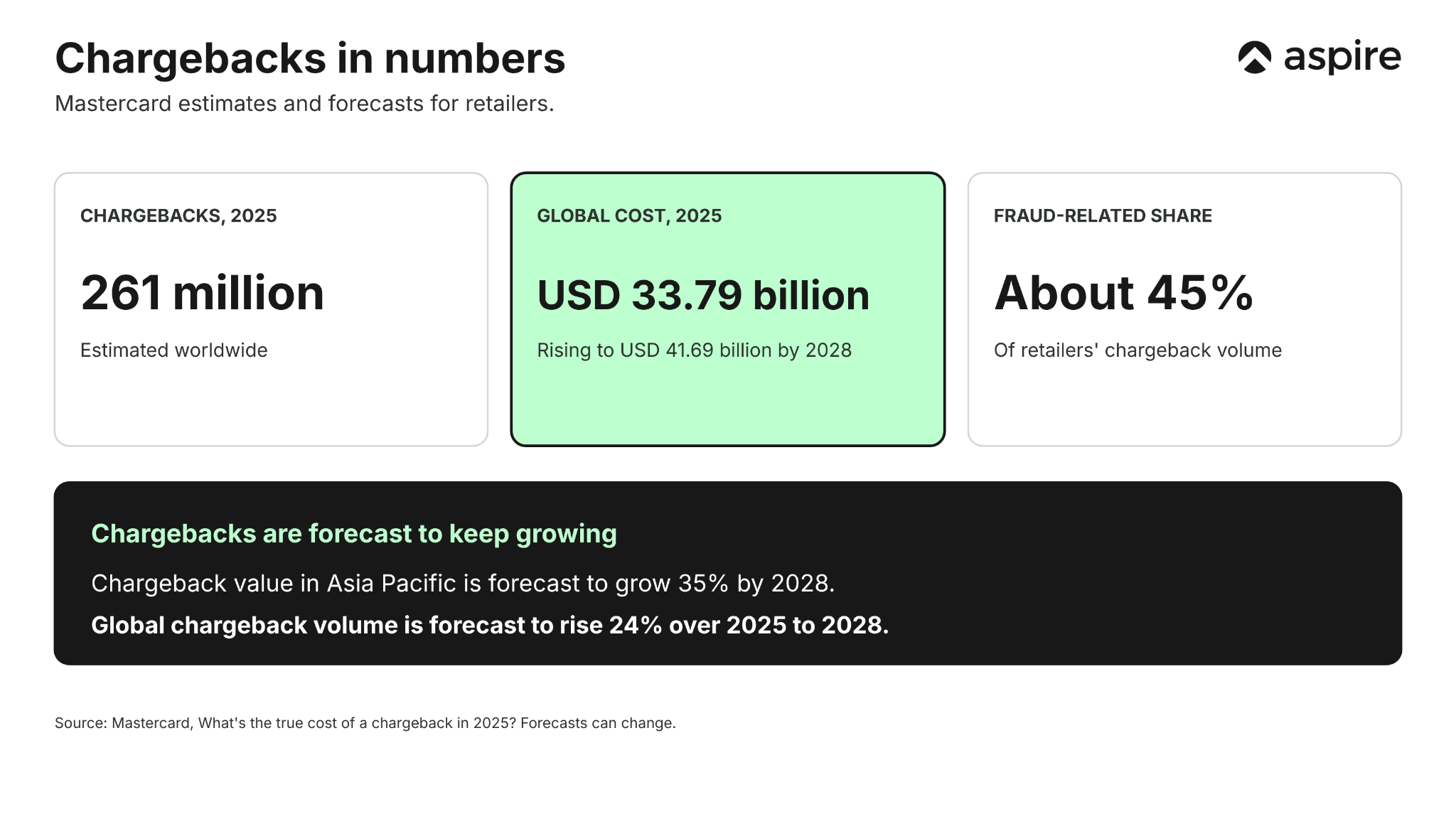
Mastercard projects global chargeback costs to rise from USD 33.79 billion in 2025 to USD 41.69 billion in 2028.¹ Third-party and first-party fraudulent chargebacks together make up about 45% of retailers' chargeback volume globally.¹
Mastercard also forecasts Asia Pacific chargeback value to grow 35% by 2028.¹ Check your payment processor's agreement for any separate dispute fee, and see Aspire's guide on chargebacks.
Why does supplier currency matter?
A card that converts every payment at the point of sale adds a foreign currency fee to every supplier invoice. Many Hong Kong sellers source from mainland China or other overseas suppliers and pay in a currency that is not HKD.
The HKMA says paying in a foreign currency usually triggers a handling fee of about 0% to 2.5% from the card issuer, on top of the exchange rate applied.⁵ That range dates from 2015, so check current fee schedules.
What actually solves each pain point?
The common theme is to isolate spend by source and remove conversion from the cost side.
| Pain point | What solves it |
|---|---|
| A fraud freeze pausing every ad campaign | A separate virtual card per ad platform, so 1 freeze does not cascade |
| Inventory float draining cash | A repayment window that lets sales catch up before the balance is due |
| Chargebacks compounding on lost revenue | Per-transaction tracking that makes disputes faster and better evidenced |
| FX cost on overseas suppliers | A multi-currency account that pays suppliers in their own currency |
What does this look like in practice?
The fixes play out differently for each type of e-commerce business. 3 scenarios show the pattern, and all 3 are invented for illustration.
How does a DTC brand run multi-platform ads?
A direct-to-consumer brand can issue 1 virtual card per ad platform. A freeze on 1 platform then leaves the others running, and each platform's cap is set independently.
Take a brand spending HKD 200,000 a month on ads. At 1.2% cashback that is HKD 2,400 a month, compared with HKD 1,600 at the HSBC World card's published rate of 2 RewardCash per HKD 250. The comparison assumes the spend is eligible, so confirm both programs' terms.
How can a China-sourcing seller cut FX cost?
A seller can hold RMB and pay mainland suppliers from that balance. Suppose the store pays suppliers HKD 500,000 a year. A card with an assumed 1.95% fee would charge HKD 9,750 in fees, while the account's FX spread from 0.18% applies once, when the RMB balance is funded, and comes to HKD 900.
This is illustrative, and your own fee depends on your card agreement and account rate. See Aspire's guides to foreign currency accounts and cross-border payments.
How does a marketplace seller track spend?
A seller on Shopify, Amazon and SHOPLINE can assign 1 virtual card per channel. Spend is then attributable to the right channel at the point of transaction, instead of being reconstructed at month-end.
Every card posts to 1 dashboard, so finance sees platform-by-platform spend without separate statements. See Aspire's guides to top e-commerce platforms in Hong Kong and expense management.
When does a rewards card make sense?
A points or miles card suits modest, steady spend concentrated in a few categories. The annual fee and FX exposure then stay limited.
It makes less sense as ad spend and supplier payments scale, because a flat cashback rate across categories can capture more value. For a different spend profile, see Aspire's guide to corporate cards for travel.
How does Aspire handle e-commerce spend?
Aspire approaches e-commerce spend through isolation and currency, not category-based rewards.
- Per-platform virtual cards. Multiple virtual cards can be issued alongside a physical card, so 1 freeze does not stop every account. See virtual cards vs physical cards.
- Multi-currency account. Aspire’s spending in USD or HKD avoids FX fees, and the card works in 13 currencies.
- Flat cashback. Aspire lists marketing, SaaS, e-commerce and logistics among eligible spend at 1.2%.
- Real-time dashboard. Every transaction posts live, with spend limits and budgets per card.
Why Hong Kong Businesses Choose Aspire
Managing e-commerce spend across ad platforms, suppliers and marketplaces is 1 part of running an efficient business, and Aspire is built to remove the friction around all of it.
💱 FX spreads from 0.18%, up to 3x cheaper than traditional banks. This applies across 130+ countries and 40+ currencies through Aspire's multi-currency account. It's useful for anything from paying overseas suppliers to settling international payments without losing margin to markup.
💰 1.2% unlimited cashback applies on every corporate card transaction, with no monthly cap. It kicks in automatically on eligible spend, with no minimum threshold to hit first. Over time, it quietly turns routine business spend into working capital.
🌐 Local transfer network, not multi-hop SWIFT chains, is how Aspire routes most payments. This means faster settlement and fewer intermediary fees eating into your payment before it reaches the recipient. It also reduces the chance of funds being held up for review at a correspondent bank along the way.
💸 Fixed USD 8 inbound SWIFT fee, tracked end-to-end with SWIFT GPI, applies when SWIFT is the right rail for your payment. There are no surprise deductions from correspondent banks along the way, so the amount you're quoted is the amount that arrives. You can also download payment confirmation instantly from the app, without calling the bank.
⚡ Approved in as little as 1 business day, with no branch visits and no paperwork stacks. Applications are completed entirely online, from document upload to approval. There's no waiting weeks on a relationship manager to call you back.
Open a free multi-currency business account built for Hong Kong SMEs, or explore how Aspire's corporate card fits into your day-to-day e-commerce spend.
Frequently Asked Questions
A risk model can flag a legitimate ad charge, or a spend limit can block it. Check the card's limits first, then use 1 card per ad platform so a wrong decline affects 1 platform only.
It depends on your processor's agreement, so check its terms. Winning a dispute still takes staff time to gather evidence.
Separate cards generally serve e-commerce better. A freeze or billing issue then stops 1 platform, not every campaign.
Often yes, because ad, inventory, SaaS and supplier spend rarely match a points card's bonus categories. Check the eligible-spend list for any program you compare.
Not always. For occasional payments, converting through your existing account may be enough, while regular payments in 1 currency are cheaper to hold as a balance in that currency.
Sources
- Mastercard, "What's the true cost of a chargeback in 2025?"
- HSBC Hong Kong, "Business Mastercard" product page (issuer terms, accessed November 2026)
- American Express Hong Kong, "Gold Business Card" product page (issuer terms, accessed November 2026)
- American Express Hong Kong, "Business and Corporate Cards" (issuer terms, accessed November 2026)
- HKMA, "Hong Kong Dollars or Foreign Currencies? Making the Smart Choice when Using your Credit Cards Overseas" (December 2015)
This blog is for general information only and does not constitute financial, legal, tax, or professional advice. Aspire’s services are subject to the terms outlined in our 'Terms of Service' and 'Pricing' pages. We make no guarantees as to the accuracy, completeness, or timeliness of the content, and past results do not indicate future performance. Always consult a qualified professional before acting on any information provided.
Galih Gumelar
Writer
Galih is a seasoned writer specialising in macroeconomics, business, finance and politics. With a writing history at CNN Indonesia, The Jakarta Post, and various other reputed organisations, Galih leverages his broad range of experiences to create insightful resources for those wanting to start a business.
Aspire Launchpad
Start Your Business with Aspire Launchpad
From incorporation to venture capital, we connect you with trusted service providers to make your entrpreneurial journey seamless.

Latest articles
Corporate Card •
Top 5 Corporate Cards for Agencies in HK
Compare 5 corporate cards for HK agencies on funding model, rewards and FX. See how per-client virtual cards protect cash flow and margin on ad spend.
Corporate Card •
Top 4 Business Cards for Freelancers in HK
Compare 4 business cards for HK freelancers and sole proprietors. See eligibility, personal liability, irregular income and multi-currency controls.

Corporate Card •
Top 5 Travel Corporate Cards for HK Companies
Compare 5 corporate cards for travel in HK on rewards, fees and perks, and see how virtual cards and multi-currency tools cut FX cost.
Start your journey with Aspire
Open your free account