



Hong Kong Employment Laws: What Employers Need

Galih Gumelar

Summary
A contract is continuous after 4 weeks. From 18 January 2026, that means at least 17 hours a week, or 68 hours in a 4-week period.²
The minimum wage is HKD 43.1 per hour. The rate has applied since 1 May 2026 and is reviewed every year.³
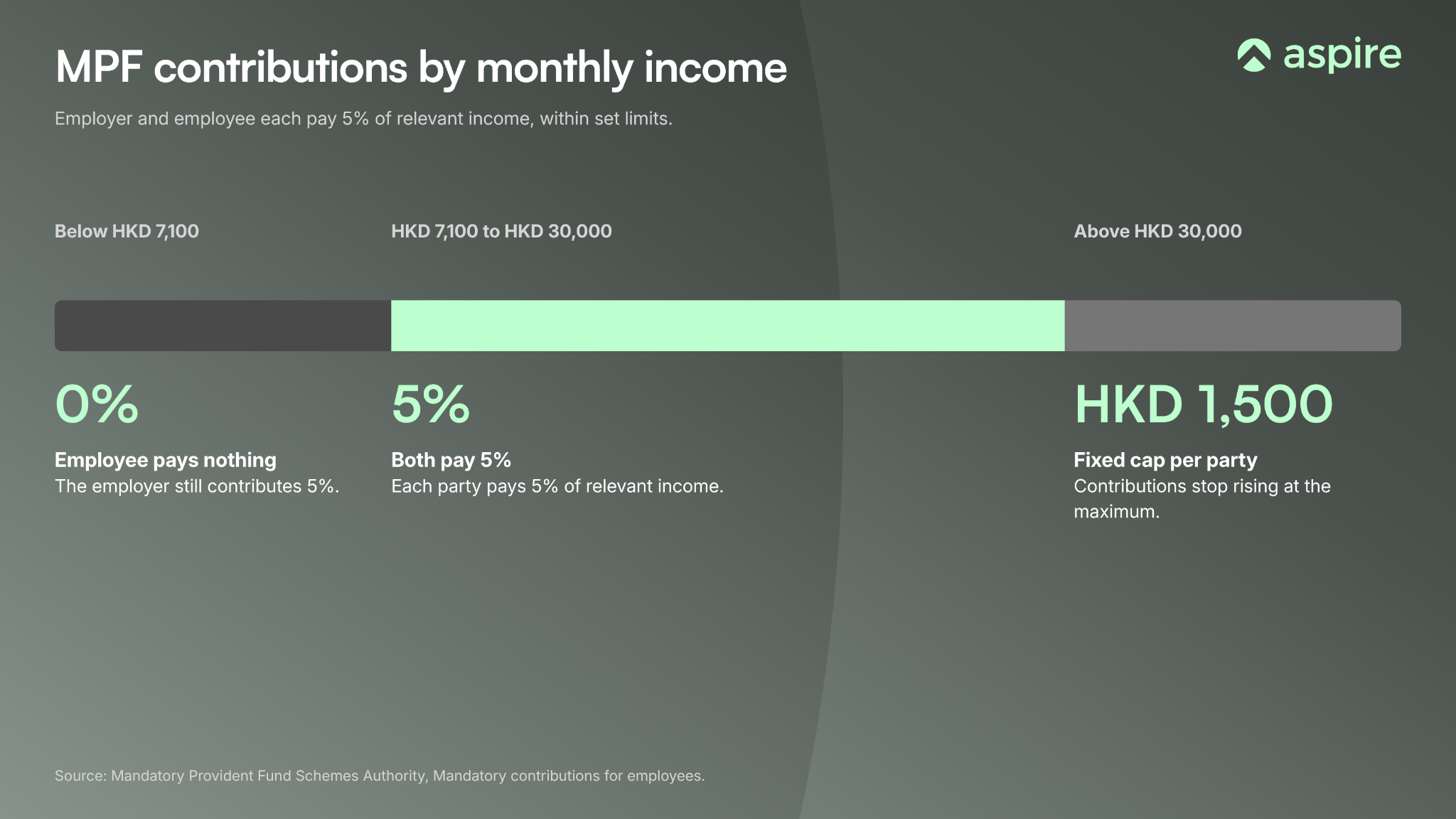
MPF is 5% from the employer and 5% from the employee. Relevant income is capped at HKD 30,000 a month, so the maximum is HKD 1,500 each.⁴
Wages are due within 7 days of the wage period. Late payment attracts interest.⁵
Annual leave runs from 7 to 14 days. It grows with years of service.¹
Severance and long service pay are capped at HKD 390,000. The monthly wage used in the formula is capped at HKD 22,500.⁶
Hong Kong employment laws put most employer duties in 1 place, the Employment Ordinance (Cap. 57), and add the Minimum Wage Ordinance, the MPF rules and the Employees' Compensation Ordinance on top. Every employee gets basic protections from day 1, and the richer rights unlock once a contract counts as continuous.¹
This guide walks through contracts, wages, MPF, leave, termination and severance for employers. It also shows how to run payroll and MPF from your Aspire business account so the deadlines are easy to hit.
Who does the Employment Ordinance cover?
The Employment Ordinance covers all employees, whether full-time or part-time, and gives them core protections such as wage payment and limits on deductions. Employees on a continuous contract get further rights such as rest days, paid annual leave, sickness allowance, severance payment and long service payment.¹
The table below shows how the 2 tiers differ.
| Tier | Who qualifies | Main rights |
|---|---|---|
| Basic protection | Every employee | Wages on time, limits on deductions, statutory holidays, minimum wage |
| Continuous contract | Employees meeting the 4-week test | Rest days, paid annual leave, sickness allowance, maternity and paternity leave, severance and long service pay |
What is a continuous contract?
A contract is continuous when the employee has worked for 4 weeks or more, with at least 17 hours in each week. Under the rule that took effect on 18 January 2026, a week under 17 hours still counts when the employee works 68 hours or more across the 4-week period.²
The old test required 18 hours in each week, and the change is not retrospective. The employer carries the burden of proving that a contract is not continuous, so part-time rosters are worth reviewing.²
What must an employment contract include?
Employers and employees are free to agree terms, but any term that cuts a right under the Ordinance is void.⁷ A written contract is the cleanest way to show what was agreed, and the Labour Department publishes notes for preparing one.⁷
At a minimum, a contract should state:
- Wages, including the rate, overtime rate and any allowances.
- The wage period, for example monthly.
- The notice period needed to end the contract.
- Probation terms, if any, with the length stated.
- Leave entitlements at or above the statutory floor.
The guide to the employment contract covers clause wording in more detail. Employers should also keep wage and employment records for each employee, such as hours worked, wages paid and leave taken.⁵
A clear org chart helps here too, because job titles and reporting lines feed the contract. See what an organizational chart is for a quick structure.
What is the minimum wage in Hong Kong?
The statutory minimum wage is HKD 43.1 per hour from 1 May 2026, up from HKD 42.1.³ It applies to employees whatever their mode of employment, including full-time, part-time, monthly-rated, daily-rated and casual staff.³
If a wage period spans 1 May 2026, the new rate applies only to hours worked on or after that date.⁸ The rate is reviewed every year, so payroll settings need a check each spring.
When must wages be paid?
Wages are due when the wage period ends, and employers must pay them within 7 days. Failing that, the employer must pay interest on the outstanding amount.⁵
Late pay is also an enforcement priority. Directors and responsible persons of a company can be held liable for wage offences, not only the company itself.⁹
How much MPF must employers pay?
Employers and employees each contribute 5% of the employee's relevant income, subject to minimum and maximum income levels. The employer pays its share from its own funds and deducts the employee's share from wages.⁴
For a deeper primer, read the guide to what MPF is, and use the MPF calculator to check a payslip.
What are the MPF income levels?
The levels depend on how the employee is paid. Below the minimum, only the employer contributes. Above the maximum, contributions stop rising.⁴
| Pay basis | Minimum relevant income | Maximum relevant income | Cap per party |
|---|---|---|---|
| Monthly | HKD 7,100 | HKD 30,000 | HKD 1,500 |
| Weekly | HKD 1,960 | HKD 7,000 | HKD 350 |
| Daily | HKD 280 | HKD 1,000 | HKD 50 |
When are MPF contributions due?
First-time contributions are due by the next contribution day after the month in which the employee's 60th day of employment falls. For monthly-paid staff, contributions are generally due on the 10th of the following month, so September's contributions fall due by 10 October.⁴
New employees get a contribution holiday on their own share for the first 30 days of employment, but the employer share is still payable from day 1.⁴ Payroll tools that auto-calculate both sides remove most of the risk here.
What leave do employees get?
Employees on a continuous contract are entitled to rest days, statutory holidays, annual leave, sickness allowance and family leave. The table gives the headline rule for each.
| Entitlement | Who qualifies | What the employer must provide |
|---|---|---|
| Rest days | Continuous contract | At least 1 rest day of 24 hours in every 7 days¹ |
| Statutory holidays | All employees get the days; holiday pay needs 3 months' continuous service | 15 days in 2026, rising to 16 in 2028 and 17 in 2030¹⁰ |
| Annual leave | After 12 months' continuous service | 7 to 14 days, paid¹ |
| Sickness allowance | Continuous contract, 4 or more consecutive sick days, medical certificate | 4/5 of average daily wages¹¹ |
| Maternity leave | Female employees; pay needs 40 weeks' continuous service | 14 weeks¹² |
| Paternity leave | Male employees | 5 days per child⁷ |
How does annual leave grow?
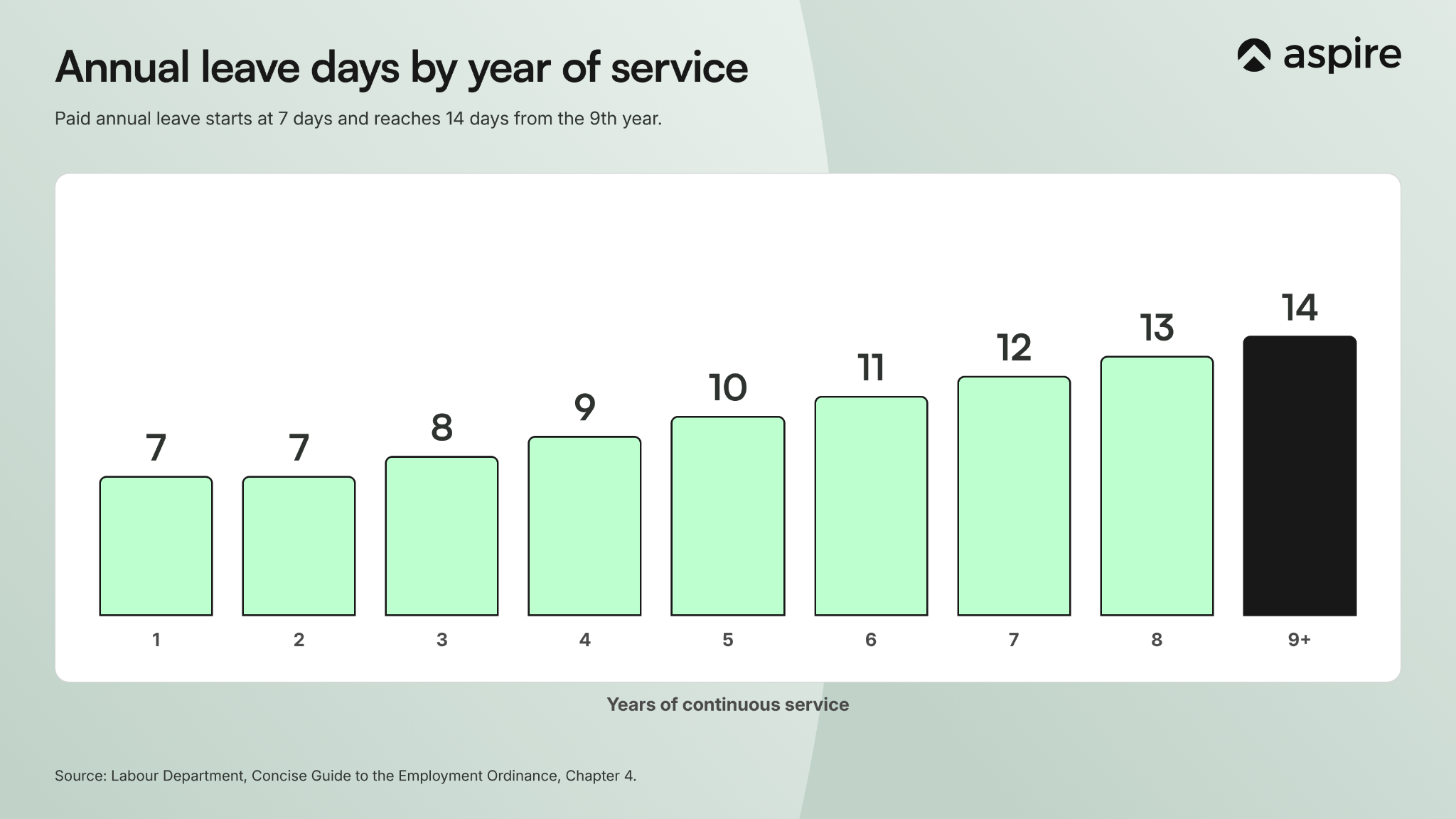
Annual leave starts at 7 days and rises to 14 days by the 9th year of service. It must be taken within 12 months after the leave year it was earned.¹
| Years of service | Annual leave days |
|---|---|
| 1 | 7 |
| 2 | 7 |
| 3 | 8 |
| 4 | 9 |
| 5 | 10 |
| 6 | 11 |
| 7 | 12 |
| 8 | 13 |
| 9 or above | 14 |
The employer sets the timing after consulting the employee and must confirm it in writing at least 14 days ahead, unless a shorter period is agreed.¹ During employment, payment in lieu is allowed only for leave beyond 10 days, though on termination untaken leave is paid out.¹
How do statutory holidays and sick days work?
Paid statutory holidays cannot be swapped for cash. An employer must not make any form of payment in lieu of granting a holiday.¹
Sickness days build up at 2 paid days per completed month in the first 12 months and 4 days per month after that, up to a maximum of 120 days.⁷ The allowance is 4/5 of average daily wages, and employers can ask for a medical certificate.¹¹
How can an employer end a contract lawfully?
An employer can end a continuous contract with notice or payment in lieu of notice, and the notice must be at least 7 days if the contract sets a period. If the contract is silent, the notice period is at least 1 month.¹³
Payment in lieu is based on the employee's average wages over the preceding 12 months.¹³
What notice applies during probation?
In the first month of probation, no notice or payment in lieu is needed. After that, the continuous-contract rules apply, with an agreed period of at least 7 days.¹³
When is summary dismissal allowed?
Summary dismissal, without notice, is limited to wilful disobedience of a lawful and reasonable order, misconduct, fraud or dishonesty, and habitual neglect of duties. Striking is not a lawful ground.¹³
Who cannot be dismissed?
The Ordinance bars dismissal in several protected situations, and the fine for breaching it is HKD 100,000.¹³
- A confirmed pregnant employee who has served notice of pregnancy.
- An employee on paid sick leave.
- An employee who has given evidence in certain proceedings.
- An employee involved in union activity.
- An employee injured at work, before a compensation agreement or certificate of assessment.
When is severance or long service pay due?
Severance payment applies to redundancy-type dismissals after 24 months of continuous service. Long service payment applies after 5 years, on grounds such as an unrenewed fixed-term contract, lay-off, death or ill-health resignation. An employee cannot receive both.⁶
The guide to long service payment in Hong Kong goes deeper on calculations.
| Point | Severance payment | Long service payment |
|---|---|---|
| Minimum service | 24 months | 5 years |
| Typical trigger | Redundancy, or dismissal that is not summary dismissal | Unrenewed fixed-term contract, lay-off, death, ill-health resignation |
| Claim step | Written notice within 3 months of dismissal | No claim notice needed |
| Payment deadline | Within 2 months of the claim notice | Within 7 days of termination |
How are the payments calculated?
For monthly-paid staff, the formula is last full month's wages × 2/3 × years of service. The wage used is capped at HKD 22,500, so each year of service is worth at most HKD 15,000.⁶
The total is capped at HKD 390,000 and part-years are pro-rated.⁶ An employee at the wage cap with 10 years' service would be owed HKD 150,000.
What changed with MPF offsetting?
Since 1 May 2025, employers can no longer use the accrued benefits of mandatory MPF contributions to offset the post-transition portion of these payments.¹⁴ Service before that date can still be offset, so payments for long-serving staff are split into 2 portions.⁶
The Labour Department runs a subsidy scheme to share the cost of the post-transition portion.¹⁴ Budgeting for the cash cost matters, so see the guide to cash flow management.
What penalties apply for breaches?
Most Employment Ordinance offences carry a fine of HKD 50,000, and the worst cases add imprisonment. The table lists the main ones.
| Breach | Maximum penalty |
|---|---|
| Not granting rest days or holidays ¹ | HKD 50,000 fine |
| Not paying annual leave pay ¹ | HKD 50,000 fine |
| Not paying sickness allowance ¹¹ | HKD 50,000 fine |
| Late severance payment ⁶ | HKD 50,000 fine |
| Wilful non-payment of long service payment ⁶ | HKD 350,000 fine and 3 years' imprisonment |
| Dismissing a protected employee ¹³ | HKD 100,000 fine |
What insurance must employers hold?
An employer must hold employees' compensation insurance for every employee, including part-timers. The minimum cover is HKD 100 million per event, rising to HKD 200 million above 200 employees.¹⁵
See the guide to business insurance in Hong Kong for providers and costs.
What should employers check every month?
A monthly rhythm keeps most obligations on track. Use this checklist.
- Confirm the minimum wage is met for every hourly-rated employee.
- Pay wages within 7 days of the wage period ending.
- Pay MPF by the 10th and keep both shares in the payroll file.
- Update leave balances for annual leave and sickness days.
- Review part-time hours against the 17-hour and 68-hour tests.
- Update staff costs in your budget and overheads.
Payroll costs also create accrued expenses, such as untaken leave, that belong in your books. Choosing a pay run approach is easier with payroll methods explained.
How can Aspire help with payroll and MPF?
Aspire lets you run payroll, MPF and contractor payments from 1 account, so wage deadlines and contribution days are handled in 1 place. See the payroll use case for how it fits together.
Local HKD payments over FPS are free, so a monthly pay run does not cost extra in transfer fees. Corporate cards can be limited by department or project, and expense management categorises spend automatically and syncs with Xero, QuickBooks and NetSuite. Reimbursements are covered in managing employee reimbursement expenses.
Hiring abroad adds another layer, so read how to hire overseas employees. New founders can also review the Hong Kong private limited company basics first.
Why Hong Kong Businesses Choose Aspire
Payroll and MPF are 2 of the biggest recurring costs in a Hong Kong business, and Aspire supports the accounts, cards and payments around them.
💱 FX spreads from 0.18%, up to 3x cheaper than traditional banks. This applies across 130+ countries and 40+ currencies through Aspire's multi-currency account. It's useful for anything from paying overseas contractors to settling international payments without losing margin to markup.
💰 1.2% unlimited cashback applies on every corporate card transaction, with no monthly cap. It kicks in automatically on eligible spend, with no minimum threshold to hit first. Over time, it quietly turns routine business spend into working capital.
🌐 Local transfer network, not multi-hop SWIFT chains, is how Aspire routes most payments. This means faster settlement and fewer intermediary fees eating into your payment before it reaches the recipient. It also reduces the chance of funds being held up for review at a correspondent bank along the way.
💸 Fixed USD 8 inbound SWIFT fee, tracked end-to-end with SWIFT GPI, applies when SWIFT is the right rail for your payment. There are no surprise deductions from correspondent banks along the way, so the amount you're quoted is the amount that arrives. You can also download payment confirmation instantly from the app, without calling the bank.
⚡ Approved in as little as 1 business day, with no branch visits and no paperwork stacks. Applications are completed entirely online, from document upload to approval. There's no waiting weeks on a relationship manager to call you back.
Open a free multi-currency business account built for Hong Kong SMEs, or explore how Aspire's corporate card fits into your day-to-day spend.
Frequently Asked Questions
The statutory minimum wage is HKD 43.1 per hour from 1 May 2026.³
Employees get 15 statutory holidays a year from 2026, rising to 16 in 2028 and 17 in 2030.¹⁰
An employer pays 5% of relevant income, capped at HKD 1,500 a month for employees earning HKD 30,000 or more.⁴
Wages must be paid within 7 days after the wage period ends, or interest becomes payable.⁵
Only for summary dismissal grounds such as misconduct, fraud or habitual neglect of duties. Otherwise notice or payment in lieu is required.¹³
It is due within 7 days of termination, after 5 years of continuous service on a qualifying ground.⁶
Yes. Every employee gets basic protections, and part-timers on a continuous contract get further rights.²
Sources
- Labour Department, A Concise Guide to the Employment Ordinance, Chapter 4: Rest Days, Holidays and Leave (government guide)
- Labour Department, Employment (Amendment) Ordinance 2025 (government page)
- Hong Kong Government, New Statutory Minimum Wage rate of $43.1 per hour takes effect today (government press release)
- Mandatory Provident Fund Schemes Authority, Mandatory contributions for employees (regulator page)
- Labour Department, A Concise Guide to the Employment Ordinance, Chapter 3: Wages (government guide)
- Labour Department, A Concise Guide to the Employment Ordinance, Chapter 11: Severance Payment and Long Service Payment (government guide)
- Labour Department, Notes for preparing an employment contract (government guide)
- Labour Department, Concise Guide to Statutory Minimum Wage 2026 (government guide)
- Labour Department, Liability to Pay Wages (government guide)
- Labour Department, Employment (Amendment) Ordinance 2021 on statutory holidays (government page)
- Labour Department, A Concise Guide to the Employment Ordinance, Chapter 5: Sickness Allowance (government guide)
- Labour Department, Maternity Protection (government guide)
- Labour Department, A Concise Guide to the Employment Ordinance, Chapter 9: Termination of Contract of Employment (government guide)
- Labour Department, Abolition of MPF Offsetting Arrangement (government page)
- Labour Department, A Guide to Employees' Compensation Insurance (government guide)
This blog is for general information only and does not constitute financial, legal, tax, or professional advice. Aspire’s services are subject to the terms outlined in our 'Terms of Service' and 'Pricing' pages. We make no guarantees as to the accuracy, completeness, or timeliness of the content, and past results do not indicate future performance. Always consult a qualified professional before acting on any information provided.
Galih Gumelar
Writer
Galih is a seasoned writer specialising in macroeconomics, business, finance and politics. With a writing history at CNN Indonesia, The Jakarta Post, and various other reputed organisations, Galih leverages his broad range of experiences to create insightful resources for those wanting to start a business.
Aspire Launchpad
Start Your Business with Aspire Launchpad
From incorporation to venture capital, we connect you with trusted service providers to make your entrpreneurial journey seamless.

Latest articles

Starting a Business •
Business Phone Line Hong Kong: Landline, Virtual or SIM?
Compare landline, virtual +852 and business SIM options for your Hong Kong company, with documents, setup times and costs.

Guides •
Dependant Visa Hong Kong: Requirements and Process
Learn who can sponsor a dependant visa in Hong Kong, the documents, fees, processing time, work rights and how to extend stay.

Starting a Business •
Virtual Office Hong Kong: Cost and Top Providers
Learn what a virtual office in Hong Kong costs, which providers publish prices, and how to use one for company and business registration.
Start your journey with Aspire
Open your free account