



What Is APR? Meaning, Formula and Examples

Galih Gumelar

Summary
APR is the yearly cost of borrowing. It combines the interest rate with related fees such as handling and service charges.²
A flat rate understates the cost. A 0.7% monthly flat rate on a 12-month loan works out to an APR of 16.26%.³
Banks must state APR on personal loans and credit cards. Money lenders show a rate under the Money Lenders Ordinance, which may not compare directly.¹
Money lender rates are capped. The statutory cap is 48% a year, and a court may reopen a loan above 36%.⁴
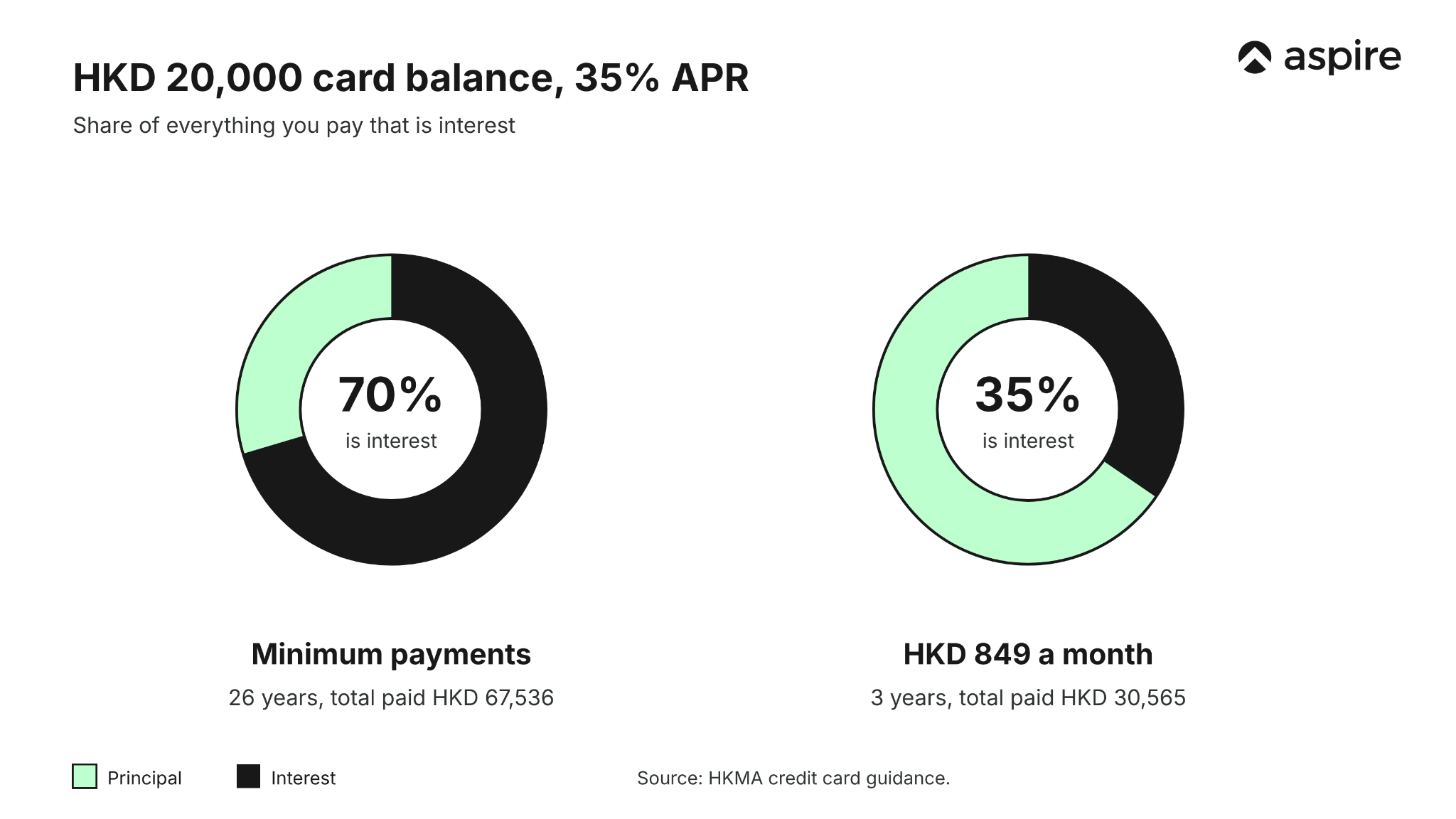
Minimum card payments cost far more. Clearing a HKD 20,000 balance with minimum payments takes 26 years in the HKMA's example.⁵
Compare total repayment as well as APR. Use the same amount and tenor for every quote.¹
APR, short for annualised percentage rate, is the yearly cost of a loan or credit card, with interest and fees combined into 1 figure. In Hong Kong the Investor and Financial Education Council (IFEC) calls it a reference rate for comparing the borrowing cost of different products.¹
We wrote this guide for Hong Kong business owners and finance leads who compare loans, overdrafts and cards. It explains what APR includes, how to calculate it, which rules apply in Hong Kong and which traps to avoid.
What is APR?
APR is the annualised percentage rate, a single yearly figure that shows the total cost of borrowing. The IFEC describes it as the basic interest rate plus other fees and charges of a loan product, expressed as an annualised rate.¹
The HKMA tells borrowers to use APR to compare personal credit products from different banks, and says it reflects the actual borrowing cost.² A lender can advertise a low monthly rate, but only the APR puts interest and fees on the same yearly scale.
What does APR include and exclude?
APR includes interest and related fees such as handling and service charges, but not penalty charges.² The table shows the usual split.
| Usually in the APR | Usually not in the APR |
|---|---|
| Basic interest rate | Late payment fees |
| Handling fees | Early repayment penalties |
| Service charges | Other charges triggered by breaking the loan terms⁶ |
That is why 2 loans with the same interest rate can have different APRs once 1 of them adds a handling fee.
How is APR different from a flat rate?
A monthly flat rate shows interest only, while APR shows the annual cost including fees. The table compares the rates you will meet when you borrow in Hong Kong.
| Rate | What it covers | Where you meet it |
|---|---|---|
| Monthly flat rate | Interest only, charged on the original loan amount | Personal instalment loans² |
| Annual interest rate | Interest only, shown yearly | Loan agreements and quotes¹ |
| APR | Interest plus related fees, annualised | Bank loans and credit cards¹ |
| Money lender effective rate | Interest measured under the Money Lenders Ordinance, sometimes labelled APR | Licensed money lender loans¹ |
Instalment loans usually charge interest on the full amount using a monthly flat rate, while revolving loans charge daily interest on the amount drawn.² The HKMA warns that a monthly flat rate barely above 0% can still carry a high annual cost.²
How do you calculate APR?
APR is the yearly rate that makes the present value of all your repayments equal the amount you actually received. Lenders use a net present value method, and banks follow the method set by the Hong Kong Association of Banks.⁶ ¹
What is the APR formula?
In practice you solve for the monthly rate (r), then annualise it. The formula has 2 steps.
- Find r. Solve for the monthly rate that discounts every repayment back to the net amount received. A spreadsheet IRR or RATE function does this.
- Annualise it. Apply APR = (1 + r)^12 − 1, where r is the monthly rate as a decimal.
For example, a monthly rate of 1.5% (r = 0.015) gives (1.015)^12 − 1 = 19.56%. The IFEC also offers a Borrowing and Debt Calculator that converts flat rates and fees to APR.¹
How does a flat rate become an APR?
The IFEC's example is a HKD 50,000 loan over 12 months at a 0.7% monthly flat rate, which pays HKD 4,200 in interest and annualises to 16.26%.³ The table shows each step and what a 1% handling fee adds.
| Measure | Figure | How it is reached |
|---|---|---|
| Monthly flat rate | 0.7% | Quoted by the lender |
| Total interest | HKD 4,200 | 50,000 × 0.7% × 12 |
| Monthly repayment | HKD 4,516.67 | (50,000 + 4,200) ÷ 12 |
| Naive annual rate | 8.4% | 0.7% × 12 |
| APR | 16.26% | Monthly rate of about 1.263%, compounded over 12 months |
| APR with a 1% handling fee | About 18.49% | HKD 500 fee deducted from the amount received |
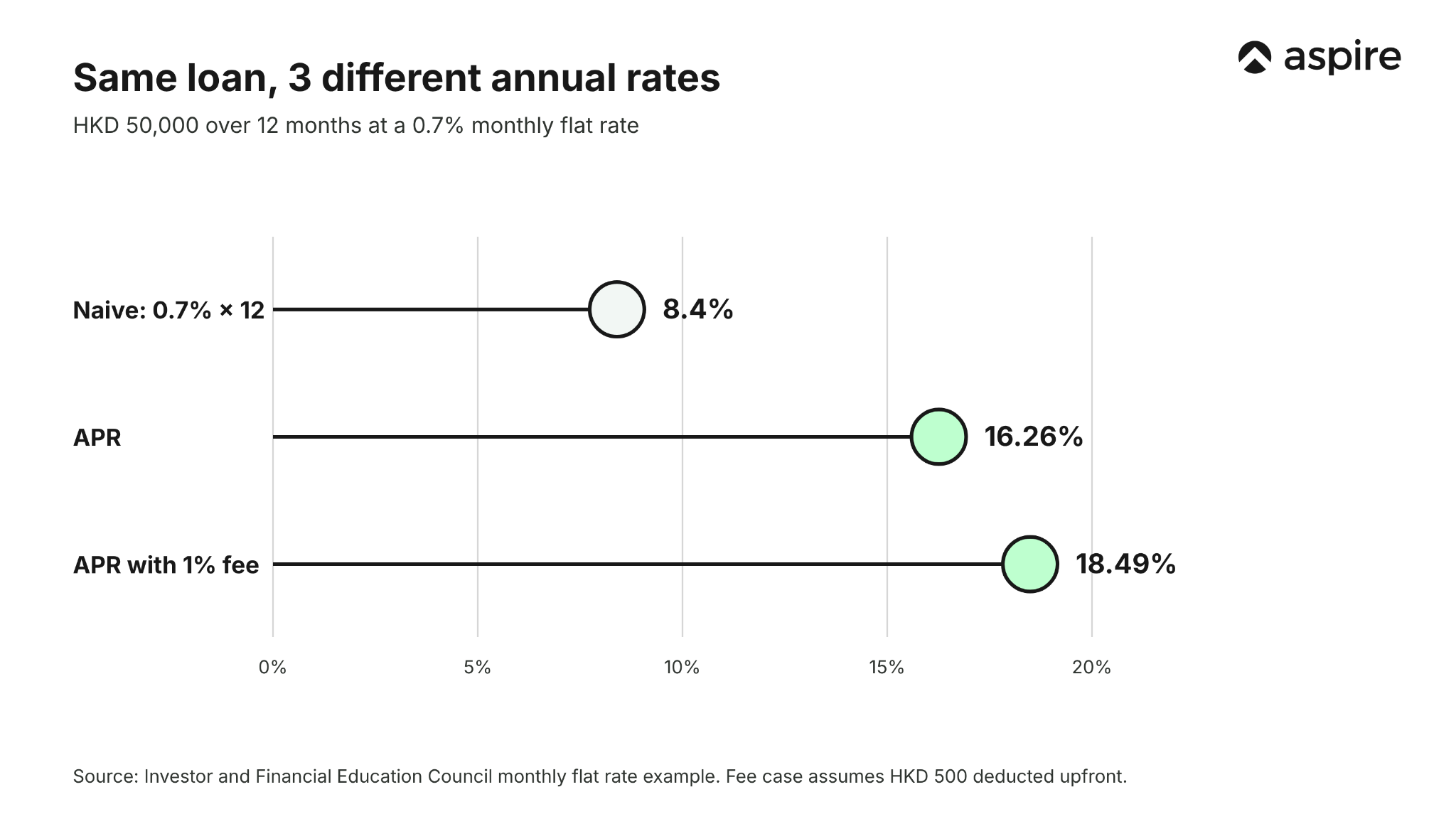
Multiplying 0.7% by 12 gives only 8.4%, and the IFEC warns that this is not the annual rate.³ The gap exists because you repay principal every month, so you owe about half the loan on average while interest is charged on the full HKD 50,000.
Must Hong Kong lenders show APR?
Banks in Hong Kong must state the APR of personal loans and credit cards, and licensed money lenders must show an annual rate calculated under the Money Lenders Ordinance.¹ The 2 measures differ, so the figures may not be directly comparable.¹
The Code of Banking Practice says advertisements that mention an interest rate should indicate the APR where relevant.² If more than 1 interest rate applies during a loan, the code says the bank should give an APR that takes all of them into account.⁷
A money lender's rate may be labelled Effective Rate, APR or True Annual Percentage Rate of Interest.¹ Since 30 December 2022 the statutory cap on lending rates is 48% a year, down from 60%, and a court may reopen a loan above 36% as extortionate, down from 48%.⁴ The Companies Registry website offers a calculator to check a loan's effective rate.⁴
Borrowing cost is only 1 input into your funding plan. Our business loans guide and startup funding options cover the alternatives, and a cash flow forecast shows how much repayment your cash flow management can carry. The debt-to-equity ratio shows how much leverage a lender will see, and longer payment terms with suppliers can reduce how much you need to borrow.
How does APR work on credit cards?
On a credit card, APR converts the monthly interest rate and fees into a yearly figure. The HKMA gives an example where a 2.5% monthly interest rate equals an APR of 35%.⁵
Retail purchases generally enjoy an interest-free period when there is no outstanding balance. Cash advances generally have none, and interest builds daily from the withdrawal date until you repay in full.⁵
What does the minimum payment cost?
Paying only the minimum can multiply the cost of a card balance. The minimum payment is the sum of all interest and fees plus at least 1% of the outstanding principal.⁵
The HKMA's example is a HKD 20,000 balance at 2.5% monthly interest, a 35% APR, with no new spending.⁵
| Monthly repayment | Time to clear | Total paid | Interest paid |
|---|---|---|---|
| Minimum payment | 26 years | HKD 67,536 | HKD 47,536 |
| HKD 849 | 3 years | HKD 30,565 | HKD 10,565 |
Business cards that carry credit work the same way, so check the APR, late fees and cash advance charges before you apply. Our guides to corporate credit card fees and how to get a corporate credit card cover the fee side, and prepaid cards versus business credit cards compares the 2 types. Card fees such as the foreign transaction fee sit outside the APR calculation.
Why Hong Kong Businesses Choose Aspire
Understanding APR keeps borrowing costs visible, and Aspire supports the accounts, cards and payments that run the rest of a Hong Kong business's finances.
💱 FX spreads from 0.18%, up to 3x cheaper than traditional banks. This applies across 130+ countries and 40+ currencies through Aspire's multi-currency account. It's useful for anything from paying overseas suppliers to settling international payments without losing margin to markup.
💰 1.2% unlimited cashback applies on every corporate card transaction, with no monthly cap. It kicks in automatically on eligible spend, with no minimum threshold to hit first. Over time, it quietly turns routine business spend into working capital.
🌐 Local transfer network, not multi-hop SWIFT chains, is how Aspire routes most payments. This means faster settlement and fewer intermediary fees eating into your payment before it reaches the recipient. It also reduces the chance of funds being held up for review at a correspondent bank along the way.
💸 Fixed USD 8 inbound SWIFT fee, tracked end-to-end with SWIFT GPI, applies when SWIFT is the right rail for your payment. There are no surprise deductions from correspondent banks along the way, so the amount you're quoted is the amount that arrives. You can also download payment confirmation instantly from the app, without calling the bank.
⚡ Approved in as little as 1 business day, with no branch visits and no paperwork stacks. Applications are completed entirely online, from document upload to approval. There's no waiting weeks on a relationship manager to call you back.
Open a free multi-currency business account built for Hong Kong SMEs, or explore how Aspire's corporate card fits into your day-to-day spend.
Frequently Asked Questions
APR stands for annualised percentage rate, which some lenders write as annual percentage rate. Both mean the yearly cost of a loan or card, including fees.¹
No. The interest rate covers interest only, while APR adds related fees and expresses the total as a yearly rate.²
No. APR generally excludes late payment fees and early repayment penalties.⁶
The statutory cap is 48% a year for loans made under agreements that took effect from 30 December 2022.⁴
No. APR is the yearly cost of borrowing, while APY, or annual percentage yield, is the yearly return on savings after compounding.
Not always. APR methods differ between banks and money lenders, so compare the total repayment for the same amount and tenor.¹
Aspire gives SMEs 1 place for their business account and cards, including a corporate card with 1.2% unlimited cashback and an Advanced Card with credit approved for eligible businesses. Read each card's rates and fees before you apply.
Sources
- Investor and Financial Education Council, The Annualised Percentage Rate is what you should really look at (statutory investor education page, accessed November 2026)
- Hong Kong Monetary Authority, Personal Credit (regulator consumer guidance, accessed November 2026)
- Investor and Financial Education Council, Take a closer look at the monthly flat rate (statutory investor education page, accessed November 2026)
- HKSAR Government, Statutory limits of effective interest rates under the Money Lenders Ordinance lowered (press release, 29 December 2022)
- Hong Kong Monetary Authority, Credit cards (regulator consumer guidance, undated)
- HSBC Hong Kong, What is APR (bank explainer, accessed November 2026)
- Community Legal Information Centre, Interest on loans (legal information page, accessed November 2026)
This blog is for general information only and does not constitute financial, legal, tax, or professional advice. Aspire’s services are subject to the terms outlined in our 'Terms of Service' and 'Pricing' pages. We make no guarantees as to the accuracy, completeness, or timeliness of the content, and past results do not indicate future performance. Always consult a qualified professional before acting on any information provided.
Galih Gumelar
Writer
Galih is a seasoned writer specialising in macroeconomics, business, finance and politics. With a writing history at CNN Indonesia, The Jakarta Post, and various other reputed organisations, Galih leverages his broad range of experiences to create insightful resources for those wanting to start a business.
Aspire Launchpad
Start Your Business with Aspire Launchpad
From incorporation to venture capital, we connect you with trusted service providers to make your entrpreneurial journey seamless.

Latest articles

Incorporation •
Business Insurance Hong Kong: Types and Costs
Learn which business insurance Hong Kong companies must buy, which optional covers suit SMEs, what drives the cost and how to buy from a licensed provider.

Guides •
Postal Code in Hong Kong: What to Enter?
Learn why Hong Kong has no postal code, what to enter in online form fields and how to write a Hong Kong address correctly for mail and shipping.

Incorporation •
What Is IR56B? HK Employer's Return Explained
Learn what IR56B is, who must file it, which related forms apply and how to e-file the Hong Kong employer's return within 1 month.
Start your journey with Aspire
Open your free account