


Finance tech stack for startups: Banking, accounting, and spend tools

Bintang Lestada

Summary
A finance tech stack covers 6 layers of work, from moving money and controlling spend to billing customers, keeping the books, paying people, and planning ahead
Grow your finance tech stack when an operational trigger appears, such as a first hire abroad or a second entity, because triggers fit every business model
The layer most stacks skip is cross-border, which covers multi-currency accounts, FX, and paying people and suppliers abroad
A US LLC wholly owned by a foreign person can owe a Form 5472 filing, and a missed one carries a USD $25,000 IRS penalty
About 73% of SaaS companies in The SaaS CFO's 2026 survey still forecast in spreadsheets
Before you add any tool, check that it syncs with your accounting system in every currency and entity you operate
One Aspire account to manage your business finances in one place.
Get a business account¹, issue corporate cards², manage expenses, and automate financial workflows, all from one powerful platform built for modern businesses.
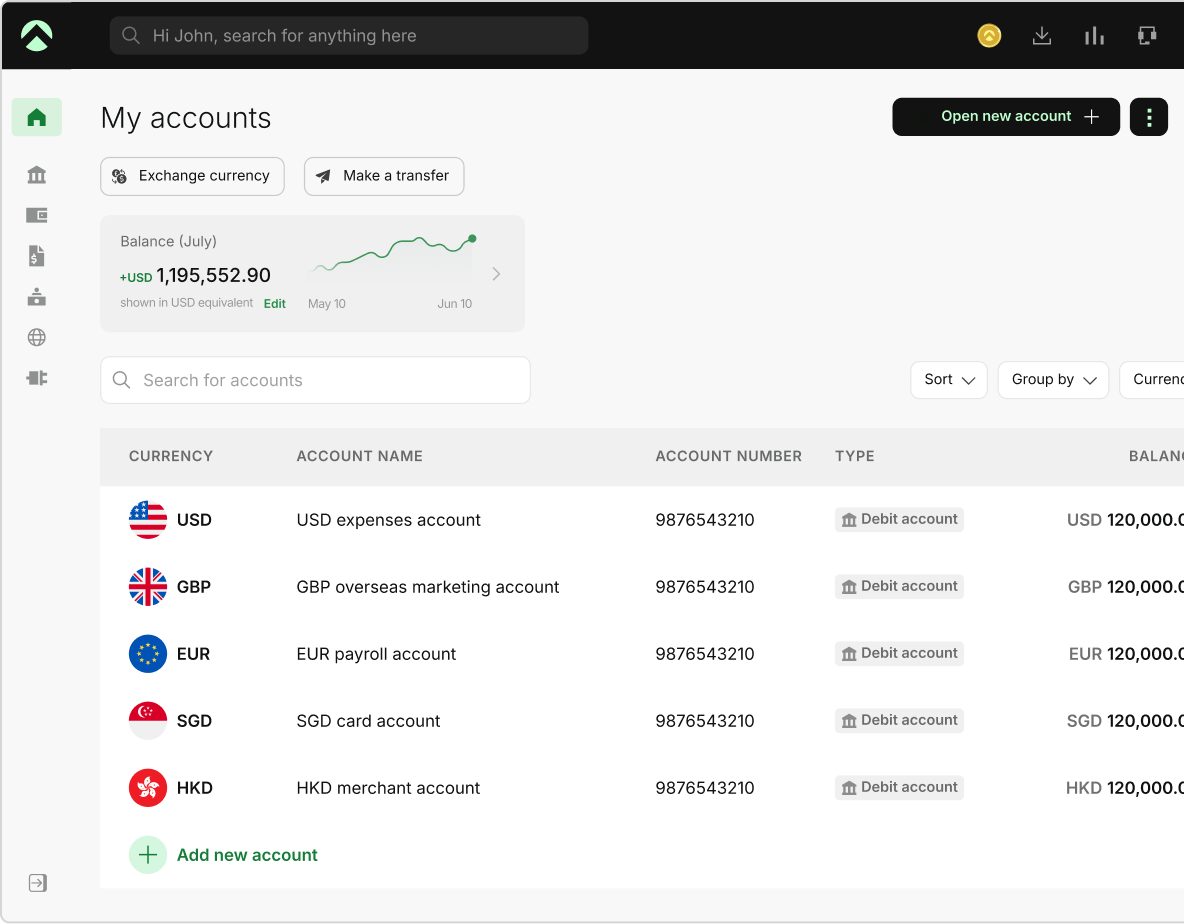
Your tools decide how fast you close the month, how cleanly you pay an overseas contractor, and how long due diligence takes.
Most founders build their finance tech stack one sign-up at a time. A bank account here, a card there, and a spreadsheet for everything else. Then a second currency or foreign entity arrives, and the tools stop agreeing with each other.
Here's how a finance tech stack actually fits together: the 6 layers, what to add and when, and the cross-border setup.
What is a finance tech stack?
A finance tech stack is a mix of different software a business uses to move money, control spend, bill customers, keep its books, pay its people, and plan. A good finance tech stack shares data between tools, so you enter each transaction once.
In practice, a good finance tech stack has 3 traits:
- One source of truth for your numbers
- Automatic syncs between tools
- Ability to add a currency or entity without starting over
Here's a quick test for your current finance tech stack:
When a payment leaves your account today, how many tools does it touch before it lands in your books?
If the answer includes a CSV export or retyping, that's where your finance stack is broken.
People often use these terms interchangeably, but they mean different things:
| Term | What it usually means |
|---|---|
| Finance tech stack, finance stack, or financial stack | The tools a company uses to run its own finances |
| CFO tech stack | The same stack from the finance leader's seat, including planning and board reporting |
| Fintech stack | The infrastructure a company uses to build financial products for its customers, such as APIs and sponsor banks |
The 6 layers of a modern finance tech stack
If you've seen an office of the CFO market map, you know the list of finance tools is long. The SaaS CFO's 2026 survey sorts them into 22 categories. You don't need a tool in each one. You need to cover 6 jobs.
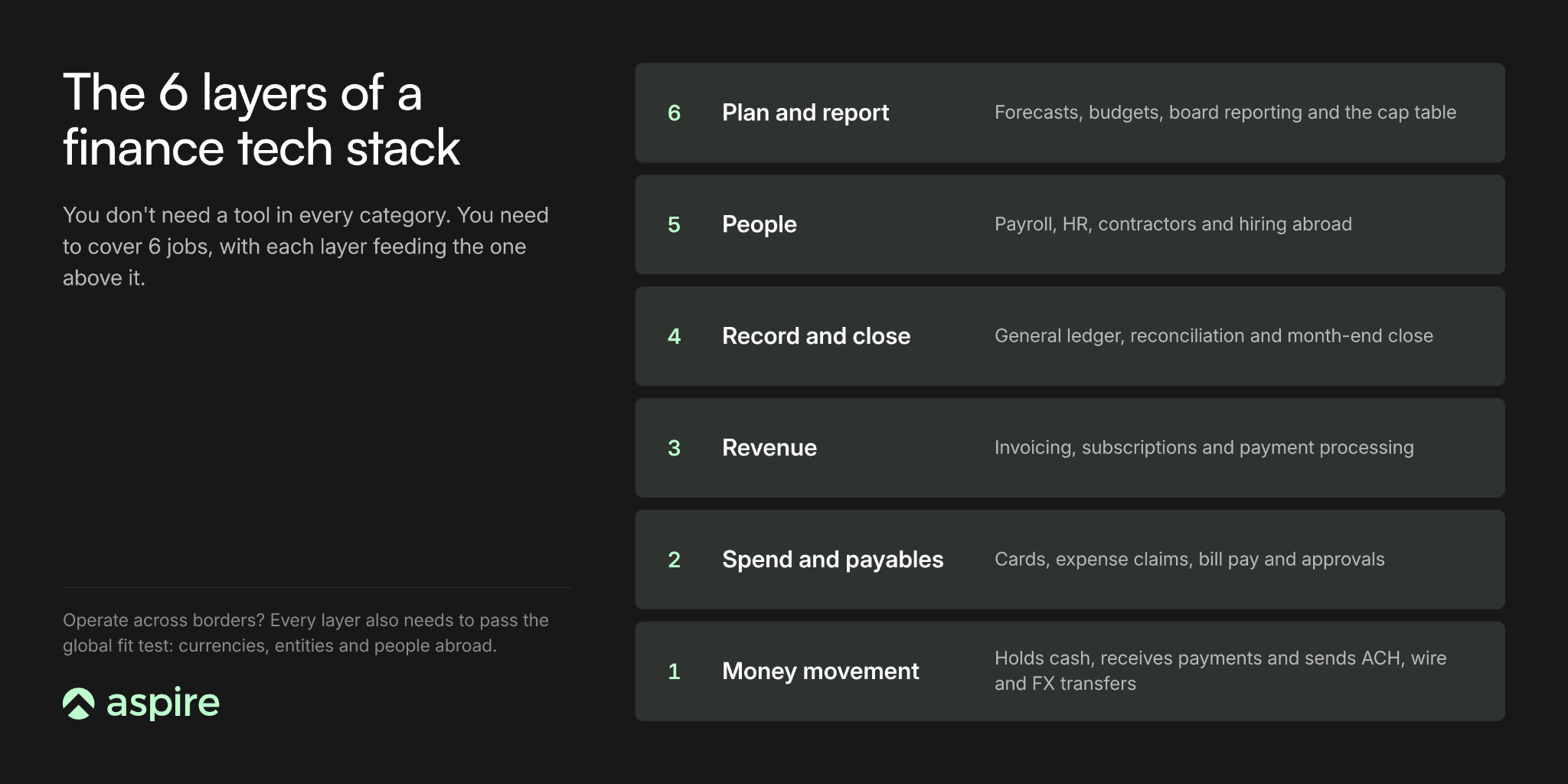
Once you operate across borders, every layer of your finance tech stack also needs to pass the global test in the last column.
| Layer | Job it does | Common tools | Global fit test |
|---|---|---|---|
| 1. Money movement | Holds cash, receives payments, and sends ACH, wire, and FX transfers | Aspire¹, Mercury, Relay, Chase | Can you hold, receive, and pay in the currencies you actually use? |
| 2. Spend and payables | Cards, expense claims, bill pay, and approvals | Aspire¹, Ramp, Brex, BILL, Expensify | Can employees abroad spend and get reimbursed in their own currency? |
| 3. Revenue | Invoicing, subscriptions, and payment processing | Stripe Billing, Chargebee, Maxio, invoicing inside accounting software | Can customers pay in their currency and with local methods? |
| 4. Record and close | General ledger, reconciliation, and month-end close | QuickBooks Online, Xero, NetSuite, Sage Intacct, FloQast, Numeric | Does it handle multiple currencies and more than one entity? |
| 5. People | Payroll, HR, contractors, and hiring abroad | Gusto, Rippling, Justworks, Deel, Remote | Can you pay a hire in a country where you have no entity? |
| 6. Plan and report | Forecasts, budgets, board reporting, and the cap table | Spreadsheets, planning tools such as Cube, Datarails, and Pigment, plus Carta or Pulley | Does it combine entities and currencies into one view? |
1. Money movement
This is the foundation of your finance tech stack, because every other layer reads from it. For a founder who operates only in the US, the right account depends on how money moves through your business.
Check whether you need cash or check deposits, access to lending, treasury options for idle cash, and deposit insurance that covers your balance. Once you pay suppliers or teams abroad, you also need accounts in other currencies and a clear view of each FX cost.
2. Spend and payables
This layer approves the spend before it happens and matches every receipt and bill to a transaction. Our roundup of the best expense management software compares the main options.
3. Revenue
A SaaS company with monthly plans needs subscription billing and revenue recognition. A services firm often needs only invoicing and a payment processor, so match this layer to how you actually charge.
4. Record and close
Your general ledger is the system of record. QuickBooks leads with about 26% share in The SaaS CFO's 2026 survey of 500 participants at software companies, while Sage Intacct, NetSuite, Campfire, and Rillet gain ground as companies scale.
With accounting automation, transactions from every other layer of your stack post to the ledger without manual entry.
5. People
Payroll tools pay your team and file payroll taxes. For hires abroad, an employer of record, or EOR, becomes the legal employer for you, so you can hire without a local entity.
6. Plan and report
About 73% of SaaS companies in the same survey still forecast and budget in Excel or Google Sheets instead of dedicated FP&A tools.
A spreadsheet works until the plan outgrows it. Move to planning software when you need to consolidate entities, control who can edit what, track versions, run scenarios, meet reporting requirements, or pull live data from systems.
Finance tech stack for startups: What to add, and when
Trigger events work for every founder's finance tech stack. Find the row that matches what just happened in your business:
| If this just happened | Add or upgrade | Why now |
|---|---|---|
| You incorporated and opened your first account | A business account, cards, and accounting software | Clean, separate books from your first tax filing |
| You signed your first overseas customer or supplier | Multi-currency accounts and a clear FX rate | Every conversion through USD carries an FX markup |
| You made your first hire outside the US | An EOR or a contractor payment tool | You can hire without opening an entity in that country |
| You handle more than a handful of bills a week | Bill pay with approvals and bill capture | Manual bill entry is where duplicate and late payments start |
| You opened a second legal entity | Accounting that consolidates entities, often NetSuite or Sage Intacct | Spreadsheet consolidation is hard to defend in an audit |
| Your close runs past a week, or your first audit is scheduled | Close management software | Reconciliations need owners, due dates, and an evidence trail |
| The board wants scenarios, and updating the model takes days | Planning and forecasting software | Spreadsheets struggle once several systems feed the plan |
Early on, specialist tools can make sense when they solve a specific problem and integrate cleanly with your core accounting system. An ERP becomes more relevant as entities, workflows, reporting, and controls become harder to manage across separate tools.
Point solutions only pay off if they connect. Here's how the table plays out in one finance tech stack.
Example: A global founder's finance tech stack, day 1 vs month 18
A founder runs a Delaware C corp with 4 engineers in Portugal and Mexico, and customers pay in USD and EUR.
| Layer | Day 1 | Month 18, after opening a Canadian entity |
|---|---|---|
| Money movement | US business account with a EUR account alongside | Add a CAD account for the new entity |
| Spend and payables | Company cards and receipt capture | Add bill pay with approvals |
| Revenue | Stripe for cards, bank transfers for larger invoices | No change |
| Record and close | QuickBooks Online or Xero | Move to an ERP that consolidates both entities |
| People | EOR for the engineers abroad | Local payroll in Canada |
| Plan and report | A spreadsheet model | Still a spreadsheet, until the board asks for scenarios |
The cross-border layer most finance tech stacks skip
Selling abroad is normal for small companies. Of the 271,250 identified US exporters in 2024, 97.1% were small businesses, according to the SBA Office of Advocacy's 2026 profile.
Multi-currency accounts and FX
If you receive EUR and pay EUR suppliers but hold only USD, you pay an FX markup twice. Holding the currencies you use lets you convert only when you choose to.
Here's an illustrative example. A 1% markup on USD $40,000 of monthly supplier payments costs USD $4,800 a year. Compare international business bank accounts on the FX markup as well as the transfer fee.
Paying people and suppliers abroad
Contractors, EOR hires, and overseas suppliers each need the right form on file. Add this paperwork to your finance tech stack before you pay anyone abroad:
- Foreign individuals: Request Form W-8BEN instead of a W-9, which certifies their foreign status for US tax purposes
- Foreign companies: Request Form W-8BEN-E, the entity version of the same certificate
- US contractors: Collect a W-9. The Form 1099-NEC threshold for nonemployee compensation is USD $2,000 for payments made from 2026, up from USD $600
- Every payee: Agree on the invoice currency and who covers FX costs before you pay
US filings that global founders miss
Global founders with a US entity face filings domestic founders never see, so your finance tech stack needs a calendar entry or an advisor for each.
Did you know? A foreign-owned US disregarded entity, such as a single-member LLC with a foreign owner, is treated as a corporation for Form 5472. In any year it has reportable transactions with its owner or other related parties, it files Form 5472 with a pro forma Form 1120. The penalty for not filing is USD $25,000.
Sales tax is the other one. Since the 2018 South Dakota v. Wayfair ruling, states can require out-of-state sellers to collect sales tax without a physical presence. Thresholds vary, so confirm your filings with a US tax professional.
How to evaluate fintech vendors for integration compatibility
A finance tech stack is only as good as the handoffs between its tools, such as card to ledger or billing to forecast. Check each handoff before you buy, because fixing a broken sync later means cleaning up months of records.
Ask these 6 questions before any vendor joins your finance tech stack. Get the answers in writing:
- Native sync: Does it sync directly with your accounting system, or only by CSV export?
- Currencies: Does the sync carry every currency you hold, or only USD?
- Entities: Can it handle more than one entity, and how does it map each one to your books?
- Detail: Does it push receipts, categories, and classes, or only the amount?
- Gaps: Is there an open API or webhooks for the handoffs it doesn't cover?
- Exit: What happens to your data if you leave?
A tool that fails 2 of these adds manual work every month. Test AI features the same way. Gartner found 59% of finance functions used AI in 2025, so ask vendors to run theirs on your own transactions during the trial.
Tech stack consolidation: When fewer tools win
Point solutions give you depth in one job, and platforms cut the number of handoffs. Most founders end up with a mix, so decide where each layer of the finance tech stack sits.
| Signs you need tech stack consolidation | Signs a point solution is the right call |
|---|---|
| The same transaction lives in 3 tools | One job needs depth that no platform offers |
| Month-end starts with exports and copy-paste | The tool syncs cleanly and your team uses it daily |
| You pay for overlapping features twice | Replacing it means retraining the whole team |
Vendor ownership and product roadmaps can change. Avoid building critical workflows around integrations you can't replace or export, so you can swap one layer of your finance tech stack without rebuilding the others.
Finance tech stack mistakes to avoid
These 4 patterns force a rebuild later. Each one is cheap to avoid while your finance tech stack is small:
- Buying for a company you aren't yet: An enterprise ERP before your second entity adds cost and a long setup
- Adding tools without an owner: Every tool in your finance tech stack needs one person who checks that it syncs and still earns its cost
- Ignoring currency until it hurts: Adding multi-currency support to a finance tech stack after a year of paying abroad means untangling old FX conversions
- Skipping data hygiene: Inconsistent vendor names and categories break every sync downstream
5 finance tech stack platforms to consider
Most founders start with one platform for money movement and spend, then connect it to their accounting software. Here's how 5 common options compare:
| Platform | Best for | Layers covered | Key features | Starting price | Trade-off |
|---|---|---|---|---|---|
| Aspire¹ | Founders who pay, hold, and hire across currencies | Money movement, spend, and people | Multi-currency accounts¹ in 13 currencies including USD, payments to 98+ currencies* with FX from 0.22% above mid-market, virtual corporate cards², bill pay, and an EOR powered by Deel | $0 per month. | Holds only 13 currencies |
| Mercury | US startups that bank mainly in USD | Money movement, spend, and invoicing | Free ACH, domestic wires, and real-time payments, company cards, invoicing, and bill pay | $0 per month. Paid plans add advanced invoicing | 1% conversion fee on non-USD international wires |
| Ramp | Teams that need tight spend control and bill approvals | Spend and payables | Corporate cards, expense management, bill pay with approval workflows, travel booking, and QuickBooks and Xero integrations | $0 per user per month. Plus from USD $15 per user per month, plus a platform fee | Multi-entity support and NetSuite sync need Plus |
| Brex | Teams that travel and spend in many countries | Money movement and spend | Cards accepted in 210+ countries and territories, expense management, bill pay, business accounts, and NetSuite integration | $0 per user per month. Premium from USD $12 per user per month | Multiple entities need Premium |
| Airwallex | Businesses that collect and hold many currencies | Money movement, spend, and revenue | Accounts to collect and hold 20+ currencies, local transfers to 120+ countries, multi-currency cards, invoicing, and subscription billing | $0 per user per month for up to 10 spend users. Grow from USD $12 per user per month, plus a platform fee | FX from 0.5% above interbank for major currencies and 1% for others |
Choose by your biggest gap. Mercury fits founders who stay in USD, Ramp and Brex fit teams where spend control is the main problem, and Aspire and Airwallex fit founders whose money moves across borders.
None of these replace your accounting software or planning tools. Aspire's integrations include QuickBooks and Xero.
Final thoughts
The right finance tech stack gives every tool a clear job and keeps your numbers flowing cleanly between them. A few well-integrated specialist tools often beat one platform stretched across every job. Add a tool when a trigger calls for it, and review the whole stack every time you add a country.
Frequently Asked Questions
A starter finance tech stack includes a business account, company cards, accounting software, a payment processor, and payroll. Add other tools as triggers appear.
Move when a trigger forces it, such as a second legal entity, complex revenue recognition, or an upcoming audit.
A CFO tech stack runs the company's own finances. A fintech stack is the infrastructure a company uses to build financial products for its customers.
Check that the tool syncs natively with your accounting system, carries every currency and entity you use, and pushes full transaction detail. Then confirm you can export your data if you leave.
In an early startup, the founder or first finance hire usually owns the finance tech stack. As the team grows, a controller or head of finance takes over, and each tool gets a named owner.
Sources
- https://www.thesaascfo.com/surveys/finance-accounting-tech-stack-survey/ - Sep 30, 2026
- https://emt.gartnerweb.com/ngw/globalassets/en/finance/documents/1q26-cfo-report.pdf - Sep 30, 2026
- https://advocacy.sba.gov/wp-content/uploads/2026/09/United_States.pdf - Sep 30, 2026
- https://www.irs.gov/pub/irs-pdf/i5472.pdf - Sep 30, 2026
- https://www.irs.gov/instructions/i1099mec - Sep 30, 2026
- https://www.irs.gov/forms-pubs/about-form-w-8-ben - Sep 30, 2026
- https://www.irs.gov/forms-pubs/about-form-w-8-ben-e - Sep 30, 2026
- https://www.supremecourt.gov/opinions/17pdf/17-494_j4el.pdf - Sep 30, 2026
This blog is for general information only and does not constitute financial, legal, tax, or professional advice. Aspire’s services are subject to the terms outlined in our ’Terms of Service’ and ’Pricing’ pages. We make no guarantees as to the accuracy, completeness, or timeliness of the content, and past results do not indicate future performance. Always consult a qualified professional before acting on any information provided.
Bintang Lestada
Writer
Bintang is a seasoned writer specialising in fintech, agtech, politics, and pop culture. With a writing history at VICE ASIA, Letterboxd, Whiteboard Journal and other reputable organisations, Bintang leverages their broad range of experiences to resources that educate audiences, build trust, and support business growth.
Aspire Launchpad
Supercharge your finance operations with Aspire
Find out how Aspire can help you speed up your end-to-end finance processes from payments to expense management.

Latest articles

Business Advice •
Best ERP solutions for manufacturing: features and systems to compare
Compare the best ERP solutions for manufacturing, based on their features, pricing, pros, and cons to ultimately find the right system for your business.

Expense Management •
Financial management for nonprofits: Budgeting, cash flow, and controls
Master nonprofit budgeting, cash flow forecasting, donor restrictions, financial controls, and board reporting. Complete financial management guide for founders.

Business Account •
6 best law firm accounting software options for 2026
Discover the 6 best law firm accounting software options for 2026. See how Clio, CosmoLex, LeanLaw + QuickBooks, and others handle trust accounting, billing, and reporting, plus where Aspire fits for operating finances.