


Global treasury management: Definition, benefits, challenges, and strategies

Bintang Lestada

Summary
Global treasury management gives founders control over international cash flow, currency exposure, and compliance once they're operating in more than one country
It rests on 5 pillars: cash and liquidity management, FX risk mitigation, cross-border payment infrastructure, investment management, and global compliance; each needing deliberate attention as a business scales
Left unmanaged, international cash may create real costs: FX spreads eat into margins, cash gets trapped in disconnected regional accounts, and liquidity can dry up right when it's needed most
The difference from domestic treasury mainly comes down to the number of variables at play: multiple currencies, jurisdictions, banking relationships, and payment rails instead of just one
Founders typically hit friction around compliance (including US-specific rules like OFAC sanctions screening), currency fluctuations, FX risk, fragmented technology, and cross-border payments
For growing businesses, choosing the right treasury technology, forecasting cash flow, centralizing the treasury function, using multi-currency accounts, and setting strong cash controls is achievable with a global fintech platform like Aspire
One Aspire account to manage your business finances in one place.
Get a business account¹, issue corporate cards², manage expenses, and automate financial workflows, all from one powerful platform built for modern businesses.
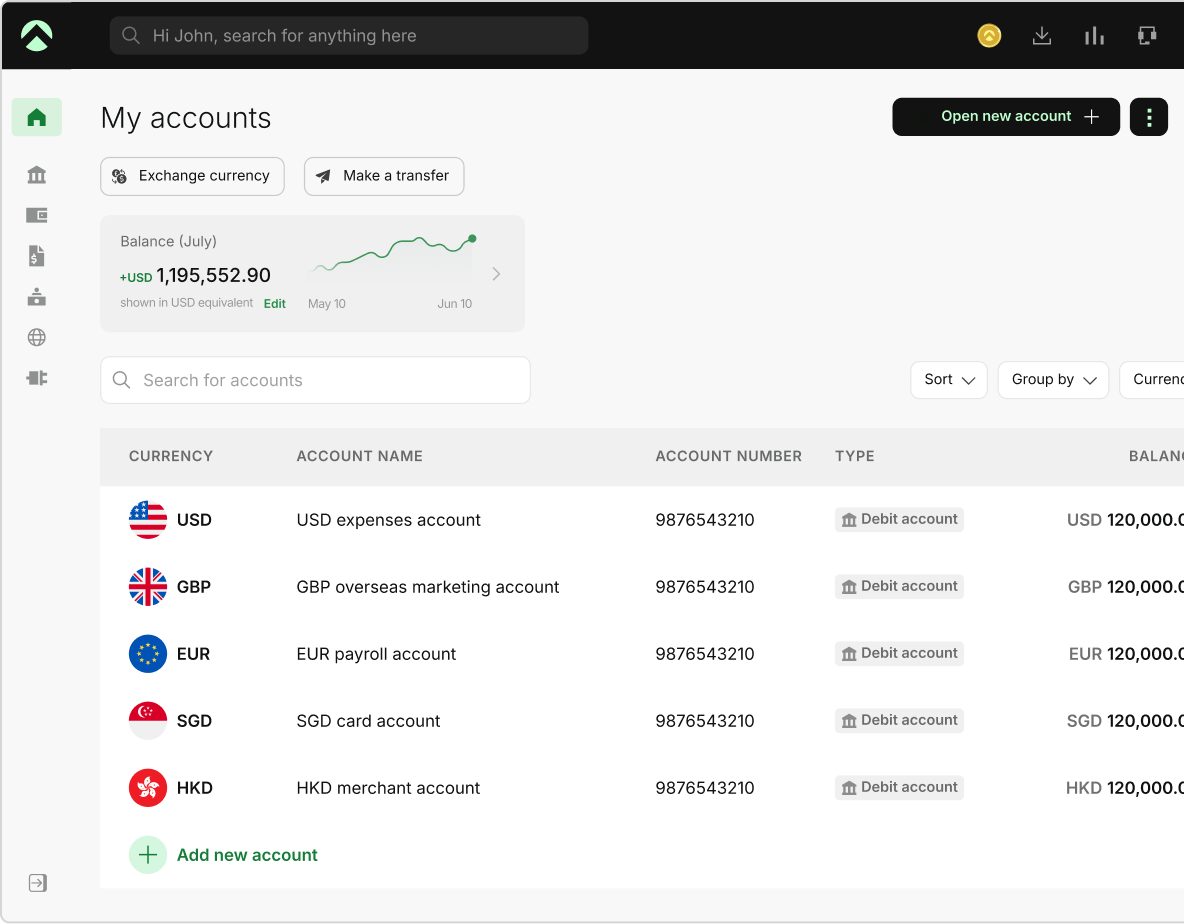
Businesses that go international often use global treasury management to handle FX volatility and reduce financial risks associated with moving money internationally.
A dollar earned in London, a payment sent to a supplier in Rome, and payroll due in three currencies before the weekend: this is the daily reality for founders scaling past their home market. Global treasury management keeps you in control of it all, instead of reacting every time a bank statement lands or an exchange rate shifts overnight.
This guide explains what global treasury management is, why it matters once you're operating in more than one country, and the strategies founders use to manage cash, currency risk, and banking relationships without losing sleep over exchange rates. We'll also cover how global treasury differs from the domestic version, the challenges that often trip up growing businesses, and how Aspire1 helps founders run treasury operations from one place instead of ten.
What is global treasury management
Global treasury management oversees your company’s international cash flow, currency exposure, and financial relationships across every country it operates in. It manages cash in different currencies, monitors FX exposure, forecasts future cash needs, and supports treasury-related regulatory compliance and payment controls.
A global treasury offers a complete approach for cash management so that you don’t have too much idle cash sitting in one account while other entities need funding. You can avoid exposing your margins to FX movements or losing visibility across separate banking systems. International treasury management connects these decisions so you can manage cash liquidity and risk in one system.
What does global treasury management include
For this guide, we group global treasury management into 5 core pillars. Strengthen these to ensure a smooth cash flow across global markets.
| Pillars of global treasury management | What it covers |
|---|---|
| Multi-currency cash and liquidity | Where your capital lives and how it moves |
| FX risk mitigation | Protecting margin from currency swings |
| Banking and cross-border payment infrastructure | How money actually gets where it's going |
| Investment management | Manages where your surplus cash can be invested for returns |
| Global compliance and risk control | Staying clean across jurisdictions |
Global cash and liquidity management
Global cash management includes knowing how and where your cash fund moves, in which currency, and whether any of it is idle cash. Streamlining cash flow lets you put cash where and when it is needed, without idle balances taking up space.
It includes activities such as:
- Monitoring cash positions
- Forecasting cash requirements
- Managing liquidity
- Moving funds between accounts
- Managing working capital
- Reducing idle cash
- Funding entities when they require cash
Whether you need to disburse payroll or pay international vendors, optimizing global cash flow through a centralized platform means centralized reporting, connected bank data, and automated cash movements. It allows you to shift funds where they are needed while your cash works in the treasury.
FX risk mitigation
Currency rates keep changing, interest rates change, and credit risk may affect the business when it starts transacting internationally. Risk management identifies these exposures early, calculates how they might affect your business, and limits the damage beforehand using tools like hedging and a diversified banking portfolio.
For example, if you collect revenue in USD but pay a supplier in GBP months later, a change in the GBP/USD rate can affect the amount of GBP available when you make the payment. Treasury then decides whether to hedge it or lock in rates to avoid the risk.
Banking and cross-border payment infrastructure
When you’re operating globally, your banking structure becomes a part of your treasury strategy. Banking relationships affect access to accounts, payment capabilities, fees, liquidity, and service levels, depending on the markets and providers involved. The structure depends on your markets, currencies, payment needs, risk controls, and level of centralization.
As for cross-border payments, founders choose from these three broad international payment solutions: the SWIFT payment network, local clearing networks like ACH, SEPA, and Faster Payments, or modern fintech payment rails. Choose the payment rail based on the destination, currency, settlement timing, cost, and compliance requirements. ACH is relevant to US payments, while cross-border payments may use SWIFT, local rails, or other networks depending on the corridor.
Investment management
Much like the domestic treasury, the global treasury also ensures that your cash balance doesn’t sit idle when you don’t need it anywhere. Investment management puts your idle cash to work by evaluating options while maintaining the liquidity and risk profile your business may need.
The goal here is to ensure that your cash isn’t losing value with changing markets by sitting idle, rather than simply earning high returns.
Global compliance and risk control
Different countries have different laws regarding how money moves inside their borders and regulatory rules like KYC and AML requirements. As a multinational business founder, managing and complying with these regulations becomes synonymous with doing business there. Regulatory compliance, financial reporting, and risk control create a foundational framework of international laws, internal policies, dual authorization payment workflows, and automated transaction monitoring and reconciliation to adhere to cross-border rules, smooth out cash flow, and reduce fraud risk.
Why is global treasury management important for businesses
Global treasury management can improve cash visibility, help manage FX exposure, and support timely international payments when the underlying systems provide the required data and controls. PwC’s 2025 Global Treasury Survey found that both CFOs and treasurers ranked cash and liquidity management as a top priority. Treasury management helps create a base for cash forecasting. Accurate forecasting helps ensure enough cash availability at critical moments and cash that keeps earning interest.
The cost of unmanaged international cash
If international cash remains unmanaged for a longer time, it may start affecting business in different ways.
- FX spreads and transaction fees can reduce the amount ultimately received or increase the cost of funding overseas obligations
- Cash trapped across disconnected regional accounts sits idly without adding to your runway
- Liquidity may remain unavailable when you most need it, leading to unnecessary borrowing
Global treasury management helps connect all these and give you a clear picture of what to do with your cash, control FX margins, and fulfil liquidity needs when they arise.
When should you start focusing on treasury management
Global treasury management becomes more important when:
- You hire international contractors or team members
- A significant part of your revenue comes from foreign currencies
- You’re expanding vendor relationships or operations overseas
At this stage, your treasury process needs to account for multiple currencies, jurisdictions, payment rails, and banking relationships.
Differences between global and domestic treasury management
Domestic treasury management deals with regulatory compliance of the country your business operates in, while global treasury management has to factor in FX changes, tax and regulatory compliance at different local and national levels, international payment fraud mitigation, and managing local payment rails and multi-currency accounts.
Here’s how treasury management differs at a global vs domestic level:
| Aspect | Domestic treasury management | Global treasury management |
|---|---|---|
| Cash | Managed primarily within one market | Spread across countries, entities, and accounts |
| Currency | Operates with one primary currency | Multiple currencies and FX exposure |
| Payments | Primarily domestic payment rails | Domestic and cross-border payment methods |
| Compliance | Primarily one regulatory environment | Multiple jurisdictions and requirements |
| Banking | Fewer banking relationships | Regional and international banking relationships |
| Risk | Mainly domestic liquidity and financial risks | Adds FX, cross-border, country, and operational risks |
| Forecasting | Mainly domestic cash flows | Consolidates cash flows across currencies and entities |
| Controls | Controls limited to one market | Must account for different entities, markets, and access requirements |
The difference lies in the number of variables you need to manage at the same time.
Challenges in global treasury management
The more markets you add to your business, the more complex your global treasury management may get. Here are some challenges that founders have to overcome with global treasury solutions:
Compliance
Founders with business operations in different countries often have to deal with local compliance, tax rules, reporting requirements, and banking regulations. Mismanagement or falling behind on them may risk fines, delayed transactions, or frozen accounts at the worst possible time. US teams may also need to consider US sanctions requirements managed by the Office of Foreign Assets Control (OFAC). Before sending or receiving cross-border payments, US-based founders may need to screen relevant counterparties and transactions against applicable sanctions lists and identify transactions involving sanctioned jurisdictions or parties.
A process that works for your US operations may not work the same way in another market. Founders need a compliance approach that scales as fast as the countries they add.
Currency fluctuations
Currency exchange rates keep changing with time. If your business earns revenue in USD and incurs costs in GBP, these movements can affect your margins: if USD weakens, you may lose dollars. Unmanaged FX exposure can reduce margins when exchange-rate movements increase the home-currency cost of payments or reduce the value of foreign-currency revenue.
Identify where your currencies enter and leave your business, then determine how much exposure you can accept.
FX risk
Another risk that comes along with currency fluctuations is that of FX risk. Beyond day-to-day fluctuations, this covers the broader exposure a business carries when its costs, revenue, and assets are in different currencies.
Some of the common ways to manage FX exposure include:
- Matching currency inflows with outflows
- Converting currencies when needed
- Holding funds in multiple currencies that you need
- Using hedging instruments where suitable
The correct approach depends on your exposure’s size, timing, and predictability.
Technology integrations
Your business’s treasury data may sit across banks, accounting platforms, payment providers, and spreadsheets. Having a connected global treasury management system brings financial data together, automates repetitive workflows, and gives your finance team a complete view of cash.
Global business accounts with a finance stack, including multi-currency accounts*, FX*, expense management, and treasury/yield3 capabilities, can become a base technology for startups and businesses planning to cross borders. Fintech platforms like Aspire1 allow third-party integrations like accounting software, payment gateways, and mobile payments to support accounts, payments, and payroll globally.
International payments
Another challenge in global treasury management is cross-border payments. These introduce additional considerations like payment rails, settlement times, currencies, and FX fees, beneficiary information, and compliance checks.
A payment can be operationally successful and may still create a treasury problem if it arrives late. For example, if a payment requires conversion from USD into EUR, changes in the USD/EUR rate between the time the obligation is forecast and the time the currency is purchased can change the USD cost of the payment, unless you use a hedging instrument like locking in the FX rate.
Choose from different funds transfer options, whether ACH payments, wire transfers, or SWIFT payment solutions, and use them as your situation demands.
Strategies for effective global treasury management
Start with better visibility, clear controls, and automation where transaction volume justifies it. You do not need a large treasury team to establish these processes.
Choose treasury technology that fits your business
The right treasury setup depends on the complexity of your business. Identify what you need to manage first:
- Number of entities and bank accounts
- Currencies and markets
- Payment volume
- Cash forecasting
- FX exposure
- Accounting and ERP integrations
- Approval and control requirements
- Global compliance and reporting needs
A dedicated treasury management system can consolidate cash data, forecasting, payments, and risk information. The goal is to choose a setup that gives your team the visibility and control it needs without adding complexity. For startups, a fintech platform can also bring several day-to-day treasury functions together without requiring a complex enterprise TMS.
For example, platforms like Aspire combine multi-currency accounts*, FX and global payments, treasury3 for surplus cash, and expense management in one platform. This gives your finance team a single platform to manage several of their global financial functions.
Build a cash flow forecasting process
Cash flow forecasting monitors your earnings and expenses to create a near-accurate roadmap of the business's future. Use the previous data to map out the inflows and outflows. This may include payroll, vendor payments, taxes, debt obligations, and expected receivables. For global operations, you may use currency, entity, or market for the forecast to identify liquidity gaps and idle cash that can be allocated more effectively.
Then compare forecasts with actual cash movements regularly to identify potential cash gaps early on to act. Accurate cash flow forecasting means fewer surprises, better decisions when it comes to foreign currency exchange, and meeting financial obligations on time.
Centralize global treasury function
Centralizing treasury activities under one function can standardize policies, controls, and reporting. A connected treasury platform can then give that function a consolidated view of cash and risk. It also means a reduction in duplicated processes and improved visibility across bank accounts, more time spent on cash flow analysis than reconciling numbers across systems, and a single team that has complete visibility of your cash.
A practical model can centralize activities such as:
- Cash visibility
- Treasury policies
- FX exposure management
- Banking strategy
- Liquidity planning
- Reporting
Your local teams can continue managing tasks where market-specific knowledge is required.
Use multi-currency accounts
Multi-currency accounts let you hold, send, and receive funds in multiple currencies instead of converting them for every transaction. This simplifies reporting, since revenue and costs in different currencies stay in one account.
For example, if your business receives funds in EUR from European customers and pays EUR-based vendors, holding EUR can reduce unnecessary conversion activity. You may convert the rest of the balance when you need to spend in another currency.
Use hedging strategies
Hedging techniques can help protect your FX margins from currency volatility. Forward contracts fix an exchange rate for a future transaction. FX swaps combine an exchange of currencies with a later reverse exchange. Options give the holder the right, but not the obligation, to exchange currency at a specified rate.
Hedging works well when it is planned rather than used as a reactive treasury strategy for every market movement.
Set cash controls for enterprise risk management
Strong cash controls protect the business from error and fraud while it scales across more entities and people with access to company funds. Some of the most useful cash controls include:
- Role-based access
- Segregation of duties
- Payment approval thresholds
- Dual authorization for high-value transactions
- Beneficiary verification
- Account reconciliation
- Regular review of bank permissions
- Real-time transaction alerts
The controls scale and tighten as your team and transaction volume go up.
Where Aspire fits in your global treasury setup
Aspire1 is a fintech platform for multinational founders. It brings key global treasury tasks into a single business account1 where you can send international payments in 98+ currencies*, and gives you real-time visibility into cash across all entities and currencies. Here’s how US founders can use Aspire to manage their international cash flow:
- Hold, send, and receive payments in USD, EUR*, GBP*, CNY*, HKD*, AUD*, CAD*, CHF*, JPY*, NOK*, NZD*, SGD*, and SEK* at no additional cost
- Send global payments to 98+ currencies* across 130+ countries with FX rates from 0.22% above mid-market
- Issue physical and virtual corporate cards2 with card controls, cashback^, and accounting integrations for instant transaction visibility and damage control
- Pay your international team members and vendors with global payroll and payments
- Put your idle cash to work with treasury3: start from any balance, earn up to 3.55% yield3 on larger invested balances, and access funds the next business day
Aspire is a one-stop business fintech stack for global founders with no business account fees, allowing them to access treasury without minimum balance.
Frequently Asked Questions
The best treasury management system for global enterprises depends on the requirements of the specific business. Some examples of TMS platforms include SAP Treasury and Risk Management, Kyriba, and FIS Integrity.
The five pillars of treasury management include: multi-currency cash and liquidity, FX risk mitigation, cross-border payment infrastructure, investment management, and global compliance and risk control.
For most businesses, a CFO, a treasurer, or a treasury management department typically handles treasury management. However, if the company is new and growing, the founder may also handle it for the time being.
You may not need a large treasury team to apply treasury management principles. If your business operates internationally, basic practices such as cash forecasting, currency exposure tracking, payment controls, and consolidated cash visibility can become useful.
Marketplace businesses and SaaS companies with international customers and vendors feel these challenges the earliest, as they move money across countries from day one. However, any founder with a team, vendor, or customer base outside their home country will benefit from managing treasury as a core function.
Sources
- Architects of change: Treasury leadership in an era of transformation - Jun 25, 2025
- Sanctions List Service - Aug 17, 2026
- OTC foreign exchange turnover in April 2025 - Sep 30, 2025
- Single Euro Payments Area (SEPA) - Nov 26, 2026
- Customer Due Diligence Requirements for Financial Institutions - May 11, 2016
This blog is for general information only and does not constitute financial, legal, tax, or professional advice. Aspire’s services are subject to the terms outlined in our ’Terms of Service’ and ’Pricing’ pages. We make no guarantees as to the accuracy, completeness, or timeliness of the content, and past results do not indicate future performance. Always consult a qualified professional before acting on any information provided.
Bintang Lestada
Writer
Bintang is a seasoned writer specialising in fintech, agtech, politics, and pop culture. With a writing history at VICE ASIA, Letterboxd, Whiteboard Journal and other reputable organisations, Bintang leverages their broad range of experiences to resources that educate audiences, build trust, and support business growth.
Aspire Launchpad
Supercharge your finance operations with Aspire
Find out how Aspire can help you speed up your end-to-end finance processes from payments to expense management.

Latest articles
Payments •
AP automation for manufacturing: How to automate invoices and supplier payments
Learn how AP automation for manufacturing handles invoice capture, PO and receipt matching, approvals, exceptions, supplier payments, and ERP sync.

Payments •
Healthcare AP automation: how to streamline invoices, approvals, and payments
Healthcare AP automation explained for finance teams: how invoice capture, approvals, and vendor payments work, what it costs, and how to choose a tool.
Expense Management •
Nonprofit expense tracking: A practical guide for finance teams
Learn how nonprofit expense tracking should work from purchase through receipt capture, coding, approval, reimbursement and month-end reconciliation.
Start your journey with Aspire