


What Is FDI? A Guide to HK & China Investment

Galih Gumelar

Summary
Definition: FDI is a cross-border investment that gives the investor lasting influence over a foreign business. A stake of 10% or more of voting power is the usual starting point.
Hong Kong's role: Hong Kong recorded USD 116.5 billion of FDI inflows in 2025, down 15.6% from 2024. Its inward FDI stock still grew 10.2%.
Core types: FDI is classed as horizontal, vertical, conglomerate or platform. Companies enter through Greenfield projects, acquisitions, joint ventures or alliances.
Key risks and setup: Currency, policy, repatriation and integration risks all apply. The new entity also needs registration, a business bank account and a plan for moving capital.
Aspire advantage: A multi-currency account lets an invested entity hold, convert and move money across borders without being forced to convert on receipt.
Foreign direct investment (FDI) is money a company puts into a business in another country to gain a lasting say in how it runs. It is different from buying foreign shares on the stock market, because the investor takes part in management, not just in the returns.
Hong Kong sits on both sides of this flow. It receives large inflows from abroad and it is also a main route for capital moving into mainland China.
This guide explains what FDI is, the 4 types and the ways companies enter a market, and what the latest data says about Hong Kong. It then covers the risks, and the banking and payments work that begins the day after an investment is approved.
What is foreign direct investment?
FDI is a cross-border investment in which an investor in 1 economy builds a lasting relationship with an enterprise in another. The investor wants a meaningful say in how the enterprise is run, according to the OECD.¹
How is an FDI relationship identified?
A holding of 10% or more of an enterprise's voting power is generally presumed to show a lasting interest. The OECD adds that the test is applied through its framework for direct investment relationships, so it is not a rigid cut-off.¹
An investment is generally treated as FDI when it has these 3 features:
- A cross-border element, where the investor and the enterprise are resident in different economies
- A meaningful, lasting stake, typically 10% or more of voting power
- Active involvement in management or operations, not a passive financial position
Is FDI the same as portfolio investment?
No. Portfolio investment is a passive financial position, while FDI aims at influence over operations. A fund buying 2% of a foreign listed company is a portfolio investor. A manufacturer buying 40% of a foreign supplier is making FDI.
What are the 4 types of FDI?
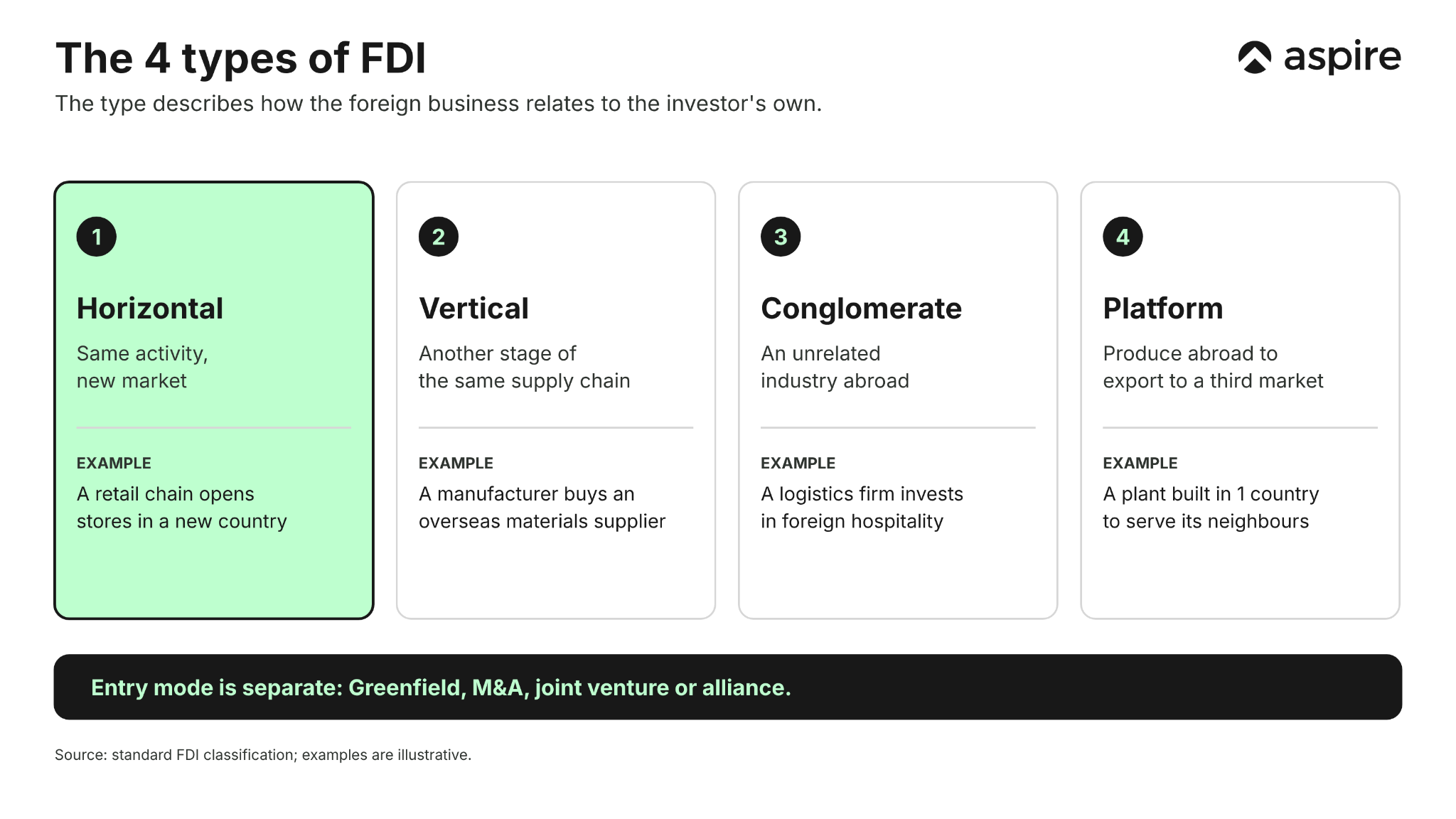
FDI is generally classified into 4 types, based on how the foreign business relates to the investor's existing business.
| Type | What it involves | Example |
|---|---|---|
| Horizontal FDI | Expanding the same business activity into a foreign market | A retail chain opening stores in a new country |
| Vertical FDI | Investing in a different stage of the same supply chain abroad | A manufacturer acquiring an overseas raw materials supplier |
| Conglomerate FDI | Investing in an unrelated industry in a foreign market | A logistics company investing in a foreign hospitality business |
| Platform FDI | Producing abroad to export to a third country, not to the home or host market | A company building a plant in 1 country to serve its neighbours |
How do companies enter a foreign market?
There are 4 common entry modes, and they trade control and speed against cost and risk. The type of FDI describes the relationship, while the entry mode describes the mechanism.
| Entry mode | What it involves | Main trade-off |
|---|---|---|
| Greenfield investment | Building new operations from scratch | Full control from day 1, but the most time and capital upfront |
| Mergers and acquisitions (M&A) | Acquiring or merging with an existing foreign company | A faster route to market, with integration complexity |
| Joint venture | Sharing ownership with a local partner | Shared risk and local knowledge, but shared control |
| Strategic alliance | Collaborating without a new entity or an equity stake | Flexible, but it may not count as FDI at all |
Why is Hong Kong a top FDI destination?
Hong Kong combines large FDI stocks with free capital movement and a common law system. The Basic Law guarantees the free flow of capital into, out of and within Hong Kong under Article 112, according to the Hong Kong government's family office portal.²
How much FDI does Hong Kong receive?
Hong Kong received USD 116.5 billion of FDI inflows in 2025, and its inward stock stood at USD 2.59 trillion. The figures below come from UNCTAD's World Investment Report 2026 country factsheet and from InvestHK.³ ⁴
| Metric | Figure |
|---|---|
| FDI inflows, 2024 | USD 137.9 billion |
| FDI inflows, 2025 | USD 116.5 billion, down 15.6% year on year |
| Inward FDI stock, 2025 | USD 2.59 trillion, up 10.2% year on year |
| New and expanded company set-ups, H1 2026 | 413 companies, about 10% up year on year |
| Expected investment from those set-ups | Over HK$53 billion |
| Jobs expected from those set-ups | Over 8,600 |
Is FDI into Hong Kong rising or falling?
Both, depending on the measure. Annual inflows fell 15.6% in 2025, while the cumulative stock grew 10.2% and InvestHK reported more company set-ups in the first half of 2026.³ ⁴
This is not a contradiction, because a flow measures 1 year and a stock measures the accumulated total. Treat the InvestHK figure as an expectation reported by the company, not as recorded capital.
Who invests most in Hong Kong?
Mainland China and the British Virgin Islands (BVI) were the top 2 sources of Hong Kong's inward FDI at the end of 2024. The Census and Statistics Department (C&SD) published the split in December 2025.⁵
| Source economy | Share of inward FDI stock, end-2024 | 2024 inflow |
|---|---|---|
| Mainland China | 32.7% | HK$466.0 billion |
| British Virgin Islands | 30.4% | HK$237.0 billion |
BVI-registered companies are commonly used as holding vehicles, so the ultimate investor may sit elsewhere. Aspire's guide to a BVI company bank account covers the banking side of that structure.
Why is Hong Kong a gateway to China?
Hong Kong handles about 2/3 of China's inward and outward direct investment, according to the HKMA. The HKMA calls Hong Kong the dominant gateway to the Mainland and the largest offshore renminbi hub.⁶
How big is Hong Kong's outward FDI?
Hong Kong's outward FDI stock reached USD 2.44 trillion in 2025, up 10.9%. Outflows were USD 95.3 billion, up 2.9% year on year, per the UNCTAD factsheet.³
Mainland China is also the top destination. It held 52.1% of Hong Kong's outward FDI stock at the end of 2024, ahead of the BVI at 27.6%.⁵
What makes the gateway role work?
The gateway role rests on 4 features that lower the friction of investing into the Mainland.
- Free capital flow. Article 112 of the Basic Law guarantees the free flow of capital into, out of and within Hong Kong.²
- Offshore renminbi depth. The HKMA reports that Hong Kong consistently processes over 70% of offshore RMB payments, citing SWIFT data.⁶
- Market access channels. Stock Connect, Bond Connect and Swap Connect link overseas investors to Mainland markets.⁶
- Common law system. International investors already know how contracts, shareholder rights and disputes work under common law.
What risks come with FDI?
FDI carries 4 main financial and operational risks, and most of them appear after the deal closes. Plan for them in the budget, not just in the legal review.
Which financial risks matter most?
| Risk | What it involves |
|---|---|
| Currency risk | Returns and repatriated profits move with exchange rates between the investment and reporting currencies |
| Political and regulatory risk | Changes in host-country policy, tax or foreign ownership rules can affect an investment after the fact |
| Repatriation restrictions | Some jurisdictions limit how freely profits or capital can return to the investor's home country |
| Integration and operational risk | Combining operations, systems or cultures proves harder than planned, especially in M&A and joint ventures |
Aspire's guide to foreign exchange risk explains how businesses measure and reduce the currency exposure.
Do governments need to approve FDI?
In many jurisdictions, yes, especially for sensitive sectors. Telecommunications, media, defence and some financial services are common examples.
Hong Kong guarantees free capital flow, but sector licences can still apply to specific industries. Confirm the rules for your sector with a lawyer or the relevant regulator before you commit.
What happens after you decide to invest?
The financial work starts on the day the investment is approved. A new entity cannot hire, pay suppliers or receive capital until it is registered and banked.
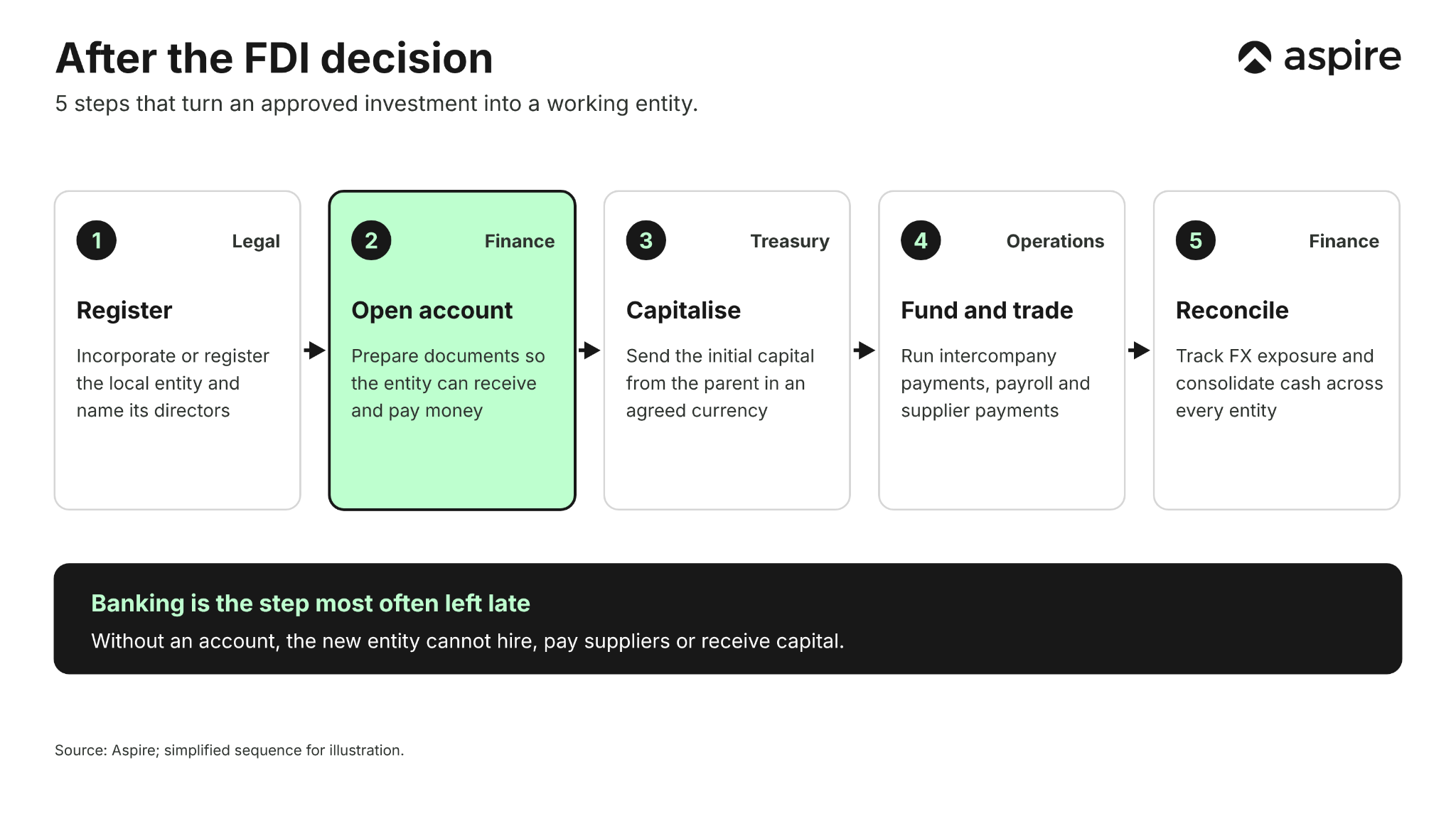
How do you set up the entity and bank?
A foreign-invested entity generally needs a local registration and a business bank account before it can transact. Start with Aspire's guide on how to register a company in Hong Kong.
Banking is the step most often left too late. See the documents required to open a business bank account, the options to open a business bank account in Hong Kong and the guide for a new company opening a business bank account.
How do you move capital across borders?
Capital moves in 3 stages: initial capitalisation, ongoing intercompany funding and eventual repatriation of profit. Each stage involves an international payment that should be cost-predictable and documented for tax and regulatory purposes.
Compare rails in Aspire's guides to cross-border payments and international payments. Check how profits are taxed locally in the guide to the corporate tax rate in Hong Kong.
How do you manage FX and reconciliation?
Revenue or costs in a currency other than the parent's reporting currency create ongoing FX exposure, not a 1-off conversion. Holding balances in the currency you will spend lets you choose when to convert. See Aspire's guide to a foreign currency account and the top multi-currency accounts in Hong Kong.
Once a structure spans more than 1 legal entity, a consolidated cash view becomes a daily task. Aspire's global account and expense management tools help teams see spend across entities. Review Aspire's pricing when you model costs.
Should you build or buy to enter Hong Kong?
A European consumer electronics company weighing Hong Kong entry shows the trade-off. The company is invented for illustration. It compares a Greenfield retail and distribution presence with buying an existing local distributor.
| Factor | Greenfield | Acquisition |
|---|---|---|
| Control | Full control over brand and operations | Inherits the target's brand, staff and contracts |
| Speed to revenue | Slower, as suppliers and staff start from zero | Faster, as distribution already exists |
| Main risk | Time to build market awareness | Integration and due-diligence findings |
Either way, the same steps follow: register the entity, open a business account, capitalise it from the home market and manage the euro and Hong Kong dollar exposure for as long as the investment runs.
When should you upgrade your payments setup?
Upgrade before the investment structure goes live, not after the first reconciliation problem. Watch for these 3 signals:
- Revenue or costs already appear in more than 1 currency
- Capital or profit moves regularly between a parent company and a foreign entity
- More than 1 legal entity must be reconciled into a single cash position
Why Hong Kong Businesses Choose Aspire
Whether your business is receiving foreign investment or making it, the financial infrastructure behind that investment needs to keep pace, and Aspire is built to support the rest of your operations.
💱 FX spreads from 0.18%, up to 3x cheaper than traditional banks. This applies across 130+ countries and 40+ currencies through Aspire's multi-currency account. It's useful for anything from capitalising a new entity to settling international payments without losing margin to markup.
💰 1.2% unlimited cashback applies on every corporate card transaction, with no monthly cap. It kicks in automatically on eligible spend, with no minimum threshold to hit first. Over time, it quietly turns routine business spend into working capital.
🌐 Local transfer network, not multi-hop SWIFT chains, is how Aspire routes most payments. This means faster settlement and fewer intermediary fees eating into your payment before it reaches the recipient. It also reduces the chance of funds being held up for review at a correspondent bank along the way.
💸 Fixed USD 8 inbound SWIFT fee, tracked end-to-end with SWIFT GPI, applies when SWIFT is the right rail for your payment. There are no surprise deductions from correspondent banks along the way, so the amount you're quoted is the amount that arrives. You can also download payment confirmation instantly from the app, without calling the bank.
⚡ Approved in as little as 1 business day, with no branch visits and no paperwork stacks. Applications are completed entirely online, from document upload to approval. There's no waiting weeks on a relationship manager to call you back.
Open a free multi-currency business account built for Hong Kong SMEs, or explore how Aspire's corporate card fits into your day-to-day spend.
Frequently Asked Questions
FDI gives the investor lasting influence over a foreign business, usually through 10% or more of voting power. Portfolio investment buys foreign shares or bonds without seeking control.¹
Free capital flow under Article 112 of the Basic Law, a common law system and deep capital markets make it a practical regional base.² UNCTAD recorded USD 116.5 billion of inflows in 2025.³
Annual inflows fell 15.6% in 2025, but the inward stock rose 10.2%.³ A flow covers 1 year, while a stock is the accumulated total.
The HKMA says Hong Kong handles about 2/3 of China's inward and outward direct investment.⁶ Offshore RMB depth and access channels such as Stock Connect make the route practical.
A local registration and a dedicated business bank account, before it can transact or receive capital. A multi-currency account becomes relevant when revenue, costs or capital move in a currency other than the parent's.
Sources
- OECD, "FDI Statistics: Explanatory Notes"
- Hong Kong Government Family Office portal, "World's Freest Economy: No Capital Control"
- UNCTAD, "World Investment Report 2026: Hong Kong, China country factsheet"
- Hong Kong Government News, "InvestHK: 413 companies set up or expand in Hong Kong in H1 2026" (25 June 2026)
- Census and Statistics Department, "External Direct Investment Statistics of Hong Kong, 2024" (9 December 2025)
- HKMA, "Dominant Gateway to China"
This blog is for general information only and does not constitute financial, legal, tax, or professional advice. Aspire’s services are subject to the terms outlined in our 'Terms of Service' and 'Pricing' pages. We make no guarantees as to the accuracy, completeness, or timeliness of the content, and past results do not indicate future performance. Always consult a qualified professional before acting on any information provided.
Galih Gumelar
Writer
Galih is a seasoned writer specialising in macroeconomics, business, finance and politics. With a writing history at CNN Indonesia, The Jakarta Post, and various other reputed organisations, Galih leverages his broad range of experiences to create insightful resources for those wanting to start a business.
Aspire Launchpad
Start Your Business with Aspire Launchpad
From incorporation to venture capital, we connect you with trusted service providers to make your entrpreneurial journey seamless.

Latest articles

Guides •
How to Use Dinpay: HK Business Guide
Learn how to use Dinpay (智付) from Hong Kong, with its products, payouts, onboarding, licences and fees, and where Aspire may fit better.
Guides •
How to Use Payoneer: HK Business Guide
How to use Payoneer in Hong Kong: sign up, receive HKD, withdraw, fees and card limits, plus where we may fit better.

Expense Management •
Automated Expense Management in HK: A Practical Guide
Automate expense management in HK: the tools that help, how Aspire optimises each step, what to automate first and a worked example for a 20-person firm.
Start your journey with Aspire
Open your free account