



Payroll Processing in HK: A Monthly Run Guide

Galih Gumelar

Summary
A payroll run has 7 steps. They run from the pay cut-off to reconciling the bank debit against payslips.
Wages are due within 7 days after the wage period ends. The Labour Department says employers should pay as soon as practicable.¹
MPF contributions are due on the 10th of the following month. Each side pays 5% of relevant income, within set minimum and maximum levels.²
IR56 filings follow joiners and leavers. The IRD sets the deadlines at 3 months after hiring and 1 month before leaving.³
The payment step is where errors cost money. A bulk file, a second approver and a test payment protect each run.
Payroll processing is the monthly cycle of calculating pay, approving it, paying staff and reporting to the MPF trustee and the IRD. In Hong Kong, 2 dates drive the cycle: wages are due within 7 days of the end of the wage period, and MPF contributions are due by the 10th of the next month.
This guide walks through the monthly run in order. It also covers the filings that attach to payroll, a worked net-pay example and the payment step.
What is payroll processing in HK?
Payroll processing is the set of tasks that turn a monthly salary list into paid staff, a paid MPF contribution and accurate records. It covers calculation, approval, payment, reporting and archiving.
It is different from choosing payroll software or reading the Employment Ordinance. Our guides on payroll methods and managing payroll in Hong Kong cover the legal basics, and our comparison of top payroll systems in Hong Kong covers software.
How do you process payroll each month?
You process payroll in 7 steps, from locking the pay period to filing the records. The order matters because each step feeds the next.
- Set the cut-off. Choose the last day for changes, such as new joiners, leave and allowances.
- Update the master data. Check salaries, bank details and MPF scheme details for every employee.
- Calculate gross to net. Add allowances, deduct the employee MPF share and any other deductions.
- Review and approve. A second person checks the totals and signs off the file.
- Pay salaries. Send the payment file so staff are paid inside the 7-day window.
- Pay MPF. Submit employer and employee contributions by the contribution day.
- Issue payslips and reconcile. Match the bank debit to the payroll report and archive the file.
A joiner or leaver changes steps 2, 3 and 6, so build a short change list before every cut-off.
When are pay and MPF due in HK?
Wages are due not later than 7 days after the end of the wage period, and MPF contributions are due on the 10th of the next month. The Labour Department says wages become due when the last day of the wage period ends.¹
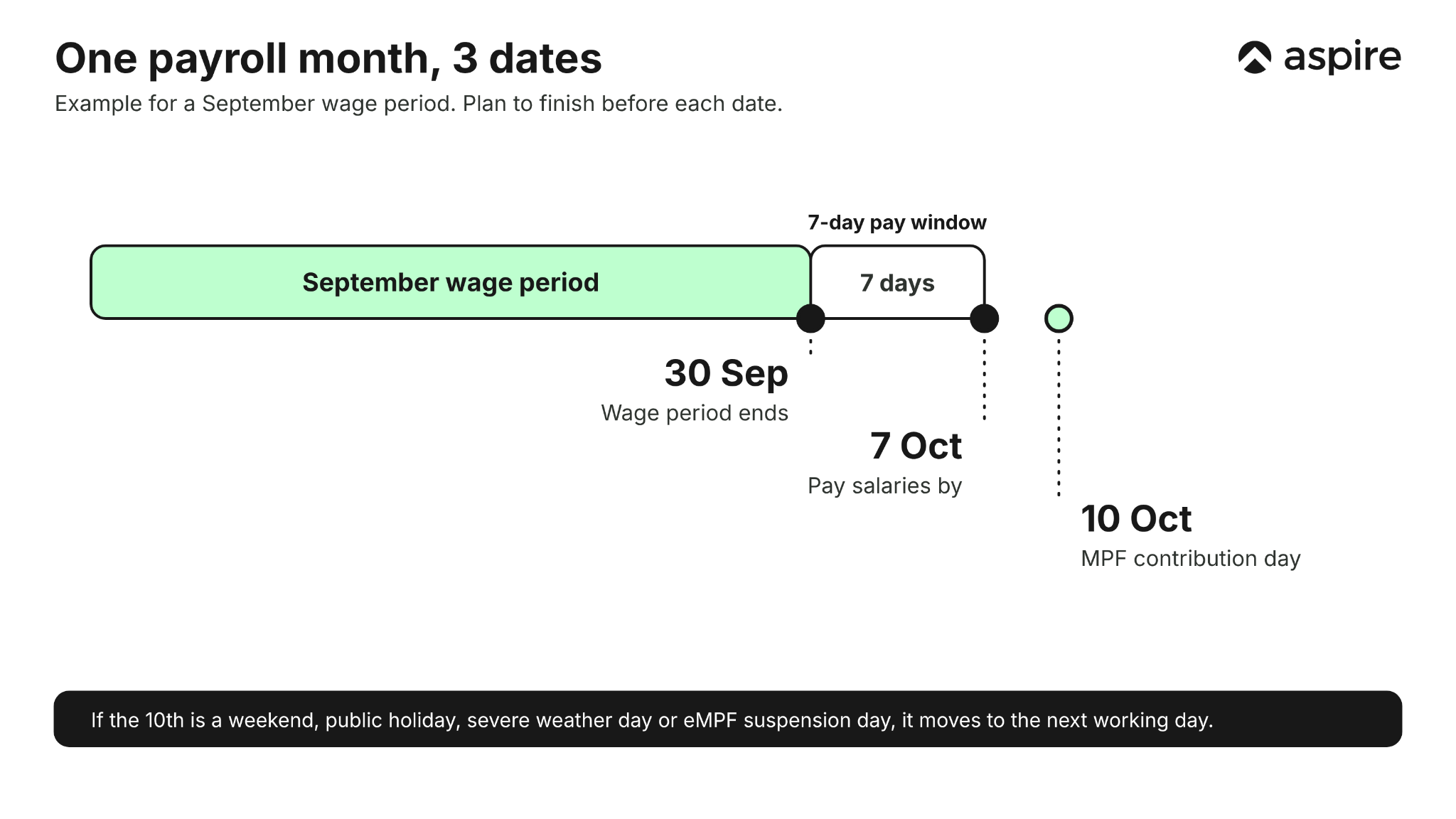
The MPFA says the contribution day moves to the next working day when the 10th falls on a weekend, public holiday, severe weather warning day or eMPF suspension day.² Plan to submit a few days early so a holiday shift never catches you out.
Which IRD filings follow payroll?
Payroll creates 5 IRD filings, and 3 of them are triggered by joiners and leavers. The table lists the form, the timing and the point to remember.³
| Form | When | What to know |
|---|---|---|
| BIR56A | Within 1 month of issue | The annual Employer's Return |
| IR56B | With the annual return | Give each employee a copy |
| IR56E | Within 3 months of hiring | For staff likely to be chargeable to Salaries Tax |
| IR56F | 1 month before employment ends | Filed for leavers |
| IR56G | 1 month before leaving Hong Kong | File 2 copies and withhold amounts due until the IRD letter of release |
The IRD offers electronic filing for IR56E, IR56F and IR56G.³
How do you calculate net pay in HK?
Net pay is gross pay minus the employee MPF share and any other deductions. MPF is 5% from the employee and 5% from the employer, within minimum and maximum relevant income levels.²
The MPFA sets the monthly levels at HKD 7,100 and HKD 30,000. Below the minimum, only the employer pays, and above the maximum, each side pays HKD 1,500.²
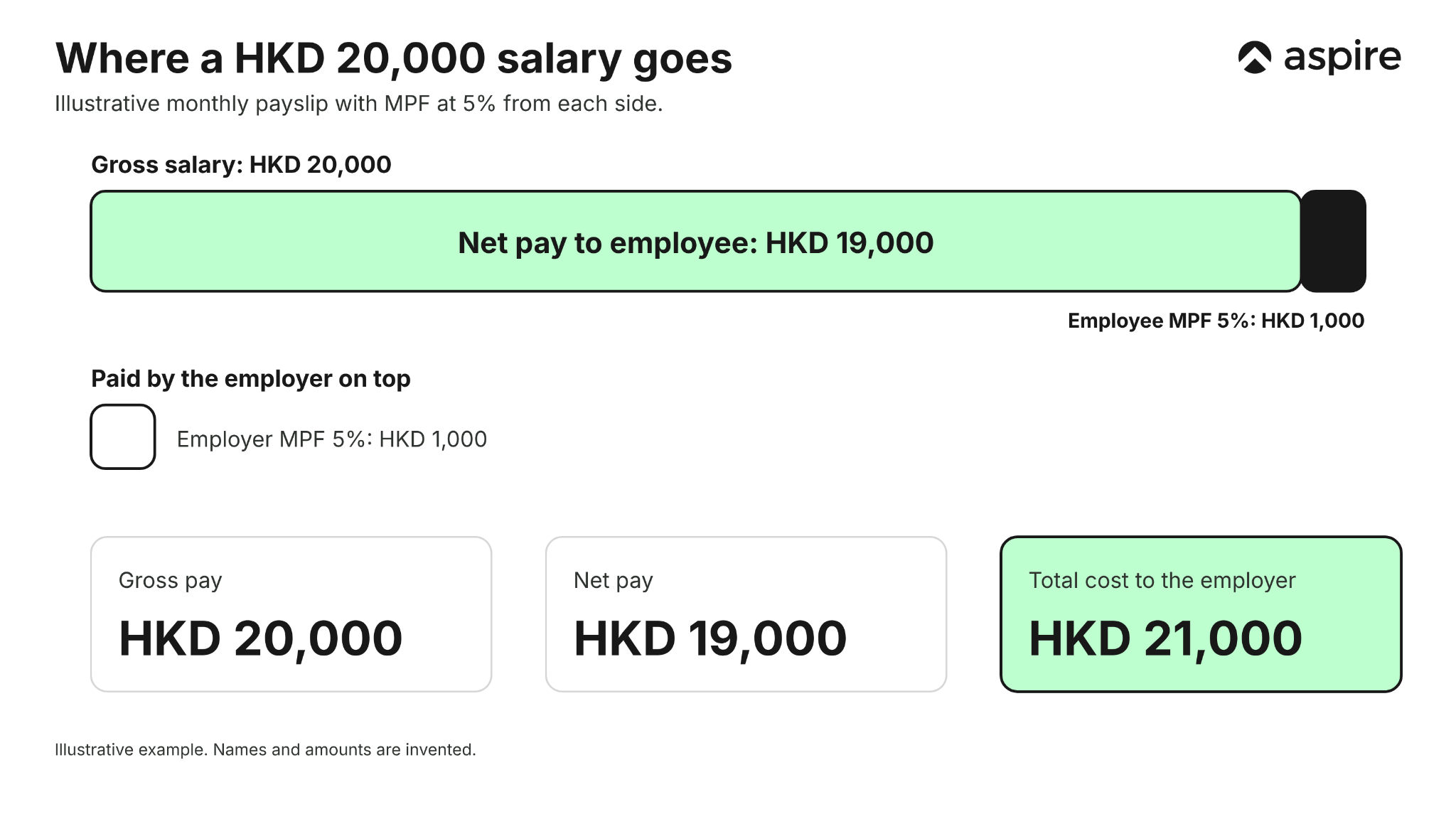
This illustrative example uses a Hong Kong design studio with 1 employee on a monthly salary. All names and figures are invented, and the studio has no other deductions.
The studio pays gross salary through payroll, deducts the employee share and adds the employer share to the MPF submission. Its total monthly cost for the employee is the salary plus the employer contribution.
How do you pay staff in bulk?
You pay staff in bulk by uploading 1 payroll file that pays every employee in a single batch. The file saves the repeated keying of bank details and gives you 1 record to reconcile.
At DBS, payroll runs through Batch FPS and appears as 1 consolidated debit. DBS says same-day processing applies before 7:00 PM, and instructions can be future-dated up to 90 days.⁴ The HKMA says companies can pay salaries through FPS using HKID numbers.⁵
Our bulk payments let you pay thousands of destinations from 1 CSV file. Our bulk payment solution guide compares the options, and our guide to CHATS and FPS explains the rails.
How do you reconcile a payroll run?
You reconcile a payroll run by matching 1 bank debit to the payroll report and each employee to a payslip. A bank such as DBS shows payroll as 1 consolidated debit, so the report is your detail.⁴
- Match the total. The debit should equal the net pay total in the file.
- Match each line. Check every employee's net pay against the payslip.
- Clear returns. Re-pay any rejected payment the same day.
- Post to the books. Record wages and the MPF liability in your accounts.
What changes for joiners and leavers?
Joiners and leavers change the MPF, the IR56 filings and the final pay. Each needs its own check in the monthly run.
For a joiner, the MPFA gives a 30-day contribution holiday for the employee share, while employer contributions start on the first day.² File the IR56E within 3 months of hiring.³
For a leaver, file the IR56F 1 month before the employment ends. If the person is leaving Hong Kong, file the IR56G and hold back the amounts due until the IRD release letter arrives.³
From 1 May 2025, employers can no longer use accrued benefits from mandatory MPF contributions to offset severance or long service payments for later employment.⁶ See our guide to severance pay in Hong Kong when you budget for a departure.
What mistakes break a payroll run?
Most payroll errors come from stale data and missing approvals, not from the arithmetic. Check these 6 points before every run.
- Late changes. Joiners, leavers and allowances missed after the cut-off.
- Old bank details. Payments sent to closed accounts are returned.
- Wrong MPF base. Contributions calculated on basic pay instead of relevant income.
- No second approver. One person prepares and approves the same file.
- Missed dates. Salary after day 7 or MPF after the contribution day.
- Open exits. An IR56F or IR56G forgotten for a leaver.
A short checklist at each cut-off prevents all 6. Our Hong Kong bank code list helps you confirm bank and branch codes.
Do you need payroll software?
You need payroll software when manual spreadsheets start causing late changes or calculation errors. A team of 5 can run a spreadsheet, but a team of 50 with joiners every month usually cannot.
Software calculates MPF, produces payslips and exports the payment file. Our accounting integration with Xero shows how a payroll journal reaches your books, and our systems guide compares the main options.
How do we support payroll?
We let you pay salaries, MPF contributions and contractors from 1 account, with approvals set per user. Our payroll page has the full feature list.
- Salaries and MPF together. Pay MPF contributions with salaries.
- Free local transfers. Pay local teams for free through FPS.
- Overseas salaries. Pay in CNY, MYR, SGD, USD and 40+ currencies.
- Payroll tools. Sync or import from Talenox, Payboy and HReasily.
- Reusable data. Save employee details once, duplicate past transfers and schedule payouts.
- Controlled access. Limit salary visibility to selected team members and set approvals per user.
If you hire abroad, our guide to hiring overseas employees covers the next step.
Why Hong Kong Businesses Choose Aspire
Payroll is 1 recurring cost, and Aspire supports the accounts, cards and transfers that sit around it.
💱 FX spreads from 0.18%, up to 3x cheaper than traditional banks. This applies across 130+ countries and 40+ currencies through Aspire's multi-currency account. It's useful for anything from paying overseas suppliers to settling international payments without losing margin to markup.
💰 1.2% unlimited cashback applies on every corporate card transaction, with no monthly cap. It kicks in automatically on eligible spend, with no minimum threshold to hit first. Over time, it quietly turns routine business spend into working capital.
🌐 Local transfer network, not multi-hop SWIFT chains, is how Aspire routes most payments. This means faster settlement and fewer intermediary fees eating into your payment before it reaches the recipient. It also reduces the chance of funds being held up for review at a correspondent bank along the way.
💸 Fixed USD 8 inbound SWIFT fee, tracked end-to-end with SWIFT GPI, applies when SWIFT is the right rail for your payment. There are no surprise deductions from correspondent banks along the way, so the amount you're quoted is the amount that arrives. You can also download payment confirmation instantly from the app, without calling the bank.
⚡ Approved in as little as 1 business day, with no branch visits and no paperwork stacks. Applications are completed entirely online, from document upload to approval. There's no waiting weeks on a relationship manager to call you back.
Open a free multi-currency business account built for Hong Kong SMEs, or explore how Aspire's corporate card fits into your day-to-day spend.
Frequently Asked Questions
Payroll processing is the monthly cycle of calculating pay, approving it, paying staff and reporting MPF and tax. It ends with reconciled records.
Not later than 7 days after the end of the wage period.¹
The contribution day is the 10th of the following month, or the next working day if it falls on a holiday.²
Not at first. A small team can use a spreadsheet, and software helps once joiners, leavers and MPF calculations multiply.
Yes. We support overseas salaries in CNY, MYR, SGD, USD and 40+ currencies.
Yes, we let you pay contractors alongside salaries, but their MPF and tax treatment differs from employees.
Sources
- Labour Department, "Employers Should Pay Wages on Time" (leaflet)
- MPFA, "Mandatory contributions" (MPF system, accessed November 2026)
- Inland Revenue Department, "Employer's obligations" (Employer's Return, accessed November 2026)
- DBS Bank (Hong Kong), "Payroll and bulk payment" (issuer page, accessed November 2026)
- HKMA, "The Faster Payment System: transcending boundaries and connecting with everyday lives" (27 March 2024)
- HKSAR Government, "Abolition of MPF offsetting arrangement comes into effect today" (1 May 2025)
This blog is for general information only and does not constitute financial, legal, tax, or professional advice. Aspire’s services are subject to the terms outlined in our 'Terms of Service' and 'Pricing' pages. We make no guarantees as to the accuracy, completeness, or timeliness of the content, and past results do not indicate future performance. Always consult a qualified professional before acting on any information provided.
Galih Gumelar
Writer
Galih is a seasoned writer specialising in macroeconomics, business, finance and politics. With a writing history at CNN Indonesia, The Jakarta Post, and various other reputed organisations, Galih leverages his broad range of experiences to create insightful resources for those wanting to start a business.
Aspire Launchpad
Start Your Business with Aspire Launchpad
From incorporation to venture capital, we connect you with trusted service providers to make your entrpreneurial journey seamless.

Latest articles

Finance Tools •
Payroll Management (HK): MPF, Wage Rules & Tax Filings
A complete guide to managing payroll in Hong Kong. Understand Employment Ordinance rules, statutory MPF caps, leave calculations, and tax reporting requirements.

Finance Tools •
Top 4 Bulk Payment Solutions in HK for SME
Compare 4 top bulk payment solutions in HK: rails, limits, approvals and costs, plus a worked example of paying 200 payees and a safety checklist.

Guides •
eBay for Hong Kong Sellers: Setup, Fees, Payouts
A step-by-step eBay tutorial for Hong Kong sellers: register, set up payouts, list items, understand fees and tax, and move your earnings into a business account.
Start your journey with Aspire
Open your free account