



Understanding the Nuance of Tax Invoices in Singapore

Aaron Oh

A tax invoice in Singapore is the GST-compliant version of an invoice: a legally required document that GST-registered businesses must issue to record the GST charged on a sale of goods or services. It's distinct from a standard invoice, which simply confirms a sale without any tax details.
Invoicing itself is a fundamental part of any business: it helps you get paid, supports tax filing, and gives you a paper trail if a dispute ever comes up with a customer. But in Singapore, GST-registered businesses have a specific legal obligation on top of that. Get the tax invoice wrong, and it can affect your customer's ability to claim input tax, or draw scrutiny from IRAS during an audit.
Before we get into the nuances of tax invoices in Singapore, let's first understand what an invoice is and how the tax invoice meaning differs from it.
What is an invoice and its types
An invoice is a commercial document you issue to buyers to record a sale and collect payment for a product or service. It typically includes details such as the product or service code, the cost of the item sold, invoice number, business name and address, customer name, and billing address, among other things.
Businesses use several kinds of invoices depending on the situation, including standard invoices, tax invoices, simplified tax invoices, commercial invoices, pro forma invoices, and self-billed tax invoices, several of which we cover later in this guide. The two you'll encounter most often as a business in Singapore are standard invoices and tax invoices.
A standard invoice is issued to end customers and doesn't contain any GST details. A tax invoice, on the other hand, is issued by a GST-registered business and includes the Goods and Services Tax (GST) details of the sale, in addition to the price of goods and services.
While not every business needs to issue an invoice, it's advisable to do so. Aspire's invoice management software can help you issue different kinds of invoices to your customers.
Tax invoice meaning
Tax invoice means a legally binding document of sale that a GST-registered business issues to a buyer to record a taxable supply, within 30 days of that supply taking place. It is essential for tax purposes, such as filing GST returns and claiming input tax credit.
You issue the tax invoice to your customer and keep your own copy for record-keeping. You don't need to submit every tax invoice to IRAS when you file your GST return, but you are required to retain your tax invoices for at least five years, as IRAS can request them during an audit.
What does a tax invoice contain
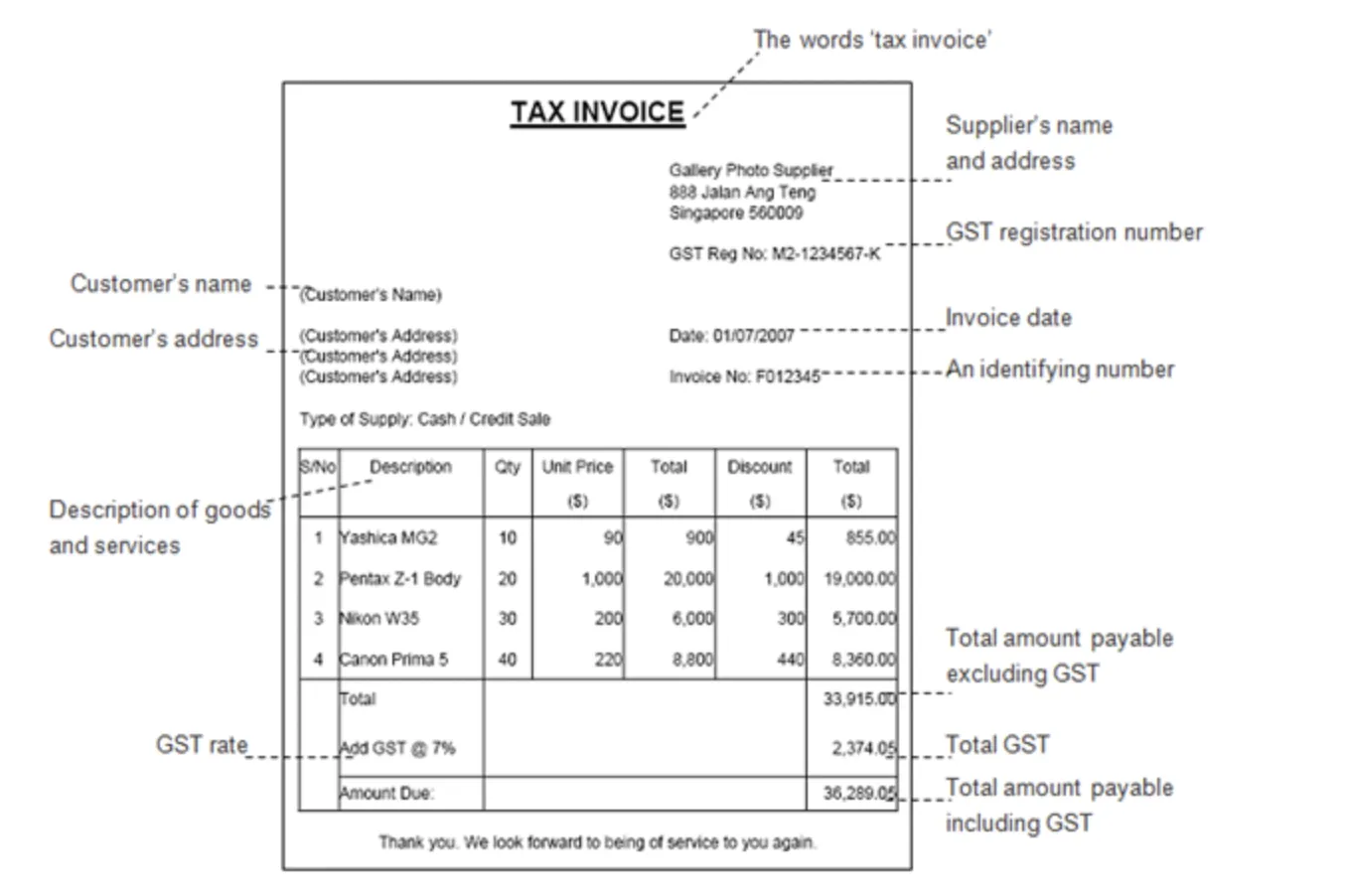
A tax invoice should contain the following:
The words "Tax Invoice" displayed on the document
- Date of invoice issue
- The invoice number
- Name of the buyer
- Billing address of the buyer
- Name of the seller
- Billing address of the seller
- The seller's GST registration number
- The description of the items
- Quantity
- Price per item
- GST charged on each item
- Total amount payable excluding GST
- The amount of GST charged
- Total cost, including GST
Foreign-currency invoice requirement
If you invoice a customer in a foreign currency, you must convert three amounts into Singapore dollars on the tax invoice itself:
- Total amount payable excluding GST
- Total GST payable
- Total amount payable including GST
You can show these SGD figures alongside the original foreign-currency amounts on the same invoice; you don't need to reissue the invoice purely in SGD. IRAS requires you to use an approved exchange rate for GST purposes, such as rates published by local banks or locally circulated newspapers, when doing the conversion.
This matters directly to your customer too: a GST-registered buyer can only claim input tax based on the SGD amounts stated in the tax invoice you issue, so an inaccurate or missing conversion can affect their ability to claim.
For your own GST return, you report the SGD figures shown on the invoice as your value of standard-rated supplies and output tax due, so getting this right at invoicing time saves you a reconciliation headache later.
Difference between a tax invoice and a standard invoice
A tax invoice is issued by a GST-registered business to a customer and includes Goods and Services Tax (GST) details. IRAS recognizes it for filing GST returns and claiming input tax credit. A standard invoice is issued to customers directly to record the sale of a product or a service, without any GST details.
Some of the other differences between the two types of invoices are:
| Standard invoice | Tax invoice | |
|---|---|---|
| Issued by | Any business, to record a sale | A GST-registered business, to record GST charged on a sale |
| GST details | Not included | Includes the seller's GST registration number and the GST amount charged |
| Number of copies | One original per sale; a duplicate can be reissued if the customer loses it | One original per sale; a duplicate marked "Copy" or "Duplicate" can be reissued if lost |
| Purpose | Keeping track of goods and services sold; supports accounting and internal record-keeping | Supports GST input tax claims for the buyer, and accurate GST reporting for the seller |
Both invoice types typically share the same core contents, such as the name and billing address of the buyer and seller, and the receipt or invoice number. You may also issue a separate GST invoice alongside the tax invoice where relevant.
Understanding credit and debit notes
Credit note
A seller issues a credit note, a legal document that informs buyers about a price adjustment or a refund they owe the buyer. Usually, credit notes are issued when the buyer returns any items, or they have been overcharged for an order. Instead of returning the payment to the buyer, a simple credit note is given. You can also use it to fix errors in past invoices or offer the buyer discounts or concessions on a future purchase. It's an efficient way to ensure that business records are fair and organized by rectifying billing errors.
A valid credit note should include your name, address, and GST registration number, the buyer's name and address, a unique credit note number, the date of issue, the reason for the credit, and the GST adjustment amount. It must also reference the original tax invoice number and date, so IRAS can trace the adjustment back to the sale it relates to.
Debit note
A debit note is a document that requests payment where no GST is charged, or that a business issues to collect a credit it's owed from a supplier. It's typically a reminder that a payment is due, or that a billing mistake needs to be corrected outside the standard GST invoicing flow. Debit notes are commonly issued for things like internal billings between related entities, or non-taxable charges, where a tax invoice wouldn't apply.
For a standard-rated supply to a GST-registered customer, IRAS requires a tax invoice or simplified tax invoice, not a debit note, so that the customer can support their input tax claim. This is the key difference from a credit note: a credit note is the correct GST document for reducing what a customer owes on a taxable supply, while a debit note serves a narrower purpose limited to non-GST-charged requests for payment or credits owed by a supplier.
When a debit note is issued to collect a credit due from a supplier, it should include the same details as a credit note: both parties' names and addresses, a unique number, the date, the reason for the adjustment, and a reference to the original document it relates to.
Tax invoice vs. credit note vs. debit note
Now that you understand what a tax invoice is, let us see how it differs from credit and debit notes.
| Feature | Tax Invoice | Credit Note | Debit Note |
|---|---|---|---|
| Purpose | This document is issued by the supplier to the buyer or customer for the goods or services provided. | It is issued by the supplier to the buyer for any adjustments or returns and it reduces the amount the buyer owes the seller. | It is issued by the supplier to the customer for any additional charges that were previously not added in the invoice, and it increases the amount the buyer owes the seller. |
| Impact on GST | It essentially acts as a record of the GST to be paid by the customer. | Whenever a credit note is issued, the input tax claim or GST payable is reduced. | When a debit note is issued, the input tax claim or the GST to be paid increases. |
| Issuing Date | Whenever any taxable supply is made, such as the sale of services or goods, a tax invoice is issued. It needs to be issued within 30 days of the delivery or provision of products or services. | Whenever there is an error in the original invoice or goods are returned, a credit note is issued. It will be issued after a reduction in the original transaction is made. | Whenever a price increase is noticed or additional services or goods are supplied, it can be issued. It will be issued when there is an increase in the original transaction amount. |
Understanding how a tax invoice is different from a receipt
Sellers and vendors issue invoices and receipts to customers, but the two serve different purposes. A receipt is evidence that a payment has been made. It confirms the transaction took place and acts as proof of payment, but it doesn't support a GST claim.
A tax invoice, on the other hand, is the GST document that supports an input tax claim. If your customer is GST-registered, you're generally required to issue a tax invoice rather than a receipt, so they can use it to claim input tax.
If you sell mainly to non-GST-registered end consumers, IRAS allows you to issue a serially printed receipt instead of a tax invoice. The receipt must show your business name, address, GST registration number, date of issue, the total amount payable including GST, and the words ‘Price payable includes GST’. Receipts are generally less detailed than tax invoices, since they don't need to break out the GST amount or rate separately. Aspire's invoice management software can be used to issue regular invoices as well as tax invoices for different business sales.
Common mistakes to avoid in tax invoices
Here are some of the most common mistakes businesses make while issuing tax invoices.
Not providing the required information
IRAS has given a detailed list of information that must be mentioned in every tax invoice, and omitting any of it results in non-compliance. Whether it is the supplier's name, invoice number, date of issue, description of goods or services provided, quantity or value of goods and services, or anything else along these lines, vital information must be mentioned. You were introduced to what a tax invoice is and the detailed list of information it must include earlier in this guide. Ensure the information provided on a tax invoice is up-to-date and correct.
Incorrect use of tax rates
Certain services in Singapore are zero-rated, some are exempt from GST, and some have a standard rate. Whenever your business issues a tax invoice, ensure the correct tax rate is mentioned. When an incorrect tax rate is mentioned, it results in non-compliance and can also attract penalties.
Not separating the GST
Whenever GST is chargeable on a standard tax invoice, IRAS requires it to be shown as its own line, alongside the total amount excluding GST and the total amount including GST. It should never be folded into a single lump-sum figure with no breakdown. This results in unnecessary confusion for both the tax authorities during an audit and for the customer.
Not issuing the invoice on time
Ensure the business issues a tax invoice within 30 days of fulfilling a delivery or supply. Not doing this not only results in non-compliance but can cause delays while filing for GST claims. A good business practice is to promptly issue a tax invoice after the services or goods are provided.
Incorrect GST information
Whenever a tax invoice is issued by a GST-registered business, the correct GST registration number must be mentioned. Incorrect or missing GST numbers can result in rejection of the claim when the buyer inputs tax credit.
Not registered for GST
Another common mistake businesses make is issuing tax invoices when they are not registered for GST. If the business is not registered, it is not allowed to charge GST or issue a document labeled "Tax Invoice"; doing so violates Singapore's GST regulations.
Not keeping a proper record
Businesses are required to maintain a detailed, accurate, and up-to-date record of all the tax invoices they have issued for at least five years. Not doing this can attract severe penalties during an audit. It is also important to keep a record of not just the tax invoices but the receipts, too. The difference between a tax invoice vs. receipt is that the former is used to request a payment, while the latter is an acknowledgment of the payment received.
What is Goods and Services Tax (GST), and why is it included in a tax invoice
Goods and Services Tax (GST) is a consumption tax that IRAS levies on the sale of goods and services in Singapore, currently at 9% (effective since 1 January 2024), and it's also charged on imported goods. Most sales are standard-rated, meaning GST applies at the full 9%, while some supplies are zero-rated (like exported goods and international services) or exempt altogether (such as residential property sales and certain financial services).
A tax invoice exists to record this GST clearly: it shows what was charged, at what rate, so both you and your customer have an accurate record for IRAS reporting. You only need to issue a tax invoice with GST if your business is GST-registered.
Exemptions: When a tax invoice is not required
All GST-registered businesses in Singapore must issue tax invoices to record the goods or services provided and support GST claims. However, a tax invoice might not be needed in the following situations.
Supplies exempt from GST
In Singapore, certain supplies are exempt from GST, such as the sale and lease of residential properties and certain financial services. Since no GST is charged, a tax invoice isn't required for these. Some exempt categories have their own specific invoicing rules; for example, IRAS requires an invoice to be issued for an exempt supply of investment precious metal, even though no GST applies. It's worth checking IRAS's guidance for the specific category your business deals in, rather than assuming one rule applies across all exempt supplies.
Sales of SGD $1,000 or less
If the transaction value for a single supply is SGD $1,000 or less (including GST), businesses may issue a simplified tax invoice instead of a standard tax invoice.
Export of goods or services
If goods or services are exported beyond Singapore's borders, GST on such transactions is zero-rated. Though tax invoices might not be needed in the same form, the business or exporter must maintain a detailed record of transactions to report GST.
Non-GST-registered customer
A tax invoice does not need to be issued to a customer who isn't GST-registered. In this case, a business can issue a regular receipt or invoice instead, since the customer has no need to claim input tax.
One important thing for all businesses is to maintain a proper, detailed, and organized record of all their transactions, regardless of whether a tax invoice is needed.
Calculating GST on tax invoices
Now that you have a fair overview of an invoice, a tax invoice's meaning and how it differs from a receipt, let's take a look at how to calculate a GST invoice.
There are two ways to calculate the GST amount on your tax invoice:
You could apply 9% GST to the value of each item and then add all the GST components
You could directly compute 9% on the total price of all goods and services sold
For example, let's assume you are a paper manufacturer. You make the following sale to another company:
- Five reams of A4 70Gsm copier paper at the rate of SGD $20 per ream
- 10 reams of A4 all-purpose premium quality paper at the rate of SGD $17.59 per ream
- Seven reams of A4 digital premium quality paper at the rate of SGD $34.80 per ream
If you follow the initial GST invoicing method of computing GST on each item, then the calculation would be as follows:
| Item | Units Purchased | Cost Per Unit (S$) | Total Cost (S$) | GST at 9% |
|---|---|---|---|---|
| A4 70Gsm copier paper | 5 | 20 | 100.00 | 9.00 |
| A4 all-purpose premium quality paper | 10 | 17.59 | 175.90 | 15.83 |
| A4 digital premium quality paper | 7 | 34.80 | 243.60 | 21.92 |
| Total | 519.50 | 46.75 |
As mentioned, you could also calculate GST on the total sales amount. The calculation would be as follows:
| Item | Units Purchased | Cost Per Unit (S$) | Total Cost (S$) |
|---|---|---|---|
| A4 70Gsm copier paper | 5 | 20 | 100.00 |
| A4 all-purpose premium quality paper | 10 | 17.59 | 175.90 |
| A4 digital premium quality paper | 7 | 34.80 | 243.60 |
| Total | 519.50 | ||
| GST at 9% | 46.76 | ||
| Total Payable | 566.26 |
As you can see, there is a possibility that the GST invoice amount may vary slightly under both circumstances due to rounding off. However, both methods are acceptable. The only condition is that you should use the methods consistently.
Tax invoice template
A tax invoice must have all the components required to qualify as a legal document. It must also provide details on zero-tax products, services, exempt goods, or other supplies. Here is a sample invoice from the IRAS website:
When should you issue a tax invoice
If you are a GST-registered company dealing with customers who are also GST-registered, you must issue a tax invoice. As per IRAS rules and guidelines, you must send the GST tax invoice within 30 days of the time of supply. Your customers will use your GST invoice as proof to claim input tax.
If your customer is not GST-registered, and you are, you will still need to issue a GST tax invoice as proof of the GST that you have collected and must pay to the government.
However, you do not have to issue a tax invoice in certain circumstances. If you are dealing with zero-rated supplies, such as the export of goods or international services, you do not need to issue a tax or GST invoice. Certain goods and services are exempt from GST altogether, such as the sale and lease of residential properties or financial services.
If your business is not registered for GST, but your customer is, you can issue a regular commercial invoice instead of a tax invoice. Just make sure it doesn't include the words "Tax Invoice," a GST registration number, or GST shown as a separate charge, since none of these apply to a non-GST-registered business.
Why should you issue a tax invoice
If you're GST-registered, issuing a tax invoice isn't optional; it's a legal requirement for standard-rated supplies to GST-registered customers. Beyond compliance, it supports your customer's input tax claim by giving them the GST breakdown they need, and it supports your own output tax reporting when you file your GST return. It also creates an audit trail: a clear, retrievable record of what was sold, at what price, and how much GST was charged, which protects both parties if IRAS ever requests supporting documents.
What is a simplified tax invoice
A simplified tax invoice is a less detailed tax invoice that you can issue if your sale amount is SGD $1,000 or less, including GST.
In a simplified tax invoice, you will only need to provide the following details:
- Your business's name
- Your business's billing address
- Your GST registration number
- Date of invoice issue
- An invoice number
- Description of the product or service sold
- Total amount payable, including GST, with a note that the price payable includes GST
You can also use a sales voucher or a debit note instead of a simplified tax invoice as long as it contains all the necessary details.
Introducing e-Invoicing in Singapore
The Inland Revenue Authority of Singapore (IRAS) has introduced a mandatory electronic invoicing system to replace paper or PDF invoices, under the GST InvoiceNow requirement.
This is being rolled out in phases based on when a business registers for GST and its annual taxable turnover:
| Implementation date | Who it applies to |
|---|---|
| 1 November 2025 | Businesses that register for GST voluntarily within 6 months of incorporation |
| 1 April 2026 | Businesses that apply for voluntary GST registration on or after 1 April 2026, regardless of incorporation date or business structure |
| 1 April 2028 | Businesses applying for compulsory GST registration on or after 1 April 2028, and existing GST-registered businesses with total annual supplies of SGD $200,000 or less |
| 1 April 2029 | Existing GST-registered businesses with total annual supplies of SGD $1,000,000 or less |
| 1 April 2030 | Existing GST-registered businesses with total annual supplies of SGD $4,000,000 or less |
| 1 April 2031 | Existing GST-registered businesses with total annual supplies above SGD $4,000,000 |
As per the e-invoicing initiative, all GST-registered businesses are required to directly transmit their invoice information to IRAS for tax purposes. This platform is based on the international Peppol standard to provide an automated, structured, and seamless transfer of invoicing information between businesses and IRAS.
The primary benefits of adopting the e-invoice system include the removal of manual entry due to this platform's direct system-to-system data transfer. It ensures the standardization of invoice formats used by businesses everywhere in Singapore. Finally, it offers direct integration with IRAS for GST administration, reducing compliance errors.
Final word
As a Singapore business that is GST registered, you need to send a tax invoice or a GST tax invoice to your customers for all standard-rated supplies. You do not need to send a tax invoice on zero-rated goods and services, exempt products, or other deemed supplies that are not taxed under GST.
A tax invoice is just as crucial for your business as it is for your customer. You should hold on to your tax invoices for at least five years.
You can use Aspire's accounts receivable solution (https://aspireapp.com/receivable-management) to produce different kinds of invoices for your business. With features such as automatic reconciliation, tax compliance, auto-reminders for clients, and automated cash flow insights, there's so much you can do with invoices generated via Aspire.
This blog is for general information only and does not constitute financial, legal, tax, or professional advice. Aspire’s services are subject to the terms outlined in our 'Terms of Service' and 'Pricing' pages. We make no guarantees as to the accuracy, completeness, or timeliness of the content, and past results do not indicate future performance. Always consult a qualified professional before acting on any information provided.
Aaron Oh
Writer
Aaron is a seasoned content writer specialising in finance, insurance and tech industries. With a writing history at S&P Global, EdgeProp, Indeed, Prudential, and others, Aaron leverages finance knowledge and business insights to help businesses improve productivity and performance.
Aspire Launchpad
Supercharge your finance operations with Aspire
Find out how Aspire can help you speed up your end-to-end finance processes from payments to expense management.

Latest articles

Product Updates
Aspire release notes (September 2026): Aspire MCP and more
Connect Aspire to Claude, ChatGPT and Cursor with Aspire MCP, plus new launches in Hong Kong and Singapore and the latest in Agentic ERP.
E-commerce •
E-commerce fulfilment in Singapore: Complete guide for businesses
Learn how e-commerce fulfilment works in Singapore, from warehousing and order processing to delivery, costs, and choosing the right fulfilment partner.

E-commerce •
3PL for ecommerce warehousing in Singapore
Learn how 3PL warehousing works for e-commerce businesses in Singapore, its benefits, how it works and how to choose the right provider.
Start your journey with Aspire
Open your free account