



What Is a Company Kit Set in Hong Kong?

Galih Gumelar

Summary
Definition: A Company Kit Set (Green Box) bundles the documents and tools a new Hong Kong company needs, usually the Articles of Association, company chops, statutory registers and share certificates.
Legal status: Keeping the statutory registers is required under the Companies Ordinance, while a common seal has been optional since the Ordinance took effect.¹ ²
Key uses: The kit supports bank account opening, audits, raising capital and share transfers.
Ongoing duty: The registers are living records, so update them whenever directors, members or significant controllers change.
Aspire advantage: Aspire helps new Hong Kong entities open a multi-currency business account online, with approval in as little as 1 business day.
After incorporating a limited company in Hong Kong, most founders are offered a Company Kit Set, commonly known as the Green Box. It is one of those things almost every new owner receives without fully knowing what is inside, why it matters or whether the physical version is still necessary.
This guide covers what the kit contains, which parts the law actually requires, and how to use and store it. It also shows where it fits in the path from incorporation to your first business bank account.
What is a Company Kit Set (Green Box)?
A Company Kit Set is a bundle of corporate documents and tools issued after a Hong Kong company is incorporated. It is traditionally packed in a dark green box, which is where the "Green Box" nickname comes from.
The kit acts as organised, physical proof of the company's legal existence. It also holds the records the company must maintain to operate compliantly from day 1.
Who issues the Company Kit Set?
The kit is typically assembled by the company secretary or formation provider that handles your incorporation. It is a service deliverable, not a document issued by the Companies Registry itself.
Because of this, treat incorporation, the kit and banking as 1 connected process. Aspire's guide on how to register a company in Hong Kong walks through the front end of that process.
What is inside the Green Box?
A standard kit has 4 main categories of items.
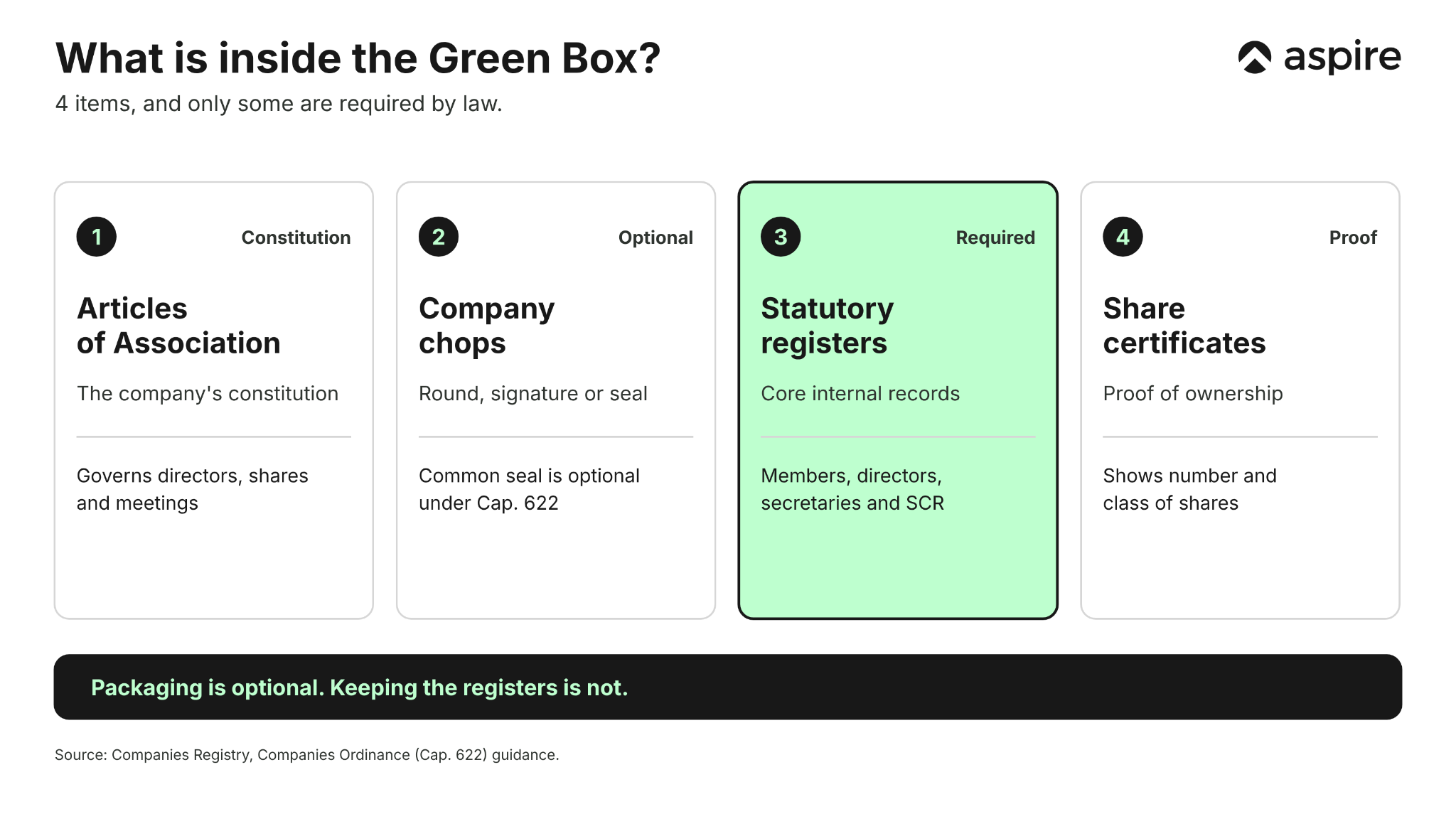
| Item | What it is |
|---|---|
| Articles of Association | The constitutional document setting internal rules on shareholder rights, director powers and governance |
| Company chops | Rubber or metal stamps used to authenticate documents on the company's behalf |
| Statutory registers | The internal records the Companies Ordinance requires the company to keep |
| Share certificates | Proof of ownership issued to each shareholder |
What do the Articles of Association cover?
The Articles are the company's constitution. They set out how directors are appointed, how shares transfer and how shareholder meetings run.³
The memorandum of association no longer exists for new Hong Kong companies, so the Articles carry these rules on their own.³
Which chops come in the kit?
Most kits include a round chop and a signature (or "long") chop, and some add a metal common seal. The round chop suits low-risk routine confirmations, while the signature chop sits beside a handwritten signature on formal documents.
Aspire's company chop guide explains the legal standing and appropriate use of each type.
Which registers must you keep?
The Companies Ordinance requires a register of members, a register of directors and a register of company secretaries.² Companies must also keep a Significant Controllers Register (SCR), which lists the people with meaningful control over the company.⁴
Why do share certificates matter?
A share certificate evidences a shareholding, stating the number and class of shares held. It matters most when you raise capital, transfer ownership or face due diligence for a sale.
Is a physical Company Kit still required?
No single physical kit is required by law, and neither is a chop. The Companies Registry says a company does not have to keep a common seal under the Companies Ordinance (Cap. 622), although it may still adopt one.¹
Without a seal, a company can still execute a document with signatures. A company with 1 director has that director sign, while a company with 2 or more directors needs 2 directors, or a director and the company secretary.¹
In practice, a bank or counterparty may still ask to see a chop, so confirm their requirements before you skip it. The statutory registers are different, because the duty to keep them stays regardless of the packaging.
How much does a Company Kit cost?
Prices vary by provider, so ask for an itemised quote. The cost depends on chop quality, the number of documents and whether the kit is bundled with incorporation or company secretary services.
For reference, Aspire's chop guide cites roughly HK$50 to 150 for a local signature or round chop.
What is the Company Kit used for?
The kit's documents are used whenever a third party needs to verify the company. The first time most founders produce them is at bank account opening.
| Use case | How the kit is involved |
|---|---|
| Opening a business bank account | Banks commonly ask to see the Articles, registers and sometimes a chopped form |
| Undergoing an audit | Auditors typically review the statutory registers and share records |
| Raising capital | Share certificates and the register of members matter in due diligence |
| Transferring shares | The Articles govern the process, and updated certificates follow |
Aspire's guides cover the documents required to open a business bank account and how to open a business bank account in Hong Kong. A new company opening a business bank account faces a few extra checks.
How should you store and manage the kit?
Store the kit securely, limit who can use the chops and keep the registers current.
Where should the kit be stored?
Keep it at the registered office or with the company secretary. It holds sensitive records and any chops that can authenticate documents.
Who should have access to the chops?
Only authorised people. A chop can authenticate some documents without a signature beside it, so open access creates real internal risk.
How often should registers be updated?
Update a register whenever the underlying facts change. A new director or a share transfer needs an entry.
The Companies Registry sets a tight window for the SCR: a company must notify a significant controller within 7 days of learning of a registrable change.⁴ The SCR must be kept at the registered office or another place in Hong Kong.⁴
What does a new kit look like in practice?
A Hong Kong-incorporated design studio with 2 founders shows the sequence. The studio is invented for illustration.
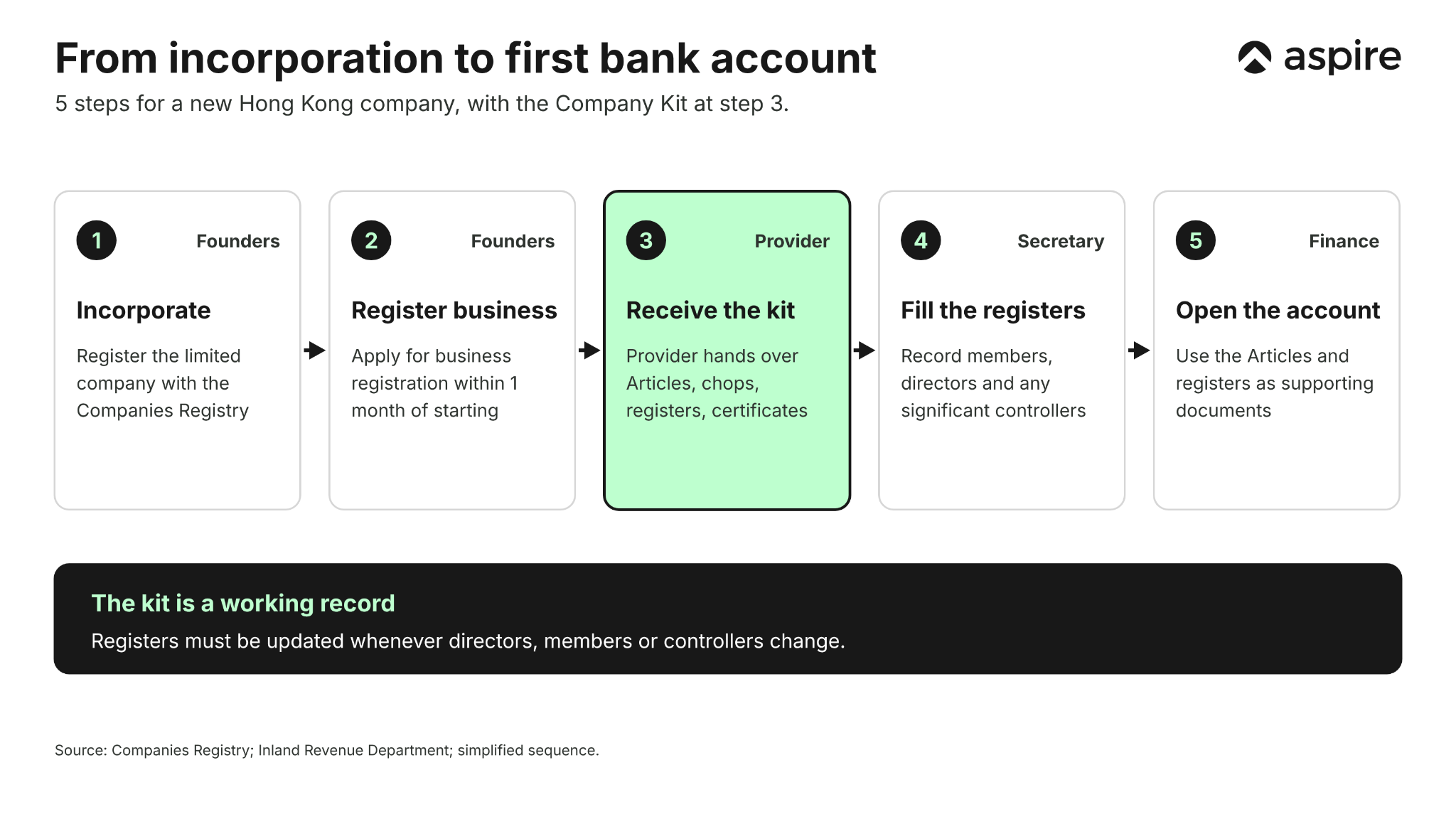
The founders incorporate the company, then register the business, since anyone running a business in Hong Kong must register within 1 month of starting it.⁵ Their provider hands over the kit, and they record both founders in the register of members and register of directors.
They then add the SCR entries and open a business account using the Articles and registers as supporting documents. For account types and features, see Aspire's guide to corporate accounts. The business registration guide explains the certificate step.
Can you bundle incorporation and banking?
Yes, bundling avoids the gap between whoever incorporates the company and whoever opens its bank account. Aspire Launchpad connects founders with partner incorporation providers and with an Aspire business account.
Ask the provider you choose exactly which kit items are included and who keeps the registers. Compare setups in Aspire's guide to SME banking options. Check the local tax position in the guide to the corporate tax rate in Hong Kong.
Why Hong Kong Businesses Choose Aspire
Getting your incorporation and kit sorted is 1 part of setting up properly, and Aspire supports what happens financially from there.
💱 FX spreads from 0.18%, up to 3x cheaper than traditional banks. This applies across 130+ countries and 40+ currencies through Aspire's multi-currency account. It's useful for anything from paying overseas suppliers to settling international payments without losing margin to markup.
💰 1.2% unlimited cashback applies on every corporate card transaction, with no monthly cap. It kicks in automatically on eligible spend, with no minimum threshold to hit first. Over time, it quietly turns routine business spend into working capital.
🌐 Local transfer network, not multi-hop SWIFT chains, is how Aspire routes most payments. This means faster settlement and fewer intermediary fees eating into your payment before it reaches the recipient. It also reduces the chance of funds being held up for review at a correspondent bank along the way.
💸 Fixed USD 8 inbound SWIFT fee, tracked end-to-end with SWIFT GPI, applies when SWIFT is the right rail for your payment. There are no surprise deductions from correspondent banks along the way, so the amount you're quoted is the amount that arrives. You can also download payment confirmation instantly from the app, without calling the bank.
⚡ Approved in as little as 1 business day, with no branch visits and no paperwork stacks. Applications are completed entirely online, from document upload to approval. There's no waiting weeks on a relationship manager to call you back.
Open a free multi-currency business account built for Hong Kong SMEs, or explore how Aspire's corporate card fits into your day-to-day spend.
Frequently Asked Questions
Not as a single package. The registers the Ordinance requires must be kept, but the Green Box bundle and the chops are not legal requirements in themselves.¹ ²
Registers can generally be rebuilt from company records, certificates reissued and chops re-ordered. Tell your company secretary promptly if a chop goes missing.
Yes. The kit belongs to the company, so hand it over to the new provider with the other company records.
Not strictly, because a common seal is optional.¹ Some banks may still ask for a chop, so check with them first.
Format matters less than accuracy, so keep the registers complete and current. Confirm with your company secretary which format they maintain.
Sources
- Companies Registry, "Common Seal" (Companies Ordinance FAQ)
- Companies Registry, "New Companies Ordinance (Cap. 622): Highlights Overview"
- Companies Registry, "The New Companies Ordinance" pamphlet
- Companies Registry, "Register of Significant Controllers" briefing
- Inland Revenue Department, "Business Registration: General Information"
This blog is for general information only and does not constitute financial, legal, tax, or professional advice. Aspire’s services are subject to the terms outlined in our 'Terms of Service' and 'Pricing' pages. We make no guarantees as to the accuracy, completeness, or timeliness of the content, and past results do not indicate future performance. Always consult a qualified professional before acting on any information provided.
Galih Gumelar
Writer
Galih is a seasoned writer specialising in macroeconomics, business, finance and politics. With a writing history at CNN Indonesia, The Jakarta Post, and various other reputed organisations, Galih leverages his broad range of experiences to create insightful resources for those wanting to start a business.
Aspire Launchpad
Start Your Business with Aspire Launchpad
From incorporation to venture capital, we connect you with trusted service providers to make your entrpreneurial journey seamless.

Latest articles

Finance Tools •
Top 8 Fintech Digital Payment Solutions in HK
Compare 8 top fintech digital payment solutions in HK: stated fees, how each collects payments, HKMA usage data and a checklist to choose well.

Incorporation •
EOR Services in HK: How They Work and Cost
Understand EOR services in Hong Kong: how an employer of record works, what it costs, which HK rules it handles and how to choose a provider.

Finance Tools •
Top 6 Fintech Global Payment Solutions for HK Businesses
Compare 6 top fintech global payment solutions for HK businesses and how they differ from banks: stated fees, speeds and a checklist to choose well.
Start your journey with Aspire
Open your free account