



EOR Services in HK: How They Work and Cost

Galih Gumelar

Summary
An EOR becomes the legal employer. You manage the daily work, and the EOR handles contracts, payroll and compliance.
Hong Kong sets fixed employer duties. An employer must enrol staff in MPF within 60 days, pay wages within 7 days and file IR56 forms.¹ ² ³
Our EOR starts from USD 399 per employee per month. We hire through our partner Deel in 150+ countries.
Cost is more than the fee. Salary and employer costs sit on top of the EOR fee.
Providers state different starting prices. Our EOR is listed first among 5 in the comparison table.
An EOR suits long-term hires without an entity. A short project often fits a contractor, and several hires in 1 country may justify an entity.
EOR services let a business hire staff through an employer of record (EOR) that acts as their legal employer, so the business needs no local entity. In Hong Kong, the idea works in 2 directions: overseas firms hire in Hong Kong, and Hong Kong firms hire abroad.
This guide explains how an EOR works and what it costs. It also covers the Hong Kong rules an EOR must meet and how to choose a provider.
SLUG (delete this line before upload): eor-services-hong-kong
What are EOR services in HK?
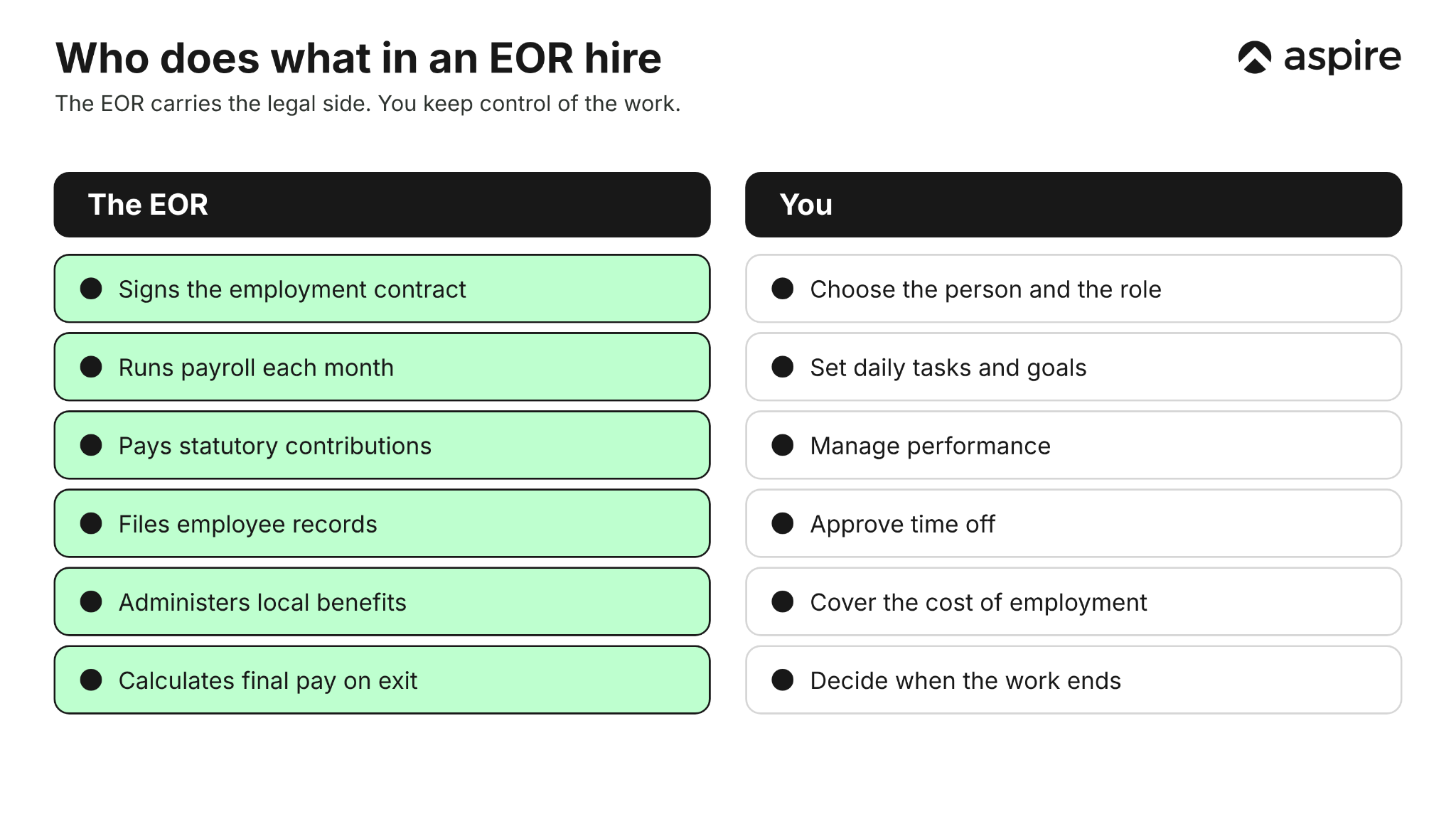
EOR services are a service in which a provider legally employs your staff while you direct their work. The EOR signs the employment contract, runs payroll, pays statutory contributions and keeps the employee records.
You still choose the person, set the tasks and manage performance. The EOR does not recruit for you, and it is not a staffing agency.
How does an EOR work in HK?
An EOR works by taking over the legal side of employment while you keep control of the work. The diagram shows how the 2 sides split.
The usual sequence has 5 steps.
- Choose the country and role. Agree the job title, salary and start date.
- Sign with the provider. The EOR issues a local employment contract.
- Onboard the employee. Collect documents and enrol them in local schemes.
- Run payroll each month. The EOR pays salary and statutory contributions.
- Manage the exit. The EOR calculates final pay and any termination payments.
Our guide to hiring overseas employees covers the wider options before you pick an EOR.
When does a business need an EOR?
A business needs an EOR when it wants to employ someone in a place where it has no legal entity. The table shows the 3 common situations.
| Situation | Example | What the EOR does |
|---|---|---|
| Hong Kong firm hires abroad | A Hong Kong design studio hires a developer in another country | Employs the developer under local law |
| Overseas firm hires in Hong Kong | A foreign start-up hires a sales lead in Hong Kong | Employs the lead under Hong Kong law |
| Market test | A company tests demand in a new city | Employs a first hire without an entity |
EOR or entity: which route fits?
The right route depends on how long you plan to hire, how many people you need and how much control you want. The table compares the 4 routes by who the legal employer is.
| Route | Legal employer | You handle |
|---|---|---|
| EOR | The EOR | Daily work and performance |
| Own entity | You | Everything, including filings |
| Contractor | Nobody; the person is self-employed | The scope of work |
| Payroll outsourcing | You | Employment decisions, with payroll run for you |
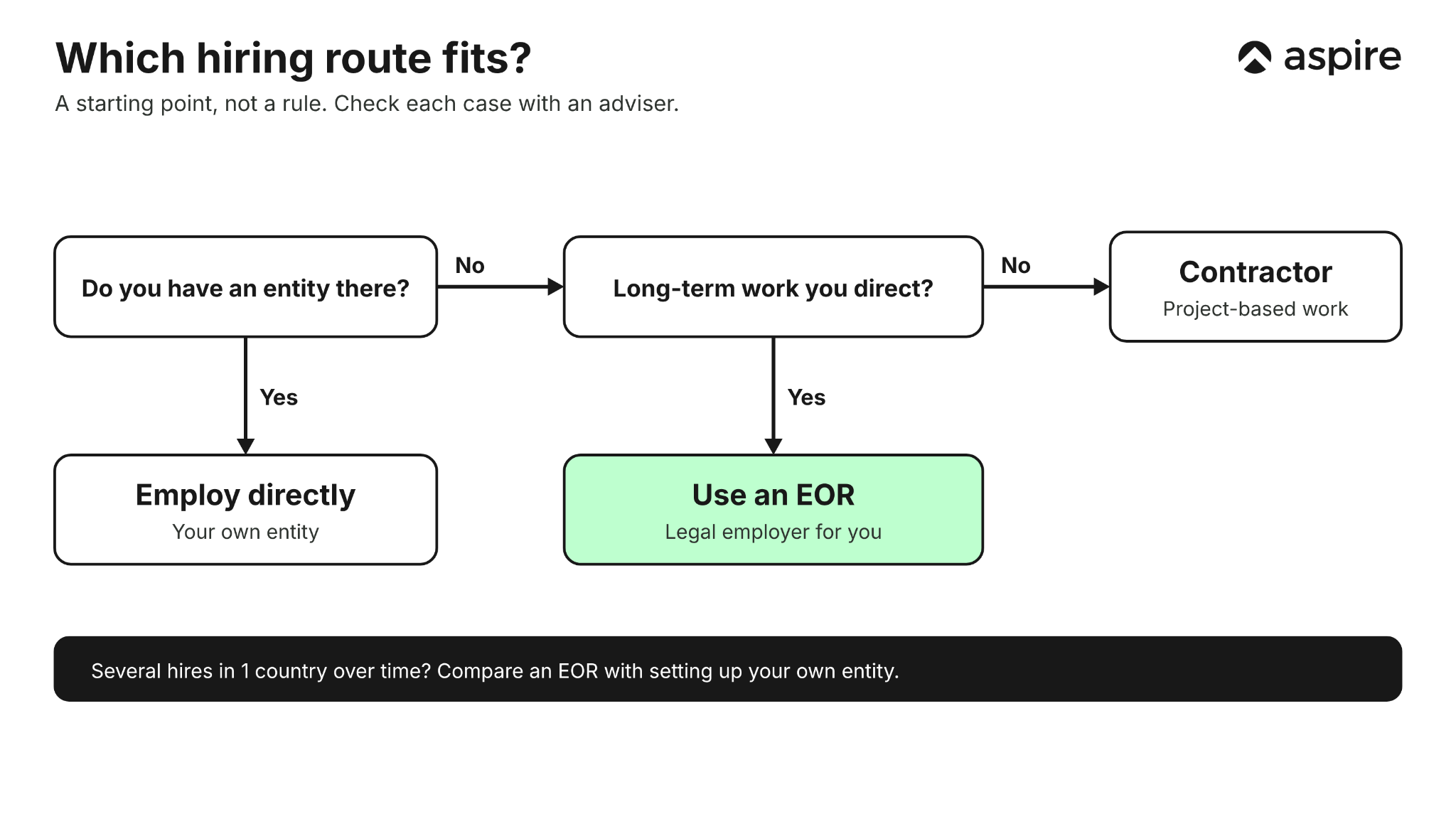
Contractors need care, because a person who works like an employee may be treated as one. Our guide to payroll methods explains how payroll outsourcing differs from an EOR.
Which are the top EOR providers?
These 5 providers publish EOR coverage or pricing details, and we list ours first. The table shows what each states, and prices are starting points that change by country and contract.
| Provider | EOR countries | Price stated | Contract terms |
|---|---|---|---|
| Aspire EOR | 150+ through our partner Deel | From USD 399 per employee per month | / |
| Deel | 130+⁴ | From USD 599 per employee per month⁴ | Month-to-month, no long-term commitment⁴ |
| Remote | 90+⁵ | From USD 599 per employee per month⁵ | Annual contracts for that rate⁵ |
| Oyster | 180+, including Hong Kong⁶ | Not stated | Not stated |
| Atlas | Not stated | Typically USD 400 to 1,000 per employee per month in Hong Kong⁷ | Not stated |
For Hong Kong, Deel states that it manages MPF contributions.⁸ Oyster states that it handles MPF enrolment and remittance and the IR56B, IR56E and IR56F filings.⁶
Ask every provider what the monthly fee covers, because Atlas says its fee is separate from salary, benefits, taxes and permit costs.⁷
What does an EOR cost in HK?
An EOR charges a monthly fee per employee, and you also bear the salary and employer costs. Our EOR starts from USD 399 per employee per month.
Employer costs vary by country, so the example below uses an assumption. This illustrative example uses a Hong Kong design studio hiring 1 developer abroad. All figures are invented.
| Cost line | Monthly amount |
|---|---|
| Gross salary | USD 3,000 |
| Employer costs (assumed 15%) | USD 450 |
| EOR fee (from) | USD 399 |
| Total | USD 3,849 |
Add 1 more line for currency conversion when you pay in a local currency. Our guide to foreign exchange risk explains how to control it.
Which HK rules does an EOR handle?
An EOR that employs staff in Hong Kong takes on the employer duties set by the MPFA, the Labour Department and the IRD. The table lists the main ones.
| Duty | Rule |
|---|---|
| MPF enrolment | Within 60 days of employment, with a maximum fine of HKD 350,000 and 3 years' imprisonment for late enrolment¹ |
| MPF contributions | 5% from each side, due on the 10th of the next month⁹ |
| Wages | Within 7 days after the wage period ends² |
| New employee filing | IR56E within 3 months of hiring³ |
| Leaver filings | IR56F or IR56G 1 month before the employment ends or the person leaves Hong Kong³ |
Our guides to the MPF and payroll processing cover the detail.
Exits cost more since 1 May 2025, when employers lost the right to use mandatory MPF accrued benefits to offset severance or long service payments for later service.¹⁰ Our guide to severance pay explains the calculation.
What are the risks of using an EOR?
The main risks are weak contract terms, unclear exit costs and treating the EOR as a shield. Check these 5 points before you sign.
- Exit costs. Ask who pays termination and notice costs.
- Fee scope. Confirm what the monthly fee covers and what sits on top.
- Contract length. Check minimum terms and notice periods.
- Control. You direct the work, so the employment must still look genuine.
- Data. Ask where employee records are stored.
How do you choose an EOR provider?
Choose a provider on coverage, price clarity and support, not on a ranking. Use this 6-point checklist.
- Country coverage. Confirm the countries you need.
- Price clarity. Ask for the full cost breakdown.
- Legal employer. Confirm which entity employs your staff.
- Payroll and currency. Check local-currency payment support.
- Benefits. Confirm local statutory benefits and any extras.
- Accounting fit. Check that costs reach your books, such as Xero.
How do we support EOR hiring?
We help Hong Kong businesses hire abroad through our partner Deel, which is the legal employer. You can hire in 150+ countries, and our employer of record page has the full feature list.
- Pricing. We start from USD 399 per employee per month.
- Contracts. We generate localised employment contracts.
- Payroll. We run payroll with local-currency payments.
- Benefits. We administer local statutory benefits.
- Time off. You approve time off with public holiday tracking.
- Contractors. We also onboard and manage contractors.
Our payroll page covers staff you employ directly.
Why Hong Kong Businesses Choose Aspire
Hiring through an EOR is 1 part of growing a team, and Aspire supports the accounts, cards and transfers that sit around it.
💱 FX spreads from 0.18%, up to 3x cheaper than traditional banks. This applies across 130+ countries and 40+ currencies through Aspire's multi-currency account. It's useful for anything from paying overseas suppliers to settling international payments without losing margin to markup.
💰 1.2% unlimited cashback applies on every corporate card transaction, with no monthly cap. It kicks in automatically on eligible spend, with no minimum threshold to hit first. Over time, it quietly turns routine business spend into working capital.
🌐 Local transfer network, not multi-hop SWIFT chains, is how Aspire routes most payments. This means faster settlement and fewer intermediary fees eating into your payment before it reaches the recipient. It also reduces the chance of funds being held up for review at a correspondent bank along the way.
💸 Fixed USD 8 inbound SWIFT fee, tracked end-to-end with SWIFT GPI, applies when SWIFT is the right rail for your payment. There are no surprise deductions from correspondent banks along the way, so the amount you're quoted is the amount that arrives. You can also download payment confirmation instantly from the app, without calling the bank.
⚡ Approved in as little as 1 business day, with no branch visits and no paperwork stacks. Applications are completed entirely online, from document upload to approval. There's no waiting weeks on a relationship manager to call you back.
Open a free multi-currency business account built for Hong Kong SMEs, or explore how Aspire's corporate card fits into your day-to-day spend.
Frequently Asked Questions
An EOR is a provider that legally employs your staff while you manage their work. It runs payroll and handles compliance.
Our EOR starts from USD 399 per employee per month, and other providers state starting prices of USD 599. Salary and employer costs are on top.
No. A PEO shares employment with you, while an EOR becomes the legal employer.
No. With payroll outsourcing you stay the employer, and the provider only runs payroll.
Yes, an EOR can employ staff in Hong Kong under Hong Kong law. It must then meet the MPF, wage and IRD duties.
Only for genuine project work. A person who works like an employee may be treated as one.
Sources
- MPFA, "Employers' enrolment for employees" (MPF system, accessed November 2026)
- Labour Department, "Employers Should Pay Wages on Time" (leaflet)
- Inland Revenue Department, "Employer's obligations" (Employer's Return, accessed November 2026)
- Deel, "Pricing" (issuer page, accessed November 2026)
- Remote, "Pricing" (issuer page, accessed November 2026)
- Oyster, "Employer of record in Hong Kong" (issuer page, accessed November 2026)
- Atlas, "Employer of record in Hong Kong" (issuer page, accessed November 2026)
- Deel, "Hire and pay employees in Hong Kong" (issuer page, accessed November 2026)
- MPFA, "Mandatory contributions" (MPF system, accessed November 2026)
- HKSAR Government, "Abolition of MPF offsetting arrangement comes into effect today" (1 May 2025)
This blog is for general information only and does not constitute financial, legal, tax, or professional advice. Aspire’s services are subject to the terms outlined in our 'Terms of Service' and 'Pricing' pages. We make no guarantees as to the accuracy, completeness, or timeliness of the content, and past results do not indicate future performance. Always consult a qualified professional before acting on any information provided.
Galih Gumelar
Writer
Galih is a seasoned writer specialising in macroeconomics, business, finance and politics. With a writing history at CNN Indonesia, The Jakarta Post, and various other reputed organisations, Galih leverages his broad range of experiences to create insightful resources for those wanting to start a business.
Aspire Launchpad
Start Your Business with Aspire Launchpad
From incorporation to venture capital, we connect you with trusted service providers to make your entrpreneurial journey seamless.

Latest articles

Finance Tools •
Top 6 Fintech Global Payment Solutions for HK Businesses
Compare 6 top fintech global payment solutions for HK businesses and how they differ from banks: stated fees, speeds and a checklist to choose well.

Expense Management •
Corporate Card Management in HK: Guide & Policy Checklist
Master corporate card management in Hong Kong. Implement smart spend limits, leverage virtual cards, simplify monthly reconciliation, and maintain required records.

Finance Tools •
Virtual Corporate Card in HK: What Is It?
How HK teams use virtual corporate cards: types, safety, FX costs, a provider comparison and a rollout plan with limits per employee, vendor or project.
Start your journey with Aspire
Open your free account