



Virtual Corporate Card in HK: What Is It?

Galih Gumelar

Summary
What it is: A virtual corporate card is issued instantly and used online, in apps or through a phone wallet.¹
Why teams use it: 1 card per employee, vendor or subscription means 1 problem never stops every payment.
Safety: Tokenisation keeps the real card number hidden from merchants, and limits cap the damage of a leak.¹
Cost: Paying in a foreign currency by card usually adds a handling fee of about 0% to 2.5%.²
Providers: HSBC offers a wallet-based virtual card to its commercial customers, and we offer unlimited virtual cards with each account.
A virtual corporate card is a company payment card that exists only as a card number, issued in seconds and tied to a spend limit. For a Hong Kong team, the real question is not what it is, but how to issue one card per employee, vendor or subscription and keep each under control.
This guide covers how virtual corporate cards work, the types, safety, cost and a Hong Kong provider comparison. It then shows how a team can roll them out.
What is a virtual corporate card in HK?
A virtual corporate card is a payment card with no plastic, issued to the company and used by an employee, a vendor or a tool. It has its own number, limit and rules, and it settles against the company's account or credit line.
Hong Kong has 4 common forms: a virtual version of a bank corporate card, a virtual debit card from a business account, a mobile card held in a phone wallet, and a single-vendor card. For a broader primer, see our complete guide to virtual cards and our comparison of virtual and physical cards.
How does a virtual corporate card work?
An admin issues a card, the user adds it to a wallet or merchant, and each spend is checked against the card's limits. The card then reconciles to the company's books without a paper trail.
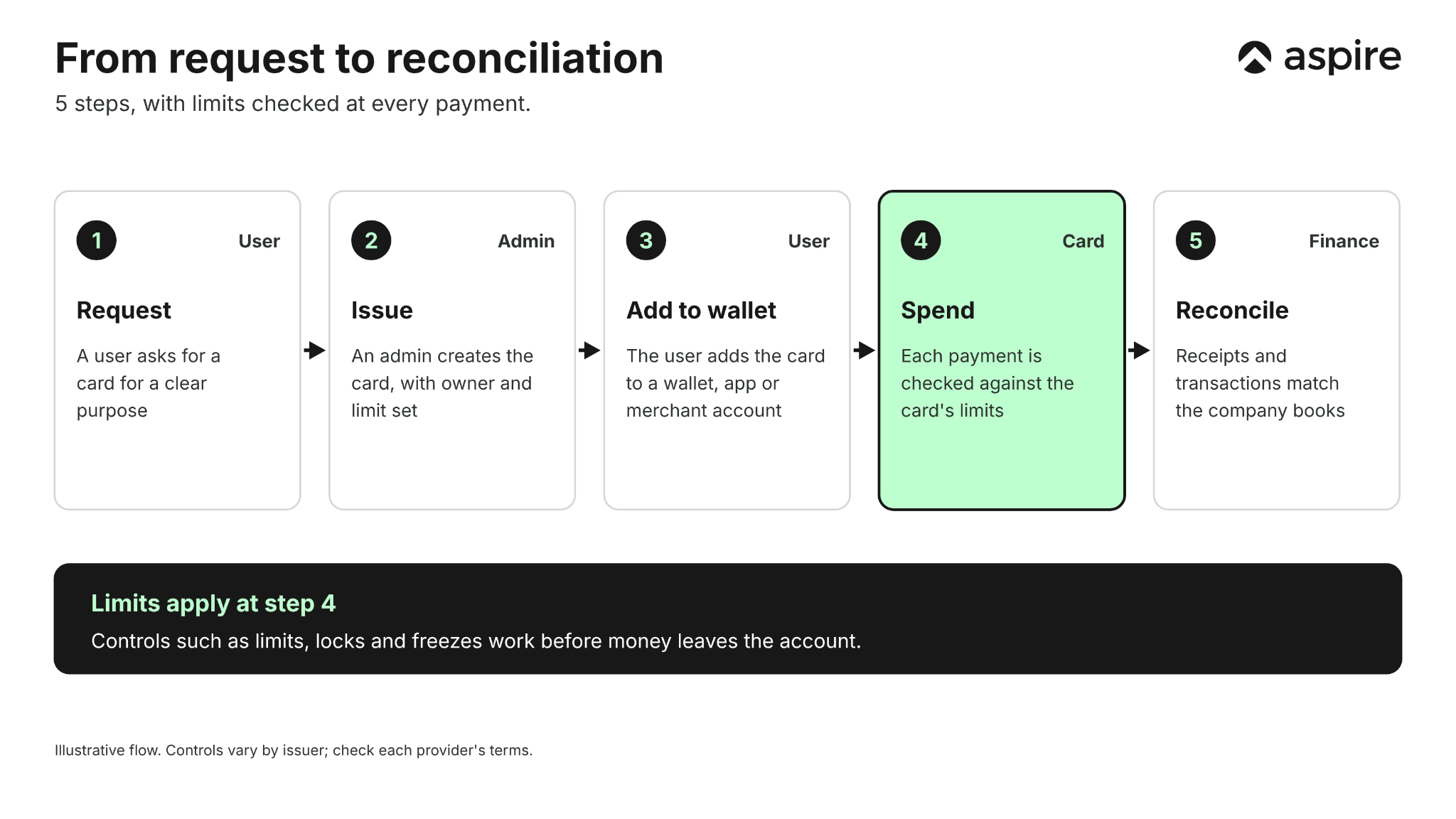
HSBC's launch release says virtual cards can be issued instantly through a portal and added to digital wallets for in-store, online and in-app payments.¹ See our guide to how card issuing works for the network and issuer roles behind each payment.
Which types of virtual card exist?
Virtual corporate cards are credit, debit or prepaid, and the type decides who carries the risk. Check the issuer's licence and terms before you choose.
| Type | How it settles | Watch for |
|---|---|---|
| Virtual credit card | Bills the company's credit line later | Repayment date and any personal guarantee |
| Virtual debit card | Spends from the account balance | Balance must be funded first |
| Virtual prepaid card | Spends from preloaded value | Issuer licence and unused value |
The HKMA licenses multi-purpose stored value facilities under the Payment Systems and Stored Value Facilities Ordinance, and prepaid cards are physical SVFs.³ Credit cards do not store value, so they fall outside that regime.³ See our guide to virtual credit card benefits and disadvantages.
Which cards should a team issue?
Issue 1 card per use case, so each card has 1 owner, 1 limit and 1 purpose. A freeze or a leak then stays inside that use case.
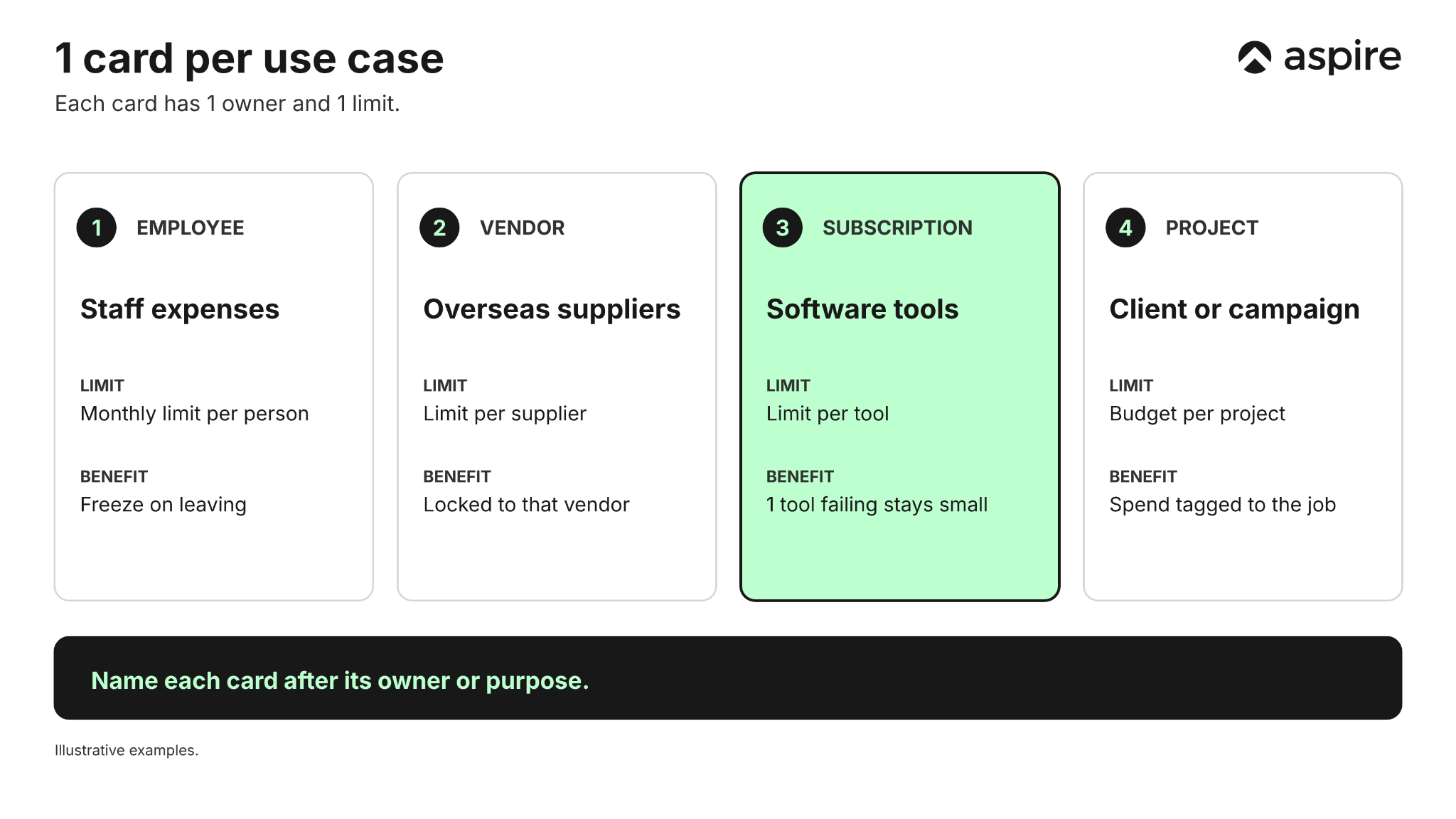
Name every card after its owner or purpose, so a statement line tells you who spent it and why. Our use-case guides cover travel, e-commerce, freelancers and agencies.
Is a virtual corporate card safe?
A virtual corporate card is safer than sharing 1 plastic card, because its number is hidden and its limit is capped. The HSBC and Mastercard release says tokenisation keeps real card numbers hidden from merchants.¹
Controls add a second layer. You can set a limit, restrict where a card works and freeze it at once if it is lost or misused. See our guide to spend limits.
How do HK virtual cards compare?
The providers differ in who can apply and in how they issue cards. The table uses each issuer's published terms, and the details can change.
| Provider | Virtual card model | Eligibility and cost stated |
|---|---|---|
| Aspire corporate card | Unlimited virtual cards at no extra cost, plus an optional credit line | Zero activation and transaction fees; credit line subject to approval |
| HSBC virtual corporate card | Issued through a portal and added to digital wallets¹ | HSBC commercial customers enrolled in its programme; fees not stated |
| American Express Gold Business Card | Not stated on the product page⁴ | HKD 980 annual fee with the first year waived |
Ask each provider for its foreign currency fee and its entry rules. A Business Registration Certificate is generally needed to open a business bank account in Hong Kong.⁵ ⁶ See our guide to the corporate credit card.
What does a virtual card cost?
The main cost is the foreign currency handling fee, not the card itself. The HKMA says paying in a foreign currency usually triggers a handling fee of about 0% to 2.5% from the issuer.²
The Consumer Council found the highest fee among the cards it surveyed in 2015 was 2.45%.⁷ Both figures date from 2015, so check current fee schedules in each card agreement.
Our card has zero activation and zero transaction fees, and we pay 1.2% cashback on eligible spend under our cashback terms.
How do you roll out a card programme?
Settle 5 policy decisions before the first card goes out. Each one stops a problem that is hard to fix later.
- Owner: every card has 1 named owner who answers for it.
- Limit: set the limit from last quarter's spend, then review it monthly.
- Approval: decide which spend needs sign-off before it happens.
- Receipts: require a receipt on every transaction.
- Offboarding: freeze a leaver's card on their last day.
Our expense management tools and corporate card give you limits, approvals and receipt capture in 1 place.
How does a HK team use virtual cards?
A 12-person Hong Kong design studio shows the programme in practice. The business is invented for illustration.
The studio gives each employee a card with a monthly limit and puts each of its 10 software tools on its own card. If an employee leaves, 1 freeze stops that card, and the other 11 cards and all subscriptions keep running.
The studio spends HKD 30,000 a month on subscriptions. At 1.2% cashback that is HKD 360 a month, assuming the spend is eligible under our cashback terms.
How does Aspire support virtual cards?
We build virtual cards around control and separation. These are the main features.
- Issuing: an admin creates a card for a user, and it is available immediately.
- Controls: you set spending limits and approval rules, lock categories and freeze a card.
- Currencies: 13 currencies, including HKD, USD, CNY and EUR.
- Credit: an optional credit line in HKD or USD, up to 51 days interest-free, subject to approval.
- Cashback: 1.2% on eligible spend, with no activation or transaction fees.
Why Hong Kong Businesses Choose Aspire
A virtual corporate card is only 1 part of controlling company spend, and Aspire is built to support the accounts and payments that sit around it.
💱 FX spreads from 0.18%, up to 3x cheaper than traditional banks. This applies across 130+ countries and 40+ currencies through Aspire's multi-currency account. It's useful for anything from paying overseas suppliers to settling international payments without losing margin to markup.
💰 1.2% unlimited cashback applies on every corporate card transaction, with no monthly cap. It kicks in automatically on eligible spend, with no minimum threshold to hit first. Over time, it quietly turns routine business spend into working capital.
🌐 Local transfer network, not multi-hop SWIFT chains, is how Aspire routes most payments. This means faster settlement and fewer intermediary fees eating into your payment before it reaches the recipient. It also reduces the chance of funds being held up for review at a correspondent bank along the way.
💸 Fixed USD 8 inbound SWIFT fee, tracked end-to-end with SWIFT GPI, applies when SWIFT is the right rail for your payment. There are no surprise deductions from correspondent banks along the way, so the amount you're quoted is the amount that arrives. You can also download payment confirmation instantly from the app, without calling the bank.
⚡ Approved in as little as 1 business day, with no branch visits and no paperwork stacks. Applications are completed entirely online, from document upload to approval. There's no waiting weeks on a relationship manager to call you back.
Open a free multi-currency business account built for Hong Kong SMEs, or explore how Aspire's corporate card fits into your day-to-day spend.
Frequently Asked Questions
Yes, if it is added to a phone wallet. HSBC's virtual card works at point-of-sale terminals through digital wallets.¹ Check each provider's wallet support.
It depends on the provider. Our corporate card page describes unlimited virtual cards at no extra cost, while other issuers set their own limits.
No. A virtual card can be credit, debit or prepaid, so check which type you are getting and who holds the risk.
It depends on the issuer's entry rules. Hong Kong businesses need a Business Registration Certificate to open a business bank account, and each issuer sets its own further checks.⁵
Not automatically. The HKMA range is about 0% to 2.5% for card issuers, so check the fee in your card agreement.²
Sources
- Mastercard, "Mastercard and HSBC Unveil First Mobile Virtual Corporate Card in Hong Kong" (19 June 2025)
- HKMA, "Hong Kong Dollars or Foreign Currencies? Making the Smart Choice when Using your Credit Cards Overseas" (December 2015)
- HKMA, "E-wallets and prepaid cards"
- American Express Hong Kong, "Gold Business Card" product page (issuer terms, accessed November 2026)
- Hong Kong government (HKeNGAGE), "Business registration guide for entrepreneurs" (accessed November 2026)
- Inland Revenue Department, "Business Registration" (accessed November 2026)
- Consumer Council, "Credit card transaction fees" (press release, 15 December 2015)
This blog is for general information only and does not constitute financial, legal, tax, or professional advice. Aspire’s services are subject to the terms outlined in our 'Terms of Service' and 'Pricing' pages. We make no guarantees as to the accuracy, completeness, or timeliness of the content, and past results do not indicate future performance. Always consult a qualified professional before acting on any information provided.
Galih Gumelar
Writer
Galih is a seasoned writer specialising in macroeconomics, business, finance and politics. With a writing history at CNN Indonesia, The Jakarta Post, and various other reputed organisations, Galih leverages his broad range of experiences to create insightful resources for those wanting to start a business.
Aspire Launchpad
Start Your Business with Aspire Launchpad
From incorporation to venture capital, we connect you with trusted service providers to make your entrpreneurial journey seamless.

Latest articles
Expense Management •
Corporate Card Management in HK: Guide & Policy Checklist
Master corporate card management in Hong Kong. Implement smart spend limits, leverage virtual cards, simplify monthly reconciliation, and maintain required records.

Business Account •
SME Business Account in HK: Why You Need One
Why SMEs need a business account in Hong Kong, the 5 pain points they face, and how our account handles cash flow, FX, payroll and spend.
Finance Tools •
Payroll Management (HK): MPF, Wage Rules & Tax Filings
A complete guide to managing payroll in Hong Kong. Understand Employment Ordinance rules, statutory MPF caps, leave calculations, and tax reporting requirements.
Start your journey with Aspire
Open your free account