



What Is Card Issuing in Hong Kong?

Galih Gumelar

Summary
Definition: Card issuing is how a licensed institution creates and manages payment cards. The issuer approves or declines each authorisation request and carries responsibility for the card program.¹
Declines: A decline often reflects a spend control working as intended, not a card fault.
Virtual cards: They can be issued within minutes because nothing physical is made or shipped, and some support single-use numbers and per-card limits.
Hong Kong rules: Banks, and prepaid-card issuers licensed by the HKMA, can issue cards locally.²
Branded programs: Businesses usually issue their own cards through a sponsoring bank and a program manager, not by becoming a card scheme member.³
Every time a corporate card is tapped, swiped or used online, a chain of checks runs in the background before the transaction goes through or is declined. Most businesses have no reason to think about this machinery.
That changes when a card is declined unexpectedly, a virtual card is needed urgently, or the business starts to consider issuing cards to its own customers. This guide covers both sides of card issuing: what happens behind a corporate card you already use, and how companies come to issue their own branded cards.
What is card issuing?
Card issuing is the process by which a bank or licensed institution creates and manages payment cards for cardholders. The cardholder can be a consumer, an employee using a corporate card or a customer of a fintech product.
The issuer decides whether to approve a card application and sets the spending rules. It also bears the financial responsibility for how the card is used.
Who is involved in a card transaction?
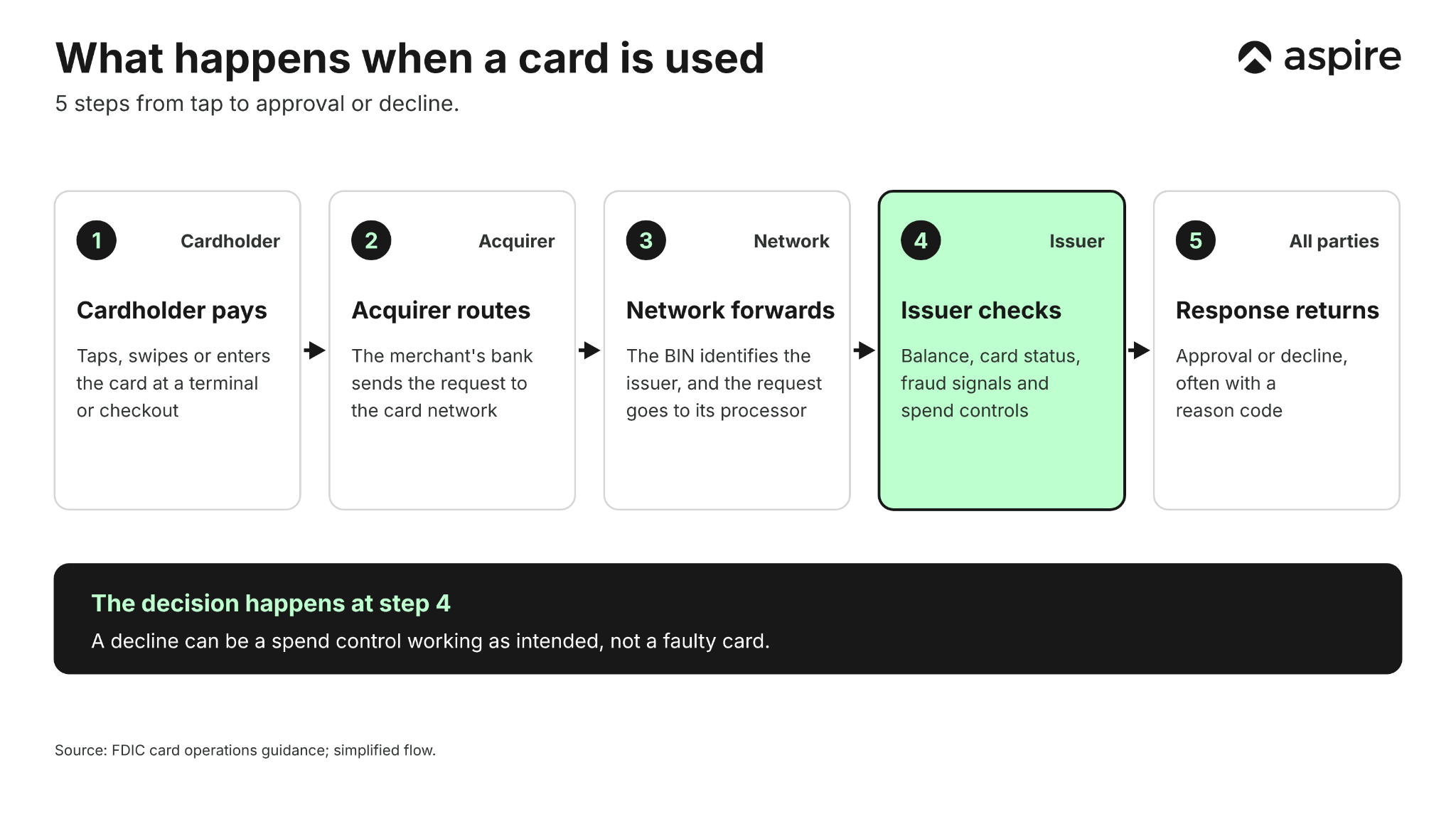
A card payment involves 4 main parties, each with a distinct job. The FDIC's guidance on card activities describes the same roles.¹
| Party | Role |
|---|---|
| Issuer (or BIN sponsor) | The licensed institution ultimately responsible for the card program |
| Issuer processor | The platform that evaluates transactions in real time for the issuer |
| Card network | Visa, Mastercard or another scheme that routes messages between parties |
| Acquirer | The merchant's bank, which submits the transaction into the network |
The card number starts with a BIN, which ISO/IEC 7812 calls the Issuer Identification Number.⁴ Aspire's guide on what a BIN number is explains the mechanics.
Who can issue cards in Hong Kong?
Licensed banks can issue cards, and so can HKMA-licensed operators of multi-purpose stored value facilities (SVFs). The HKMA licenses multi-purpose SVFs under the Payment Systems and Stored Value Facilities Ordinance, and prepaid cards are physical SVFs.²
Licensed banks are deemed licensed to issue SVFs.⁵ Credit cards do not store value, so they fall outside the SVF regime.²
What are the 4 card types businesses use?
Businesses encounter 4 card types: debit, credit, prepaid and virtual.
| Type | How it works |
|---|---|
| Debit | Linked to an account, with funds deducted in real time or after a short delay |
| Credit | Gives a spending limit that the holder repays within a billing cycle |
| Prepaid | Loaded with funds in advance, useful for controlled spending |
| Virtual | Exists only as card data (number, expiry, CVV), with no physical card |
A single program often combines types. A company director may hold a physical card while employees or vendors get virtual cards.
Aspire offers a Multi-Currency Card for transactions in 13 local currencies and an Advanced Card, which is credit-based for eligible businesses. See the corporate card page and Aspire's guide to the types of corporate cards for small businesses.
What happens when you use a corporate card?
A card payment is a 5-step request and response between the merchant and the issuer. The sequence is the same for a tap, an online checkout or an ATM.
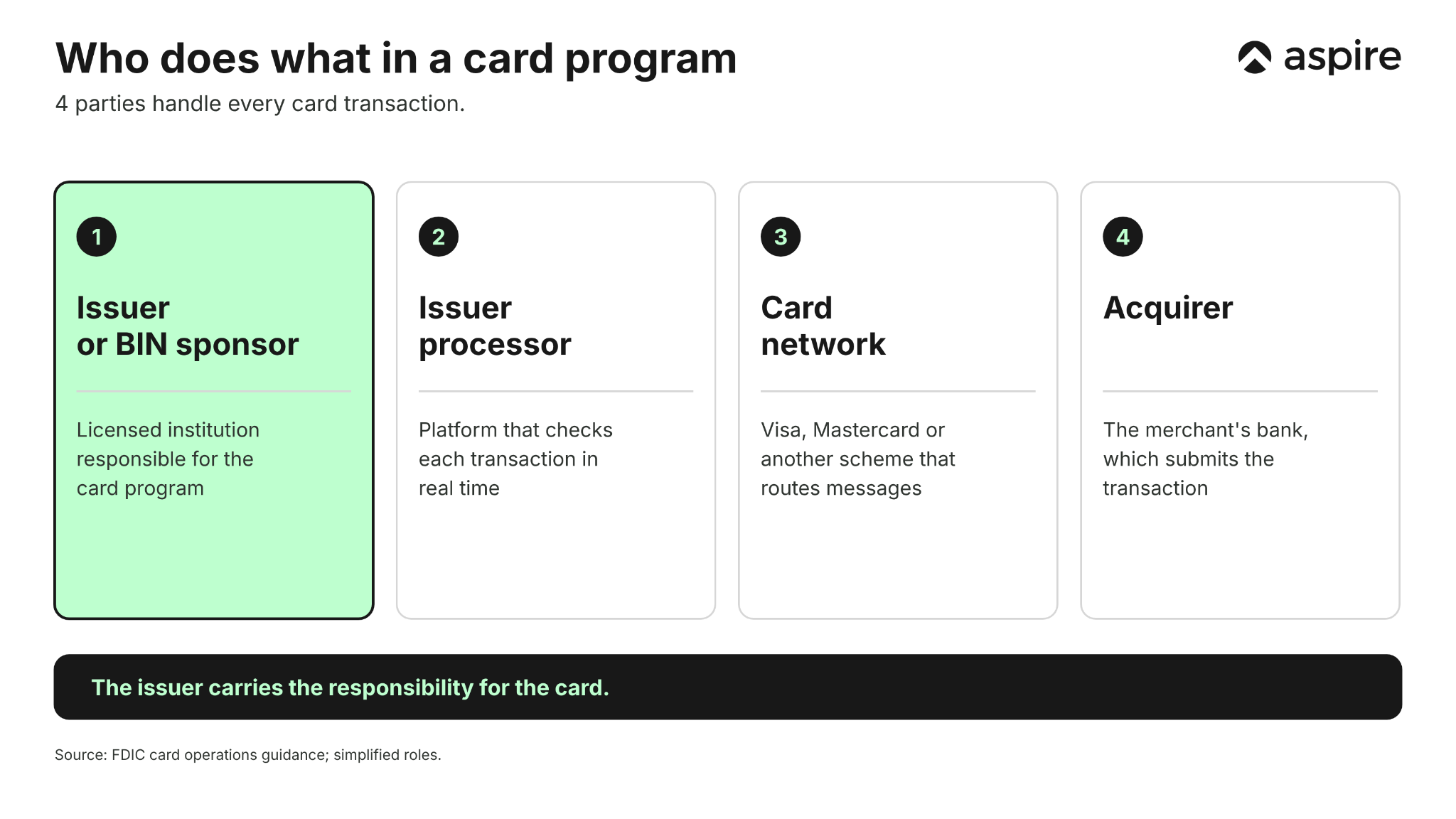
- The cardholder starts the payment at a terminal, online checkout or ATM.
- The acquirer routes the request into the card network.
- The network forwards it to the issuer processor, using the BIN to identify the issuer.
- The issuer processor runs its checks on balance, card status, fraud signals and spend controls.
- A response returns along the same chain as an approval or decline, often with a reason code.
The whole exchange usually takes seconds. Approved transactions are cleared and settled afterwards, when the network calculates net positions and funds move from issuer to acquirer.¹
What does the issuer check?
The decision step checks 4 things before the issuer responds.
- Balance or available credit
- Card status, meaning active, frozen or reported lost
- Fraud scoring based on patterns, location and velocity
- Spend limits and merchant category restrictions at card or program level
Why does a card get declined?
A decline is not always a card problem. A transaction blocked by a merchant category rule is the spend control doing its job.
The issuer typically returns a reason code, so a restricted card can be told apart from an insufficient balance. Check the card's limits first, as in Aspire's guide on spend limits.
Why are virtual cards instant?
A virtual card can be live within minutes because nothing has to be manufactured or shipped. The issuer generates the number, expiry date and CVV digitally.
A physical card must be printed or embossed, chip-encoded and delivered, which takes days. See Aspire's comparison of virtual and physical cards.
What extra security can virtual cards add?
Depending on the issuer, virtual cards can carry controls a printed card cannot. 3 common examples:
- Rotating security codes that change on a schedule
- Single-use numbers valid for exactly 1 transaction
- Limits and merchant restrictions set when the card is issued
These suit per-vendor or per-project spend, where a business wants a disposable number instead of 1 shared card. Read more in Aspire's complete guide to virtual cards in Hong Kong and its note on virtual card benefits and disadvantages.
How does issuing scale with an API?
An API lets a business create cards without manual steps. According to Aspire's product page, its Card Issuance API supports unlimited virtual cards, single-use cards, spend limits, merchant locks, expiry dates and freezing in real time. See the Card Issuance API page for the current feature set.
How can a business issue its own cards?
Most businesses issue branded cards through a sponsoring bank, not as a scheme member. Examples include a marketplace paying out sellers, a neobank offering debit cards, or an expense platform with its own brand.
Building a program as a licensed principal member is slow and capital-intensive. Sponsorship is the usual shortcut.
What is BIN sponsorship?
BIN sponsorship lets a company that is not a scheme member issue cards under a scheme's brand using a licensed member's BIN. The sponsor, a principal member with an issuing licence, bears ultimate responsibility for issuance and compliance.³
Sponsorship covers scheme licensing only. Banking or payment permissions, anti-money laundering duties and safeguarding of customer funds still apply, so assess compliance case by case.³
Which route fits your business?
| Route | What it involves |
|---|---|
| Full BIN sponsorship | Work with a sponsor bank and issuer processor to launch a fully branded program |
| Embedding an existing provider's cards | Integrate an established card product by API, without a distinct branded program |
What matters day to day for card users?
For most businesses the priority is using existing cards well, not becoming an issuer. 4 habits decide the value.
| Consideration | Why it matters |
|---|---|
| Spend controls | Per-card limits and merchant restrictions stop 1 card's misuse affecting the whole business |
| Virtual card speed | A new card in minutes avoids waiting days for a physical one |
| Reconciliation | Per-card, per-employee data reduces manual matching against budgets |
| Decline handling | Knowing a decline can be a spend control avoids needless support calls |
Aspire's expense management, budgets and cashback pages cover these controls. For a Hong Kong example, Endowus reported saving 900 hours a year after moving to Aspire cards and expense management, see Aspire case study.
Why Hong Kong Businesses Choose Aspire
Understanding how card issuing works is useful background, and what matters day to day is a card program built around how your business spends, which is where Aspire comes in.
💱 FX spreads from 0.18%, up to 3x cheaper than traditional banks. This applies across 130+ countries and 40+ currencies through Aspire's multi-currency account. It's useful for anything from paying overseas suppliers to settling international payments without losing margin to markup.
💰 1.2% unlimited cashback applies on every corporate card transaction, with no monthly cap. It kicks in automatically on eligible spend, with no minimum threshold to hit first. Over time, it quietly turns routine business spend into working capital.
🌐 Local transfer network, not multi-hop SWIFT chains, is how Aspire routes most payments. This means faster settlement and fewer intermediary fees eating into your payment before it reaches the recipient. It also reduces the chance of funds being held up for review at a correspondent bank along the way.
💸 Fixed USD 8 inbound SWIFT fee, tracked end-to-end with SWIFT GPI, applies when SWIFT is the right rail for your payment. There are no surprise deductions from correspondent banks along the way, so the amount you're quoted is the amount that arrives. You can also download payment confirmation instantly from the app, without calling the bank.
⚡ Approved in as little as 1 business day, with no branch visits and no paperwork stacks. Applications are completed entirely online, from document upload to approval. There's no waiting weeks on a relationship manager to call you back.
Open a free multi-currency business account built for Hong Kong SMEs, or explore how Aspire's corporate card fits into your day-to-day spend.
Frequently Asked Questions
A spend control is the usual cause, such as a merchant category restriction, a per-transaction limit or a fraud flag. Check the card's limits first.
Often within minutes of approval, because nothing physical is made or shipped. A physical card still needs printing and delivery.
Not generally, and in some respects it is more secure. Depending on the issuer, it can carry rotating codes or single-use numbers.
The issuer carries legal and financial responsibility for the program. The issuer processor evaluates each transaction in real time on the issuer's behalf.
Not necessarily. Most businesses use a sponsoring bank and a program manager, which covers scheme licensing only, so other permissions and compliance duties still need checking.³
Sources
- FDIC, "Credit Card Activities Manual, Chapter 19: Credit Card Operations" (roles of issuers, acquirers and card associations)
- HKMA, "E-wallets and prepaid cards"
- Addleshaw Goddard, "BIN sponsorship and card issuing: unlocking payment card innovation" (2025)
- ISO, "ISO/IEC 7812-1:2017 Identification cards: Identification of issuers, Part 1: Numbering system"
- Hong Kong Government, "Regulatory regime for stored value facilities and retail payment systems commences operation" (13 November 2015)
This blog is for general information only and does not constitute financial, legal, tax, or professional advice. Aspire’s services are subject to the terms outlined in our 'Terms of Service' and 'Pricing' pages. We make no guarantees as to the accuracy, completeness, or timeliness of the content, and past results do not indicate future performance. Always consult a qualified professional before acting on any information provided.
Galih Gumelar
Writer
Galih is a seasoned writer specialising in macroeconomics, business, finance and politics. With a writing history at CNN Indonesia, The Jakarta Post, and various other reputed organisations, Galih leverages his broad range of experiences to create insightful resources for those wanting to start a business.
Aspire Launchpad
Start Your Business with Aspire Launchpad
From incorporation to venture capital, we connect you with trusted service providers to make your entrpreneurial journey seamless.

Latest articles
Expense Management •
Corporate Card Management in HK: Guide & Policy Checklist
Master corporate card management in Hong Kong. Implement smart spend limits, leverage virtual cards, simplify monthly reconciliation, and maintain required records.
Finance Tools •
Virtual Corporate Card in HK: What Is It?
How HK teams use virtual corporate cards: types, safety, FX costs, a provider comparison and a rollout plan with limits per employee, vendor or project.

Business Account •
SME Business Account in HK: Why You Need One
Why SMEs need a business account in Hong Kong, the 5 pain points they face, and how our account handles cash flow, FX, payroll and spend.
Start your journey with Aspire
Open your free account