


SME Business Account in HK: Why You Need One

Galih Gumelar

Summary
Why an SME needs one: A business account separates company money from personal funds and supports the 7-year record rule.¹
Pain point 1: Banks apply risk-based checks, so opening can be slow for a start-up.²
Pain point 2: Late payment is common, with 49% of Hong Kong B2B credit sales overdue in 2025.³
Pain points 3 to 5: Cross-border costs, manual payroll runs and loose staff spend drain a small team.
Why SMEs choose Aspire: 1 account with online opening, multi-currency payments, cards and spend tools.
An SME business account in Hong Kong is the account that keeps a small company's money, payments and records in 1 place, separate from the owner's personal finances. For a small team without a dedicated finance department, the account you choose decides how much admin lands on the founder.
This guide explains why an SME needs a business account, the 5 pain points small businesses run into most, and what to look for in a fix. It then shows how our account is built for each pain point.
What is an SME business account in HK?
An SME business account is a bank or fintech account held in the name of a small company, sole proprietorship or partnership. In Hong Kong statistics, SMEs are firms with fewer than 50 persons engaged.⁴
The account holds revenue, pays costs and leaves a statement trail. See our guide to corporate accounts in Hong Kong for the basic definitions.
Why does an SME need a business account?
An SME needs a business account to keep company money separate, stay compliant and run payments without the owner's personal funds. 3 reasons matter most for a small team.
- Clean records. The IRD says business records must be kept for at least 7 years, and a dedicated account gives you the trail.¹
- Registration. A Business Registration Certificate is needed to open a business bank account, and registration is due within 1 month of starting.⁵ ⁶
- Controls. On a small team, 1 mistaken payment comes straight out of working capital. See our guide to spend limits.
What are the usual SME pain points?
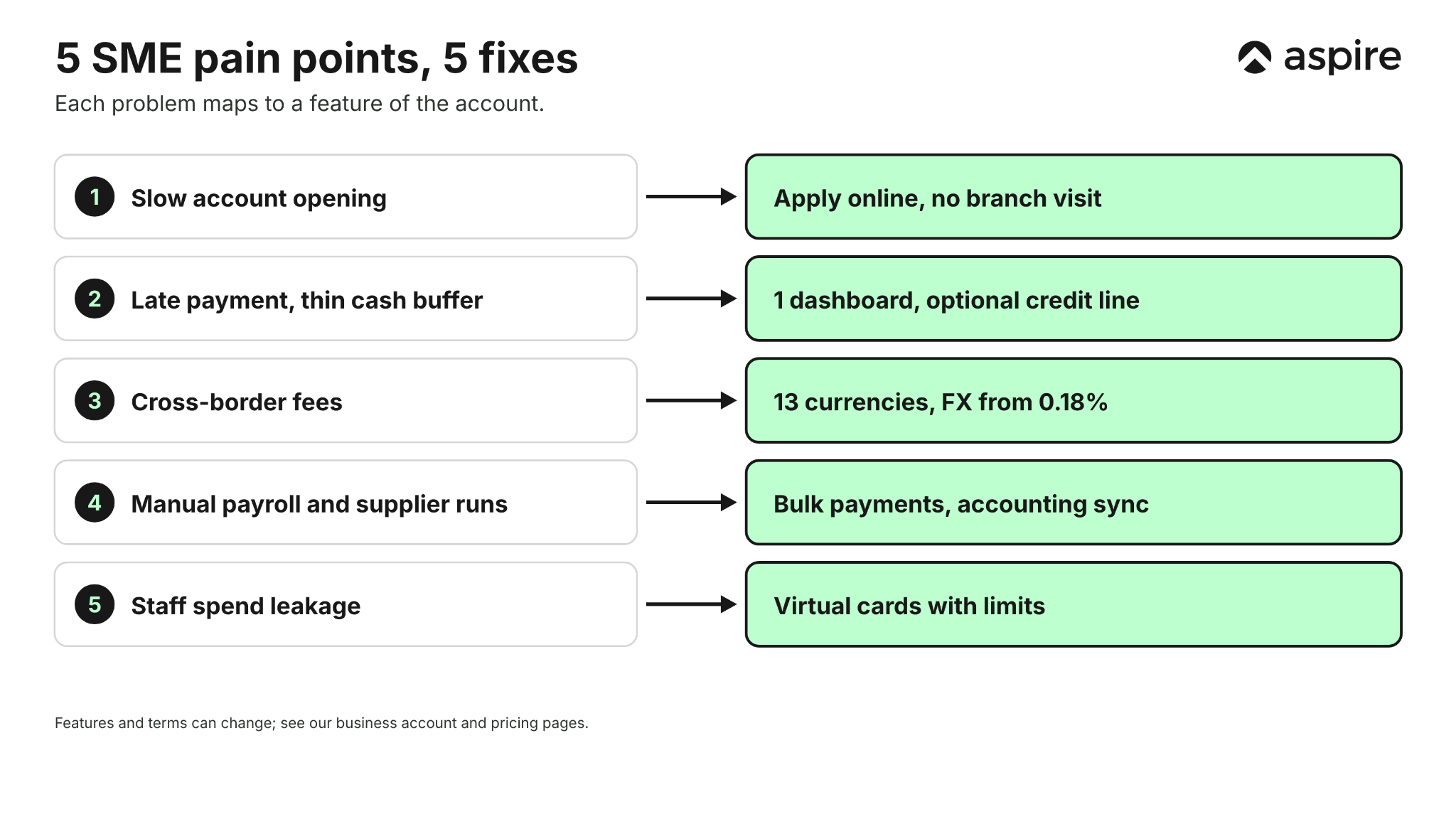
SMEs run into 5 recurring problems, and most of them come from using an account built for larger companies. The sections below take each in turn.
Why is opening an account hard for a start-up?
Banks apply customer due diligence to every applicant, and a new business has little history to show. The HKMA's FAQ says there are no special requirements for start-ups or SMEs, so banks tailor checks to each customer's risk.⁷
The HKMA says simple cases may finish within several days, depending on how complete your information is.² A start-up may also lack a business registration certificate, because the IRD does not register businesses that have not started operating.⁷
How does late payment hit SME cash flow?
Late payment is the norm in Hong Kong B2B trade, and a small business has the thinnest cash buffer. Atradius reports that 49% of B2B credit sales are overdue and 7% of invoices end as bad debts, with payment terms averaging around 60 days.³
Atradius surveys firms of all sizes, so the figures are not SME-only. Even so, an SME that waits 60 days on a large invoice still has to pay staff and suppliers in the meantime.
How do cross-border payments drain margin?
Overseas suppliers and clients add FX spreads and SWIFT fees to every payment. A small importer or exporter pays them repeatedly, and each fee comes straight out of a thin margin.
Why do payroll and supplier runs take so long?
Without bulk payments, a small team pays suppliers and staff 1 transfer at a time. The work falls on the founder or a part-time bookkeeper, then needs reconciling against the books.
How do you stop staff spend leaking?
Staff buying software, travel and supplies on personal cards creates claims, delays and unclear costs. Founders end up approving claims by chat and chasing receipts at month-end.
Which type of account suits an SME?
Hong Kong SMEs can choose from 4 account types, and each solves a different mix of the pain points above. Check each provider's current terms, because the trade-offs shift.
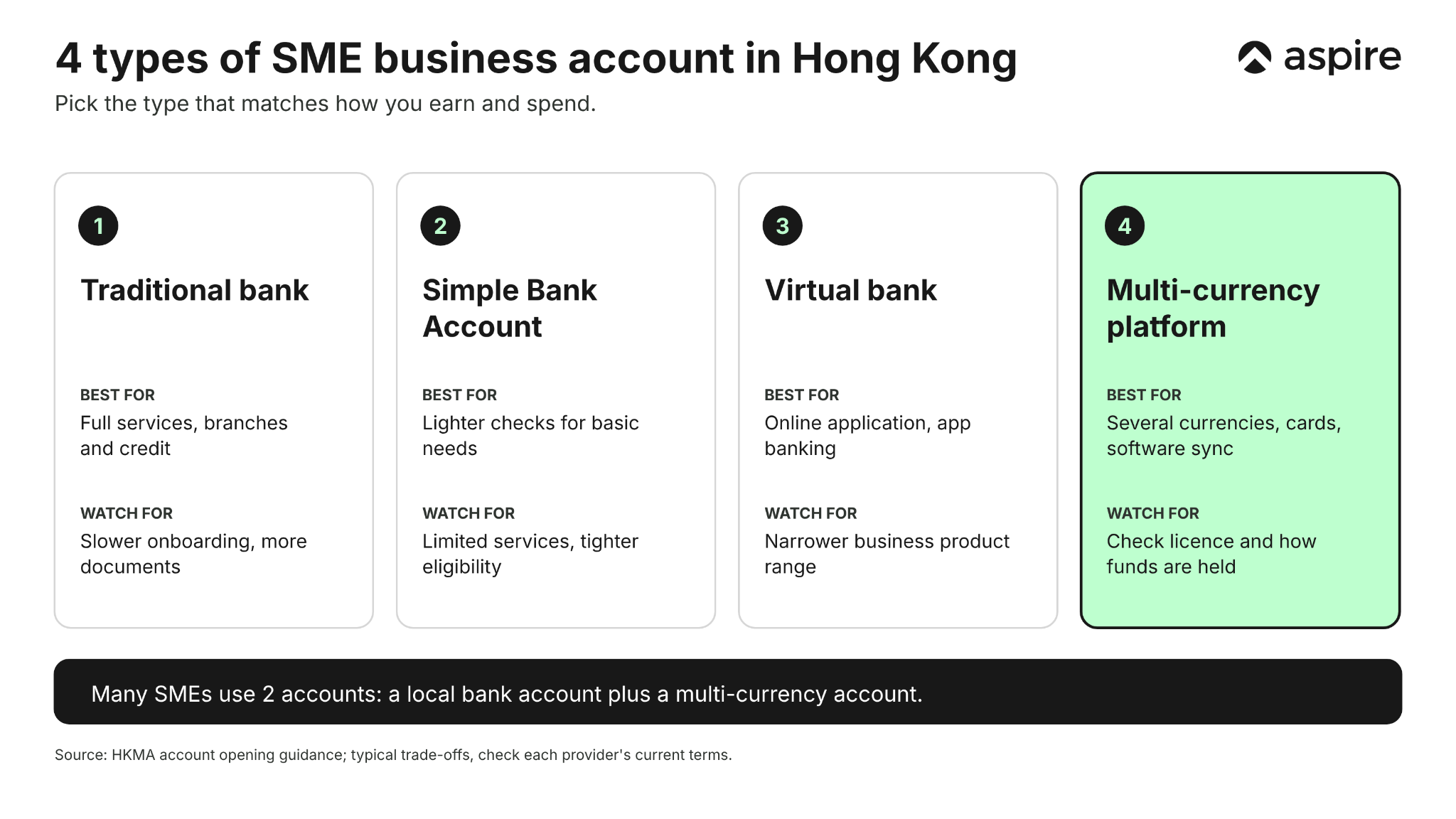
Your business profile points to the account type to test first. The table shows 3 common profiles.
| Business profile | What matters most | Test first |
|---|---|---|
| Local service firm with HK customers | FPS, low monthly cost, simple setup | Simple Bank Account or traditional account |
| Importer paying overseas suppliers | Multi-currency balances, FX spread, SWIFT cost | Multi-currency platform |
| E-commerce seller with card spend | Cards, marketplace payouts, accounting sync | Multi-currency platform with cards |
For ranked providers, see our guides to the best business accounts in Hong Kong and top SME banking options.
A Simple Bank Account is a basic business account that the HKMA introduced in 2019 with lighter due diligence. Each bank sets its own version.⁸
One bank's Simple Business Account is open to local sole proprietorships, partnerships and single-layer limited companies where the relevant parties hold a Hong Kong permanent ID card.⁹ Another bank's version offers local transfers only and excludes cross-border remittances.¹⁰
How do you compare SME account fees?
Compare 5 fee types before you commit, and ask each provider for its tariff in writing.
| Fee type | What to ask |
|---|---|
| Account opening | Is there a one-off fee, and is it refunded if you are rejected? |
| Monthly or maintenance | Is there a fee, and is it waived above a balance? |
| Minimum balance or deposit | What is required, and what is the penalty below it? |
| Transfers | What do FPS, CHATS and SWIFT cost per payment? |
| FX spread | What margin sits on top of the mid-market rate? |
Why do SMEs choose Aspire?
SMEs choose Aspire because 1 account covers the 5 pain points above, and it is built for small teams. Here is how each one is handled.
- Opening. You apply online, and approval can take as little as 1 business day. See our guide to opening a business account online.
- Cash flow. You see every balance in 1 dashboard, and our corporate card has an optional credit line, subject to approval.
- Cross-border cost. You can hold 13 currencies, with FX spreads from 0.18% and a fixed USD 8 inbound SWIFT fee. See our guides to cross-border payments and multi-currency accounts.
- Payroll and suppliers. Our bulk payments tool runs payroll in 1 upload, and accounts sync with Xero and QuickBooks.
- Staff spend. You can issue multiple virtual cards, each with its own limit, and earn 1.2% cashback on eligible spend. See our guide to expense management.
- Cost. The Basic plan costs HKD 0 a month and Premium costs HKD 399. See our pricing page.
How does this work for a real SME?
A Hong Kong-incorporated trading company with 20 staff shows how the pain points combine. The business is invented for illustration.
It pays a Taiwanese supplier USD 50,000 a month and sells to local retailers on 60-day terms. Each 0.1% of FX spread costs USD 50 on that payment, so an FX spread from 0.18% costs from USD 90 a month.
While retailers pay late, the owner covers the gap with the optional credit line instead of delaying the supplier. Payroll goes out as 1 bulk upload, and staff buy software on virtual cards with set limits. Our customer Zenyum reported saving 1,664 hours a year, and its case study shows how at company scale.
Why Hong Kong Businesses Choose Aspire
Choosing the right SME business account is the first step, and Aspire supports the accounts, cards and payment tools that run behind it every day.
💱 FX spreads from 0.18%, up to 3x cheaper than traditional banks. This applies across 130+ countries and 40+ currencies through Aspire's multi-currency account. It's useful for anything from paying overseas suppliers to settling international payments without losing margin to markup.
💰 1.2% unlimited cashback applies on every corporate card transaction, with no monthly cap. It kicks in automatically on eligible spend, with no minimum threshold to hit first. Over time, it quietly turns routine business spend into working capital.
🌐 Local transfer network, not multi-hop SWIFT chains, is how Aspire routes most payments. This means faster settlement and fewer intermediary fees eating into your payment before it reaches the recipient. It also reduces the chance of funds being held up for review at a correspondent bank along the way.
💸 Fixed USD 8 inbound SWIFT fee, tracked end-to-end with SWIFT GPI, applies when SWIFT is the right rail for your payment. There are no surprise deductions from correspondent banks along the way, so the amount you're quoted is the amount that arrives. You can also download payment confirmation instantly from the app, without calling the bank.
⚡ Approved in as little as 1 business day, with no branch visits and no paperwork stacks. Applications are completed entirely online, from document upload to approval. There's no waiting weeks on a relationship manager to call you back.
Open a free multi-currency business account built for Hong Kong SMEs, or explore how Aspire's corporate card fits into your day-to-day spend.
Frequently Asked Questions
To separate company money from personal funds, keep records for the IRD and run payments with controls. The IRD requires business records for at least 7 years.¹
Yes. The HKMA says there are no special requirements for start-ups, though a start-up may not yet hold a business registration certificate.⁷
The HKMA says a large initial deposit should not be a condition for opening an account.² Some products still carry minimum balances, so check the tariff.
Yes. Many SMEs combine a local bank account for tax and credit with a multi-currency account for overseas payments.
Start with the bank's review process, then contact the HKMA's account opening hotline, (852) 2878 1133, if needed.²
Sources
- Inland Revenue Department, "Record Keeping"
- HKMA, "Useful Information About Account Opening and Maintenance"
- Atradius, "B2B payment practices trends, Hong Kong 2025" (9 July 2025)
- Census and Statistics Department, "Results of monthly survey on business situation of small and medium-sized enterprises for September 2025"
- Hong Kong government (HKeNGAGE), "Business registration guide for entrepreneurs" (accessed November 2026)
- Inland Revenue Department, "Business Registration" (accessed November 2026)
- HKMA, "Frequently Asked Questions on Customer Due Diligence"
- HKMA, "Role of the HKMA" (account opening)
- HKMA, "CCB (Asia) Simple Business Account"
- HKMA, "Launch of Simple Bank Accounts" (Bank of Communications)
This blog is for general information only and does not constitute financial, legal, tax, or professional advice. Aspire’s services are subject to the terms outlined in our 'Terms of Service' and 'Pricing' pages. We make no guarantees as to the accuracy, completeness, or timeliness of the content, and past results do not indicate future performance. Always consult a qualified professional before acting on any information provided.
Galih Gumelar
Writer
Galih is a seasoned writer specialising in macroeconomics, business, finance and politics. With a writing history at CNN Indonesia, The Jakarta Post, and various other reputed organisations, Galih leverages his broad range of experiences to create insightful resources for those wanting to start a business.
Aspire Launchpad
Start Your Business with Aspire Launchpad
From incorporation to venture capital, we connect you with trusted service providers to make your entrpreneurial journey seamless.

Latest articles
Expense Management •
Corporate Card Management in HK: Guide & Policy Checklist
Master corporate card management in Hong Kong. Implement smart spend limits, leverage virtual cards, simplify monthly reconciliation, and maintain required records.
Finance Tools •
Virtual Corporate Card in HK: What Is It?
How HK teams use virtual corporate cards: types, safety, FX costs, a provider comparison and a rollout plan with limits per employee, vendor or project.
Finance Tools •
Payroll Management (HK): MPF, Wage Rules & Tax Filings
A complete guide to managing payroll in Hong Kong. Understand Employment Ordinance rules, statutory MPF caps, leave calculations, and tax reporting requirements.
Start your journey with Aspire
Open your free account