



Corporate Card Management in HK: Guide & Policy Checklist

Galih Gumelar

Summary
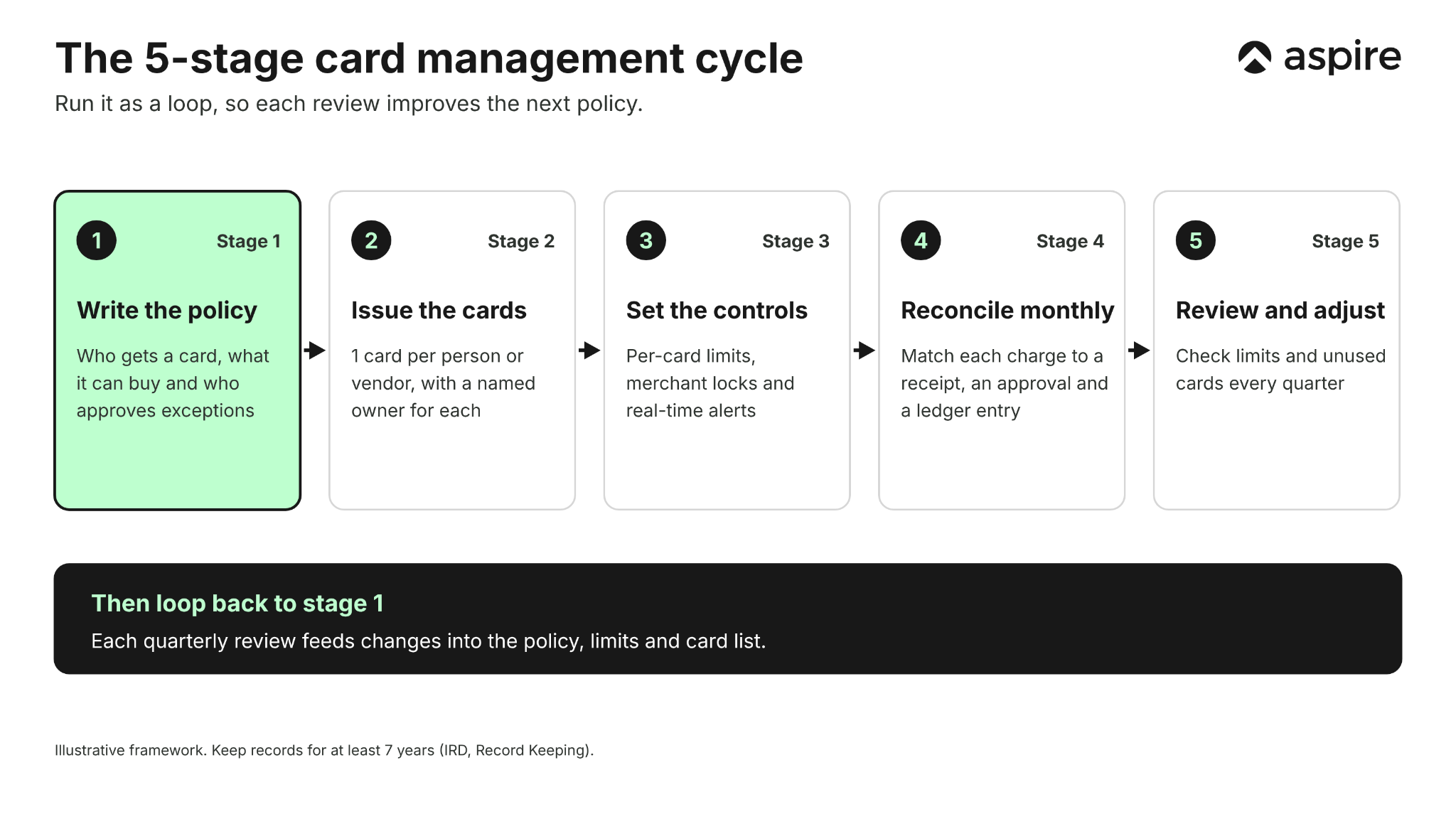
Corporate card management covers 5 stages: policy, issuing, controls, reconciliation and review.
A written card policy should name who gets a card, what it may buy, and who approves exceptions.
Per-card limits and merchant locks stop most misuse before it happens, and virtual cards make them easier to apply.
A fixed monthly reconciliation schedule keeps receipts, approvals and ledger entries from piling up.
Hong Kong businesses must keep business records for at least 7 years, so receipts and card statements need a home.
Corporate card management is the set of rules, controls and routines a business uses to issue company cards, limit what they can buy and match every charge to a receipt. For a Hong Kong SME, it decides whether cards save time or quietly create a month-end mess.
Most guides on this topic are written for US or Gulf companies and stop at a list of tips. This guide treats card management as a 5-stage cycle that a small finance team can run, with limit examples, a reconciliation schedule and the record-keeping rules that apply in Hong Kong.
What is corporate card management?
Corporate card management is the end-to-end control of company cards, from who receives one to how each charge is approved, matched and reviewed. It sits between finance, operations and the employees who spend.
The practical test is simple. If the finance lead can answer "who spent what, on which budget, with which receipt" within minutes, the programme works.
Most programmes follow a cycle of 5 stages, shown below.
How does it differ from expense claims?
Card management controls the card itself, while expense management handles the claims and receipts that follow a payment. Cards cover spend made directly on the company account, and claims cover money employees spent first and want back.
Aspire's expense management tools cover both sides, so they can sit in 1 workflow.
Which card types need managing?
Hong Kong SMEs mainly choose between debit, credit or charge, virtual and prepaid cards, and each one needs a slightly different control focus. The table compares them.
| Card type | How it works | Management focus |
|---|---|---|
| Corporate debit | Spends from the company balance | Per-card limits and top-up rules |
| Corporate credit or charge | Spends on a credit line repaid later | Credit limit sharing and repayment date |
| Virtual card | Digital card number for a single use | Merchant locks and expiry |
| Prepaid card | Spends only a loaded amount | Reload approvals |
Aspire's card combines a corporate debit card with an optional credit line in HKD or USD, subject to approval, according to its card page. Aspire's guides on types of corporate cards for small businesses and corporate credit card fees go deeper on each format and its costs.
Who runs the card programme?
A named finance owner should run the programme, with approvers and cardholders each holding a defined part. Without an owner, limits drift and nobody notices unused cards.
The table below splits the roles for a team of around 20 to 50 people.
| Role | Responsibility |
|---|---|
| Finance owner | Issues and closes cards, sets limits, runs the monthly close |
| Approver (team lead) | Confirms each charge was for the team's work |
| Cardholder | Keeps receipts, stays inside limits, reports loss at once |
| Accountant or bookkeeper | Codes transactions and posts them to the ledger |
| Director | Signs off the policy and reviews exceptions |
What belongs in a card policy?
A card policy is a short written document that says who may hold a card, what it may be used for and what happens when the rules are broken. A 1-page version is enough for most SMEs.
A workable policy covers these points:
- Eligibility: which roles receive a card and who approves the request.
- Permitted spend: categories such as software, travel and advertising.
- Banned spend: personal purchases, cash withdrawals and anything the company will not reimburse.
- Limits: per-card and per-transaction caps by role.
- Receipts: a deadline for uploading proof of purchase.
- Loss and fraud: who to tell and how fast.
- Consequences: repayment of misuse and removal of card rights.
Keep personal spend off the card entirely. The Inland Revenue Department says expenses are generally deductible only when incurred to produce chargeable profits, and personal or household costs are not deductible.¹
How should you set limits?
Set each limit from the role's real spend pattern, not from a flat company-wide number. A marketing lead buying advertising needs a higher ceiling than an office manager buying supplies.
The example below shows limits for an imaginary 30-person agency. The figures are illustrative, so replace them with amounts from your own past statements.
| Role | Example monthly limit | Extra control |
|---|---|---|
| Marketing lead | HKD 60,000 | Advertising platforms only |
| Operations manager | HKD 20,000 | Supplier and subscription merchants |
| Sales staff | HKD 5,000 | Travel and client meals |
| Director | HKD 100,000 | Approval above HKD 30,000 per transaction |
Review each limit every quarter. A limit that is never reached suggests the card is unneeded, and a limit hit every month suggests the budget is wrong.
What controls does a card need?
Per-card spend limits, merchant locks and real-time alerts are the controls that matter most. Aspire's corporate card offers spending limits per card, approval rules, merchant controls and category locks, transaction limits and automated transaction alerts.
Teams can also set limits by budget. Aspire's budgets let budget owners add members and set team spending limits.
When do virtual cards help?
Virtual cards help most for recurring vendors, online subscriptions and short projects, because each card can be locked to 1 purpose. If a vendor's system is breached, only that card is exposed.
A business might give its ad agency a card capped at HKD 40,000 a month, give a software subscription its own card, and close each card when the contract ends. Aspire's guide to virtual cards in Hong Kong explains when to choose them over physical cards.
What if staff travel or buy overseas?
Foreign spend adds currency conversion costs, so a multi-currency card keeps those costs visible. Aspire's Multi-Currency Card spends directly from balances in 13 currencies, including HKD, USD, CNY, EUR and JPY, and Aspire's card page says spending in USD or HKD avoids FX fees.
For overseas supplier payments that are not card-friendly, a business can use a multi-currency business account or its global payments tools.
How do you reconcile each month?
Reconciliation matches every card transaction to a receipt, an approval and a ledger entry, and a fixed schedule makes it routine. Without a schedule, receipts go missing and approvers forget what a charge was for. The HKMA tells cardholders to review every monthly statement and to keep receipts and agreements, which may be needed for a chargeback request.²
A simple monthly routine looks like this:
- Day 1: finance exports or syncs the previous month's card transactions.
- By day 3: cardholders upload missing receipts and add a short note.
- By day 5: approvers confirm each charge belongs to the team's work.
- By day 7: the accountant codes the transactions and flags anything unmatched.
- By day 10: finance chases exceptions and closes the month.
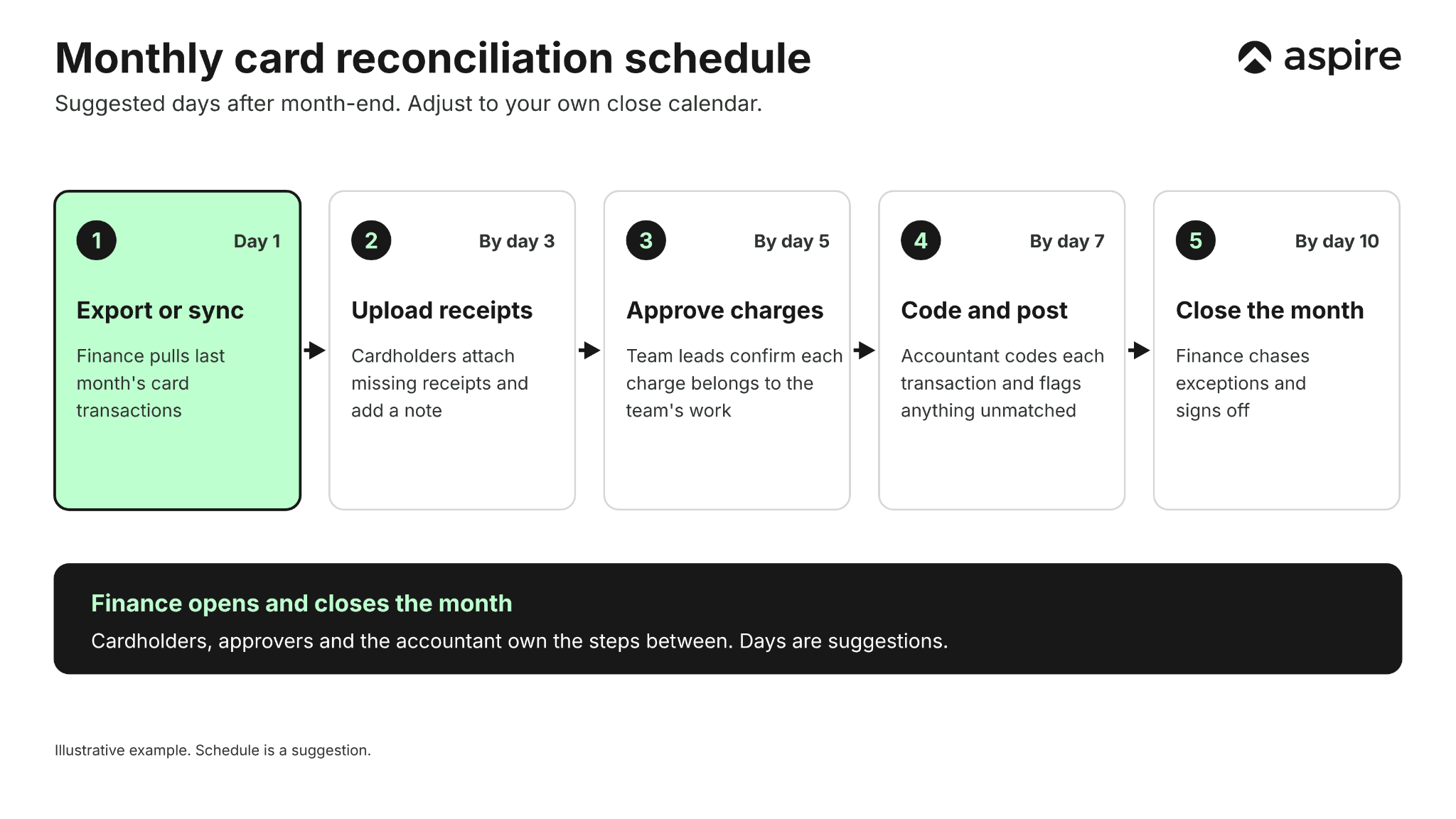
The dates are a suggested schedule, so adjust them to your own close calendar. A shorter cycle works better for businesses with more transactions.
How can software shorten the close?
Software shortens the close by capturing receipts at the time of purchase and syncing transactions to the ledger. Aspire's expense tools let employees scan receipts in the app, and the platform can sync expenses to Xero and NetSuite with attachments or export data for Zoho Expense.
Automation does not replace review. A finance lead still needs to read the exceptions, because software cannot judge whether a purchase made sense.
What records must you keep?
Hong Kong businesses must keep records that explain their income and spending for at least 7 years. The Inland Revenue Department cites section 51C of the Inland Revenue Ordinance as the source of this duty, and it says records must be in English or Chinese.³
Those records include bank statements, invoices, receipts and vouchers. The IRD also states that failing to comply without reasonable excuse may lead to a fine of up to HKD 100,000.³
Card statements and receipts are part of this paper trail. A receipt captured in an app on the day of purchase is far easier to find 5 years later than a paper slip in a drawer.
How do you control fraud risk?
Card controls and fast reporting limit fraud losses. The HKMA tells cardholders to report suspicious or unauthorised transactions to the issuing bank promptly.⁴
The HKMA's June 2023 card protections also include options to switch card-not-present transactions on or off and instant card suspension through internet banking.⁵
The Code of Banking Practice generally caps a cardholder's liability at HK$500 when they did not act fraudulently or with gross negligence and reported promptly, but whether that protection reaches a company card depends on your card agreement.⁶
For company cards, the practical steps are to freeze a card at once when it is lost, review alerts daily and remove access when an employee leaves. Aspire's card page lists freezing a lost or stolen card among its security features.
What should you look for in a provider?
The best card provider for an SME is the one that gives granular controls and clean accounting data at a cost you understand. Use these 6 criteria when you compare options:
- Control depth: per-card limits, merchant locks and approval rules, not just a single company limit.
- Virtual card volume: whether you can create cards for each vendor without extra fees.
- Alerts and freezing: real-time notifications and instant freeze from the app.
- Accounting sync: receipts and transactions that reach Xero, NetSuite or your own system without retyping.
- Currency handling: support for the currencies your suppliers and staff use, and the FX cost of each.
- Total cost: card fees, FX margins and credit terms, checked against the provider's pricing page.
Aspire's guide to rewards and incentives from corporate card providers is a useful companion when cashback and perks are part of the decision.
What does a real case look like?
Consider a 25-person design agency in Hong Kong with a single shared company card. The case is an invented example.
Before the change, 4 managers used the same card for advertising and software, and the bookkeeper chased receipts for 3 weeks each month. After the finance lead issued 1 card per manager with role-based limits and moved recurring software onto virtual cards, each charge had an owner.
The month-end close now follows the schedule above. Missing receipts surface by day 3, and the director reviews only exceptions, so the finance lead no longer spends the first 2 weeks of the month on cleanup.
Why Hong Kong Businesses Choose Aspire
Good card management is one part of running finance operations smoothly, and Aspire supports the payments, cards and spend tools that surround it.
💱 FX spreads from 0.18%, up to 3x cheaper than traditional banks. This applies across 130+ countries and 40+ currencies through Aspire's multi-currency account. It's useful for anything from paying overseas suppliers to settling international payments without losing margin to markup.
💰 1.2% unlimited cashback applies on every corporate card transaction, with no monthly cap. It kicks in automatically on eligible spend, with no minimum threshold to hit first. Over time, it quietly turns routine business spend into working capital.
🌐 Local transfer network, not multi-hop SWIFT chains, is how Aspire routes most payments. This means faster settlement and fewer intermediary fees eating into your payment before it reaches the recipient. It also reduces the chance of funds being held up for review at a correspondent bank along the way.
💸 Fixed USD 8 inbound SWIFT fee, tracked end-to-end with SWIFT GPI, applies when SWIFT is the right rail for your payment. There are no surprise deductions from correspondent banks along the way, so the amount you're quoted is the amount that arrives. You can also download payment confirmation instantly from the app, without calling the bank.
⚡ Approved in as little as 1 business day, with no branch visits and no paperwork stacks. Applications are completed entirely online, from document upload to approval. There's no waiting weeks on a relationship manager to call you back.
Open a free multi-currency business account built for Hong Kong SMEs, or explore how Aspire's corporate card fits into your day-to-day spend.
Frequently Asked Questions
It is the process of issuing company cards, setting spending controls and matching each charge to a receipt and approval. It covers policy, issuing, controls, reconciliation and review.
A named finance owner should run the programme, with team leads approving charges and cardholders keeping receipts.
Monthly is the minimum for most SMEs. Businesses with high volume can review weekly to catch problems earlier.
They can, but it creates reimbursement work and weakens control. A company card with limits keeps spend visible from the start.
At least 7 years, according to the Inland Revenue Department.³ Keep statements and receipts together.
Not always. Virtual cards suit online, recurring and project spend, while physical cards suit in-person purchases.
Sources
- Inland Revenue Department, "Profits Tax" (deductions)
- HKMA Smart Consumers, "Credit Cards"
- Inland Revenue Department, "Record Keeping"
- HKMA Smart Consumers, "Beware of Fraudsters!"
- HKMA, "Annex 1: Details of Major Enhancements on Protection of Payment Card Customers" (June 2023)
- Community Legal Information Centre (HKU), "Unauthorised transactions" (credit cards)
This blog is for general information only and does not constitute financial, legal, tax, or professional advice. Aspire’s services are subject to the terms outlined in our 'Terms of Service' and 'Pricing' pages. We make no guarantees as to the accuracy, completeness, or timeliness of the content, and past results do not indicate future performance. Always consult a qualified professional before acting on any information provided.
Galih Gumelar
Writer
Galih is a seasoned writer specialising in macroeconomics, business, finance and politics. With a writing history at CNN Indonesia, The Jakarta Post, and various other reputed organisations, Galih leverages his broad range of experiences to create insightful resources for those wanting to start a business.
Aspire Launchpad
Start Your Business with Aspire Launchpad
From incorporation to venture capital, we connect you with trusted service providers to make your entrpreneurial journey seamless.

Latest articles

Finance Tools •
Virtual Corporate Card in HK: What Is It?
How HK teams use virtual corporate cards: types, safety, FX costs, a provider comparison and a rollout plan with limits per employee, vendor or project.

Business Account •
SME Business Account in HK: Why You Need One
Why SMEs need a business account in Hong Kong, the 5 pain points they face, and how our account handles cash flow, FX, payroll and spend.

Finance Tools •
Payroll Management (HK): MPF, Wage Rules & Tax Filings
A complete guide to managing payroll in Hong Kong. Understand Employment Ordinance rules, statutory MPF caps, leave calculations, and tax reporting requirements.
Start your journey with Aspire
Open your free account