



What Is a BIN Number and How Does It Work?

Galih Gumelar

Summary
Definition: A BIN (or IIN) is the first 6 to 8 digits of a card number. It identifies the issuer, and together with the card network it points to the card type.
8-digit shift: ISO/IEC 7812-1:2017 defined the 8-digit format, Visa began assigning 8-digit BINs in 2019, and the April 2022 deadline required acquirers and processors to support them.
Card number length: The full card number does not change. Only the split between the BIN and the account digits moves.
Key functions: BINs drive transaction routing, fraud checks and card-type identification.
Business impact: BIN handling affects reconciliation, fraud monitoring, data storage rules and how you judge card rewards.
A BIN number is the short sequence of digits at the start of every payment card, and it does a lot of work before a transaction completes. It tells the payment network which institution issued the card, what type of card it is and where to send the authorisation request.
This guide explains what a BIN is, how to read one, the types that exist, why the numbering system changed from 6 to 8 digits and what it means for a Hong Kong business that issues, accepts or manages cards.
What is a BIN number?
A Bank Identification Number (BIN) is the first 6 to 8 digits of a payment card number, and it identifies the institution that issued the card. Every card an issuer releases under the same product range shares the same BIN.
The digits after the BIN are unique to the cardholder's account. The full card number is called the Primary Account Number (PAN).
How does a BIN differ from an IIN, PAN and BIC?
BIN and IIN are the same digits under 2 names, while PAN and BIC are different things. The formal ISO/IEC 7812 standard uses Issuer Identification Number (IIN).¹
| Term | What it refers to |
|---|---|
| BIN (Bank Identification Number) | The first 6 to 8 digits of a card number, identifying the issuer |
| IIN (Issuer Identification Number) | The formal ISO name for the same digits |
| PAN (Primary Account Number) | The full card number, including BIN, account digits and a check digit |
| BIC (Bank Identification Code) | A separate code of 8 or 11 characters that identifies a bank in international wire transfers |
How do you read a BIN number?
A BIN is not random, because each position in the card number carries a meaning. The first digit shows the broad industry, the next digits identify the issuer and product, and the last digit validates the number.
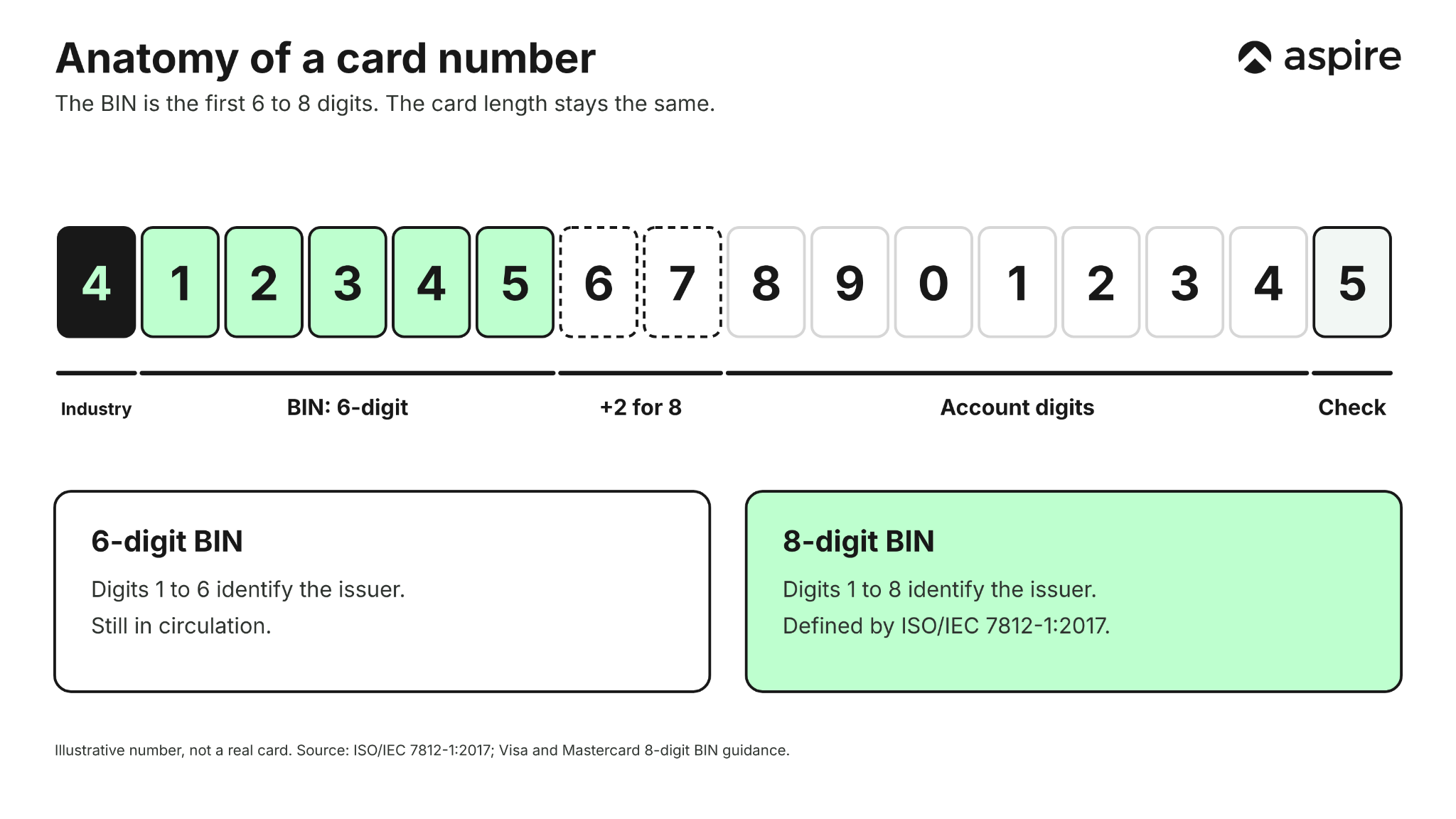
| Position | What it indicates |
|---|---|
| 1st digit (Major Industry Identifier) | The broad industry of the issuer |
| Digits 2 onward within the BIN | The specific issuing institution and product range |
| Remaining PAN digits | The individual cardholder's account number |
| Final digit | A check digit that validates the number's format |
Which card network does the first digit show?
The first digit usually points to the card network, but it is a hint, not proof. Mastercard also issues from a 2-series range, 222100 to 272099, alongside its 5-series.²
| First digit | Typical network |
|---|---|
| 2 or 5 | Mastercard |
| 3 | American Express, among others |
| 4 | Visa |
| 6 | UnionPay and Discover, among others |
Use an authorised BIN table when you need a certain answer, not a guess from the first digit.
What types of BIN exist?
BINs fall into 6 common types, based on how the card is used and how it is funded. The use is consumer or commercial, and the funding is prepaid, debit or credit.
| Type | Common use cases |
|---|---|
| Consumer prepaid | Gift cards, incentive and rewards cards |
| Commercial prepaid | Bill pay, group purchasing, media and ad-buying budgets |
| Consumer debit | Neobank accounts, on-demand services |
| Commercial debit | Expense management platforms, business neobanks |
| Consumer credit | Standard personal credit cards |
| Commercial credit | Corporate credit cards, business lines of credit |
For how corporate cards work in Hong Kong, see Aspire's guides to the corporate credit card and how to get one.
What is a shared BIN versus a dedicated BIN?
A dedicated BIN is assigned to 1 organisation, while a shared BIN is used by several organisations under the same licensed framework. Cards on a shared BIN draw their leading digits from the same range.
The underlying program may serve several fintech brands behind the scenes. Both setups are common in modern card programs.
Why did BINs expand from 6 to 8 digits?
BINs expanded because demand for issuer codes outgrew the 6-digit format. Mastercard says rising BIN demand, partly driven by tokenisation, prompted the change.³
The change happened in stages rather than on 1 date, as the table shows.
| When | What happened |
|---|---|
| 2017 | ISO/IEC 7812-1:2017 is published, and Mastercard announces it will adopt the 8-digit standard¹ ³ |
| 2019 | Visa begins assigning 8-digit issuing BINs⁴ |
| April 2022 | Visa's mandate date arrives, and Mastercard begins assigning 8-digit BINs on request⁴ ³ |
Do 6-digit BINs still exist?
Yes, 6-digit and 8-digit BINs coexist. Visa says merchants and service providers should be ready to support both lengths at once.⁴
A single prefix cannot be both, because once a 6-digit BIN is split into 8-digit BINs, the 6-digit one ceases to exist.⁴ The card number length does not change, so your cards keep working.
What is a BIN number used for?
A BIN does far more than name a bank, because it drives how a transaction is routed and checked. The payment network reads the BIN first to decide which institution receives the authorisation request.
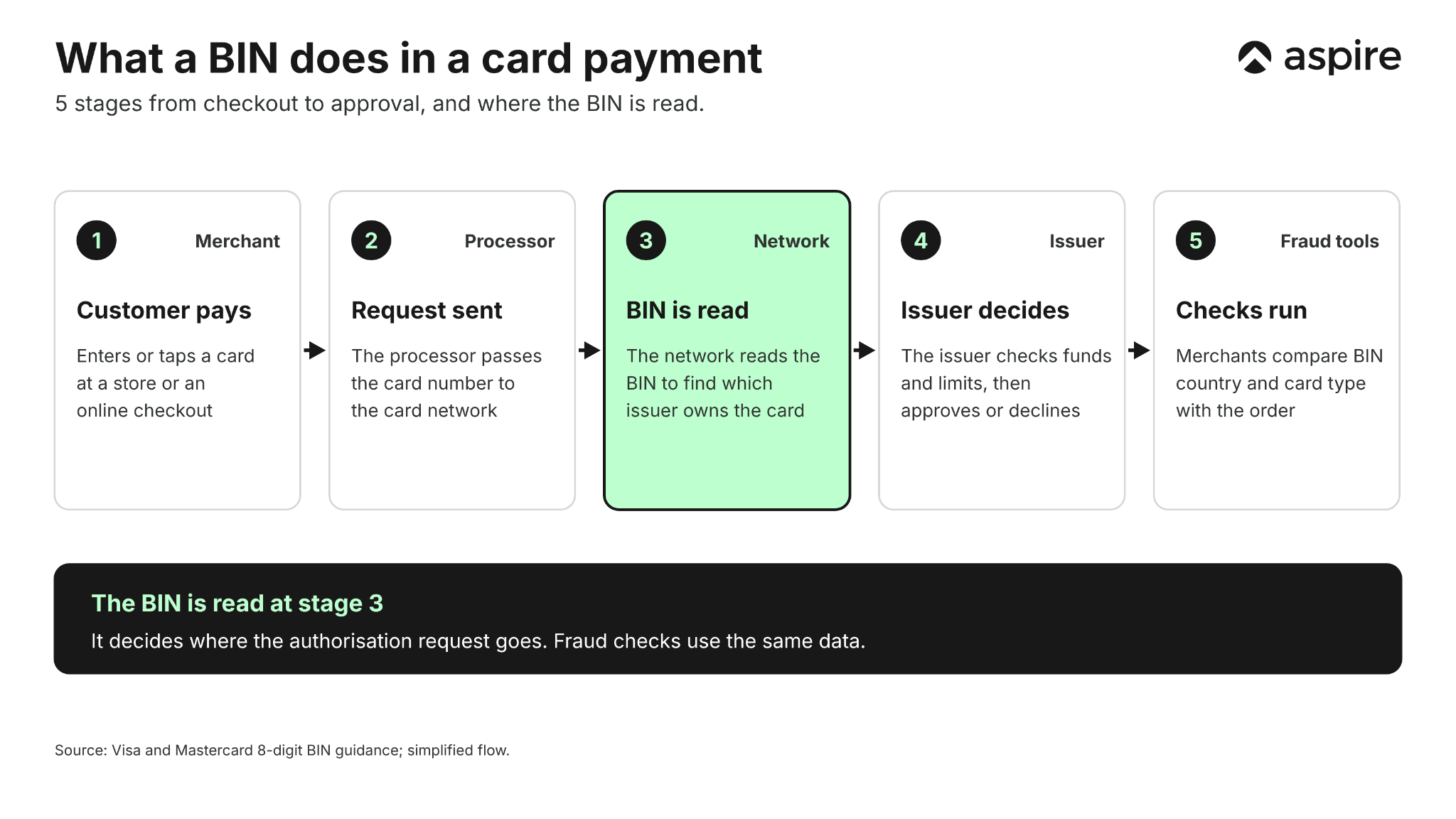
| Use | How it works |
|---|---|
| Transaction routing | The network reads the BIN to find the issuer for the authorisation request |
| Fraud prevention | Merchants compare BIN data, such as issuing country, card type and issuing bank, with other order details to flag mismatches |
| Card type identification | Shows whether a card is credit, debit or prepaid, which can affect processing fees and acceptance rules |
| Geographic verification | Shows the issuing country, so a mismatch with the customer's location is an early fraud signal |
| Interchange optimisation | Separates consumer from commercial cards, which typically carry different interchange |
How does a BIN affect a Hong Kong business?
BIN handling affects 4 everyday jobs: reconciliation, fraud checks, data storage and judging card rewards. The list shows what to do for each.
- Reconcile by card type. Tag physical and virtual cards separately when you match transactions with your books, especially with many virtual cards across staff and vendors. Aspire's guide to virtual versus physical cards explains the difference, and expense management matches each card's spend to receipts.
- Use an authorised BIN table. Visa says BIN tables found on the internet are only about 30% accurate, so use authorised tables or Visa's BIN Attribute Sharing Service.⁴
- Store as few digits as you can. PCI DSS limits display to the first 6 and last 4 digits unless there is a documented business need, and Mastercard recommends storing the fewest digits possible.³ ⁵
- Read rewards claims by card type. Commercial and consumer BINs typically carry different interchange and rewards structures. Compare cards in Aspire's guide to cashback cards for Hong Kong businesses.
What changed for systems that read the BIN?
Any system that reads BINs must handle both 6-digit and 8-digit values. Visa warns that acquirers and processors that were not ready risk failed transactions and longer resolution times.⁴
If you accept cards online, confirm with your payment provider that routing, fraud scoring and reports use the full BIN. If you issue cards, you control the BIN only through your issuer or program manager. Aspire's corporate card gives teams virtual and physical cards without any BIN setup on your side.
Why Hong Kong Businesses Choose Aspire
Understanding what sits behind a card number is one thing, and managing card spend across a growing team is another, which is where Aspire helps.
💱 FX spreads from 0.18%, up to 3x cheaper than traditional banks. This applies across 130+ countries and 40+ currencies through Aspire's multi-currency account. It's useful for anything from paying overseas suppliers to settling international payments without losing margin to markup.
💰 1.2% unlimited cashback applies on every corporate card transaction, with no monthly cap. It kicks in automatically on eligible spend, with no minimum threshold to hit first. Over time, it quietly turns routine business spend into working capital.
🌐 Local transfer network, not multi-hop SWIFT chains, is how Aspire routes most payments. This means faster settlement and fewer intermediary fees eating into your payment before it reaches the recipient. It also reduces the chance of funds being held up for review at a correspondent bank along the way.
💸 Fixed USD 8 inbound SWIFT fee, tracked end-to-end with SWIFT GPI, applies when SWIFT is the right rail for your payment. There are no surprise deductions from correspondent banks along the way, so the amount you're quoted is the amount that arrives. You can also download payment confirmation instantly from the app, without calling the bank.
⚡ Approved in as little as 1 business day, with no branch visits and no paperwork stacks. Applications are completed entirely online, from document upload to approval. There's no waiting weeks on a relationship manager to call you back.
Open a free multi-currency business account built for Hong Kong SMEs, or explore how Aspire's corporate card fits into your day-to-day spend.
Frequently Asked Questions
No. The BIN is only the first 6 to 8 digits of the PAN, and the remaining digits identify the individual account, apart from a final check digit.
None in function. IIN is the formal ISO name for the same digits, and it is more common now that non-bank companies issue cards.¹
Networks began assigning 8-digit BINs as demand for issuer codes grew, and the April 2022 deadline required acquirers and processors to support them.⁴ ³ Your card number length did not change.
Mostly. The first digit usually points to the network, but check an authorised BIN table for a certain answer.
A dedicated BIN belongs to 1 organisation, while a shared BIN serves several under the same licensed framework. Both are common in card programs.
Sources
- ISO, "ISO/IEC 7812-1:2017 Identification cards: Identification of issuers, Part 1: Numbering system"
- Mastercard, "2-Series BIN Impact Checklist for Merchants"
- Mastercard, "8-Digit BIN Expansion and PCI Standards"
- Visa, "8-Digit BIN Expansion FAQ for Merchants"
- PCI Security Standards Council, "8-Digit BINs and PCI DSS: What You Need to Know"
This blog is for general information only and does not constitute financial, legal, tax, or professional advice. Aspire’s services are subject to the terms outlined in our 'Terms of Service' and 'Pricing' pages. We make no guarantees as to the accuracy, completeness, or timeliness of the content, and past results do not indicate future performance. Always consult a qualified professional before acting on any information provided.
Galih Gumelar
Writer
Galih is a seasoned writer specialising in macroeconomics, business, finance and politics. With a writing history at CNN Indonesia, The Jakarta Post, and various other reputed organisations, Galih leverages his broad range of experiences to create insightful resources for those wanting to start a business.
Aspire Launchpad
Start Your Business with Aspire Launchpad
From incorporation to venture capital, we connect you with trusted service providers to make your entrpreneurial journey seamless.

Latest articles
Expense Management •
Corporate Card Management in HK: Guide & Policy Checklist
Master corporate card management in Hong Kong. Implement smart spend limits, leverage virtual cards, simplify monthly reconciliation, and maintain required records.
Finance Tools •
Virtual Corporate Card in HK: What Is It?
How HK teams use virtual corporate cards: types, safety, FX costs, a provider comparison and a rollout plan with limits per employee, vendor or project.

Business Account •
SME Business Account in HK: Why You Need One
Why SMEs need a business account in Hong Kong, the 5 pain points they face, and how our account handles cash flow, FX, payroll and spend.
Start your journey with Aspire
Open your free account