



What Is Supplier Payments Automation in Hong Kong?

Galih Gumelar

Summary
Definition: Supplier payments automation captures invoice data, matches it to purchase orders, routes approvals and executes payment with minimal manual input.
Cost and fraud: AFP data puts the median cost of an issued cheque at USD 2.01 to 4, against USD 0.26 to 0.50 for ACH. 58% of organisations reported cheque fraud in 2025.¹ ²
Cross-border focus: Overseas suppliers add FX conversion timing, rail choice, multi-currency reconciliation and compliance documentation to the workflow.
Tax check: Hong Kong has no withholding tax on dividends or interest, and royalties are the main supplier payment type that triggers it.³
Aspire advantage: Aspire combines bill capture, approvals and bulk payments with FX spreads from 0.18% and a local transfer network.
Most guides to supplier payments automation carry 1 quiet assumption: that your suppliers are domestic. They cover invoice capture, approval routing and paying vendors by ACH or cheque, all built around a single-currency, single-country rail.
For a Hong Kong business paying manufacturers in mainland China, suppliers across Southeast Asia or vendors in Europe and the US, that assumption breaks down quickly. This guide explains how the workflow runs, what manual processing costs, and what changes when suppliers are overseas.
What is supplier payments automation?
Supplier payments automation is software that sits between your accounting system and your suppliers. It handles the process from invoice receipt through to payment, with minimal manual intervention.
You approve bills the way you always have. The software then captures the data, matches it to purchase orders and routes it through your approval chain.
How does the workflow run?
The workflow has 5 stages, and none needs manual re-entry of data between systems.
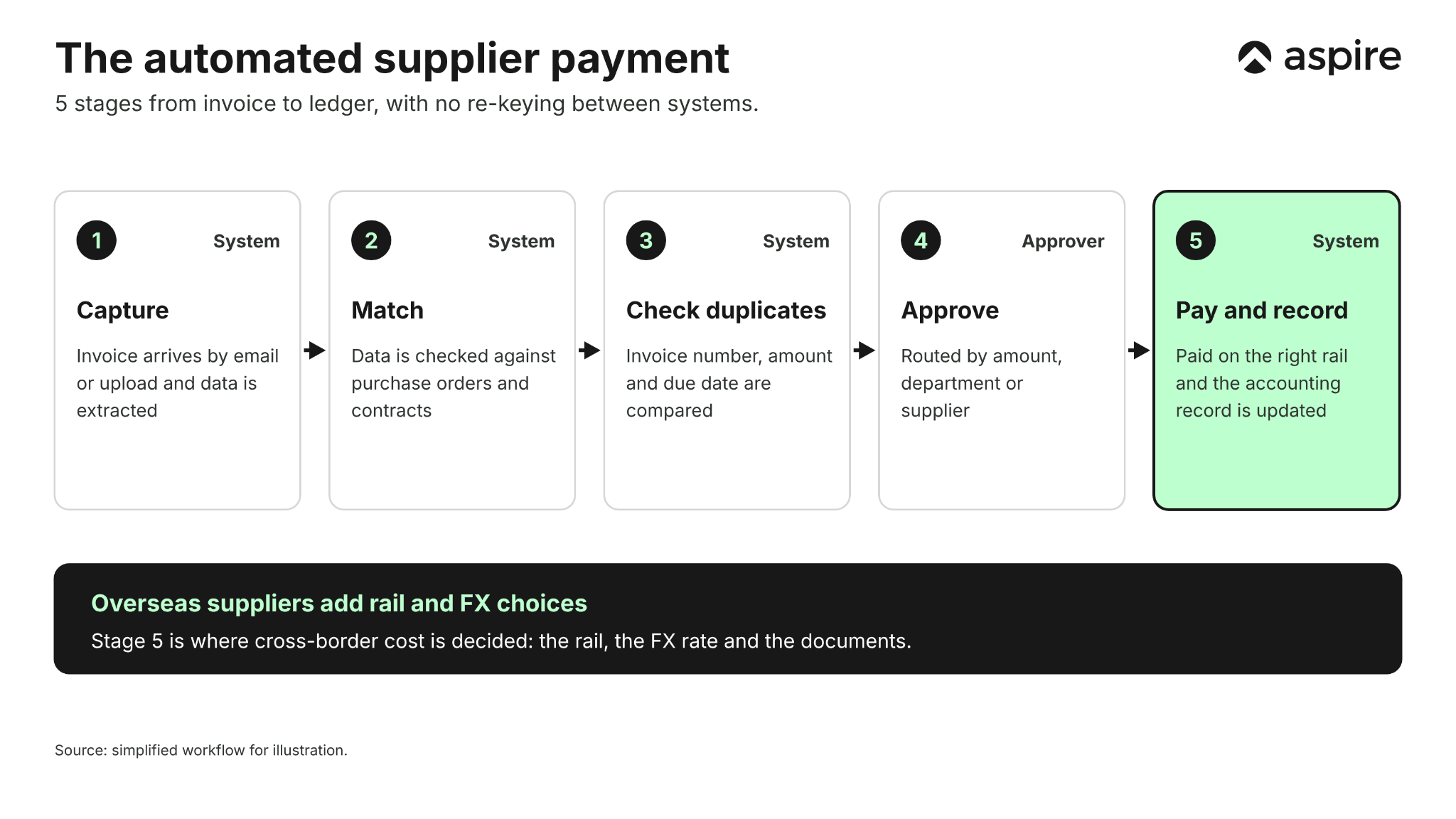
| Stage | What happens |
|---|---|
| Invoice capture | The invoice is uploaded or received electronically, and the system extracts the data |
| Matching | Extracted data is checked against purchase orders and contracts, with discrepancies flagged |
| Duplicate detection | Invoice number, amount and due date are checked against records to stop double payments |
| Approval routing | The invoice moves through an approval chain based on amount, department or supplier |
| Payment execution | The system routes payment through the right channel and updates the accounting records |
How much does manual processing cost?
Staying manual costs more than most finance teams track. The clearest public benchmark comes from the Association for Financial Professionals (AFP).
What does AFP data show per payment?
AFP's 2022 benchmarking survey found a median cost of USD 2.01 to 4 for an issued cheque. ACH cost USD 0.26 to 0.50 per payment for businesses with up to USD 4.9 billion in revenue.¹
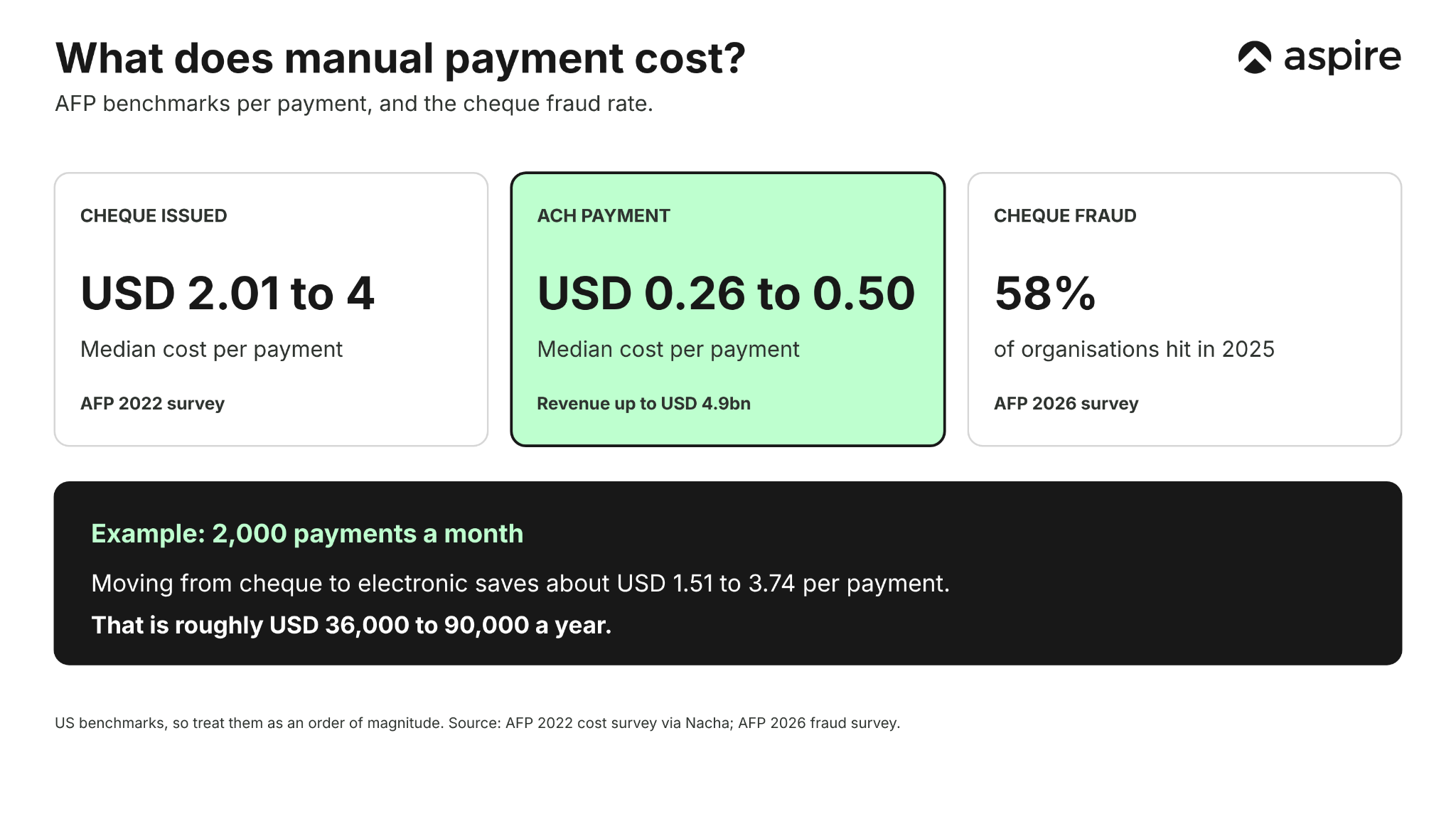
Take a Hong Kong trading company that sends 2,000 payments a month. Moving them from cheque to ACH-type electronic rails saves roughly USD 1.51 to 3.74 per payment on those medians, or about USD 36,000 to 90,000 a year. These are US benchmarks, so treat them as an order of magnitude, not a Hong Kong quote.
How big is the fraud risk?
Cheques are the most fraud-prone payment method in AFP's data. The 2026 AFP survey found 58% of organisations reported cheque fraud in 2025, and 76% reported attempted or actual payments fraud of any kind.²
Moving to electronic rails with verification controls removes the cheque exposure. It does not remove fraud, because redirected-payment scams target electronic payments too.
Which payment method suits which supplier?
The right rail depends on the supplier's location and currency.
| Method | Best for | Watch out for |
|---|---|---|
| FPS | HKD or RMB payments inside Hong Kong, available round the clock⁴ | Local suppliers only |
| CHATS or RTGS | Large local payments, see Aspire's RTGS guide | Cut-off times |
| SWIFT | Suppliers abroad when no local rail exists | Intermediary fees and delay |
| Local transfer network | Suppliers who bank in the destination country | Not available for every corridor |
| Virtual card | Suppliers who accept cards | Supplier acceptance |
For a deeper comparison, see Aspire's guide to SWIFT versus local bank transfers and the overview of B2B payment methods.
Why do overseas payments need more?
Overseas payments add 4 problems that a domestic-first tool is not built to handle. The next sections cover each in turn.
Why does conversion timing matter?
The exchange rate at the moment of conversion is part of your actual cost. A tool with no FX layer either converts at whatever rate applies at execution or hands the problem back to your bank.
Holding foreign currency lets you convert when the rate suits you. See Aspire's guides to foreign exchange risk and the top multi-currency accounts in Hong Kong.
Why does the payment rail matter?
A payment to a supplier who banks in the destination country can often use a local network instead of SWIFT. SWIFT can pass through several correspondent banks, and each may deduct a fee or add delay.
Automation that only generates SWIFT instructions misses this option. Aspire's how-to guide for SWIFT payments and its explainer on SWIFT GPI show what end-to-end tracking adds. SWIFT launched GPI so corporates could see when a payment reaches the beneficiary.⁵
Why is reconciliation harder?
A business paying suppliers in 5 currencies needs more than a single-currency ledger. The automation must handle 3 things:
- FX gain and loss postings for each settled invoice
- Multi-currency ledger entries in the supplier's own currency
- Reporting that rolls back up to a single home-currency view
What documentation and tax checks apply?
Larger cross-border payments often need supporting documents, such as invoices, contracts or trade papers. Banks and receiving countries may ask for them, so attach them to the payment record at the time of payment.
Hong Kong's withholding tax regime is narrow. According to PwC's tax summary, Hong Kong imposes no withholding tax on dividends or interest, while royalties paid to non-residents are subject to it, at rates from 2.475% up to 16.5% depending on treaty and association.³
A software licence with an IP element, for example, deserves a tax check before payment. See Aspire's guide to Hong Kong withholding tax and confirm your case with a tax adviser.
What does 1 cross-border payment cost?
The FX markup can be the largest cost on a supplier payment, and it is often not shown as a separate line item. A worked example shows the effect.
A Hong Kong e-commerce brand pays 20 overseas suppliers a month, at about USD 10,000 each. The comparison below uses assumed markups for illustration only, not quotes from any provider.
| Item | Bank with 1.0% markup (assumed) | Platform with 0.18% markup |
|---|---|---|
| FX cost on USD 10,000 | USD 100 | USD 18 |
| Cost across 20 payments a month | USD 2,000 | USD 360 |
| Difference per year | About USD 19,680 |
Add any SWIFT intermediary fees on top, and the gap widens. Ask each provider for the rate applied at execution and compare it with the interbank rate.
What does cross-border automation add?
A cross-border-capable system adds 5 capabilities to the core capture, match, approve and pay workflow.
| Capability | Why it matters |
|---|---|
| Multi-currency invoice capture | Reads invoices in the supplier's own currency, not only your reporting currency |
| Smart rail routing | Selects local networks where available and uses SWIFT only when needed |
| FX rate transparency | Shows the rate applied at the time of payment |
| Batch cross-border payments | Pays multiple suppliers in 1 batch, as bulk payments tools do for payroll |
| Compliance documentation | Attaches supporting documents to the payment automatically |
How do you onboard overseas suppliers?
Supplier onboarding is the hard part, and it is harder across borders. Each supplier must confirm banking details and learn how they will receive payment.
Each country uses a different banking format. A wrong detail causes a failed or delayed payment, so collect the right 1 for each supplier:
- IBAN for suppliers in Europe
- Routing and account numbers for suppliers in the US
- CNAPS codes for suppliers in mainland China
Choose a platform that validates banking details when you enter them, not after a payment fails.
What should you look for in a solution?
Ask 5 questions that separate a domestic-first tool from 1 built for overseas suppliers.
- Does it show the actual FX rate applied, or only a final converted amount?
- Can it route through local networks, not only SWIFT?
- Does it support batch payments across several currencies in 1 action?
- Does it connect to your accounting software?
- What happens when a payment fails or a supplier's details are wrong?
How does Aspire's payable management work?
Aspire's payable management covers bill capture, approvals and payment in 1 place. Bills can be added by email forwarding, image upload or CSV, with OCR reducing manual entry.
The page lists up to 3 approval levels, bulk payments and integrations with Xero, QuickBooks, NetSuite and SAP. See payable management, bill pay and expense management for the current feature set.
Which habits get the most from automation?
Setting up automation is the start, and a few ongoing habits decide the value.
- Capture early payment discounts. Terms of 2/10 net 30 give a 2% discount for paying 20 days early, which annualises to roughly 37%.
- Review vendor records quarterly. Deactivate dormant suppliers and confirm bank details, since a stale record can be used for a redirected payment.
- Use 1 intake channel. A dedicated email address or supplier portal gives automation cleaner data than scattered inboxes.
- Set a budget framework. Errors then get caught before approval, not only at matching.
Related guides cover invoice management, outstanding invoices and cash flow management.
Why Hong Kong Businesses Choose Aspire
Automating the approval workflow is only half the problem if the payments themselves are still routed inefficiently, and Aspire is built to solve both sides at once.
💱 FX spreads from 0.18%, up to 3x cheaper than traditional banks. This applies across 130+ countries and 40+ currencies through Aspire's multi-currency account. It's useful for anything from paying overseas suppliers to settling international payments without losing margin to markup.
💰 1.2% unlimited cashback applies on every corporate card transaction, with no monthly cap. It kicks in automatically on eligible spend, with no minimum threshold to hit first. Over time, it quietly turns routine business spend into working capital.
🌐 Local transfer network, not multi-hop SWIFT chains, is how Aspire routes most payments. This means faster settlement and fewer intermediary fees eating into your payment before it reaches the recipient. It also reduces the chance of funds being held up for review at a correspondent bank along the way.
💸 Fixed USD 8 inbound SWIFT fee, tracked end-to-end with SWIFT GPI, applies when SWIFT is the right rail for your payment. There are no surprise deductions from correspondent banks along the way, so the amount you're quoted is the amount that arrives. You can also download payment confirmation instantly from the app, without calling the bank.
⚡ Approved in as little as 1 business day, with no branch visits and no paperwork stacks. Applications are completed entirely online, from document upload to approval. There's no waiting weeks on a relationship manager to call you back.
Open a free multi-currency business account built for Hong Kong SMEs, or explore how Aspire's corporate card fits into your day-to-day supplier payments.
Frequently Asked Questions
AP automation covers the full workflow, including invoice processing, coding and approvals. Supplier payment automation refers more narrowly to executing and routing the payment. Most platforms combine both.
Often yes, because each cross-border payment carries a higher hidden cost through FX markup and fees. The break-even point comes sooner than for domestic payments.
SWIFT can pass through several correspondent banks, each of which may take a fee. A local network settles through the destination country's domestic system instead.
The system reads the invoice amount and currency, then matches it to the purchase order or contract. Any mismatch beyond your tolerance goes to manual review.
Yes, in 3 ways: it validates bank details against past records, flags sudden bank account changes and keeps an audit trail. Combine it with quarterly vendor reviews.
This varies by amount, currency and destination. It commonly includes the invoice, a contract or purchase agreement and sometimes trade documents.
Sources
- Nacha, "ACH Costs Are a Fraction of Check Costs for Businesses, AFP Survey Shows" (2022 AFP Payments Cost Benchmarking Survey)
- Association for Financial Professionals, "2026 AFP Payments Fraud and Control Survey Report"
- PwC, "Hong Kong SAR: Corporate, Withholding taxes" (Worldwide Tax Summaries)
- HKMA, "The Launch of Faster Payment System (FPS)" (17 September 2018)
- SWIFT, "Global corporates urge banks to use SWIFT gpi" (July 2017)
This blog is for general information only and does not constitute financial, legal, tax, or professional advice. Aspire’s services are subject to the terms outlined in our 'Terms of Service' and 'Pricing' pages. We make no guarantees as to the accuracy, completeness, or timeliness of the content, and past results do not indicate future performance. Always consult a qualified professional before acting on any information provided.
Galih Gumelar
Writer
Galih is a seasoned writer specialising in macroeconomics, business, finance and politics. With a writing history at CNN Indonesia, The Jakarta Post, and various other reputed organisations, Galih leverages his broad range of experiences to create insightful resources for those wanting to start a business.
Aspire Launchpad
Start Your Business with Aspire Launchpad
From incorporation to venture capital, we connect you with trusted service providers to make your entrpreneurial journey seamless.

Latest articles
Finance Tools •
Payroll Management (HK): MPF, Wage Rules & Tax Filings
A complete guide to managing payroll in Hong Kong. Understand Employment Ordinance rules, statutory MPF caps, leave calculations, and tax reporting requirements.

Finance Tools •
Top 4 Bulk Payment Solutions in HK for SME
Compare 4 top bulk payment solutions in HK: rails, limits, approvals and costs, plus a worked example of paying 200 payees and a safety checklist.

Finance Tools •
Payroll Processing in HK: A Monthly Run Guide
Learn payroll processing in HK: the monthly run, pay and MPF deadlines, IRD filings, a worked net-pay example and how to pay staff in bulk.
Start your journey with Aspire
Open your free account