



What is incurred cost: meaning and how do you manage it

Aaron Oh

Summary
Incurred costs are expenses a business becomes responsible for when it receives goods or services, uses a resource, or becomes liable for a payment, even if it pays later.
Under accrual accounting, incurred expenses are recognised in the accounting period they relate to, rather than when the payment is made.
Common examples include rent, salaries, utilities, raw materials and depreciation.
Incurred costs can be direct, indirect, fixed, variable, operating or capital costs, depending on what the expense relates to.
Tracking costs incurred helps businesses understand their spending, plan cash requirements and keep financial records accurate.
If incurred costs are not recorded in the right period, businesses may misstate their expenses and profitability.
A business can receive goods or services today but pay for them weeks later. If you record the cost only when the money leaves your account, you can end up with an inaccurate picture of what your business actually spent during the period.
This is where understanding incurred costs meaning, matters. A cost is incurred when your business receives a good or service, uses a resource, or becomes responsible for a payment, even if the bill has not been paid yet. Understanding when a cost is incurred helps you match expenses to the period they relate to and keep a clearer view of your business finances.
Incurred cost meaning
An incurred cost is a cost a company becomes responsible for when it receives a good or service, uses a resource, or otherwise incurs an obligation. Costs incurred relate to the period in which the underlying good or service is received or consumed, rather than necessarily the period in which payment is made.
The idea of costs incurred or expenses incurred is based on accrual accounting. Under the matching principle, expenses are generally recognised in the period to which they relate, rather than when they are paid.
Costs incurred may include direct, indirect, production, and operating expenses. It can also include prior period expenses.
Once you understand incurred cost meaning, the next step is to look at how businesses classify different costs.
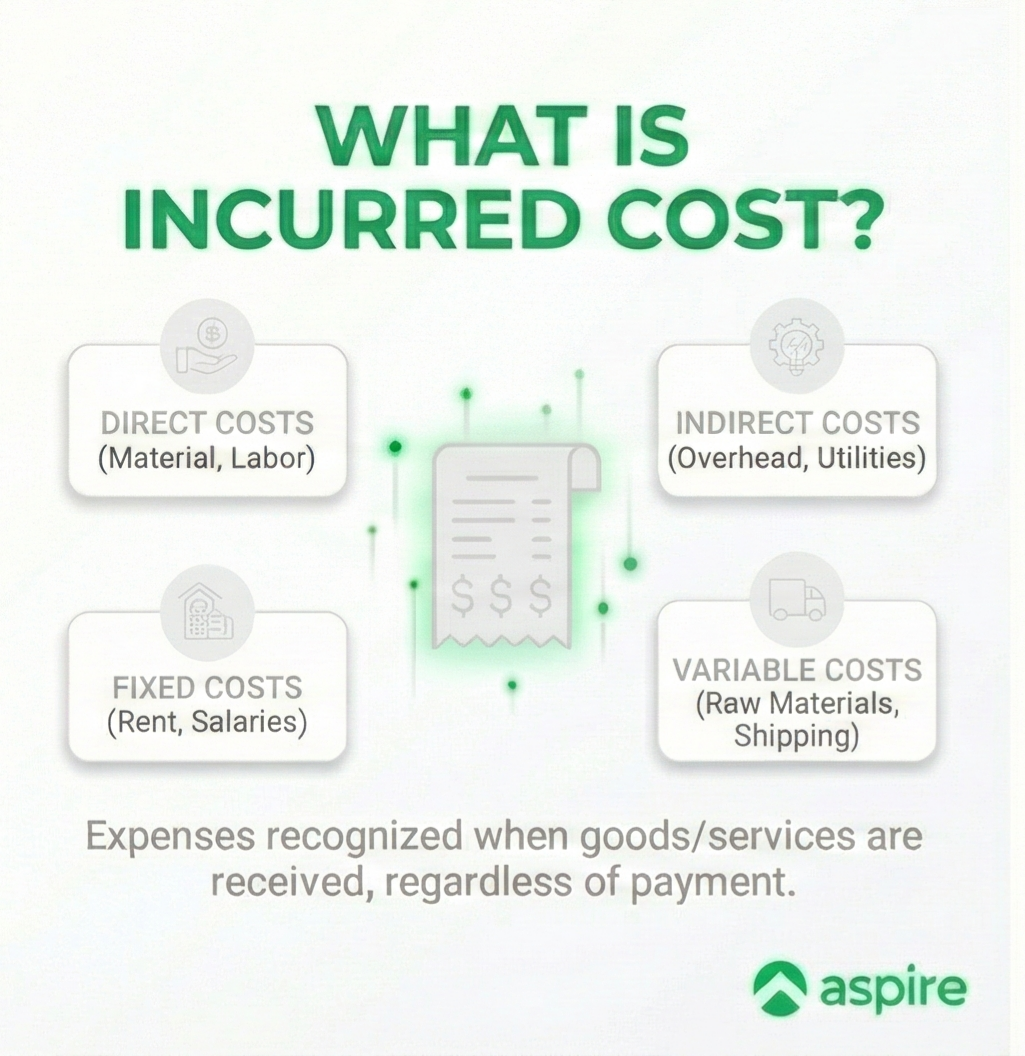
Types of incurred expenses
There are different ways to classify costs incurred by a business. The most common types of expenses incurred or costs incurred, include:
Manufacturing costs
Manufacturing costs refer to the costs incurred to change raw materials into finished goods. It includes the cost of materials, direct labour, and other direct expenses.
Direct costs
Direct costs are expenses incurred that can be directly traced to making a product or providing a service. They can include the wages of workers involved in production, raw materials used to make a product, and other costs directly associated with production.
Indirect costs
Any expense incurred that cannot be directly traced to the manufacture of goods or delivery of services is classified as an indirect cost. These costs support the overall functioning of the business and can include administration, selling, distribution, and marketing expenses.
Fixed costs
Fixed costs are costs incurred in the regular running of a business that generally do not change with the volume of goods or services produced over the short term. Common examples include rent and certain salaries.
Variable costs
Variable costs are expenses incurred that generally change with the volume of goods or services produced or sold. Examples can include raw materials, packaging, and other production costs that increase as output increases.
Capital costs
A capital cost is a cost incurred to acquire or improve a long-term asset used by the business. For instance, if a business purchases manufacturing equipment, the amount spent may be treated as a capital cost rather than an immediate operating expense.
Operating costs
Operating costs are the expenses a business incurs in its day-to-day operations. These can include internet services, office supplies, employee travel, and other costs required to keep the business running.
Sunk costs
Sunk costs are costs incurred that cannot be recovered once they have been spent. Because these costs cannot be recovered, they generally should not influence future decisions. Examples can include certain past research and development costs or amounts that have become irrecoverable.
Exit costs
Exit costs are expenses incurred when a business closes, restructures, or exits an operation. They can include employee severance payments, costs associated with disposing of assets, and fees for terminating certain contracts or leases.
Examples of incurred costs
Rentals
Rentals refer to the rent you pay for your office or factory space. While you may pay it at the end of the month, the cost is incurred for the period in which you occupy the space.
Depreciation
Depreciation is the gradual reduction in the value of an asset over a period of time. Even though it is a non-cash expense, depreciation is recognised as an expense over the period in which the asset is used. It is not tax-deductible in Singapore; businesses may instead claim capital allowances on qualifying fixed assets.
Utilities
Any cost incurred for utilities such as electricity, water bills, and telecommunications services is an expense incurred for the period in which the services are consumed. Even if you settle the bill at the month's or quarter's end, the expense is generally recognised in the period to which it relates under accrual accounting.
Supplies
Raw materials purchased for manufacturing goods represent a cost incurred when the business acquires them, but they are not necessarily an expense immediately. If the raw materials remain in inventory, they are generally recognised as an asset. The cost becomes an expense when the materials are used, or the related goods are sold, depending on the accounting treatment.
Salaries and CPF contributions
Salaries owed to employees for work already performed are examples of costs incurred. An employer's CPF contribution is also an employment cost arising from those wages. Under accrual accounting, these costs are generally recognised in the period in which employees provide the related services, even if payment is made later.
The following example shows how different costs incurred during a month are recognised under accrual accounting.
Your company incurs the following costs for August 2026. You follow the accrual method of accounting.
| Expense | Amount (SGD $) |
|---|---|
| Machinery | 166,800 |
| Office Rent | 6,950 |
| Salaries | 278,000 |
| Utilities | 278 |
| Raw materials | 33,360 |
Of this, machinery was bought on 1st January 2026, with depreciation charged for 12 months. Raw materials were bought on 1st August 2026, of which only two-thirds have been used.
How would you charge these expenses to the expense account for August 2026?
- Depreciation on machinery: Assuming straight-line depreciation over 12 months with no residual value, the monthly depreciation is SGD $13,900 (SGD $166,800 ÷ 12).
- Office rent: The cost incurred for rent for August 2026 is SGD $6,950.
- Salaries: Salary is a fixed cost incurred by the company. Even though you will pay the salary only in September, the employees' work has already been performed in August. Therefore, SGD $278,000 is included in the costs incurred for August 2026.
- Utilities: The SGD $278 utility cost relates to August. Although payment is made later, the amount is recognised in the period to which the utility consumption relates.
- Raw materials: Raw materials are a direct cost to the company. Although you purchased raw materials worth SGD $33,360, only two-thirds have been utilised. Therefore, two-thirds of the raw material cost is recognised as an expense incurred for August. This amounts to SGD $22,240.
So, the total expenses incurred for your company for August 2026 would be:
Incurred expenses = SGD $13,900 + SGD $6,950 + SGD $278,000 + SGD $278 + SGD $22,240 = SGD $321,368
Incurred cost analysis
Incurred costs reflect how much a company has incurred during a particular accounting period. It is an important figure for accountants to determine the company's financial state. Knowing the amount of costs incurred helps understand a company's cost structure and narrow down areas of improvement.
Understanding incurred cost meaning also helps businesses separate current-period costs from payments made in advance or costs that belong to another period.
Accountants can then plan how to pay off the expenses incurred over the months. If a company incurs expenses higher than its income, management will need to analyse the state of affairs and re-evaluate expense management. Managing incurred expenses can help a company keep a better eye on its profit.
Incurred cost vs accrued cost
An incurred cost is a cost that has arisen because a business has received or consumed a good or service or become obligated to pay. An accrued cost is an incurred expense that has been recognised in the accounts even though it has not yet been paid.
For example, salaries earned by employees in June but paid in July are incurred in June. If the business has not yet paid them at the end of June, the unpaid amount may be recorded as an accrued expense or salary payable.
Paid expenses and incurred costs: what’s the difference
To be able to differentiate between incurred costs and paid expenses, it is important to first understand what each principle denotes. Both are accounting principles that help businesses track their finances and cash flow.
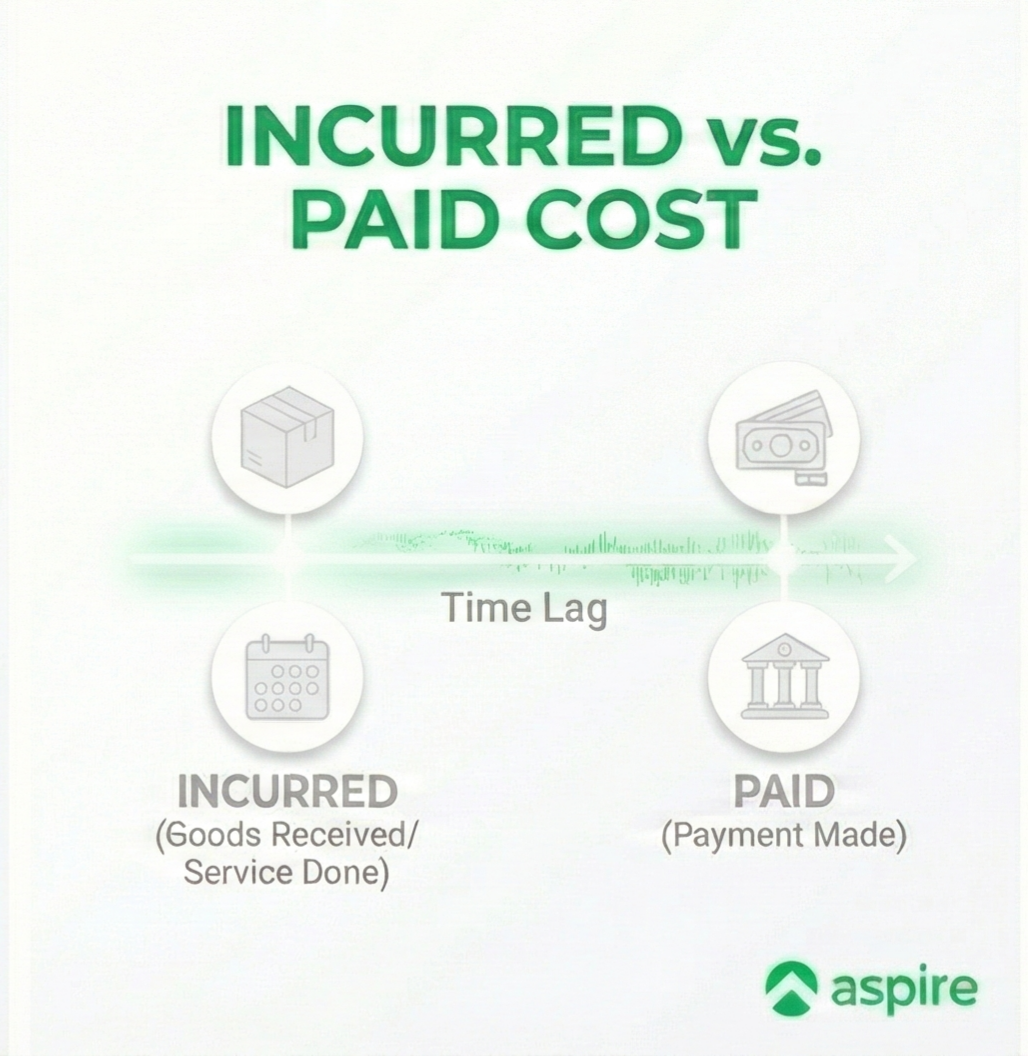
Incurred costs: These are expenditures that a business is liable for, regardless of payment status. These costs are incurred when obtaining any sort of service or goods. These are documented in the accounting system, regardless of whether the payment is made or not.
Example: A business receives an invoice for SGD $25,000 in raw materials that were ordered in August. The expense is incurred in August, regardless of when it is paid.
Not all incurred costs are immediately expensed
An incurred cost is not necessarily recognised as an expense immediately. The accounting treatment depends on the nature of the cost. For example, raw materials that remain in inventory may initially be recognised as an asset rather than an expense. The cost is generally recognised as an expense when the relevant goods are sold or consumed, subject to the applicable accounting requirements.
Paid expense: Once the company has paid the amount of money owed to the provider of the products or services, an expense that was an incurred cost is now considered a paid expense. Since they drain cash, these expenses quickly affect the company's cash flow.
Example: A web designer is paid for his services after the task has been carried out, which transforms the cost incurred into a cost paid.
Key differences between incurred costs and paid expenses
| Feature | Incurred costs | Paid costs |
|---|---|---|
| Timing | The cost arises when the business receives or consumes a good or service, or becomes obligated to pay. | The cost is settled when cash or another form of payment leaves the business. |
| Accounting | Relevant to accrual accounting, where costs are recognised in the period to which they relate. | Records the settlement of the amount owed and reduces cash or another payment asset. |
| Cash impact | May not have an immediate impact on cash if payment is due later. | Results in an immediate cash or payment outflow. |
For example, a business receives raw materials worth SGD 6,950 and agrees to pay the supplier later. The cost is incurred when the business becomes liable for the materials, while the cash outflow occurs when the invoice is settled. This is the practical cost incurred meaning: the obligation arises before the payment is made.
Why these differences matter
The difference between cash accounting and accrual accounting is that cash-based accounting only records expenses that have been paid as opposed to accrual accounting, which records costs that have been incurred.
Planning for finances requires understanding actual expenditures, which is helpful for creating a budget and estimating cash withdrawals. Costs incurred but not paid for reflect liabilities that must be settled in the future.
The use of accrual accounting and expenses incurred in Singapore
Incurred expenses are primarily relevant to accrual-based accounting. This differs from cash-based accounting, wherein expenses are recorded at the time of payment rather than when they are incurred.
Suppose a company incurs rent of SGD $868.75 in November but makes the payment only in December. Under accrual-based accounting, the expense would be recorded in November, whereas cash-based accounting would record it in December.
In Singapore, companies preparing financial statements under the applicable SFRS framework use accrual-based accounting. ACRA's guidance states that financial statements should comply with the applicable accounting standards, which include the Singapore Financial Reporting Standards (SFRS) and SFRS(I), subject to the relevant requirements and exemptions.
Accrual accounting acknowledges costs incurred and requires them to be documented in the reporting period. By doing so, accrual accounting enables you to measure your profit or loss for the relevant reporting period more accurately.
A key benefit of accrual accounting is that it gives a clearer picture of a company's financial position for a period. However, it does not show cash availability on its own. A company can report a profit even when it has not yet collected the related cash, which is why businesses also need to monitor cash flow.
Why should a founder track incurred costs
To support financial planning and profitability, founders need to keep track of the expenses they have incurred. When these costs have not yet been paid, they can also represent financial obligations that need to be planned for. Here are a few reasons why incurred costs matter to businesses:
Accurate reporting of finances
Financial statements should accurately reflect the organisation's financial situation by recognising costs in the appropriate accounting period. Where an incurred cost remains unpaid, it may also be recorded as a liability. This helps stakeholders, investors and auditors assess the company's financial position and profitability.
Improved cash flow management
Organisations that are aware of their expenses incurred can plan for upcoming payments and reduce the risk of cash shortages. Businesses can maintain liquidity by planning when to settle outstanding costs.
Cost management and financial planning
Companies can monitor spending patterns and identify unnecessary expenses by tracking costs incurred. This gives businesses a clearer basis for adjusting budgets and controlling spending.
Better vendor management
Keeping a record of incurred expenses can help businesses avoid late-payment penalties, make timely payments and maintain positive relationships with suppliers. Knowing what is owed also gives businesses a better basis for managing payment terms with suppliers.
Profitability and decision-making process
If businesses fail to account for their incurred costs, they may overstate their earnings and make decisions based on an incomplete view of their finances. Tracking expenses incurred helps businesses assess profitability more accurately and make informed decisions about spending.
Challenges of managing incurred costs
The main challenge with incurred costs is knowing what the business owes, what it has already paid, and which costs belong to the current accounting period. This becomes harder when a business is handling multiple suppliers, projects, and invoices.
High costs can affect profitability
Incurred costs can be high, especially when linked to a large project. If project costs run higher than expected, they can reduce profit and leave less room to meet financial targets.
Difficult to monitor
Incurred costs can be difficult to track when invoices come from multiple vendors. A business needs clear records to separate costs it has already incurred from those it has paid or has not yet incurred.
Complex financial reporting
Incurred costs need to be assigned to the accounting period they relate to. When invoices arrive late, or several projects are running at once, keeping financial records up to date can become more difficult.
Pressure on cash flow
An incurred cost does not always require immediate payment, but it can become a cash flow pressure when payment falls due. Several outstanding costs becoming payable at the same time can make it harder to cover other business expenses and maintain working capital.
Tax treatment requires attention
Not every incurred cost is automatically tax deductible. Depreciation is one example where the accounting treatment does not determine the tax treatment. The tax treatment depends on the nature of the expense and the applicable tax rules. Singapore businesses can refer to IRAS guidance on deductible business expenses when determining whether a particular expense qualifies for a deduction.
An Aspire solution: managing business costs with control and visibility
Aspire's spend management product enables you to manage company spending with greater control and real-time visibility. You can create real-time budgets for clients, projects or teams and set spending limits to help prevent overspending.
You can also set up approval flows, create spending policies and manage expenses from one platform, giving finance teams greater visibility into company spending. Aspire also supports accounting integrations that sync transactions and receipt information, making it easier to reconcile expenses and keep financial records organised.
Final word
A clear understanding of incurred cost meaning helps businesses recognise costs in the period they relate to, rather than looking only at when payments are made. This gives businesses a clearer view of their financial position, upcoming obligations and overall spending.
Whether the cost relates to salaries, rent, utilities, raw materials or other business expenses, knowing when a cost is incurred makes it easier to keep accurate financial records and plan cash flow. Tracking expenses incurred can also help businesses manage spending and make better-informed financial decisions.
Frequently Asked Questions
An incurred cost does not always affect cash flow immediately. A business may incur an expense when it receives a good or service but pay later. Tracking costs incurred alongside upcoming payments helps businesses plan cash requirements and avoid unexpected pressure on working capital.
An incurred cost has already arisen because a business has received or used a good or service. A committed cost is an obligation the business has agreed to but has not yet incurred. For example, a signed contract for equipment due next month creates a committed cost.
Under accrual accounting, an incurred expense is generally recognised in the accounting period it relates to, even when payment happens later. If the expense remains unpaid, the business may record a corresponding liability, such as accounts payable or an accrued expense. Understanding cost incurred meaning helps clarify why the accounting entry depends on what the cost relates to and the period in which it arises.
No. An incurred cost is not necessarily an immediate expense. Its accounting treatment depends on what the cost relates to. Equipment, for example, may initially be recognised as an asset, with its cost recognised over time through depreciation rather than expensed immediately.
Depreciation is a non-cash expense that allocates the cost of a fixed asset over its useful life. The depreciation recognised for each accounting period is an expense incurred for that period, although there is no new cash payment when the depreciation expense is recorded.
Sources
- Incurred Cost Meaning: Definition, Management and Analysis — https://wise.com/sg/blog/incurred-cost-meaning: June 03, 2025
- Incurred Expenses: Definition and Examples — https://www.indeed.com/career-advice/career-development/incurred-expenses: June 16, 2026
This blog is for general information only and does not constitute financial, legal, tax, or professional advice. Aspire’s services are subject to the terms outlined in our 'Terms of Service' and 'Pricing' pages. We make no guarantees as to the accuracy, completeness, or timeliness of the content, and past results do not indicate future performance. Always consult a qualified professional before acting on any information provided.
Aaron Oh
Writer
Aaron is a seasoned content writer specialising in finance, insurance and tech industries. With a writing history at S&P Global, EdgeProp, Indeed, Prudential, and others, Aaron leverages finance knowledge and business insights to help businesses improve productivity and performance.
Aspire Launchpad
Supercharge your finance operations with Aspire
Find out how Aspire can help you speed up your end-to-end finance processes from payments to expense management.

Latest articles

Product Updates
Aspire release notes (September 2026): Aspire MCP and more
Connect Aspire to Claude, ChatGPT and Cursor with Aspire MCP, plus new launches in Hong Kong and Singapore and the latest in Agentic ERP.
E-commerce •
E-commerce fulfilment in Singapore: Complete guide for businesses
Learn how e-commerce fulfilment works in Singapore, from warehousing and order processing to delivery, costs, and choosing the right fulfilment partner.

E-commerce •
3PL for ecommerce warehousing in Singapore
Learn how 3PL warehousing works for e-commerce businesses in Singapore, its benefits, how it works and how to choose the right provider.
Start your journey with Aspire
Open your free account