


How to accept international payments for your business in 2026

Content Team

Summary
Sending or receiving money across borders is what makes a payment "international." Depending on the transaction, you might deal with multiple banks, currency conversion, cross-border fees, or extra compliance checks
There are six steps to accepting international payments: pick a provider, get verified, add the right payment methods, manage your currencies, simplify checkout, and set up fraud and authentication controls
Payment preferences aren't the same everywhere, so offering what your customers already use tends to cut friction at checkout
Fees add up beyond the advertised transaction rate. Processing costs, an FX markup, cross-border charges, chargebacks, and intermediary bank fees can all come into play
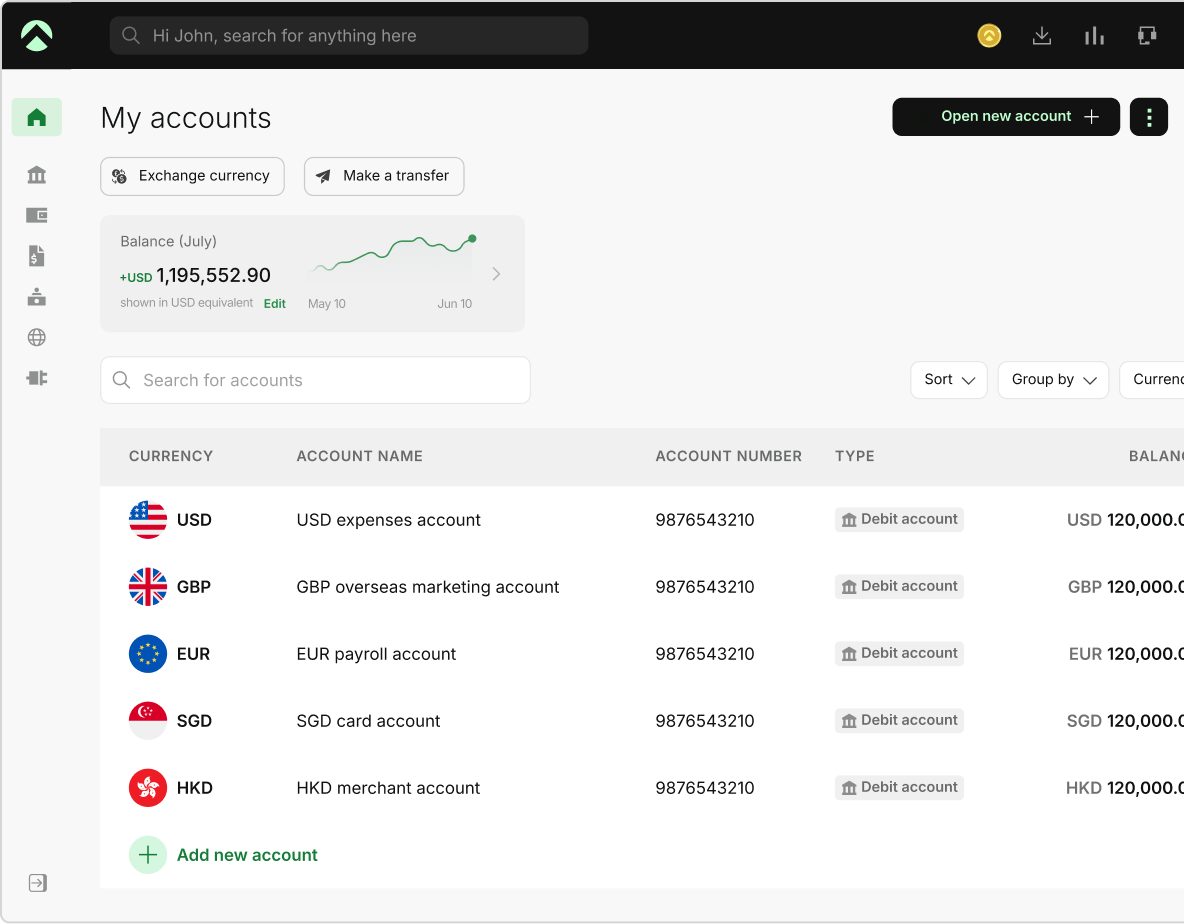
One Aspire account to manage your business finances in one place.
Get a business account¹, issue corporate cards², manage expenses, and automate financial workflows, all from one powerful platform built for modern businesses.
To accept international payments, start with a provider that supports the markets and currencies you sell into. Then add the payment methods your customers already use, manage currencies based on where you actually earn and spend, and account for FX and processing fees before you compare providers. Add fraud and compliance controls as your volume grows.
Accepting international payments involves more moving parts than domestic payments do. Say a US SaaS company invoices a client in Germany. That provider needs to receive EUR and either hold, convert, or settle the funds into a US account. An ecommerce brand that wants to accept payments globally has a different problem: it needs iDEAL or UPI at checkout so customers can pay the way they normally do.
What you build depends on your business model and where your customers are.
What are international payments
An international payment is money sent or received across borders. That covers a lot of ground in this guide: customer payments collected at checkout, and business payments received through invoices or bank transfers. Depending on the payment method, funds or payment messages might pass through several financial institutions or payment networks before they settle in the recipient's account, and along the way there's often currency conversion, compliance checks, and extra verification to deal with.
How are international payments different from domestic payments?
| Difference | International | Domestic |
|---|---|---|
| Currency | May involve FX | Usually one currency |
| Jurisdictions | Multiple | Usually one |
| Compliance | May involve additional requirements | Generally simpler |
| Intermediaries | May involve intermediary banks/payment institutions | Often fewer |
| Timing | Depends heavily on route | Often more predictable |
For card payments, authorization checks whether a transaction can be approved, capture confirms the amount to be processed, settlement moves the funds through the payment system, and payout makes the funds available to your business. Currency conversion can happen at different points depending on the provider and payment method.
Which businesses accept international payments?
Ecommerce brands, SaaS companies, agencies with overseas clients, and B2B sellers with international customers all deal with this regularly. What you need depends on your transaction size, how often you bill customers abroad, and which countries you're selling into.
How to start accepting payments from overseas
There's no single best way to accept international payments, but it comes down to six steps: choose a provider, complete verification, add the right payment methods, manage your currencies, simplify checkout, and set up fraud controls.
Step 1: Choose a provider, gateway, or processor that fits your markets
If you're figuring out how to accept international payments online, start by choosing the type of provider that fits your business model:
- Traditional bank: Can provide business accounts and international transfers, but may offer fewer payment-acceptance or local-payment options.
- Payment processor or gateway: Processes payment transactions or securely transmits payment information between your checkout and processing infrastructure.
- Multi-currency account/provider: Lets businesses receive, hold, convert, and transfer funds in multiple currencies.
- Payment platform: Can combine payment acceptance, transfers, accounts, FX, and other payment services in one platform.
These categories can overlap. Some providers combine several functions, so compare what each provider actually offers rather than relying on the provider type alone. Look at which countries and currencies are supported, settlement times, FX costs, local payment methods, accounting integrations, and whether local acquiring is available in your key markets.
The provider type and payment role aren't always the same thing. Here's what the main payment functions do:
A payment gateway to accept international payments securely transmits payment information between your checkout and payment-processing infrastructure, while a payment processor handles transaction processing and authorization. Acquirers and other financial institutions handle the movement and settlement of funds. Many providers bundle several of these functions into one platform, and some go further, combining payment acceptance with multi-currency accounts and FX services so you can receive, hold, convert, and transfer funds from one place. When you're comparing providers, look at how you'll actually collect, report, and pay out funds across markets, beyond whether a given provider technically accepts international payments.
To accept international payments, start by running through this checklist before you choose a provider:
- Countries the provider supports
- Currencies you can accept, hold, convert, and pay out
- Payment methods available in your target markets
- FX markup and transaction fees
- Settlement and payout options
- Chargeback and dispute handling
- Fraud and authentication tools
- Integration requirements
- Verification and transaction limits
Can a foreign company accept payments from US customers?
Yes, as long as your payment provider supports your country and the kind of payments you're running. Eligibility, verification, tax, and regulatory requirements all depend on your specific business and transactions, but verification typically touches on business registration, beneficial ownership, and a linked bank account. Before you launch, confirm which currencies, payment methods, and US-specific requirements your provider actually supports.
Step 2: Complete business verification before scaling
Providers typically require business verification before enabling payment functionality, although exactly what that involves and how long it takes varies. Expect identity checks, company registration details, banking information, and a review of what your business actually sells.
What you'll need to submit depends on the provider and your business structure, but plan on registration documents, a tax identification number, bank account information, identification for owners or representatives, and details about your website or products. Limits and requirements shift by provider and business profile, and don't be surprised if a provider asks for more later, like tax records or documentation for specific transactions, as your volume grows.
Step 3: Add payment methods your customers already use
Cards are widely accepted internationally, but that doesn't mean they're what people actually want to use. For B2B payments, common options include:
- Bank transfer or local receiving account: Lets businesses receive payments directly into an account in the relevant currency or market.
- Invoice: Useful for billing business customers for one-off or recurring payments.
- Payment link: Lets businesses request payment through a shareable link without requiring a full ecommerce checkout.
- Card: Useful for customers that prefer to pay invoices or purchases by card.
- Digital wallet: Options such as Apple Pay and Google Pay can simplify online checkout.
- Local payment rail: Market-specific systems such as iDEAL in the Netherlands or UPI in India can give customers a familiar way to pay.
Your payment methods should match your customers' market and your business model, since payment preferences vary by region and transaction type.
A handful of checkout changes make a real difference: cut down on required form fields, offer guest checkout, support wallet-based payments, and let browser or wallet autofill do its job where that's allowed.
How do I receive international payments?
You can receive international business payments in several ways, depending on how you bill customers and where they are located:
Option 1: Accept cards through online checkout
Set up a payment gateway or processor that supports the cards and currencies used by your customers. The customer pays through your checkout, the provider processes the transaction, and the funds are settled to your business account according to the provider's payout schedule.
Option 2: Send an invoice or payment link
Send the customer an invoice or payment link that supports the payment methods and currency you need. The customer completes the payment, and the provider receives and processes the funds before making them available to your business.
Option 3: Give the customer local bank account details
Provide the customer with local receiving-account details in the currency they need to pay. The customer makes a bank transfer, and the funds arrive in the corresponding currency account, where you can hold or convert them.
Option 4: Receive an international wire/SWIFT payment
Provide the customer with the required international bank details, such as your account number or IBAN and SWIFT/BIC code where applicable. The payment may pass through intermediary banks before reaching your account, and intermediary or receiving-bank fees may apply.
Across these options, the basic flow is: customer pays → provider receives the funds → business holds or converts the funds → funds are withdrawn or used.
Before accepting a large payment, confirm the currency, fees, transaction limits, and any verification requirements with your provider.
Step 4: Decide how you'll manage currencies and settlement
When you're accepting payment in foreign currency, some businesses convert everything back to USD as soon as it comes in, while others keep balances in EUR or GBP and convert only when they need to, timing it around vendor payments, operating needs, or where the exchange rate happens to be.
If your revenue currency matches your supplier or operating currency, you'll pay fewer repeated conversion fees. There's a checkout benefit too: local currency pricing shows customers the exact amount they owe instead of leaving them to estimate a conversion rate. A multi-currency account keeps all of this manageable from one place.
Step 5: Keep checkout simple
A long or complicated checkout adds friction, and that's worse on mobile. Show taxes or duties upfront, support Apple Pay and Google Pay, and cut the steps down to what's actually necessary so international customers can get through a purchase without hitting a wall.
Step 6: Set up fraud and authentication controls
Payment providers and issuers may use transaction, merchant, card, and geographic signals when assessing payment risk, especially for unfamiliar countries or higher-risk regions. Put reasonable fraud controls in place, like address verification and transaction monitoring, and know your PCI DSS responsibilities based on how your payment environment actually handles cardholder data. Outsourcing payment processing doesn't automatically remove your PCI DSS responsibilities. Your obligations depend on how your checkout and payment environment are implemented. It's also worth calibrating fraud settings by region to reduce unnecessary declines for legitimate customers.
3D Secure authentication and SCA
3D Secure adds an extra authentication step to certain online card payments, so you can verify it's really the cardholder paying. In the European Economic Area, PSD2's Strong Customer Authentication rules apply to certain electronic payments, with some exemptions, and 3D Secure is one of the most common ways providers meet them. The UK sets its own payment authentication rules separately from the EU, so don't assume one set of rules covers both markets.
Monitor failed international payments
Payments fail for a lot of reasons: expired cards, issuer declines, authentication errors, unsupported payment methods, bad payment information, or a temporary banking glitch. Automated retries and card-updater tools can recover some of those failed recurring payments. It's worth tracking decline rates, chargeback trends, and success rates by country too, since that's usually where the friction costing you revenue shows up first.
Tax and regulatory requirements
Accepting a payment and owing tax on it are two separate questions. Tax and compliance rules shift depending on the country and the payment method, and your obligations depend on what you sell, where your business and customers are located, and the applicable rules. Before you scale into a new region, check your VAT or GST obligations there, keep records for your cross-border transactions, and confirm what your provider's compliance coverage actually includes.
Which payment methods work best internationally
Most businesses end up mixing cards, local payment rails like ACH in the US or SEPA in Europe, digital wallets, and invoicing to build an international payment processing setup that matches how people actually pay in each market. Settlement times depend on the provider, the rail, the currency, and the transaction type, so confirm exact figures with your provider before you rely on them.
| Payment method | Works best for | Common markets | What to know |
|---|---|---|---|
| Cards | Ecommerce, SaaS, subscriptions | Global | Cross-border transactions may incur additional fees depending on the provider and card transaction |
| Bank transfers and local rails | B2B payments and large invoices | Region-specific, such as ACH in the US, SEPA in Europe, or UPI in India | Can be cost-effective for larger payments, although fees and settlement times vary by rail and provider |
| Digital wallets | Mobile commerce and faster checkout | US, Europe, Asia | Apple Pay and Google Pay can simplify online checkout by letting customers use saved payment credentials |
| Invoices and payment links | Recurring or one-off B2B billing | Global | Useful for billing clients on payment terms instead of collecting at checkout |
| SWIFT wire transfers | High-value international transactions | Global | Commonly used for international bank transfers, particularly where the recipient or bank requires SWIFT. Intermediary and receiving-bank fees may apply |
| Local receiving accounts | B2B payments and recurring international collections | Region/currency-specific | Lets businesses receive payments using local account details in supported currencies and markets |
What do international payment processing fees include?
The advertised transaction fee may not be the whole story. FX conversion, cross-border charges, and disputes can all add to the total, and settlement delays can squeeze your cash flow even when they don't cost you a direct fee.
Here's what typically shows up in the total cost:
- Processing fees for the card or payment method
- An FX conversion markup above the mid-market rate, the midpoint between the buy and sell rates in the wholesale FX market
- Cross-border fees, which can apply when a card was issued abroad
- Chargeback and dispute fees or losses, depending on the provider
- Intermediary bank fees on SWIFT transfers
The numbers add up fast. A 1-percentage-point difference in FX cost on USD $500,000 of annual international revenue works out to USD $5,000. Getting your FX exposure and settlement structure right matters more than hunting for the lowest advertised rate.
How Aspire helps businesses manage global payments
Managing payments across multiple countries gets complicated fast, and it doesn't take long to feel it. Currency conversion, settlement timing, payouts, and reconciliation all pile on overhead as volume grows, and juggling separate tools for banking, FX, and reporting only gets harder with each new market you add.
Aspire¹ puts multi-currency accounts*, international transfers, and FX conversion in one platform. You can hold balances in EUR*, GBP*, HKD*, and SGD*, send payments in 98+ currencies* across 130+ countries*, and get FX rates from 0.22% above mid-market.* For businesses managing global business payments, bringing accounts, FX, and transfers into one platform can simplify reconciliation and cash management.
For example, on USD $100,000 of monthly conversions, a rate of 0.22% above the mid-market rate corresponds to approximately USD $220. Aspire1 also supports same-day local transfers and FX payments to 40+ currencies*, so cross-border payments don't have to be spread across several accounts. Availability and pricing are subject to eligibility and verification requirements.
Frequently Asked Questions
Cut down on repeated currency conversions, settle locally where you can, and pick a provider with a lower FX markup. If you're dealing with larger invoices, it's worth comparing the total cost of bank transfers against card payments, FX and receiving fees included.
It comes down to your customer base and your margins. Local currency pricing shows customers the amount they owe in a currency they actually recognize, which tends to make the payment experience less confusing. If your international revenue keeps growing, holding multiple currencies can also cut down on unnecessary conversion costs.
Cross-border transactions often go through extra risk, currency, compliance, or issuer checks, depending on the payment method and the markets involved. What actually causes a failure varies: authentication issues, unsupported payment methods, expired cards, wrong billing information, or a banking restriction specific to that region.
It depends on the payment method, provider, currency, and receiving bank. Card payouts usually follow your provider's payout schedule. SWIFT payments can reach the beneficiary bank fast, but they can still take longer to actually show up in the recipient's account because of local processing, compliance checks, or bank hours.
SWIFT is a messaging network that banks and financial institutions use to exchange payment instructions for many international transfers, and the fees and timing depend on the banks and route involved. Local rails like ACH, SEPA, and Faster Payments work within specific markets or regions instead, and they can be faster or cheaper than a cross-border route, depending on the transaction.
Some payment methods make funds available quickly, but there's no universal instant option for international business payments. Timing depends on the payment rail, provider, currency, receiving bank, and local processing. For example, FedNow operates 24/7 and settles eligible payments within seconds, but FedNow itself supports domestic payments between US depository institutions, so an international transaction may require a separate cross-border rail or payment provider.
For large international payments, choose a provider and payment route that support the transaction amount and currency, and complete any additional verification the provider requires. Before accepting the payment, confirm transaction limits, currency-conversion costs, intermediary or receiving-bank fees, and the settlement and payout process. For bank transfers, verify the beneficiary and account details carefully to avoid delays or rejected payments.
Yes, if your bank supports the relevant international payment route and currencies. You'll generally need to provide the payer with the required bank details, such as an account number or IBAN and, where applicable, a SWIFT/BIC code. Check whether your bank charges receiving or intermediary fees and how it handles currency conversion before choosing it for regular international collections.
Sources
- https://www.swift.com/pt/node/310551
- https://www.swift.com/about-us/who-we-are/what-swift
- https://www.frbservices.org/resources/resource-centers/same-day-ach/fedach-processing-schedule.html
- https://www.federalreserve.gov/paymentsystems/fednow-additional-questions-and-answers.htm
- https://finance.ec.europa.eu/publications/strong-customer-authentication-requirement-psd2-comes-force_en
- https://www.eba.europa.eu/single-rule-book-qa/qna/view/publicId/2019_4671
- https://www.pcisecuritystandards.org/standards/pci-dss/
- https://ideal.nl/en/wat-is-ideal
- https://www.npci.org.in/product/upi
- https://www.irs.gov/publications/p515
- https://vat-one-stop-shop.ec.europa.eu/index_en
- https://aspireapp.com/us/global-payments
- https://www.pcisecuritystandards.org/faqs/does-pci-dss-apply-to-merchants-who-outsource-all-payment-processing-operations-and-never-store-process-or-transmit-cardholder-data/
- https://developer.apple.com/documentation/ApplePayontheWeb
- https://docs.stripe.com/billing/revenue-recovery/smart-retries
This blog is for general information only and does not constitute financial, legal, tax, or professional advice. Aspire’s services are subject to the terms outlined in our ’Terms of Service’ and ’Pricing’ pages. We make no guarantees as to the accuracy, completeness, or timeliness of the content, and past results do not indicate future performance. Always consult a qualified professional before acting on any information provided.
Content Team
Aspire editorial
Content team at Aspire is a society of seasoned writers & experts specialising in finance, technology and SaaS space. With 50+ years of collective experience, they help make business finance more profitable for readers. They write about finance tools, finance insights, industry trends, tactical guides to grow your business & also all things Aspire.
Aspire Launchpad
Supercharge your finance operations with Aspire
Find out how Aspire can help you speed up your end-to-end finance processes from payments to expense management.

Latest articles

Finance Tools •
Accounting software for hotels: Complete buyers’ guide 2026
A 2026 buyer’s guide to hotel accounting software, covering key features, USALI reporting, PMS integrations, selection criteria, and top platforms.
Finance Tools •
Best dental accounting software for US practices
Compare the best dental accounting software for US practices by features, pricing, accounting capabilities, and practice size.
Starting a Business •
How to get an LLC in Virginia: Costs, requirements, and key considerations
Learn how to get an LLC in Virginia: $100 formation fee, $50 annual registration fee, registered agent rules, filing steps, and post-formation requirements.