



What Is POBO? Payment on Behalf Of for HK Groups

Galih Gumelar

Summary
POBO means Payment on Behalf Of. A central entity pays creditors for other group companies, so subsidiaries need fewer bank accounts.¹
It is the payables side of the pair. COBO centralises incoming payments, and POBO centralises outgoing ones.
The tax risk is the intercompany balance. A payment made for another entity can be treated as a loan, so documentation and arm's-length terms matter.²
Hong Kong is a treasury-centre location. A qualifying treasury centre can be taxed at 8.25%, but some countries restrict payments on behalf of others.³ ⁴
It suits larger groups. Smaller groups usually get most of the benefit from lighter options.¹
POBO, short for Payment on Behalf Of, is a treasury model in which 1 central company pays suppliers for several group companies from its own accounts.¹ Each subsidiary sends a payment request, and the central entity makes the payment and records what that subsidiary now owes it.
This guide explains how POBO works, what the intercompany entries look like, and how Hong Kong tax and regional rules affect it. It also covers a stablecoin version and whether a smaller group needs POBO at all.
What is POBO (payment on behalf of)?
POBO is a centralised payment structure in which 1 legal entity, usually a shared service centre or in-house bank, pays creditors for multiple group companies.¹ The subsidiaries stay separate companies, and the money they owe is booked through intercompany accounts.
Many groups route these payments through a single account per currency instead of separate accounts in every entity.¹ Cobo is also the name of a crypto custody company, so this guide uses POBO only for the treasury model.
How do POBO and COBO differ?
POBO handles money going out, and COBO handles money coming in. The 2 models often sit in the same treasury centre.
For the full side-by-side comparison, see our guide to COBO (collection on behalf of). Some banks call the collection side ROBO.⁴
Why do groups use POBO?
Groups use POBO to replace many local payment runs with 1 controlled payment point.¹ The gains grow with the number of entities, banks and currencies.
- Fewer accounts. Subsidiaries need fewer bank accounts, which cuts bank fees.¹
- Bundled supplier payments. A shared vendor can be paid once for several entities.¹
- Better oversight. Fewer people handle payments, and treasury sees where cash leaves the group.¹
- Faster growth. A new entity can send requests without opening new accounts for payables.
How does POBO work?
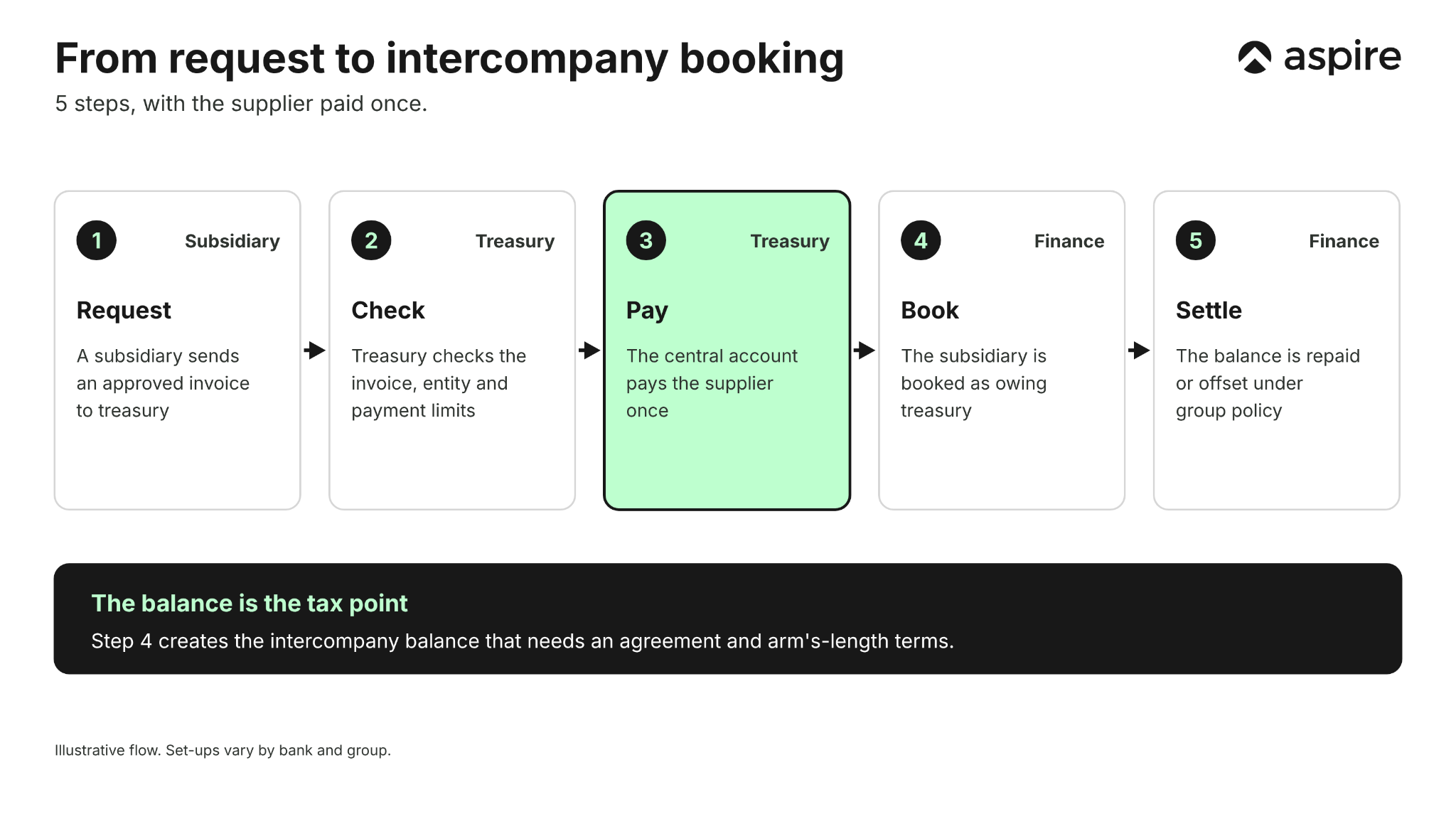
POBO works by sending every payment request to 1 central entity, which pays the supplier and books the amount to the requesting subsidiary. The steps below describe a typical set-up.
- Agree the legal basis. Intercompany agreements authorise the central entity to pay for each subsidiary.²
- Open the payment account. The central entity holds the payables account, often funded through an in-house bank.¹
- Collect requests. Subsidiaries submit approved invoices through the ERP or a payment platform.
- Pay the supplier. The central entity sends 1 external payment, using a payment file the bank accepts.¹
- Book the balance. Treasury records an intercompany payable for the subsidiary.
- Settle internally. The subsidiary repays, or balances are offset, under group policy.
What does POBO look like in Hong Kong?
This illustrative example shows how 1 treasury entity pays suppliers for 3 group companies. All names and figures are invented.
Harbour Treasury Ltd is the central entity of Harbour Gadgets, a Hong Kong electronics distributor. In 1 month it pays component suppliers from its USD account for the 3 trading entities.
| Entity | Paid by treasury (USD) | Intercompany balance |
|---|---|---|
| Harbour Trading Ltd | 55,000 | Owes treasury 55,000 |
| Harbour SG Pte Ltd | 30,000 | Owes treasury 30,000 |
| Harbour UK Ltd | 20,000 | Owes treasury 20,000 |
| Total | 105,000 | 105,000 |
Each balance stays on the books until it is settled or offset. Tax and accounting advisers should approve the treatment of these balances before the structure goes live.
What are the risks of POBO?
The main risks of POBO are tax, legal and operational, and most depend on the countries involved.⁵ Groups usually find them during design, not after launch.
| Risk area | What can go wrong | How groups manage it |
|---|---|---|
| Tax | A payment on behalf can be treated as a loan or equity contribution² | Intercompany agreements and tax sign-off |
| Regulatory | Some jurisdictions restrict payments on behalf of others⁵ | Country-by-country legal review |
| Local payments | Tax payments generally must be made locally¹ | Keep local accounts for these |
| Funding | The central account needs liquidity, often through an in-house bank¹ | Clear funding and settlement policy |
| Accounting | Intercompany receivables and payables must be recorded correctly | Consistent ERP postings |
Without unique account details, payment ownership can also become unclear, which brings reconciliation problems back.¹
How is POBO taxed in Hong Kong?
Hong Kong offers a profits tax rate of 8.25% for qualifying corporate treasury centres.³ The rate applies to relevant profits from 1 April 2016, and a separate rule lets intra-group financing businesses deduct interest under specified conditions.³
The tax risk in POBO sits in the intercompany balance, not the payment itself. A payment on behalf can be recharacterised as a disguised loan, and long-running balances may attract imputed interest.²
The IRD lists guidance on corporate treasury activity (DIPN 52) and on transfer pricing between associated persons (DIPN 59).⁶ See our guide to the corporate tax rate in Hong Kong for the standard position.
Where is POBO restricted?
There is no single global rule, and some countries restrict payments made on behalf of another entity.⁵
| Market | What to know | Practical step |
|---|---|---|
| Hong Kong | Named as a regional treasury centre location⁴ | Confirm the structure with your bank and tax adviser |
| Singapore | Named as a regional treasury centre location⁴ | Local legal and bank review |
| Mainland China, India, Malaysia | Named as markets with obstacles; a China entity may need to register as a financial institution⁴ | Specialist counsel and bank advice |
Can POBO work in China?
For mainland entities, POBO is not a plug-and-play structure. The closest legal route is the cross-border cash pooling regime, and a notice dated 13 August 2026, effective 14 September 2026, lists centralised current-account receipts and payments among covered scenarios.⁷
That regime covers cash pooling, which is a different structure from POBO, so mainland entities should take specialist advice before paying on behalf of members.
Can POBO run on stablecoins?
In principle yes: a central wallet can play the role of the payment account. Stablecoin POBO is a design pattern, not a product, and each part needs checking against local rules.
A wallet address works much like an IBAN for receiving a payment, and transfers can settle at any hour.⁸ The central entity holds the wallet in-house or with a regulated custodian, and customer checks and sanctions screening still apply.⁸
What does Hong Kong's regime say?
Hong Kong requires an HKMA licence to issue a fiat-referenced stablecoin, and that rule applies to issuers, not to the companies that use them.⁹ The Stablecoins Ordinance took effect on 1 August 2025.⁹
The HKMA granted the first 2 issuer licences on 10 April 2026 and advises using stablecoins only through regulated channels.¹⁰ Licensing applies to issuers, so a group using stablecoins still needs regulated channels, customer checks and records. See our guide to stablecoins for business in Hong Kong.
Can an SME group use POBO?
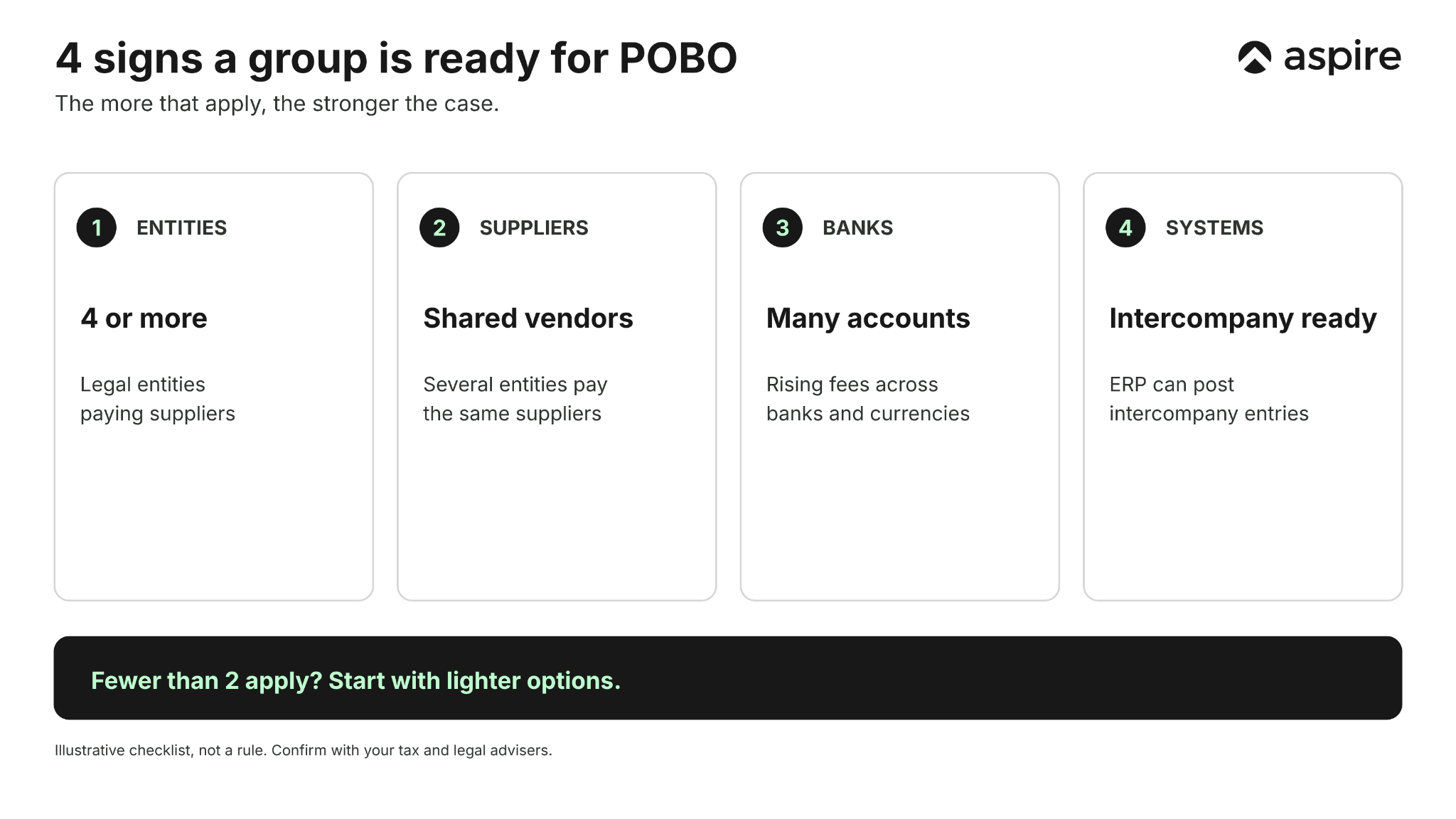
POBO is mainly a large-group tool, and RBC lists smaller companies among those it suits less.¹ Setting it up takes significant time and resources, so most SME groups do better with lighter options first.
Are there lighter alternatives?
Most SME groups can capture part of the benefit without a central payment structure.
| Option | What it solves | Limit |
|---|---|---|
| Shared approval rules across entities | Consistent control over who pays what | Payments still run entity by entity |
| 1 business account per entity | Clear ownership of each payment | More accounts to manage |
| Bulk payment runs for shared suppliers | Fewer manual payments | No intercompany booking |
For a single entity, our bill pay lets finance teams forward supplier bills to a dedicated email, route them through approvals by role and schedule payment for the due date. For groundwork, see our guides to accounts payable, accounts payables 101 and invoice payment.
What do you need to set up POBO?
A POBO programme is a cross-functional project, not a banking form. The checklist below covers the main workstreams.
- A capable bank that accepts standard payment files such as ISO 20022.¹
- Systems. An ERP or treasury system that can send requests and post intercompany entries.¹
- Intercompany agreements that authorise payment and set settlement terms.²
- Tax and legal review in each country, signed off before any entity joins.¹
- Local accounts for payments that must stay local, such as tax.¹
- A phased rollout. Trial 1 region first, with staff training.¹
Which rails and checks matter?
Rail choice affects speed and cost. Our guides cover SWIFT versus local bank transfers, how CHATS, FPS and SWIFT work in Hong Kong, the wider cross-border payments landscape and B2B payment methods.
Paying suppliers in another currency adds foreign exchange risk, so decide which entity carries it.
Why Hong Kong Businesses Choose Aspire
POBO is a group treasury structure, and Aspire supports the day-to-day payments, cards and spend that surround any business's finance operations.
💱 FX spreads from 0.18%, up to 3x cheaper than traditional banks. This applies across 130+ countries and 40+ currencies through Aspire's multi-currency account. It's useful for anything from paying overseas suppliers to settling international payments without losing margin to markup.
💰 1.2% unlimited cashback applies on every corporate card transaction, with no monthly cap. It kicks in automatically on eligible spend, with no minimum threshold to hit first. Over time, it quietly turns routine business spend into working capital.
🌐 Local transfer network, not multi-hop SWIFT chains, is how Aspire routes most payments. This means faster settlement and fewer intermediary fees eating into your payment before it reaches the recipient. It also reduces the chance of funds being held up for review at a correspondent bank along the way.
💸 Fixed USD 8 inbound SWIFT fee, tracked end-to-end with SWIFT GPI, applies when SWIFT is the right rail for your payment. There are no surprise deductions from correspondent banks along the way, so the amount you're quoted is the amount that arrives. You can also download payment confirmation instantly from the app, without calling the bank.
⚡ Approved in as little as 1 business day, with no branch visits and no paperwork stacks. Applications are completed entirely online, from document upload to approval. There's no waiting weeks on a relationship manager to call you back.
Open a free multi-currency business account built for Hong Kong SMEs, or explore how Aspire's corporate card fits into your day-to-day spend.
Frequently Asked Questions
POBO stands for Payment on Behalf Of, and some sources write it as Payables on Behalf Of. It describes a central entity paying creditors for other companies in the same group.¹
POBO centralises outgoing payments, while COBO centralises incoming ones. Both usually sit in the same treasury centre.⁴
Not always, but an in-house bank is often used to fund the central payables account.¹ It adds cost and complexity, so weigh it in the business case.
Yes, in most cases. Hong Kong is named as a regional treasury centre location,⁴ and a qualifying treasury centre can be taxed at 8.25%.³ Each group's structure still needs bank and tax adviser sign-off.
It depends on the structure, and an entity may need to register as a financial institution.⁴ The cross-border cash pooling regime is the closest framework, but it covers a different structure, so specialist advice is needed.⁷
In principle, yes, through a central wallet.⁸ Hong Kong licenses stablecoin issuers, not users, so the group still needs regulated channels and legal advice.
Sources
- RBC Capital Markets, "Is POBO (payables on behalf of) a good fit for your treasury needs?" (April 2024)
- Andersen, "Intergroup financial transactions: loans and POB", Mondaq
- Inland Revenue Department, press release on corporate treasury centre tax measures (3 June 2016)
- DBS Corporate Insights, "POBO and ROBO: Channel Flows for Group-Wide Value"
- The Global Treasurer, "How realistic are payments and collections on behalf of models at the moment?" (21 January 2013)
- Inland Revenue Department, "Departmental Interpretation and Practice Notes"
- Allen & Gledhill, "China Expands Cross-Border Cash Pooling Regime for Multinationals"
- Deloitte Netherlands, "Stablecoins and corporate treasury"
- Slaughter and May, "Hong Kong launches stablecoin regime"
- HKMA, "Granting of stablecoin issuer licences" (10 April 2026)
This blog is for general information only and does not constitute financial, legal, tax, or professional advice. Aspire’s services are subject to the terms outlined in our 'Terms of Service' and 'Pricing' pages. We make no guarantees as to the accuracy, completeness, or timeliness of the content, and past results do not indicate future performance. Always consult a qualified professional before acting on any information provided.
Galih Gumelar
Writer
Galih is a seasoned writer specialising in macroeconomics, business, finance and politics. With a writing history at CNN Indonesia, The Jakarta Post, and various other reputed organisations, Galih leverages his broad range of experiences to create insightful resources for those wanting to start a business.
Aspire Launchpad
Start Your Business with Aspire Launchpad
From incorporation to venture capital, we connect you with trusted service providers to make your entrpreneurial journey seamless.

Latest articles
Finance Tools •
Payroll Management (HK): MPF, Wage Rules & Tax Filings
A complete guide to managing payroll in Hong Kong. Understand Employment Ordinance rules, statutory MPF caps, leave calculations, and tax reporting requirements.

Finance Tools •
Top 4 Bulk Payment Solutions in HK for SME
Compare 4 top bulk payment solutions in HK: rails, limits, approvals and costs, plus a worked example of paying 200 payees and a safety checklist.

Finance Tools •
Payroll Processing in HK: A Monthly Run Guide
Learn payroll processing in HK: the monthly run, pay and MPF deadlines, IRD filings, a worked net-pay example and how to pay staff in bulk.
Start your journey with Aspire
Open your free account