



Outsourcing: What and when it could work for your business?

Zachary Pestana

Outsourcing is a strategic use of outside resources to perform activities done internally. It is now a common, sometimes a more preferable way, for businesses to achieve their main objective: earn more profit, by increasing revenue and reducing cost. Outsourcing, however, doesn't necessarily mean to hire foreigners.
3 Types of Outsourcing
There are 3 types of outsourcing, in this case, according to the location of the source:
- In-source: In-source outsourcing means to outsource a party within the country. If you own a company in Tampines and is outsourcing party from Bishan, it is considered as in-source outsourcing.
- Near-source: Near-source outsourcing is to hire a workforce from a neighboring country. For example, when a Singapore based company hires a freelancer from Indonesia.
- Out-source: Out-source is to hire a party far from another country far from where you are located. If a Singapore company hires from China, it is considered as out-source outsourcing.
Common Services of Outsourcing
What do companies usually outsource? Not just for any roles, here are the common services of outsourcing:
- Professional Services: Such as accounting, payroll and tax, human resources, customer support and lead generation, office administration services, and marketing.
- IT Services: Technical management and support, application and software development, telecommunication, web development and hosting, and infrastructure development.
- Project Services: Project planning, monitoring and controlling, staffing and training, and project appraisal.
- Manufacturing Services: Part manufacturing and assembling, facilities management, supply chain management, research, design and development, and labor management.
Why Do Companies Outsource
5 main key drivers of why companies outsource:
- Access to skills unavailable internally: Especially as a newly established business and SME, you might not have all the internal resources for your daily operations.
- Better use of internal resources: To improve the productivity of internal employees, it is better for them to focus on their role and pass on some wide workloads to outsource.
- Improved business or customer focus: Some businesses decide to focus on certain functions like customer relations. Hence, they will need to outsource any other operations that will snatch their attention.
- Accelerated business process: Businesses choose to outsource some functions to grow and expand more and faster.
- Cost reduction: Usually it cost less for businesses to outsource rather than hiring an employee. Especially when dealing with one-off projects, it makes more sense to pay an outsourced member only within the project timeline.
Benefits of Outsourcing
- Staffing flexibility
- Quicker time to market
- Access to high caliber resources
- Ability to tap into best practices
- Knowledge transfer to permanent staff
- Cost-effective and predictable expenditure
- More creative and flexible solutions
- Focus on core competencies
Risks in Outsourcing
- Reliance on the capability of the service provider
- Loss to control
- Vendor lock-in
- Hidden costs
- Confidentiality of information
- Get location
When to Outsource
Here is a decision matrix to guide companies before deciding to outsource:
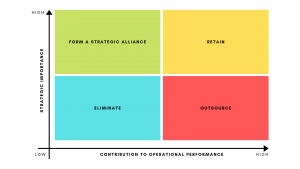
- Strategic Alliance: Outsource to a trusted partner for strategically important tasks but operationally less important
- Retain: Do in-house for a strategically important task and operationally very important
- Eliminate: Try to remove these from the process if strategically not important and operationally less important
- Outsource: Outsource when it is strategically not important but operationally very important.
How to Maximize Value from Outsourcing
There are 4 main steps that will help you maximize the value from outsourcing: Initiation, Planning, Agreement, and Execution.
- Initiation: Make sure you are clear of the purpose of outsourcing. Know how wide is the scope of the outsourced function. What are the outcomes that you want to achieve from outsourcing and the pricing strategy?
- Planning: Where to get resources? How will it fit your schedules? What are the budgets your company is willing to spend and prepare procedures before outsourcing?
- Agreement: Look out for things that can be negotiated between you and the other party. Amend to avoid mistakes in the contract.
- Execution: This includes taking care of logistics, staffing, training, when needed, and monitoring.
Success Factors
Outsourcing can be very beneficial for businesses when it is initiated, planned, agreed and executed well. To end this article, here is a list of the success factors that might contribute to the outcome of your outsourcing:
- Goals and objectives
- Strategic vision and plan
- The right vector
- Comprehensive and transparent agreement
- Open communication with people affected
- Senior-level involvement and support
- Focus on economies
The content in this is article is an extract of Rajat Gupta's conference in Accounting and Finance Show 2019 held in Suntec Conventional Centre on the 8th-9th of October 2019.

Psst... You may also be interested in: When Should You Get a Business Loan?
This blog is for general information only and does not constitute financial, legal, tax, or professional advice. Aspire’s services are subject to the terms outlined in our 'Terms of Service' and 'Pricing' pages. We make no guarantees as to the accuracy, completeness, or timeliness of the content, and past results do not indicate future performance. Always consult a qualified professional before acting on any information provided.
Zachary Pestana
Writer
Zachary is a seasoned writer in market trends and business thought leadership. With a writing history at Incorp Global, MOQdigital, and AIESEC Australia, Zachary leverages his broad range of experiences to stimulate industry conversations and engage audiences.
Aspire Launchpad
Supercharge your finance operations with Aspire
Find out how Aspire can help you speed up your end-to-end finance processes from payments to expense management.

Latest articles

Product Updates
Aspire release notes (September 2026): Aspire MCP and more
Connect Aspire to Claude, ChatGPT and Cursor with Aspire MCP, plus new launches in Hong Kong and Singapore and the latest in Agentic ERP.

E-commerce •
E-commerce fulfilment in Singapore: Complete guide for businesses
Learn how e-commerce fulfilment works in Singapore, from warehousing and order processing to delivery, costs, and choosing the right fulfilment partner.

E-commerce •
3PL for ecommerce warehousing in Singapore
Learn how 3PL warehousing works for e-commerce businesses in Singapore, its benefits, how it works and how to choose the right provider.
Start your journey with Aspire
Open your free account