




What is Go-to-Market (GTM)?
Go-to-Market (GTM, "Entering the Market") generally refers to the strategy designed by an enterprise to launch a new product or service into the market. This entire process requires the formulation of target customers, product/service value propositions, sales and marketing channels, and the logistics of delivering the product to the customer.
For example: A B2B SaaS company established in Hong Kong wants to sell its subscription-based platform to corporate clients in Singapore and the United Kingdom. It needs to decide whether to adopt a pure online self-service registration model, find local channel partners, or use a combination of online trial functions and an internal sales team. At the same time, it must plan for multi-currency collection in USD, EUR, CNY, or HKD, determine how to handle exchange rates and taxes, and establish how after-sales support will operate across different time zones.
For Hong Kong enterprises intended on global expansion, GTM is not a one-time promotional activity but a framework that covers product positioning, pricing models, and payment and settlement processes.
What are the Types of Go-to-Market?
Go-to-Market can be divided into several major types based on product nature, target audience, and sales models, including: Direct Sales GTM, Channel GTM, Product-Led Growth (PLG) GTM, and Hybrid GTM.
Direct Sales GTM
Direct Sales GTM is common in B2B services. For example, a Hong Kong consulting firm targeting Southeast Asian clients may use online demos, webinars, and a business development team to directly contact corporate decision-makers. The advantages are consistent messaging and higher gross margins, but it requires clear processes for collection, invoicing, and cross-border remittances to prevent long sales cycles from affecting cash flow.
Channel GTM
Channel GTM involves bringing products into a new market through agents, distributors, or platform partnerships; this is often seen in physical products and cross-border e-commerce brands. Local distributors are responsible for warehousing and retail networks, while the Hong Kong company focuses on branding and supply chain management. This model allows for rapid expansion but requires early planning for credit risk management of distribution partners; otherwise, it is easy to encounter issues such as excessively long accounts receivable periods and exchange rate fluctuations eroding profits.
Product-Led Growth GTM (PLG)
In recent years, more and more Hong Kong SaaS or digital products have adopted Product-Led Growth (PLG). This involves opening up the product experience first through free trials, freemium models, or low-threshold monthly fees, allowing users to decide to pay and actively recommend the product to others while solving their problems. This model relies heavily on online payments and automated collections. Enterprises need the ability to accept international credit cards and digital wallets, as well as cost-effective settlement between currencies such as HKD, USD, EUR, and CNY.
Hybrid GTM
Many Hong Kong companies eventually adopt a Hybrid GTM, using direct sales in some markets while testing the waters through Channel GTM or online platforms in other regions. They adjust pricing and collection arrangements according to different markets to balance growth speed and cost control.
When Do You Need to Formulate a Go-to-Market Strategy?
Hong Kong enterprises planning to bring new or existing products into a "new market" should formulate a clear Go-to-Market strategy before committing significant advertising or sales resources.
- Entering a "New Market": This could be a brand-new country or region, such as expanding from Hong Kong to Japan or Europe; it could also be a new customer segmentation model, such as shifting from serving large enterprises to SMEs, or from offline customers to online subscription customers.
- Obtaining Investment, Government Subsidies, or Loans: When there is a need to reach user or turnover targets within a specified time, it is difficult to account for the use of funds to investors or lenders without a data-supported GTM plan.
- Adjusting Business Models: When an enterprise plans to adjust fees—for example, changing from one-time charges to a subscription model, adding new cross-border payment methods, or performing a rebrand—it is recommended to review the Go-to-Market strategy to ensure the new positioning and price align with the target audience and sales channels.
What Are The Purposes of Formulating a Go-to-Market Strategy
If a Hong Kong company is preparing to go overseas or undergo a transformation, a complete Go-to-Market strategy can help management integrate decisions originally scattered across product, marketing, sales, and finance departments into a single plan with a timetable and quantifiable indicators. This helps the team maintain a consistent direction during execution.
On the other hand, GTM is also a risk management tool. It encourages enterprises to think ahead about factors such as the market competitive landscape, sales cycles, cash flow pressure, and exchange rate risks before deploying resources. this avoids discovering too late that costs are too high or funds are stranded in a certain market, which would affect overall operational flexibility.
How to Formulate a GTM Strategy: 7 Practical Steps and Case Analysis
Hong Kong enterprises must start from "solving market pain points" rather than simply stacking product features when formulating a Go-to-Market (GTM) strategy. Below are the detailed steps for building an efficient GTM solution:
1. Market Positioning and Customer Segmentation (Market Segmentation)
- Core: Identify the "core users" who need your product most.
- Practical Case: When a Hong Kong SaaS accounting software expands to Singapore, it should not face "all enterprises," but should be subdivided into "startups with 5-20 people and cross-border trade needs," as this customer group has the strongest demand for automated exchange rate reconciliation.
2. Competitive Environment and Alternative Solution Analysis (Competitive Analysis)
- Core: Analyze the strengths of opponents and find the "compromise solutions" customers are currently using.
- Practical Case: A cross-border e-commerce logistics company finds that although competitors have low prices, their logistics tracking is slow. Their GTM should emphasize "transparent real-time tracking," targeting sellers of goods that are sensitive to logistics timing.
3. Core Product Value (Value Proposition)
- Core: Transform features into substantive benefits for the customer.
- Practical Case: Instead of saying "We support 20 currencies," say "Process global supplier payments with one click, save 3% on exchange rate spreads, and say goodbye to traditional bank telegraphic transfers."
4. Pricing Strategy and Sales Channel Layout (Pricing & Distribution)
- Core: Decide "where to sell" and "how to collect money" based on customer habits.
- Practical Case: If an online education platform targets B2B corporate clients, it should adopt an "annual subscription system" and conduct market development through LinkedIn; if it targets B2C individual users, it should adopt "pay-per-course" and use Instagram/Facebook as the primary channels.
5. Planning End-to-End Operational Processes
- Core: Design the complete journey from the customer seeing an advertisement to completing the purchase, and then to after-sales service.
- Practical Case: Ensure that after a user clicks "Free Trial" on the webpage, they receive a welcome email within 5 seconds, and the backend can automatically generate an invoice to reduce the friction of manual operations.
6. Deploying Operational Financial Infrastructure
- Core: Choose tools that can support multinational business to reduce operating costs.
- Practical Case: Use an Aspire business account to open multi-currency virtual cards in advance specifically to pay for Google/Meta advertising fees to lock in low exchange rates, and set team spending limits to ensure cash flow is transparent and controllable during GTM execution.
7. Establishing a Data-Driven Review Mechanism (Iterative Feedback)
- Core: Set KPIs and fine-tune regularly to avoid investing too many resources in the wrong direction.
- Practical Case: Review "Customer Acquisition Cost (CAC)" and "Customer Lifetime Value (LTV)" weekly. If it is found that the ad conversion rate is high but the retention rate is low, the product onboarding process should be adjusted immediately rather than continuing to increase advertising investment.
What is the Difference Between Go-to-Market Strategy and Marketing Strategy?
Go-to-Market strategies and marketing strategies appear similar, but the former is more of a "total blueprint for a product entering the market," covering customer selection, pricing, sales models, collection, and service processes. The latter focuses on long-term brand building and customer relationship management and is a continuous marketing plan. Although the two are interrelated, their functions and timing differ. If only marketing is done without a complete GTM, it is easy for advertisements to bring traffic that is difficult to convert into sustainable income.
The table below compares the differences between Go-to-Market strategy and marketing strategy:
[Table:1]
How Aspire Helps Hong Kong SMEs Execute GTM Strategies
When executing a Go-to-Market (GTM) strategy, the efficiency of financial operations often determines the speed of market entry. Hong Kong SMEs often face challenges such as cumbersome multi-currency collection, delayed payments to overseas suppliers, and chaotic cross-market expenses when expanding across borders. If these financial links are handled poorly, they will directly become obstacles to product implementation.
How Aspire Accelerates Your GTM Plan:
- Improving the Payment Collection Flow: Through Aspire's multi-currency business account, enterprises can directly collect payments in local currencies such as HKD, USD, and CNY. This not only meets the payment preferences of customers but also effectively avoids exchange rate losses caused by passive currency conversion, protecting the gross profit margin of core products.
- Accelerating Cross-border Supply Chain Cooperation: Support for cross-border payments in over 40 currencies helps enterprises instantly pay overseas suppliers, advertising service providers, or distribution channels when entering a new market, saving the long wait and high handling fees of traditional bank telegraphic transfers.
- Precisely Controlling Cross-market Operations: When GTM enters the execution stage, Aspire's virtual cards and expense management system can help enterprises monitor marketing and team expenses in various markets in real-time. Transparent cash flow management allows enterprises to quickly adjust GTM budget allocations based on data, ensuring that resources are invested in the channels with the greatest growth potential.
Aspire: Beyond Traditional Company Accounts
Aspire provides a one-stop solution for Hong Kong enterprises, perfectly integrating global transfers, expense management, and accounting automation into a single platform. With just one Aspire business account, you can fully control your corporate finances:
- Global Payment: Fully digital account opening with approval as fast as the same day. Supports 130+ countries and 40+ currencies, with FX spreads as low as 0.18% (costs are up to 3x lower than banks).
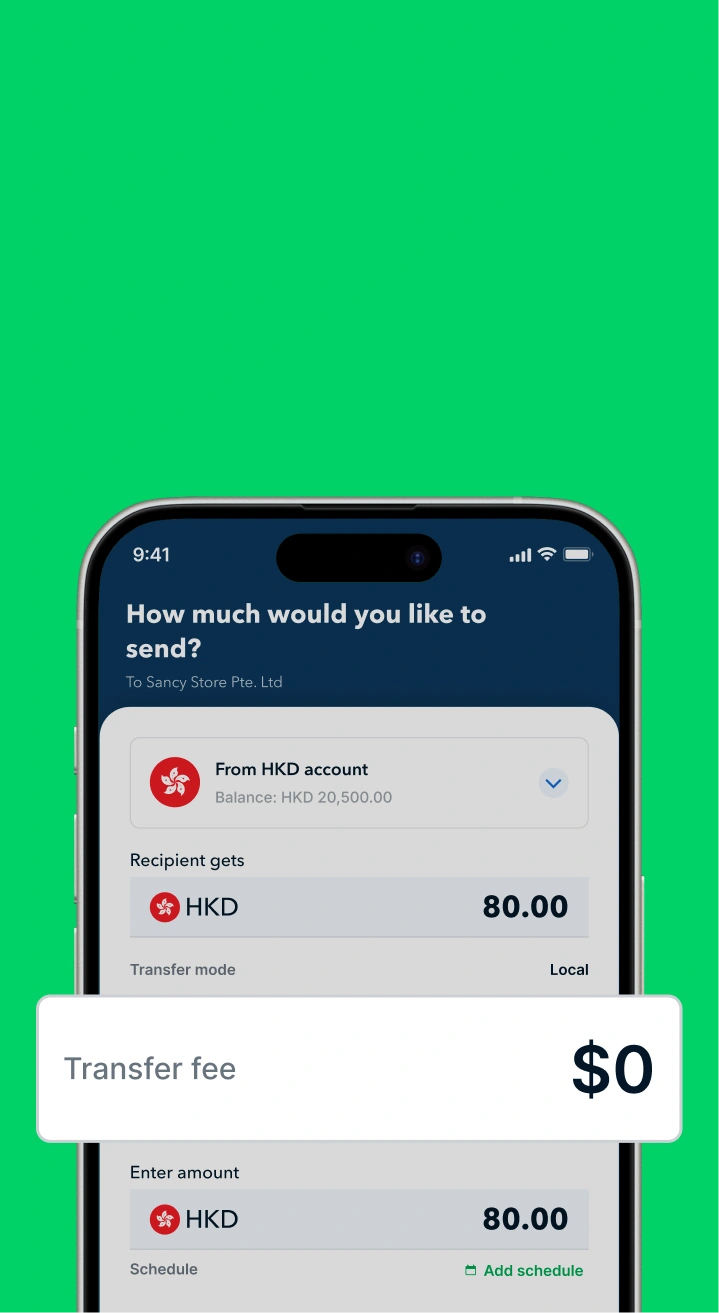
- Transfer Network: In addition to built-in FPS (Free) and CHATS to ensure local payments and payroll arrive on time, Aspire features a powerful local transfer network—allowing you to directly receive and send money overseas like a local. Compared to traditional SWIFT wire transfers, local transfers eliminate layers of intermediary bank fees and significantly shorten arrival times, helping you save on transfer expenses at the source.
- Spending Control: From Invoicing to paying Bills, the process is fully automated. You can instantly issue controllable corporate cards and pair them with "snap-and-claim" features to automatically categorize employee expenses. All transaction data syncs seamlessly with Xero, QuickBooks, and NetSuite, solving all administrative pain points from payroll to reconciliation on one platform.
- Operational Rewards: Turn your spending into returns! Earn 1.2% unlimited cashback on major business expenses, e.g. marketing and SaaS subscriptions. Your account also comes with over USD 500,000 in business rewards, covering tools like Google Workspace and Slack, rebating your operating costs from the start.
Open an account for free now to experience a smarter, more flexible business financial solution and accelerate your business growth!

.jpeg)




.webp)