



What is CNAPS (China National Advanced Payment System)?
CNAPS is an RMB payment and clearing infrastructure built by the People's Bank of China (PBOC). It is used to handle high-value and low-value fund transfers, check settlements, and other payment businesses between banks within Mainland China. Through a centralized clearing model, the system unifies transactions between commercial banks and the PBOC on a single platform, thereby enhancing national payment efficiency and security. It also laid the technical and operational foundation for the later Cross-Border Interbank Payment System (CIPS).
How does CNAPS work and what are its functions?
CNAPS consists of two application systems: the High-Value Payment System (HVPS) and the Bulk Electronic Payment System (BEPS). It provides real-time or batch RMB clearing and final settlement for Mainland banks, supporting various banking businesses.
For example, when a Hong Kong SME pays a supplier in Shenzhen for goods, if the enterprise issues an RMB cross-border wire transfer through a Hong Kong bank, it often connects to CNAPS via a clearing bank. CNAPS then transfers the funds to the designated branch account of the receiving bank according to the recipient's CNAPS Code, completing the final arrival of funds. Therefore, the accuracy of the remittance information directly affects the time of receipt.
CNAPS-HVPS (High-Value Payment System)
CNAPS-HVPS is a sub-system specifically designed for large-value RMB payments. It efficiently processes high-value credit businesses between enterprises and financial markets while remaining compatible with urgent small-value payment needs. The characteristics of HVPS are real-time, transaction-by-transaction, and full-amount settlement. Large payments issued by enterprises before the cut-off time can generally arrive in real-time on the same day. Thus, for China-Hong Kong transactions involving large RMB clearing, HVPS is a vital system for ensuring fund security and punctuality.
CNAPS-BEPS (Bulk Electronic Payment System)
CNAPS-BEPS focuses on processing daily payments that involve smaller amounts but a high volume of transactions, such as salary payments and retail payments. It primarily provides intermittent payment services for enterprises and individuals. The system typically receives payment instructions 24/7 and then performs batch clearing at preset times. It is very suitable for Mainland enterprises to send money to multiple suppliers or employees. However, in transactions between Hong Kong companies and Mainland partners, if the counterparty uses BEPS to receive domestic payments, Hong Kong enterprises need to reserve more processing time when arranging RMB cross-border remittances to avoid affecting the other party's capital turnover.
What is CIPS (Cross-Border Interbank Payment System)?
After understanding CNAPS, what is CIPS? The full Chinese name of CIPS is the RMB Cross-Border Interbank Payment System. It is a wholesale payment system approved by the People's Bank of China specifically to handle cross-border RMB clearing. It provides RMB cross-border payment and settlement services for domestic and overseas banks and financial institutions, as well as the delivery of information for letters of credit, collections, and guarantees. CIPS helps enhance the efficiency of cross-border RMB payments, reduces costs, and supports the use of RMB in international trade and investment, further promoting RMB internationalization while maintaining interconnection with CNAPS to form a domestic and international RMB payment network.
How does CIPS work and what are its functions?
CIPS adopts a dual-track operation model of the "Clearing Bank Model" and "Agent Bank Model," supporting direct access for domestic and overseas banks or indirect participation via clearing and agent banks. All cross-border RMB payment instructions complete message processing and clearing within CIPS, and through seamless docking with systems like CNAPS, ensure precise arrival of funds.
For example, when a Hong Kong trading company receives an RMB payment for goods from a Shanghai customer, if the sending bank is a CIPS participant, the cross-border remittance can be processed via CIPS direct-through processing (STP). With its extended operating hours of "5×24 hours + 4 hours," enterprises can ensure fund settlement is completed on the same day. This efficient mechanism not only breaks the limitations of regional time zones but also fully covers the operational needs of the global financial market, providing strong support for the RMB business of global users.
What are the differences between CNAPS and CIPS?
For Hong Kong companies, both CNAPS and CIPS are related to RMB payments, but their functional positioning is different: the former primarily serves domestic RMB payment clearing within Mainland China, while the latter focuses on cross-border RMB clearing. The two are both independent and interconnected. When performing cross-border remittances, enterprises often encounter codes such as the CNAPS Code and CIPS Code. Therefore, clarifying the differences between CNAPS and CIPS helps in accurately filling out remittance instructions and reducing delays caused by information errors.
[Table:1]
What is a CNAPS Code?
The CNAPS Code, also known as the "CNAPS Number" or "China Bank Joint Line Number," is a set of 12-digit identification codes assigned by the PBOC to every bank branch participating in CNAPS, used to identify banks and their branches. Just like the SWIFT system everyone is familiar with, every participating bank has a SWIFT Code. The structure of a CNAPS Code is generally "3-digit Bank Code + 4-digit Area Code + 4-digit Branch Sequence Number + 1-digit Check Code." For example, "104" usually represents Bank of China. Therefore, a "Bank of China CNAPS Code" will start with "104," combined with different area and branch codes to form the complete 12-digit number. Similarly, a "China Construction Bank CNAPS Code" will start with the bank category code representing CCB, and then be coded according to the city and sub-branch. When filling out cross-border RMB remittance instructions, if enterprises can confirm the correct CNAPS Code with the recipient in advance, it can significantly reduce the risk of needing amendments or returns due to incorrect line numbers.
How to query a CNAPS Code?
Common methods include:
- Bank Tools: Use the official online banking of the receiving bank or a specialized CNAPS query tool to search using the bank name, province/city, and branch information. Some banks like Bank of China and Zheshang Bank provide online CNAPS query pages.
- Customer Service: Directly call the receiving bank's customer service or branch to inquire about the correct line number based on the account opening information provided by the recipient.
How does Aspire help HK SMEs handle Mainland cross-border remittances?
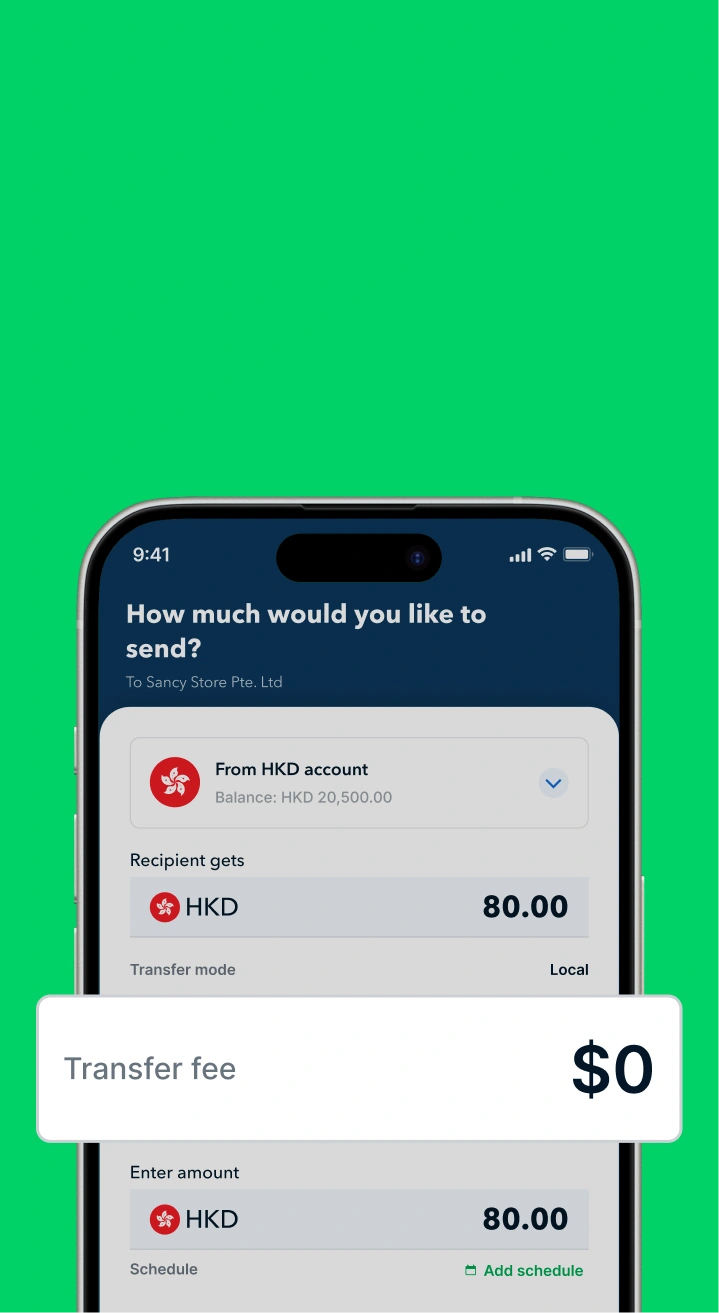
For Hong Kong SMEs pursuing operational efficiency, the speed and cost of capital turnover are competitive advantages. By seamlessly connecting to CNAPS (China National Advanced Payment System), Aspire breaks the traditional SWIFT transfer waiting period of several days, compressing cross-border settlement to arrive within 2-4 hours. This service allows you to initiate RMB remittances directly from your Aspire Multi-currency Account to Mainland suppliers at a transparent rate as low as 0.1%, just like a "domestic local transfer."
We not only provide a flexible limit of up to 350,000 RMB per transaction but also ensure that every transaction meets strict regulatory compliance requirements, helping you maintain stable supply chain operations while achieving more transparent and efficient real-time financial reconciliation.

.jpeg)




.webp)