



What Is MT202?
MT202 (General Financial Institution Transfer) is a standardised SWIFT message used exclusively for bank-to-bank fund transfers within the SWIFT network. Critically, both the sender and receiver of an MT202 are financial institutions — no corporate clients or individuals appear anywhere in the message.
To understand why, it helps to know how SWIFT message numbering works. The first digit of a SWIFT message type denotes its category:
- MT1xx series — Customer payment messages (instructions from you to your bank to transfer funds to a third party)
- MT2xx series — Financial institution transfer messages (bank-to-bank liquidity movements)
MT202 belongs to the MT2xx series. By design, it has nothing to do with customers. It is purely the mechanism by which banks move funds between themselves behind the scenes — which is exactly why it cannot serve as payment proof for your supplier or auditor.
The most common context in which MT202 appears is the cover payment — a payment structure in which the bank simultaneously sends two separate messages: an MT103 to notify the receiving bank of the transaction details, and an MT202 to instruct the correspondent bank to actually move the funds. This is why your supplier occasionally receives two documents for a single payment. For a broader overview of how international payments work for Hong Kong businesses, our dedicated guide covers the full landscape.
How MT202 Works: Serial Payment vs Cover Payment
Understanding MT202 properly requires understanding the two fundamental structures used for cross-border wire transfers.
Serial Payment (Direct Transfer)
In a serial payment, the sending bank issues a single MT103 message that travels along the correspondent banking chain step by step. Both the payment information and the funds travel the same route. This approach is transparent — every bank in the chain can see the full transaction details — but each intermediary bank along the route may deduct its own handling fee, reducing the amount that ultimately arrives with the beneficiary.
Cover Payment
A cover payment splits information and funds into two parallel paths:
- The MT103 goes directly to the beneficiary's bank, carrying the full transaction details (payer name, beneficiary account, amount, and payment reference)
- The MT202 goes to the sending bank's correspondent bank, carrying only the instruction to move the actual funds
The key advantage is that the funds bypass the per-bank fee deductions common in serial payment chains, increasing the likelihood of full-amount delivery. The trade-off is a more complex settlement process — and the occasional mismatch in timing between when the MT103 arrives and when the funds actually clear.
Nostro and Vostro Accounts: The Mechanism Behind MT202
To fully understand how MT202 moves money, you need to understand correspondent banking — and two terms that are central to it.
Nostro account (from the Latin for "ours"): An account that Bank A holds at a foreign bank. For example, a Hong Kong bank's USD account held at a New York correspondent bank is a Nostro account from the Hong Kong bank's perspective. This allows the Hong Kong bank to hold and transfer USD without needing direct access to the US Federal Reserve system.
Vostro account (from the Latin for "yours"): The same account, viewed from the other side. The New York bank refers to that same account as a Vostro account — it is the foreign bank's account held with them.
The MT202 is the instruction that triggers movement between these accounts. When a sending bank issues an MT202, it is telling its correspondent: "Debit our Nostro account held with you and transfer the funds to the beneficiary bank's correspondent." This correspondent banking infrastructure is what makes cross-border payments possible across currencies and jurisdictions where banks have no direct relationship.
MT202 Step-by-Step: A Practical Example
Here is how a cover payment works in practice. Hong Kong Bank A needs to send USD 1,000,000 to a client of UK Bank C. The two banks have no direct account relationship, so New York Bank B acts as the intermediary.
Step 1: Bank A sends MT103 to Bank C. This message contains the full transaction details — payer name, beneficiary account number, USD 1,000,000, and payment reference. Bank C now "knows" the funds are coming, but the money has not yet moved.
Step 2: Bank A simultaneously sends MT202 to New York Bank B. The instruction reads, in effect: "Debit USD 1,000,000 from our Nostro account held with you and transfer to UK Bank C's US correspondent." The MT202 contains no customer names — only bank codes and the settlement amount.
Step 3: Bank B executes the fund transfer. Bank B debits Bank A's Nostro account and routes the funds to Bank C's US correspondent via Fedwire or CHIPS.
Step 4: Bank C credits the beneficiary. Once Bank C's US correspondent confirms receipt, Bank C credits its customer's account in line with the MT103 instructions.
Throughout this process, the MT103 and MT202 travel independently and in parallel. This is precisely why your supplier may receive the MT103 notification — confirming the payment details — while the funds are still in transit along the MT202 path. The two messages move on different rails.
MT202 Field Structure
MT202 is deliberately lean. It contains no customer information whatsoever — a design choice that reflects its purpose as a pure interbank liquidity tool.
[Table:1]
Compared to MT103, the MT202 has no Tag 50 (payer information), no Tag 59 (beneficiary information), and no Tag 70 (payment reference or invoice details). This is intentional — and it is the definitive reason why an MT202 can never be used as proof of payment to a specific supplier for a specific invoice.
What Is MT202 COV?
MT202 COV is the compliance-enhanced version of MT202, where "COV" stands for "Cover." SWIFT introduced it in November 2009 in direct response to a significant AML vulnerability that had been identified in traditional cover payment flows.
The Problem with Traditional MT202
Before MT202 COV, the cover payment structure had a fundamental flaw: correspondent banks had no visibility into the underlying customer details of the transactions they were facilitating. The MT103 went directly to the beneficiary bank with full customer information, while the MT202 went to the correspondent bank with none. The correspondent's job was simply to move the money — without knowing who was sending it, who was receiving it, or why.
This made cover payments a high-risk channel for money laundering and sanctions evasion. Funds could flow through correspondent banks in complete anonymity, bypassing AML screening and sanctions list checks at the intermediary level. Regulators globally, including the Bank for International Settlements (BIS), flagged this as a systemic compliance gap — which led to SWIFT mandating MT202 COV.
What MT202 COV Added
MT202 COV introduced a mandatory Sequence B field, requiring the sending bank to include the underlying customer details within the message itself:
- Full name, account number, and address of the ordering customer (payer)
- Full name, account number, and address of the beneficiary customer (payee)
These details must match the simultaneously-sent MT103, enabling correspondent banks to perform AML checks and sanctions screening against the actual parties to the transaction — not just the bank codes.
Compliance Responsibilities Under MT202 COV
The introduction of MT202 COV also clarified the compliance obligations of each party in the chain:
Sending bank must include complete payer information, comply with KYC requirements, and use MT202 COV (not the original MT202) for all cover payment transactions involving customer funds.
Correspondent bank must implement automated monitoring to verify that payer and beneficiary fields are populated. If fields are blank or nonsensical, the bank must reject the transaction, request the missing information from the originating bank, or file a suspicious transaction report with the relevant regulator.
Receiving bank must identify and verify the beneficiary, and must have risk management procedures for correspondent banks that repeatedly submit insufficient payer information — up to and including terminating the correspondent relationship.
For SMEs, the practical implication is this: MT202 COV compliance is one reason why large cross-border transfers sometimes get held up at the correspondent bank level, even after your bank has confirmed the payment was sent. Understanding foreign exchange risk and international payment delays is increasingly important for any business doing regular overseas transactions.
MT202 vs MT103: 4 Key Differences
This is the comparison most SME founders actually need. Here is the clearest way to understand the four critical distinctions:
1. Who It Is Between
MT103 is a customer payment message — at least one party (payer or payee) is a non-financial institution, i.e. a person or a company. MT202 is a financial institution transfer — both parties are banks. Your company never appears in an MT202.
2. What Information It Contains
MT103 includes the payer's full name, address, and account number; the beneficiary's full name, account number, and bank; and a payment reference (invoice number, order reference, etc.). These are the building blocks of a commercial payment record. MT202 contains only bank BIC codes, the settlement amount, and a value date. No customer names, no invoice references, no payment purpose.
3. Its Value as Proof of Payment
MT103 is the internationally recognised standard for payment confirmation. Suppliers, tax authorities, and auditors all accept an MT103 copy as evidence that funds were remitted from your company for a specific transaction. An MT202, even one showing the correct amount, cannot prove you paid a specific supplier for a specific invoice — because your company's name simply does not appear in the document. This is the most consequential practical difference for SMEs.
4. ISO 20022 Successor Format
Following SWIFT's full transition to ISO 20022 on 22 November 2025, MT103 is now replaced by pacs.008 and MT202 / MT202 COV is replaced by pacs.009. The functional scope of each message type remains identical — only the format has changed, from fixed-length legacy MT format to structured XML.
[Table:2]
For a step-by-step guide on how to actually execute a SWIFT payment as a business, see our complete guide to making SWIFT payments.
ISO 20022: How pacs.009 Replaces MT202
ISO 20022 is the international messaging standard developed by the International Organization for Standardization (ISO) for financial industry communications. It uses XML format, enabling far richer and more structured data than the traditional fixed-length SWIFT MT format. As of 22 November 2025, SWIFT has officially replaced traditional MT messages with ISO 20022 on its FINplus service.
Under this transition, both MT202 and MT202 COV are superseded by pacs.009 (Financial Institution Credit Transfer). The functional purpose is identical to MT202 / MT202 COV, but three technical improvements make it significantly more robust:
Improvement 1: Structured Address Fields Eliminate Data Truncation
The legacy MT202 format imposed strict field-length limits. When bank names or addresses exceeded those limits, systems would automatically truncate the data — leading to incomplete information during compliance reviews, causing wire transfer delays or returned payments. pacs.009 uses XML to split address data into discrete fields (street name, city, postal code, country code), eliminating truncation at the source and enabling cleaner data exchange between banks.
Improvement 2: Enhanced AML and Sanctions Screening Accuracy
XML's structured data allows banks' AML systems and sanctions screening tools to scan by field rather than searching unstructured character strings. This dramatically reduces false positive rates — meaning fewer legitimate large transfers get frozen due to screening system errors — improving overall payment reliability for businesses conducting regular international transactions.
Improvement 3: Full UETR End-to-End Tracking
pacs.009 fully integrates the UETR (Unique End-to-End Transaction Reference) tracking mechanism. Every transaction carries a 36-character unique identifier that can be tracked in real time across the SWIFT GPI network. For SME founders chasing delayed payments, this means you can pinpoint exactly where in the correspondent chain your funds are sitting — without needing to call your bank and wait on hold.
Financial institutions that have not yet completed their ISO 20022 migration can temporarily use SWIFT's MT-to-MX format conversion service, but the long-term direction is clear: all institutions will be required to adopt the new format.
3 Practical Implications for Hong Kong SMEs
1. MT103 Has Arrived — But Funds Have Not. What Now?
In a cover payment structure, the MT103 and MT202 travel independently. The beneficiary bank receives the MT103 notification and knows payment is coming — but will not credit the account until the MT202 funds actually clear through the correspondent banking chain. If the MT202 is held up at the correspondent level for AML screening, sanctions checks, or KYC verification, the delay can range from a few hours to several business days.
The most direct way to resolve this: ask your sending bank for the UETR code from the MT103, then use SWIFT GPI to track exactly which step in the chain is causing the hold. If the delay exceeds the normal expected bank transfer timeframe, request that your bank issue a formal enquiry message to the correspondent.
2. MT202 Cannot Be Used as Proof of Payment Ever
This is the most common misconception among SME founders and finance teams. An MT202 contains only bank codes and a settlement amount. It does not include your company name, your supplier's name, the invoice number, or any payment reference. Even if the dollar amount matches your invoice exactly, neither your supplier, your auditor, nor the tax authorities can confirm from an MT202 that your company paid that specific invoice.
For valid commercial payment proof, you must provide an MT103 copy (or a pacs.008 document for payments made after November 2025). MT103 contains the complete information that makes it a legally meaningful record of a commercial transaction. For context on how different banks in Hong Kong handle this, see our guides on HSBC wire transfers and Citibank wire transfers.
3. How to Obtain MT103 Payment Proof
Most major Hong Kong banks allow corporate internet banking users to download a PDF payment confirmation — which includes MT103 content — once the transfer status shows as "Completed." If you need the full message including the UETR reference code, contact your corporate banking team directly; some banks charge a small administrative fee for this.
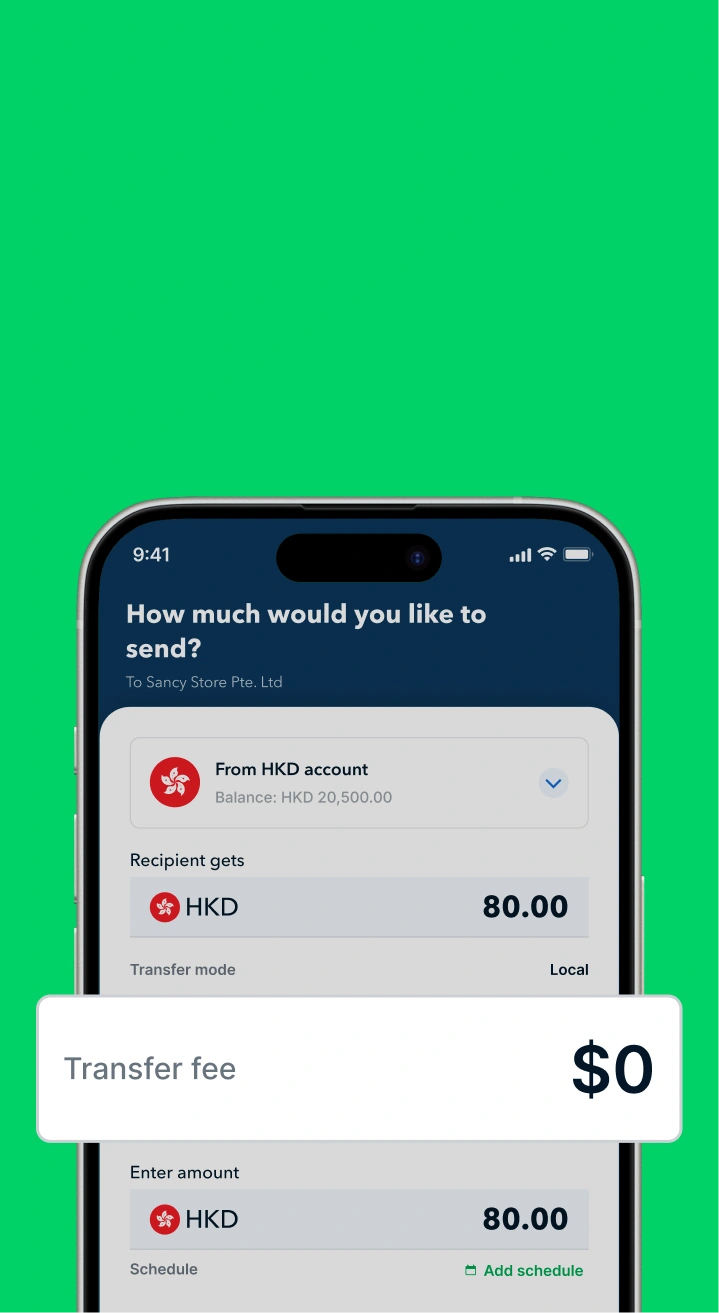
If you send SWIFT payments through Aspire, the process is significantly simpler. Once the transaction shows as completed in the app, you can download your payment confirmation instantly and for free — no phone calls, no waiting, no admin fees. Everything is handled within the platform.
Aspire: Stop Chasing Banks. Start Moving Money on Your Terms
Every time a cross-border payment gets delayed, frozen, or sent without proper documentation, it costs your business time, money, and relationships. Aspire is built to eliminate exactly these pain points — giving Hong Kong SMEs the international payment infrastructure that traditional banks charge a premium for and still deliver poorly.
Here is what that looks like in practice:
Aspire is built to eliminate exactly these friction points for Hong Kong SMEs.
- Global reach, local simplicity. With Aspire multi-currency account, your business can send and receive payments across 130+ countries in 40+ currencies — with FX spreads from just 0.18%, up to 3x cheaper than a traditional bank wire. Where possible, Aspire routes transfers through local payment rails rather than multi-hop SWIFT chains, which means fewer intermediary fees, faster settlement, and less risk of funds being held at a correspondent bank for compliance review. This is particularly valuable when sending to markets like the UK, the US, or Southeast Asia, where local payment networks can significantly reduce costs and settlement times versus SWIFT.
- SWIFT transfers with instant confirmation. When SWIFT is the right rail for your payment, Aspire processes it with full SWIFT GPI tracking enabled. Once your transfer completes, you can download your payment confirmation instantly from the app — no calls to the bank, no admin fees, no waiting for an MT103 copy to be emailed over.
- Full financial control in one platform. Issue corporate cards with configurable spending limits, automate invoice and bill management, and sync every transaction with Xero or QuickBooks in real time. For Hong Kong SMEs managing payroll, free FPS and CHATS are both natively supported — ensuring domestic payments clear on time, every time.
- 1.2% unlimited cashback. Every eligible transaction on your Aspire corporate card earns 1.2% cashback. Combined with over USD 500,000 in partner rewards included with your account, Aspire turns your operating costs into working capital from day one.
If your current banking setup has ever left you chasing a delayed wire or scrambling for payment documentation, it is time to make the switch. Open your Aspire business account today — free, fully digital, and approved fast.
Frequently Asked Questions
Q: I only have the MT202 screenshot. Can I use it to prove payment to my supplier?
No. MT202 contains only bank codes and a settlement amount — it has no payer name, no beneficiary name, and no invoice reference. To prove payment to a supplier, auditor, or tax authority, you must provide the MT103 (or pacs.008 for payments after November 2025). Even if the MT202 amount matches your invoice, it is not a valid commercial payment confirmation.
Q: The beneficiary bank has received the MT103 but the funds have not landed. What should I do?
This is a common occurrence under cover payment structures. The MT202 funds path is likely still being processed through the correspondent bank's AML and compliance checks. Ask your sending bank for the MT103's UETR code and use SWIFT GPI to identify exactly where the funds are in the chain. If the delay exceeds the normal expected timeframe, request that your bank issue a formal SWIFT enquiry to the correspondent.
Q: When does a bank use MT202 versus MT202 COV?
Since November 2009, any bank using cover payment structure for a customer payment is required to use MT202 COV — not the original MT202. The original MT202 is now reserved exclusively for a bank's own internal liquidity management (such as FX settlement between its own accounts). Using traditional MT202 in a customer cover payment context is a compliance violation.



.webp)