


What is ARR? Annual recurring revenue explained

Content Team

Summary
Annual recurring revenue (ARR) measures the predictable revenue a business expects from subscriptions or recurring contracts in one year.
ARR helps businesses track growth, forecast revenue, and evaluate long-term financial stability.
The metric focuses only on recurring income and excludes one-time fees or non-subscription revenue.
ARR consists of key components such as new ARR, expansion ARR, renewal ARR, contraction ARR, churned ARR, and reactivation ARR.
Businesses calculate ARR using either the basic formula (MRR × 12) or a comprehensive formula that accounts for upgrades, downgrades, and churn.
Common ARR mistakes include including one-time revenue, ignoring churn, miscounting discounts, or including free trials.
ARR growth rate shows how quickly recurring revenue is increasing over time and helps measure business momentum.
Companies increase ARR by reducing CAC, improving retention, introducing upgrades, expanding accounts, and optimizing pricing models.
ARR is widely used for financial forecasting, valuation, performance tracking, and strategic decision-making.
Recurring revenue models are becoming more common across industries in the United States, from digital services and memberships to maintenance contracts and subscription products. The U.S. subscription economy was valued at about USD $207.7 billion and is projected to reach roughly USD $633.6 billion by 2034, reflecting strong long-term growth in recurring business models. As more companies adopt recurring revenue strategies, measuring predictable income becomes critical. This is where annual recurring revenue (ARR) plays a key role. This guide explains Annual Recurring Revenue (ARR), how to calculate it, why it matters, and how you can improve it.
What is Annual Recurring Revenue (ARR)?
Annual recurring revenue (ARR) is the total predictable revenue a business expects to generate from subscriptions or recurring contracts over a 12-month period. It includes revenue that renews automatically and excludes one-time payments, setup fees, or non-recurring services.
For businesses that rely on subscriptions, memberships, or long-term contracts, ARR provides a clear view of predictable income and long-term revenue stability.
| For example:Consider a company with 10 customers paying USD $100 per month on annual contracts.Annual revenue per customer = USD $1,200Total ARR = USD $12,000This means the business can expect USD $12,000 in recurring revenue over the next year if all customers renew. |
Why does ARR matter?
Annual recurring revenue is a core indicator of business stability, predictability, and long-term value for founders, investors, and financial teams. It matters because:
1. Revenue Predictability
ARR helps businesses understand whether their revenue comes from predictable subscriptions or irregular one-time transactions.
According to Zylo's 2025 SaaS Management Index, SaaS spend now averages USD $4,830 per employee, which is a 21.9% increase year over year. This underscores how dominant and growing the recurring software model has become.
Founders building on strong ARR foundations know what's coming in next month, next quarter, and next year. This predictability helps founders plan hiring, marketing investment, and product development more confidently.
2. Improves forecasting
Recurring revenue allows leadership teams to forecast revenue with greater confidence. When a large portion of income renews automatically, businesses can plan hiring, expansion, and product investments with clearer financial visibility.
3. Enhances investor confidence
ARR provides a standardized metric that investors use to measure traction, scalability, and market demand.
Venture-backed SaaS companies commanded a median revenue multiple of around 10x ARR in 2024. This range now settles at 6x to 8x ARR in 2025's "new normal" market, according to SaasRise and SaaS Capital.
Consistent ARR growth signals that a company’s product is gaining adoption and retaining customers over time.
4. Provides customer retention insight
Strong ARR growth is almost always a signal of strong retention underneath it. The metric that ties the two together is net revenue retention (NRR). Companies with high NRR grow 2.5 times faster than their low-NRR counterparts.
If your ARR is growing but your NRR is below 100%, you have a retention problem that new sales are temporarily masking. ARR forces you to see it.
5. Higher business valuation
Recurring revenue significantly influences how companies are valued in acquisitions and funding rounds.
According to Aventis Advisors, the median EV/ARR multiple for SaaS companies clusters near 6x in 2025. The typical range runs from 3x to 10x, depending on growth rate, retention, and gross margin.
Businesses with predictable ARR often command higher valuation multiples because investors view them as lower risk and easier to scale.
What are the components of ARR?
Annual recurring revenue changes as customers subscribe, upgrade, downgrade, renew, or cancel their contracts. Companies track these components separately to understand where recurring revenue growth is coming from and where revenue is being lost. The table below explains the key components of ARR and what they represent:
| ARR Component | What It Means | Example |
|---|---|---|
| New ARR | Revenue generated from new customers who start a subscription during a given period. | 5 new customers sign annual contracts worth USD $1,000 each, adding USD $5,000 in ARR. |
| Expansion ARR | Additional revenue from existing customers upgrading plans, adding features, or increasing usage. | A customer upgrades from a USD $1,200 per year plan to a USD $1,800 per year plan, adding USD $600 in expansion ARR. |
| Renewal ARR | Revenue is retained when existing customers renew their subscriptions for another billing cycle. | A customer renews a USD $2,000 annual contract, keeping that revenue in ARR. |
| Churned ARR | Revenue is lost when customers cancel their subscriptions completely. | A customer paying USD $1,500 per year cancels their contract, reducing ARR by USD $1,500. |
| Contraction ARR | Revenue is lost when customers downgrade to lower-priced plans or reduce usage. | A customer moves from a USD $1,000 per year plan to a USD $700 per year plan, reducing ARR by USD $300. |
| Reactivation ARR | Revenue is gained when previously churned customers return and subscribe again. | A former customer re-subscribes to a USD $900 annual plan, adding USD $900 back to ARR. |
How do you calculate annual recurring revenue?
Annual recurring revenue can be calculated in two ways, depending on how simple or detailed your revenue model is. They are as follows:
Method 1: The Basic ARR Formula
The basic method works well when most revenue comes from monthly subscriptions. This is the simplest way to calculate ARR when your business has steady monthly recurring revenue.
| Annual Recurring Revenue (ARR) =Monthly Recurring Revenue (MRR) × 12 |
Example:
Imagine a company has 80 customers paying USD $40 per month for a subscription plan. To estimate its annual recurring revenue, you can use the basic ARR formula.
ARR = Monthly Recurring Revenue (MRR) × 12
Step 1: Calculate monthly recurring revenue
Multiply the number of customers by the monthly subscription fee.
MRR = 80 × USD $40
MRR = USD $3,200
Step 2: Multiply MRR by 12
Now convert monthly recurring revenue into annual recurring revenue.
ARR = USD $3,200 × 12
ARR = USD $38,400
Final ARR = USD $38,400
This means the company expects USD $38,400 in recurring subscription revenue over the next year, assuming all customers stay subscribed.
The basic formula is helpful when you need a quick estimate of recurring revenue. However, it does not account for revenue changes such as upgrades, downgrades, or cancellations.
For a more detailed view of revenue movement, companies often use the comprehensive ARR formula.
Method 2: The Comprehensive ARR Formula
The comprehensive method is better when you want to account for upgrades, downgrades, and churn. ARR includes only recurring subscription revenue and excludes one-time fees and non-recurring charges.
| ARR =New ARR + Expansion ARR - Contraction ARR - Churned ARR |
Where:
- New ARR refers to recurring revenue generated from newly acquired customers.
- Expansion ARR is additional recurring revenue from existing customers through upgrades, upsells, or increased usage.
- Contraction ARR represents the decrease in revenue when customers downgrade their subscriptions or reduce the number of seats.
- Churned ARR is the recurring revenue lost when customers cancel their subscriptions entirely.
Example:
Now, imagine a company starts the year with USD $250,000 in ARR. During the year, the company gains new customers, existing customers upgrade their plans, and some customers cancel or downgrade. To calculate ARR more accurately, the comprehensive formula is used.
ARR = New ARR + Expansion ARR - Contraction ARR - Churned ARR
Step 1: Start with the current ARR
This is the recurring revenue the company already has at the start of the period.
Current ARR = USD $250,000
Step 2: Add new ARR
During the year, the company acquires 20 new customers paying USD $1,000 per year.
New ARR = 20 × USD $1,000 = USD $20,000
Step 3: Add expansion ARR
Existing customers upgrade to higher plans, generating USD $8,000 in additional recurring revenue.
Expansion ARR = USD $8,000
Step 4: Subtract contraction ARR
Some customers downgrade their subscriptions, reducing revenue by USD $3,000.
Contraction ARR = USD $3,000
Step 5: Subtract churned ARR
A few customers cancel their subscriptions entirely, resulting in USD $10,000 in lost ARR.
Churned ARR = USD $10,000
Step 6: Calculate ending ARR
Now apply the formula.
Final ARR = 250,000 + 20,000 + 8,000 − 3,000 − 10,000 = USD $265,000
This means the company finishes the year with USD $265,000 in annual recurring revenue after accounting for new customers, upgrades, downgrades, and cancellations.
Common annual recurring revenue calculation and interpretation mistakes
ARR is a simple metric in theory. In practice, small mistakes can distort your understanding of growth. If ARR is calculated incorrectly, forecasts become unreliable, and strategic decisions can suffer. Founders should treat ARR carefully and ensure it reflects only predictable, recurring revenue. Here are four common mistakes to avoid:
1. Including one-time revenue
ARR should include only revenue that repeats each year. Setup fees, onboarding charges, consulting work, and implementation services are not recurring. Including them inflates ARR and creates a misleading view of growth.
2. Ignoring discounts and promotional pricing
Customers do not always pay the full list price. Promotions, discounts, or negotiated contracts reduce the actual recurring revenue collected. ARR should always reflect the real subscription price customers pay, not the advertised price.
3. Overlooking churn and downgrades
New customers can make ARR look strong, but cancellations and downgrades reduce recurring revenue. If churned ARR or contraction ARR is ignored, companies may overestimate growth and underestimate retention issues.
4. Counting non-paying users as ARR
Free trials, pilot programs, or unpaid accounts should not be included in ARR. Only customers with active paid subscriptions contribute to recurring revenue. Counting unpaid users can artificially inflate ARR projections.
What is the ARR growth rate?
ARR growth rate measures how quickly a company’s recurring revenue increases over time. It calculates the percentage change in annual recurring revenue between two periods, usually year-over-year.
This metric helps founders and investors understand if a business is expanding its customer base, increasing revenue from existing customers, or losing recurring revenue.
| Average Growth Rate= (Current Value - Past Value) / Past Value x 100% |
What is a good ARR growth rate?
A good ARR growth rate largely depends on the company's stage and size. Early-stage businesses often grow faster because they expand from a smaller revenue base, whereas mature companies typically experience more moderate growth.
Recent industry research highlights how ARR growth benchmarks change as companies grow. According to the Benchmarkit 2025 B2B SaaS Performance Metrics Report, the median ARR growth rate declines steadily as companies move through different revenue stages.
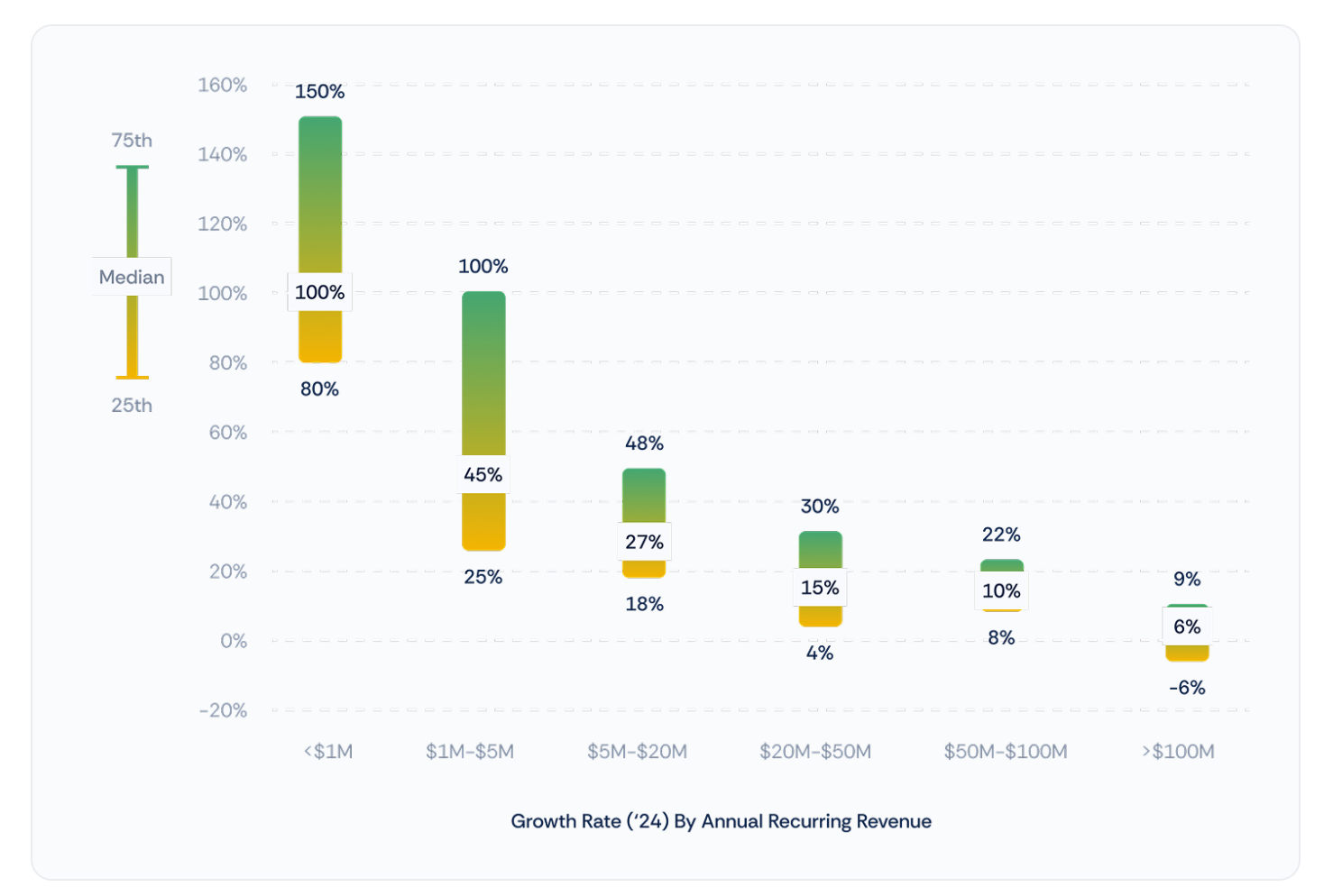
ARR benchmarks by Benchmarkit based on company stage | Source
Note: This is an SS from the competitor website. You can create your own graph like this. I have shared the link to the official report as well.
Which businesses use ARR?
The businesses that use ARR include:
- SaaS companies: Software businesses where customers pay monthly or annual subscription fees for continued access to the platform.
- Subscription platforms: Businesses such as streaming services, digital media platforms, and online tools that operate on recurring user subscriptions.
- Membership businesses: Organisations like gyms, professional associations, and online learning communities where members pay periodic fees to maintain access.
- Recurring service contracts: Businesses offering ongoing services such as IT support, maintenance, marketing retainers, or consulting agreements with fixed recurring payments.
What are the ways to increase ARR?
Increasing annual recurring revenue requires improving how a business acquires customers, retains them, and expands revenue from existing accounts. Here are ways to increase:
1. Reduce customer acquisition cost (CAC)
Customer acquisition becomes unsustainable when marketing and sales costs grow faster than subscription revenue. To improve ARR, businesses should compare recurring revenue with CAC and identify ways to improve efficiency. Optimising marketing channels, improving lead qualification, and automating parts of the sales funnel can help reduce acquisition costs and improve long-term contract value.
2. Increase retention and customer lifetime value (LTV)
Retention is one of the most reliable drivers of ARR growth. Businesses can strengthen lifetime value by improving onboarding, resolving common support issues, and delivering a better customer experience. Even small improvements in retention often compound over time and significantly increase recurring revenue.
3. Introduce upgrades that encourage engagement
Adding new features or service upgrades can motivate existing customers to increase their annual spend. This might include advanced product functionality, premium pricing tiers, or optional add-on services. Reviewing product usage data can help identify opportunities where expanded features provide clear value for customers.
4. Expand revenue from existing customers
Existing customers often represent the most efficient growth opportunity. Companies can increase ARR by offering additional seats, usage-based pricing, integrations, or complementary services. Expanding within current accounts reduces acquisition costs while increasing recurring revenue.
5. Optimise pricing and contract structures
Pricing adjustments can have a direct impact on ARR. Businesses can test tiered pricing models, introduce annual billing options, or provide incentives for longer-term contracts. Moving customers from monthly to annual plans improves revenue predictability and reduces short-term churn.
Founders often monitor ARR alongside customer churn, acquisition costs, and retention metrics. When these metrics improve together, recurring revenue becomes more sustainable and predictable over time.
What are the applications of annual recurring revenue?
Annual recurring revenue provides a clear view of predictable income and helps businesses understand long-term performance. Below are some of the key ways businesses apply ARR in practice.
1. Financial forecasting
ARR helps companies predict future revenue more accurately. Since it focuses only on recurring subscriptions and contracts, businesses can estimate how much income they are likely to generate over the next 12 months and plan budgets accordingly.
For example, if a company has USD 2 million in ARR with a 90% renewal rate, it can reasonably forecast at least USD 1.8 million in recurring revenue for the next year, even before accounting for new sales. This visibility helps founders plan hiring, marketing budgets, and product investments with greater confidence.
2. Company valuation
ARR is widely used in investor analysis and startup valuation. Investors often evaluate subscription businesses using ARR multiples because predictable revenue signals stability and long-term growth potential.
3. Performance tracking
Tracking ARR over time helps companies measure business momentum. Changes in ARR reveal whether growth is coming from new customers, upgrades, or improved retention, giving leadership teams a clearer view of overall performance.
4. Strategic decision-making
ARR data supports important strategic decisions. Companies can analyse ARR trends to refine pricing models, improve product features, or identify customer segments that generate the most recurring revenue.
5. Benchmarking and market comparison
ARR allows companies to compare their performance with other subscription-based businesses. Because it standardises recurring revenue on an annual basis, it helps investors and operators benchmark growth across companies and industries.
By analysing ARR regularly, companies gain a clearer understanding of their revenue stability, growth trajectory, and long-term business potential.
ARR Vs other metrics
Annual recurring revenue is one of the most important metrics for subscription businesses, but it does not provide the full financial picture on its own.
Companies often analyse ARR alongside other metrics to understand revenue performance, profitability, and customer economics. Each metric serves a different purpose.
Together, they help founders evaluate growth, operational efficiency, and long-term business sustainability:
Conclusion
Annual recurring revenue provides a clear view of predictable income and long-term business momentum. By focusing on recurring revenue, ARR helps companies measure growth, evaluate customer retention, and plan future investments with greater confidence.
It also gives investors a reliable benchmark for assessing scalability and financial stability. However, ARR works best when analysed alongside other metrics such as churn, customer lifetime value, and customer acquisition cost.
Together, these indicators reveal whether growth is sustainable. As recurring revenue grows, founders also need strong financial visibility to manage it effectively. As a company's recurring revenue grows, founders need a stronger financial infrastructure to manage subscriptions, payments, and expenses efficiently. Platforms like Aspire help businesses manage global payments, track spending, and maintain financial visibility, giving founders better control as ARR scales and operations expands.
Frequently Asked Questions
A good ARR growth rate depends on the company’s stage. Early-stage businesses often target 50–100% annual growth, while mature companies typically grow at 15–30%. The key benchmark is consistent growth supported by strong customer retention and sustainable unit economics.
ARR shows how much predictable revenue a business generates each year. It helps founders forecast income, evaluate growth, and plan investments. Investors also use ARR to assess scalability and financial stability because recurring revenue signals long-term business sustainability.
Businesses aim for a higher ARR because it indicates stronger recurring revenue and a growing customer base. However, ARR growth should be sustainable. Rapid growth without strong retention or healthy unit economics can create long-term financial risks.
Higher ARR means a business has more predictable revenue and stronger customer demand. It improves financial stability, supports better planning, and increases investor confidence. Companies with higher ARR often receive stronger valuations because recurring revenue signals long-term growth potential.
ARR measures the total recurring revenue a business expects over a full year, while MRR tracks recurring revenue generated each month. MRR shows short-term revenue performance, whereas ARR provides a long-term view of predictable income and overall business growth.
This blog is for general information only and does not constitute financial, legal, tax, or professional advice. Aspire’s services are subject to the terms outlined in our ’Terms of Service’ and ’Pricing’ pages. We make no guarantees as to the accuracy, completeness, or timeliness of the content, and past results do not indicate future performance. Always consult a qualified professional before acting on any information provided.
Content Team
Aspire editorial
Content team at Aspire is a society of seasoned writers & experts specialising in finance, technology and SaaS space. With 50+ years of collective experience, they help make business finance more profitable for readers. They write about finance tools, finance insights, industry trends, tactical guides to grow your business & also all things Aspire.
Aspire Launchpad
Supercharge your finance operations with Aspire
Find out how Aspire can help you speed up your end-to-end finance processes from payments to expense management.

Latest articles

Best multi-currency business accounts in the US for 2026
Compare the best multi-currency business accounts in the US for 2026. Explore fees, FX costs, currencies, holding, receiving options, and key features.

How to start an LLC in Ohio: Step-by-step guide
Starting an LLC in Ohio costs $99 and clears in two business days if expedited. The filing steps, real year-one costs, and the municipal tax to plan for.
Divvy credit card: Features, fees, eligibility
Explore Divvy credit card eligibility, fees and reward tiers, plus how its credit limits are set dynamically, and how you can boost yours.