


How to structure your team, visas, and payroll for US expansion

Aaron Oh

Summary
Your visa category, entity structure, payroll setup, and banking all shape what is possible as your team grows. Getting these right early prevents the bottlenecks that stall expansion later.
Under US immigration law, work is defined by activity, not compensation. Founders on ESTA can meet investors and attend events, but performing core operational duties without work authorisation is a violation even without pay.
The O-1, L-1, and H-1B cover the vast majority of founders and key hires entering the US. Each has different eligibility requirements, processing timelines, and implications for how and where you pay people.
Where you pay people creates a tax footprint. The EOR versus US subsidiary decision also has direct consequences for which visa types you can sponsor later, particularly the L-1.
US visa processing takes longer than most founders expect, often six months or more for candidates outside the US. Having an immigration strategy mapped before you identify the candidates is what keeps hiring on track.
At some point, ambitious founders looking to expand and build their business in the US will face the same set of questions.
Who needs to be in the US, and when? How do I pay a team that spans multiple countries and currencies? What structure gives me the flexibility to hire, raise, and grow without having to rebuild everything 6 months later?
Visa category, payroll structure, entity setup, and banking all shape what is actually possible as your team grows. Get them right early, and they run quietly in the background. If you leave them too late, they may become the bottlenecks that hurt your expansion.
A visa that does not match a role means you cannot work. If your payroll setup ignores tax residency, it creates liabilities. And, the employer of record arrangement you have seemed fine at 10 people quietly closes off the visa sponsorship route you will want at 50. Solving these issues upfront prevents the bottlenecks that stall expansion.
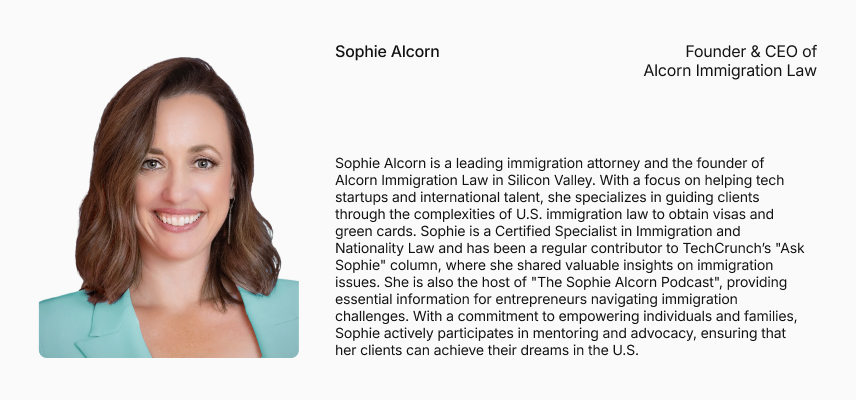
In Part II of Aspire's "Expert Webinar Series: US Expansion”, Sophie Alcorn, founder of Alcorn Immigration Law and author of TechCrunch’s Ask Sophie column, works through how these pieces fit together. This article is an extended version of that conversation, organized into a clear and practical guide for non-US founders thinking through US expansion.
Start with intent, not paperwork
Before picking a visa category, there is a more important question. What are you actually trying to do in the US, and who needs to be there to do it?
The answer shapes everything. Which visa makes sense, whether the founder needs to relocate or can operate on business visits, whether to open a subsidiary now or use an employer of record, what banking and payroll infrastructure to build, etc.
The key variables are founder location, company stage, and what Sophie calls the company's North Star. If you’re building an AI startup and targeting venture capital, the calculus is different from a profitable bootstrapped company expanding its sales footprint. If you have a co-founder already in the US versus a team entirely abroad, the paths diverge again.
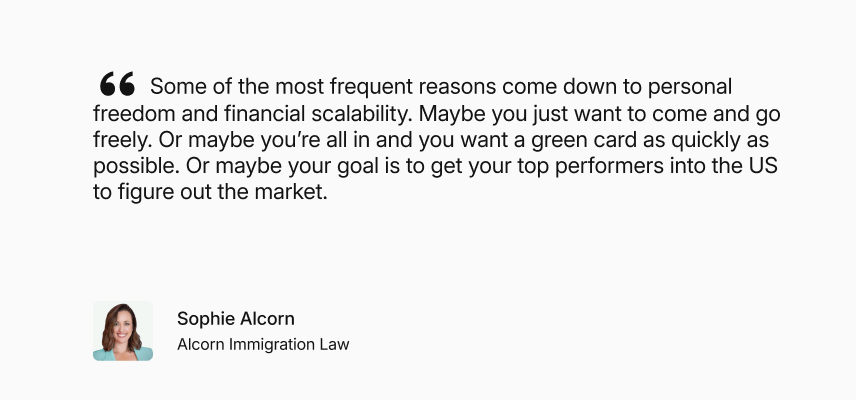
You should do the internal work before calling an immigration lawyer. Get clear on timelines, commitment level, team structure, and what success looks like in twelve months. The clearer you are, the faster and more useful that first consultation will be.
What counts as 'work' under US immigration law
Under US immigration law, work is defined by activity, not compensation. Activities that serve a business, such as managing employees, performing operational duties, and coding with the expectation of future equity. All of this can constitute work, regardless of whether or not money changes hands. An immigrant performing these activities without proper work authorization is in violation even if they have never touched US payroll.
To be precise, immigrants are not authorized to work in the US by default. Work authorization must be obtained explicitly through a visa, a green card, or specific ESTA-permitted activities.
What you can do without work authorization
| Status | Permitted activities |
|---|---|
| On ESTA or B-1/B-2 business visa |
|
If you have no work authorization, the following is not permitted, even without pay:
- Performing your core operational duties on a regular basis
- Managing employees day-to-day
- Going on US payroll
- Publicly claiming to be an operating executive based in the US
The dividing line is whether the activity is incidental to a business visit, or whether it constitutes the person’s operational role.
When does physical US presence matter
Not every company needs its founder to be physically based in the US.
For venture-backed AI startups, Sophie’s view is direct: if you want a large exit out of San Francisco, it would be the outlier rather than the norm to pull it off from abroad. Proximity to investors, talent, and the informal ecosystem still matters.

For other business models, the picture is different. A profitable company expanding its US sales footprint may not require full relocation. A founder travelling on regular business visits, combined with a small US-based team, can work. A hybrid approach such as a founder and one or two key hires in the US, with an engineering team abroad is also common and can work.
The decision also depends on what you’re willing to trade. Relocating means navigating visas, tax changes, and potential family disruption. Staying abroad means managing time zones, accepting some relationship disadvantages with US investors, and being thoughtful about which activities you can conduct on business visits.
How visa choices affect fundraising and control
In the past, founders sometimes made ownership or control concessions in their company structure to qualify for certain visa categories. This is no longer needed.
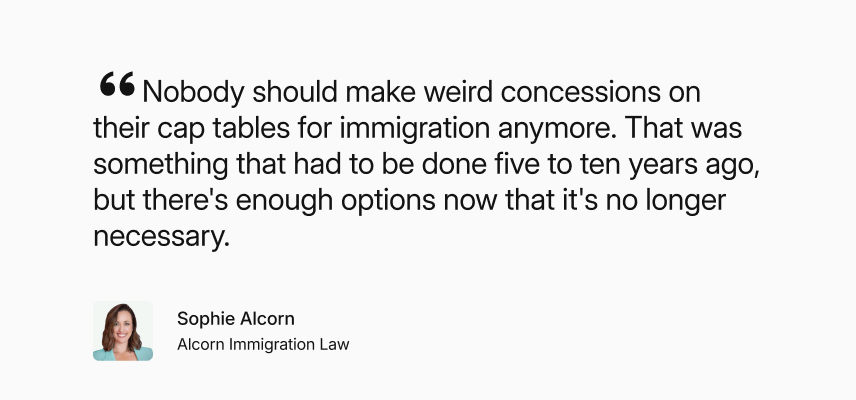
For fundraising, investor relationships are still built in person. Being abroad does not disqualify you, but it adds friction. If relocating is part of the plan, start the immigration process well ahead of when you want to be in those rooms. Lead times are long, and managing a visa application during a fundraise is avoidable with earlier planning.
The main visa pathways for founders and key hires
Three visa categories cover the vast majority of founders and key hires entering the US. Here’s how they compare:
| O-1 “Extraordinary ability” | |
|---|---|
| Who’s it for | Founders with a strong track record in tech, science, or business |
| Processing time | 2 to 4 months, (15-day premium processing available) |
| Pros |
|
| Cons |
|
* There are two options for founders who wish to stay on foreign payroll.
- Use an agent-petitioner structure in which the foreign company sponsors the O-1 and the founder remains on the foreign payroll.
- Pay yourself only for the days you’re physically in the US. Both work but they require deliberate setup.
| L-1 “Intracompany transfer” | |
|---|---|
| Who’s it for | Founders and executives expanding an existing foreign company into the US |
| Processing time | 1 to 3 months (15-day premium processing available) |
| Pros |
|
| Cons |
|
| H-1B “Specialty occupation” | |
|---|---|
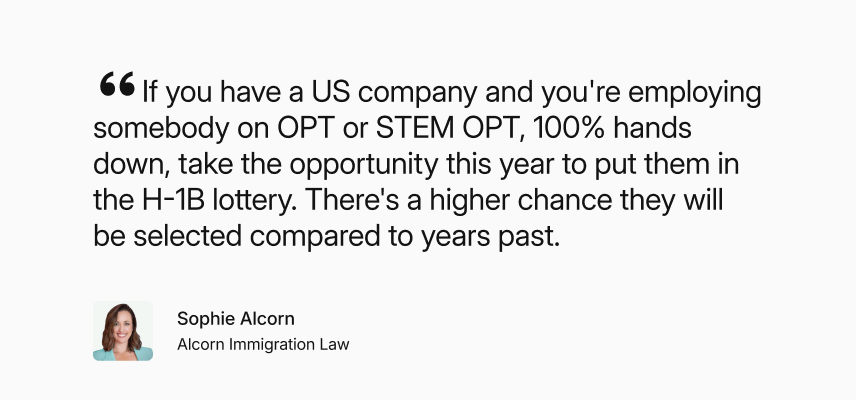
| Who’s it for | Skilled workers with at least a Bachelor’s degree. For 2026, most relevant for employees already in the US on OPT (Optional Practical Training) or STEM OPT. |
| Processing time | The H-1B lottery is held annually in March. If selected, typically 2 to 6 months for approval. (15-day premium processing available after April). |
| Pros |
|
| Cons |
|
Paying people across borders
Where you pay people creates a tax footprint. That footprint can be planned and manageable, or accidental and expensive. The difference is usually just timing.
Here are a few situations that require advance planning:
Paying yourself from a foreign entity while in the US on an O-1
If your O-1 is set up in the standard way and you are receiving payment through your Singapore, India, or UK entity, you are likely in violation of the terms of your O-1 visa. The fix is to structure the O-1 differently from the start. This also needs to be coordinated with your global mobility tax advisor, since days spent in each jurisdiction and treatment of foreign assets all affect the picture.
Paying employees and contractors across borders
Running a global team means sending money to multiple countries, in multiple currencies, to people in different legal categories. Common mistakes to avoid:
- Paying people out of a personal account (a serious red flag in due diligence)
- Using consumer FX apps for payroll
- Having no central view of who is being paid in which currency
- Misclassifying employees as contractors
A workable setup typically has one platform handling multi-currency balances, domestic payroll, international transfers, and contractor payments, with a clear audit trail on each transaction.
Employer of record vs. US subsidiary
When a company first hires in the US, there are two paths. You can either engage an employer of record (EOR) like Deel, or set up a full US subsidiary and employ people through it directly.
Starting out, it's faster and simpler to use an EOR. From an immigration perspective, most visa types work fine with an EOR structure. The significant exception is the L-1 intracompany transfer. Because the EOR is technically the employer of record, it creates real difficulty for L-1 sponsorship.
If you plan to transfer people to the US via L-1 within the next 12 to 18 months, factor that into your entity decision now. Changing structure later is possible but adds time and cost.
Banking has to be right before anything else works
A US business bank account should be easy to open. In practice, for non-US founders, it often isn’t.
Banks check residency and business activity. Having an EIN and incorporation papers is no longer enough. Here’s what they are looking for:
- Physical presence or residency in the US (virtual addresses, once widely accepted, are now a significant hurdle)
- Evidence of US business activity: customers, investors, suppliers, or other relationships demonstrating genuine activity in the jurisdiction
Without a compliant US account, investors have nowhere to wire funding, payroll providers cannot connect to your money, and vendors become difficult to pay. Banking is not the last step but the foundation to your business success.
US investors, particularly venture funds with governance documents that restrict them to investing in Delaware C corporations, will typically expect a US bank account to exist before they wire.
If you are planning a fundraise, having a US investor in your network can sometimes help unlock account opening even before full physical presence, because the investor relationship itself serves as a business activity signal.
Plan for longer than you expect
The gap between when you want someone working in the US and when they can legally do so is almost always wider than founders expect.
- Person already in the US on H-1B being transferred to your company: 4 to 6 weeks with premium processing
- Person outside the US without an existing US visa: minimum 6 months, often more
- Candidates in India: visa appointment backlogs currently run into late 2026 or 2027
- L-1 new office applications: high documentation requirements and a need to demonstrate a credible foreign operation
Plan for the gap. That means either keeping the person working remotely from their current country (ideally through a structured contractor arrangement), meeting in a third location temporarily, or planning relocations with realistic lead times built in.
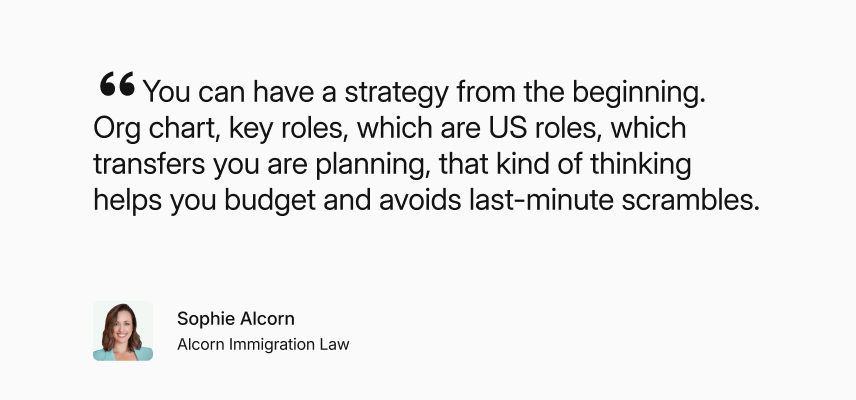
You don’t need to have identified the candidates to start the planning. You can map the structure, the roles you expect to bring to the US, realistic timelines, and budget, and then be ready to move quickly once the right people are identified.
How to maximize your first immigration consultation
The goal of an initial consultation is not to pick a visa. It is to understand your options and the trade-offs between them, so the one you choose fits the actual situation.
Sophie describes what she does in those early conversations:
- Map the situation (how many people, which locations, what timeline, are any of them already in the US, do spouses need to work)
- Compare 2 to 3 viable options, and give a clear view of timeline and cost for each
Sometimes the right answer is straightforward. Sometimes there’s an option the founder hadn’t considered that offers material advantages.
To make that conversation productive, founders should come prepared with:
- Clear goals: are you aiming to relocate permanently, or just have reliable access to the US market?
- A sense of timeline: how urgent is this? What’s triggering it? A fundraise, a customer opportunity, a hire?
- Relevant background on the company: entity structure, foreign office headcount, any existing US presence
- A rough portfolio of accomplishments for the individuals being considered for O-1 evaluation)
Tying all 3 things together
Immigration decides who can be in the room. Payroll decides what they should be paid and where. Banking is the plumbing that makes the money actually move.
Each domain has its own experts, its own compliance requirements, and its own lead times. They also intersect constantly. The wrong payroll setup violates the visa. The EOR choice closes off the transfer route. The bank account you have not opened yet holds up the round.
Start thinking about the infrastructure before you need it urgently. That is when you still have time to design it properly.
About this series
This article is part of Aspire's Webinar Series focused on helping non-US founders plan and execute successful US market entry. The series brings together legal experts, financial advisors, tax specialists, and operational leaders to provide practical, founder-first guidance on the decisions that matter most during international expansion.
The information provided is for educational purposes and does not constitute legal advice for your specific situation. Consult qualified legal counsel for advice tailored to your circumstances.
This blog is for general information only and does not constitute financial, legal, tax, or professional advice. Aspire’s services are subject to the terms outlined in our ’Terms of Service’ and ’Pricing’ pages. We make no guarantees as to the accuracy, completeness, or timeliness of the content, and past results do not indicate future performance. Always consult a qualified professional before acting on any information provided.
Aaron Oh
Writer
Aaron is a seasoned content writer specialising in finance, insurance and tech industries. With a writing history at S&P Global, EdgeProp, Indeed, Prudential, and others, Aaron leverages finance knowledge and business insights to help businesses improve productivity and performance.
Aspire Launchpad
Supercharge your finance operations with Aspire
Find out how Aspire can help you speed up your end-to-end finance processes from payments to expense management.

Latest articles

Best multi-currency business accounts in the US for 2026
Compare the best multi-currency business accounts in the US for 2026. Explore fees, FX costs, currencies, holding, receiving options, and key features.

How to start an LLC in Ohio: Step-by-step guide
Starting an LLC in Ohio costs $99 and clears in two business days if expedited. The filing steps, real year-one costs, and the municipal tax to plan for.
Divvy credit card: Features, fees, eligibility
Explore Divvy credit card eligibility, fees and reward tiers, plus how its credit limits are set dynamically, and how you can boost yours.