


How to find investors for your startup with zero network

Content Team

Summary
Build a targeted investor list using Crunchbase, AngelList, and OpenVC before you reach out to anyone
Warm introductions convert far better than cold outreach, so work through portfolio founders to get in the door
When you do go cold, ask for feedback instead of a meeting as it gets more replies
Start building investor relationships at least 6 months before you need the money
Get your finances in order before your first investor conversation. Messy books signal an unprepared founder.
Most advice on finding investors on the internet sounds generic. "Attend networking events." "Reach out on LinkedIn." "Build relationships before you need them." All true. None of it tells you what to do on a Tuesday morning when you have no network, no warm intros, and a deck that needs to be in front of the right people.
This guide is for founders starting from zero. No alumni network full of VCs. No co-founder who went to Stanford. Just a real company that needs capital and a founder willing to do the work.
Why finding investors is harder for first-time founders
You don't have the network. That's the real answer.
Most investor introductions happen through relationships built over years. If you're coming in without that, you're not just competing on the strength of your idea. You're competing against founders who already have the room's attention before they say a word.
The mistakes compound it further:
- Reaching out to investors who don't fund your stage or sector
- Leading with the ask before building any context
- Treating fundraising as a one-time sprint instead of a continuous process
- Waiting until you desperately need money to start
The good news: the gap is closeable. It just takes a different approach than most guides suggest, and that's exactly what this one covers.
How to raise funds for founders in 2026
Start early, target small funds, and lead with relationships. Here's what it looks like in practice:
- Start 6 months before you need the money. Investors fund founders they've been watching, not strangers who show up with a pitch.
- Target micro-VCs and angels first. Thousands of smaller funds are actively writing $25k–$500k checks in spaces larger VCs ignore. They're more reachable and faster to move.
- Build a warm signal before you reach out. A portfolio founder's endorsement, a shared community, or consistent content beats a cold email every time.
- Run a parallel process. Reach out to multiple investors simultaneously. Momentum creates urgency, and urgency closes rounds.
The mechanics of each step are covered in detail below.
How to build your investor pipeline from scratch
Before you send a single message, you need a list. A specific, researched list of investors who have actually funded companies like yours.
If you're building a fintech product for small businesses, you want investors who've backed fintech before, not someone whose entire portfolio is consumer social apps.
Investors who already understand your space ask better questions, move faster, and add more value after the check clears. It dramatically increases your chances of a yes. Here's how to build it.
Step 1: Define who your investor is
Get specific. You're looking for investors who:
- Write checks at your stage (pre-seed, seed)
- Have invested in your sector in the last 18 months
- Are based in or invest in the US
- Have portfolio companies at a similar profile to yours (but not competitors!)
This narrows your universe from thousands of investors to a manageable list of 50–100 people.
Step 2: Use the right tools and platforms to build and reach out
Let’s look at the tools you can use to expand your search.
1. Start withCrunchbase
Search for funding rounds in your industry, filter by stage and date, and look at who led or participated in those rounds. Don't just note the fund but instead note the specific partner who made the investment. That's who you're reaching out to.
Set a filter for rounds raised in the last 12–18 months. Investors who wrote checks recently are actively deploying capital. Investors whose last deal was 3 years ago may be in a different cycle.
2. Validate with AngelList
Many investors maintain active profiles with their portfolio. Use this to qualify investors. For example, if they explicitly say "B2B SaaS, seed stage" and you're building a consumer app, move on.
3. Cold outreach with OpenVC
It lists investors who have publicly stated they're open to cold outreach, along with their specific thesis and preferred contact method. Start here before anywhere else.
4. Find portfolios with Signal by NFX and Landscape.vc
They are worth bookmarking for understanding an investor's portfolio and whether there are conflicts with your space.
Step 3: Organize everything in a simple CRM
You don't need fancy software. A Notion database or Airtable spreadsheet works fine. Track:
- Investor name and fund
- Stage and sector focus
- How you plan to reach them (warm intro, cold, community)
- Status and last contact date
- Any notes on portfolio or thesis
Treat this list like a sales pipeline. For early-stage founders, it’s a numbers game.
Places to find investors for your startup
Once you have your initial list, you need to expand it.
1. Go broad on platforms
Most founders limit their search to investor databases. The founders who move faster are also showing up where investors actually spend their time.
Product Hunt and X
Product Hunt and X are where a surprising number of angels and early-stage investors post about what they're looking for, comment on startup launches, and respond to founders in public. Follow relevant investors, engage genuinely with their content, and you'll start appearing on their radar before you ever send a message.
LinkedIn is the most underused sourcing tool. Most founders use it to send connection requests because they don’t know how to use it to their advantage.
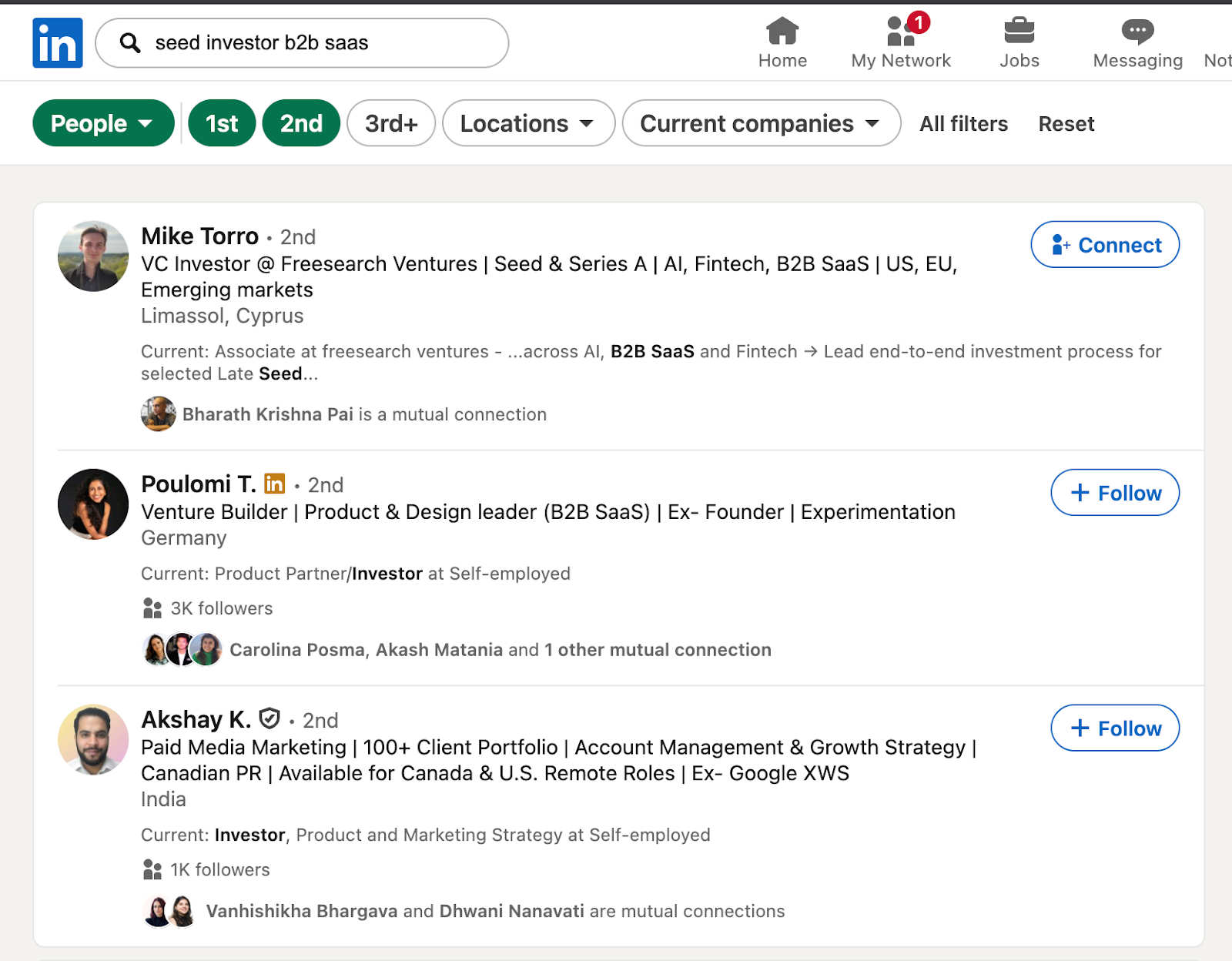
Here's a specific tactic: search "seed investor [your sector]" and filter by people, then by 1st and 2nd degree connections, and then by location. Second-degree connections are gold. They mean you have a mutual connection who could potentially make an introduction.
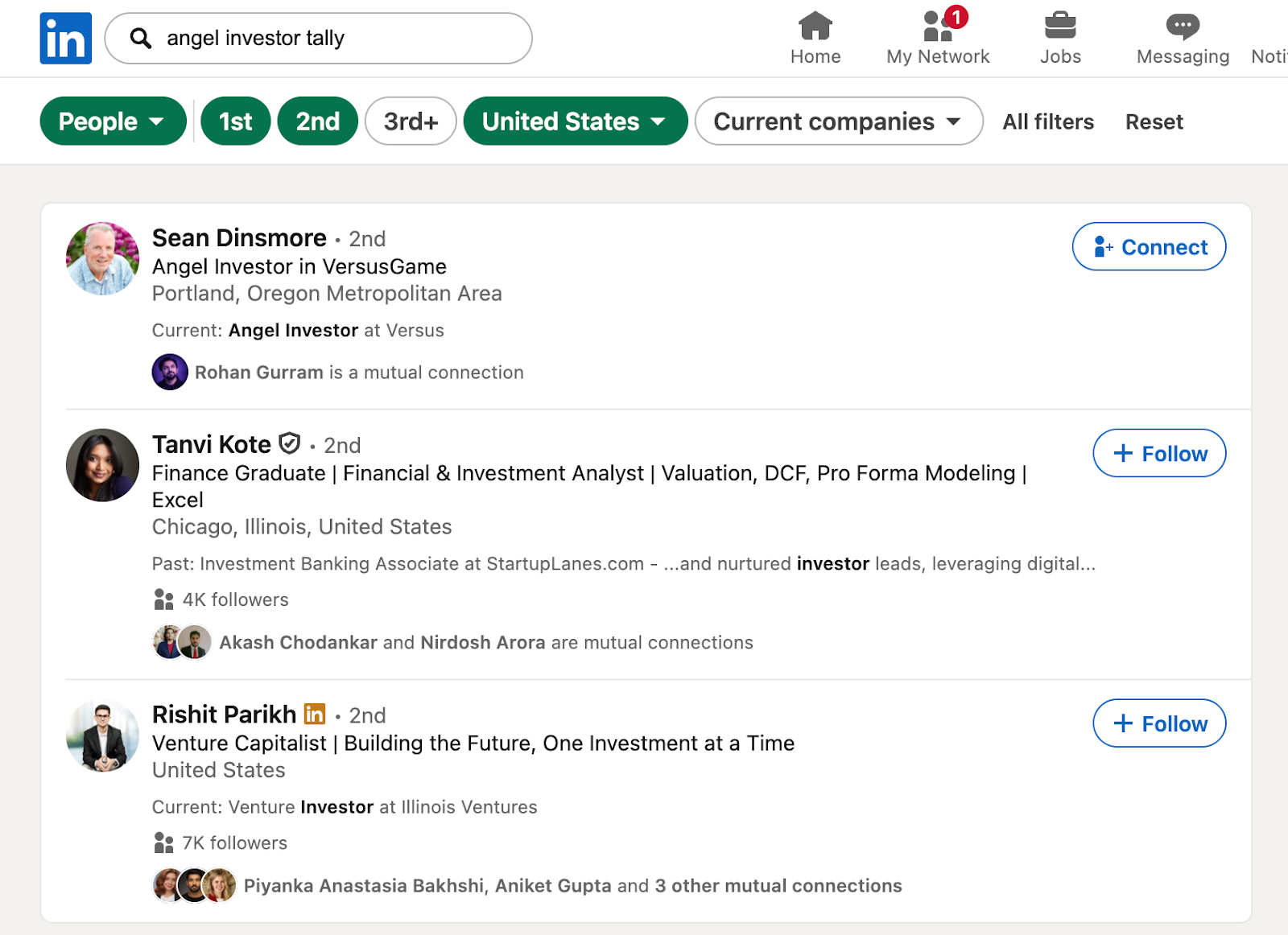
You can also search "angel investor" + a company name that's similar to yours. If someone invested in a comparable startup, they understand your space and have already validated the category.
2. Founder communities
These are the communities where founders and investors interact naturally.
Slack communities
Slack communities like Lenny's Community, and Indie Hackers have active investor members and warm environments for conversation. Contribute first. Answer questions. Share what you're learning and building. Build a reputation before you ask for anything.
WhatsApp groups
WhatsApp groups for founders in specific sectors or geographies are harder to find but incredibly valuable. The best way to discover them is to ask founders who are 6–12 months ahead of you what communities they're part of. Most will tell you, and many will add you directly.
Accelerator demo days
Accelerator demo days are worth attending as an observer where possible. YC, Techstars, and dozens of smaller accelerators host demo days that investors attend. Being in the room matters.
3. Local and regional angel networks
Don't sleep on local angel networks, especially if you're outside major tech hubs. Groups like Keiretsu Forum, Golden Seeds, and hundreds of regional angel networks are actively deploying capital and are far less competitive than national platforms.
A quick search for "[your city] angel investor network" will surface great options
.[IMAGE_PLACEHOLDER_3]
How to get warm introductions by your network
Cold outreach has a place, but warm introductions convert at a dramatically higher rate. The challenge for founders without networks is that getting a warm intro feels like a chicken-and-egg problem. Here's how to crack it.
1. Reverse-engineer funding announcements
Every time a startup announces a funding round on LinkedIn or TechCrunch, the investors who participated are usually tagged or mentioned. This is a map.
Here's your gameplan:
- Go to LinkedIn and search for 5 companies that are 1–2 years ahead of where you are in a similar space, but not direct competitors
- Filter for ones that have announced a funding round in the last 12 months
- Open each announcement post and note every investor tagged or mentioned in the comments
- Cross-reference those investors on Crunchbase to confirm they invest at your stage
- Follow each investor on LinkedIn and engage genuinely with their content for 2–3 weeks before reaching out
- When you do reach out, reference the company they backed and why your work is adjacent
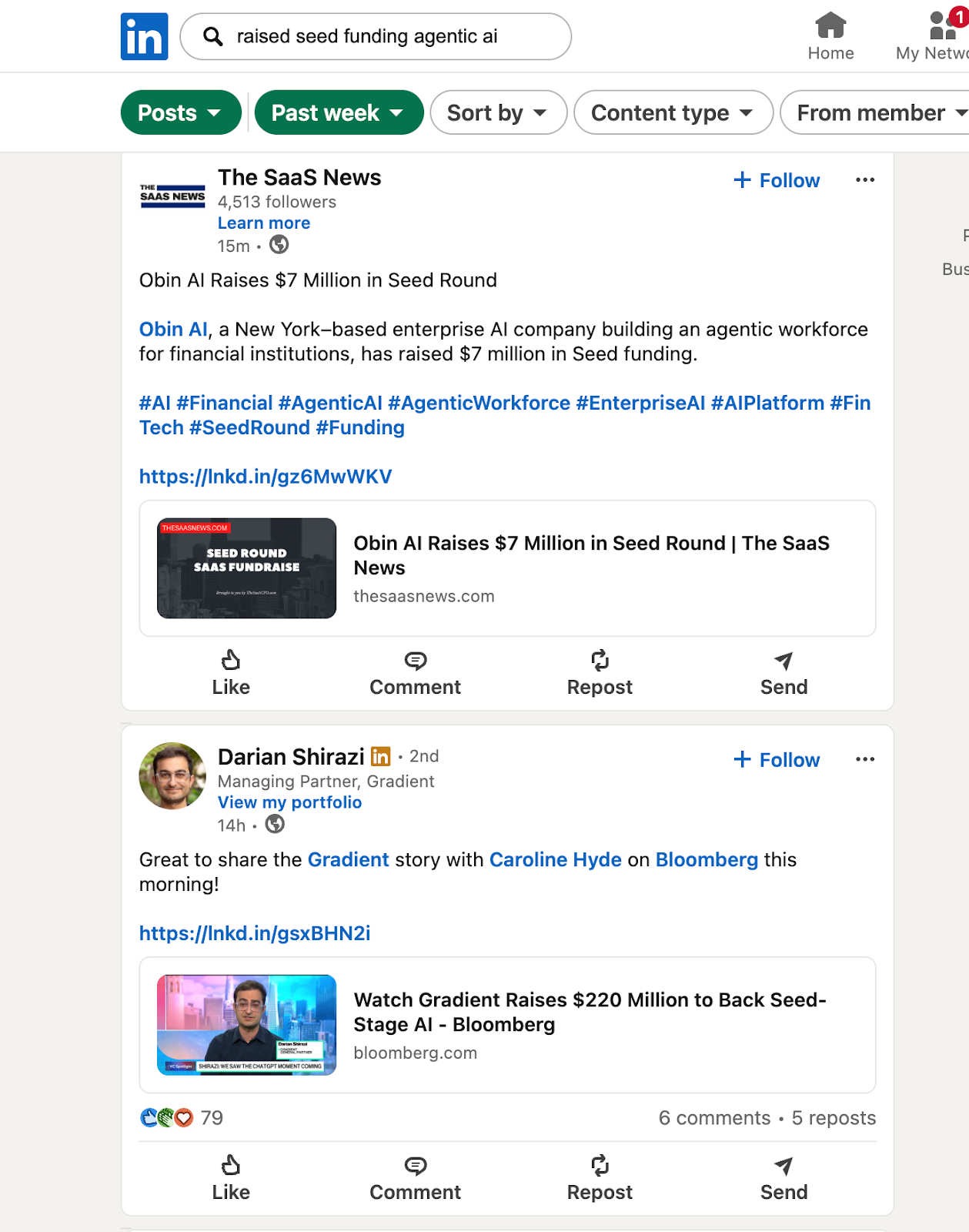
Now look at who announced the round on LinkedIn. Check who commented and who was tagged. Follow those investors. Engage with their content.
2. Talk to portfolio founders
Investors trust their portfolio founders' judgment. A positive word from a founder they've backed carries more weight than almost any cold introduction. And portfolio founders are generally willing to talk. They remember what it was like to fundraise.
Your step-by-step gameplan:
- Pick 3–5 target investors from your list who you want an introduction to
- Go to their portfolio page on their fund website or Crunchbase and find a company at a similar stage to yours
- Find the founder on LinkedIn and look for a genuine reason to reach out, a product launch, something they've written, a market insight they've shared
- Send a short, specific message. Just a real reason to connect
- Have genuine conversations first and show interest
- When the relationship feels real, ask —"I've been looking at [investor name] as a potential backer. Would you be comfortable making a brief intro if you think it's a fit?"
Don't ask in the first message. Just be a real person who's interested in their journey.
3. The mutual connection path on LinkedIn
Go back to your list of second-degree investor connections. For each one, look at who you share as a mutual connection. Ask yourself honestly: does that mutual connection know me well enough to vouch for me?
If yes, send them a short, specific message. Tell them you're raising, that you've been researching investors, and that you noticed they're connected to [investor name]. Ask if they know them well enough to make a brief introduction. Make it easy. Offer to send a short blurb they can forward.
If the mutual connection doesn't know you well, don't ask yet. Reconnect with them first.
How to do cold outreach to get maximum chances of replies
Most cold outreach fails for the same reason: it's too long, too vague, and leads with the ask.
An investor receiving 50 cold emails a day doesn't have time to read a 400-word email from someone they've never heard of. They're scanning for a reason to keep reading or a reason to stop.
What may not work
- Long intros about your background
- Vague descriptions of your market opportunity
- Asking for a call in the first message
- Attaching a deck without any context
- Generic openers like "I'd love to pick your brain"
What generally works
Lead with a specific, relevant hook. Reference something they've invested in, something they've written, or a specific aspect of their thesis that connects to what you're building. One sentence. Then tell them what you're building in plain English. Then make a small, low-friction ask.
Here's a sample text you can use:
"I noticed you backed [Company X]. We're building something adjacent in [space]. We're [one-line description]. Can you give me 10 minutes of your time on how we're thinking about [specific things]. Worth a shot?"
Or
"I got to know you recently invested in [Company X]. We are also building something adjacent in [space]. We're [say what you are doing uniquely]. Would you like to be added to our list of investors so you can stay updated on our updates and big announcements?"
Asking for feedback instead of money removes the pressure and positions you as a founder who's thoughtful and coachable. Investors love that.
The follow-up that shows you care
If someone doesn't respond, follow up once after 3–5 days with a short, non-needy message. If they still don't respond, don't follow up again. Instead, add them to a monthly founder update list.
A brief monthly update, like a few bullet points covering growth, progress, and a key challenge you've solved keeps you on an investor's radar. When you're ready to formally raise, you're a founder they've been quietly watching for 6 months.
This approach is slow and gradual. It's also one of the most effective things you can do.
Should you get investments from friends, family, and early believers?
For pre-seed founders, the first checks often come from people who know you. It's a legitimate and common path to getting your first round closed.
Being direct with people in your personal network who have the means to invest is not something to be embarrassed about. Be honest about the risk. Don't oversell. Make sure they understand they could lose everything. If they invest knowing that, they're a real backer.
Beyond close friends and family, think about early believers — These people have context that a cold investor never will. Former managers, colleagues, customers who love what you're building.
A $10k check from someone who truly believes in you is worth more than a $10k check from someone you had to convince.
What most founders get wrong about investors
A few things worth unlearning:
More outreach doesn't mean better results
Sending 200 cold emails is less effective than having 20 highly targeted, well-researched conversations. Investors can tell when they're on a mass list.
A great deck doesn't replace a great relationship
Decks get you in the room. Relationships get you the check. Focus more energy on the latter.
Rejection isn't always about you
Most "no"s are about timing, portfolio conflicts, or stage mismatch. Ask for specific feedback when you get a no. It's often more useful than the meeting itself.
Don’t bluntly ask them “How can I improve my pitch?” Get specific. Ask what features or key ideas they think were missing. Discuss how you can incorporate them. Rinse and repeat.
Fundraising is a full-time job for the founder doing it
You can't delegate it to a co-founder while you build. The investor is betting on you as much as the business. They want to see you in the room.
Speed matters more than perfection
A good deck sent today is worth more than a perfect deck sent in three weeks. Investors fund momentum. Show them you have it.
How to evaluate an investor before saying yes
Not every investor is the right investor. There are moments where you have to slow down and think clearly:
Check size and ownership expectations
Does their check size make sense for your round? Are they asking for a board seat at a stage where that's unusual? Understand what you're giving up.
Reference their portfolio founders directly
Don't just read testimonials. Find founders who took money from this investor, especially ones whose companies didn't work out. How did the investor behave when things got hard?
Understand their fund cycle
An investor near the end of their fund may not be able to follow on in your next round. That matters.
Assess their actual value-add
"We offer strategic support and introductions" means nothing. Ask for specific examples. Did the investor help them build connections? Did they receive any suggestions about acquiring clients etc? What did that lead to? Push for specifics.
Trust your gut on the relationship
You may be working with this person for 7–10 years. If something feels off in the courtship phase, it doesn't get better after the wire clears.
So, how do you actually find investors for your startup?
Finding investors is hard. It's supposed to be hard. After all, you're asking someone to bet real money on an unproven idea. But the founders who succeed are the ones who do the unglamorous work of building real relationships, staying consistent, and showing up.
There's no shortcut that replaces showing up consistently, targeting the right people, and earning trust over time. But you don't need an existing network to start. You need a list, a process, and the discipline to work it every week.
Set up your financial infrastructure before you talk to investors
Investors will ask for financial statements, clean records of expenses, and clarity on how you're managing company money. If your business finances are tangled up with personal accounts, or tracked loosely in a spreadsheet, it shows you may not be prepared enough.
Aspire1 is built for exactly this. To give founders a proper financial foundation from day one, so when an investor asks for your numbers, you have them ready.
Frequently Asked Questions
Most founders underestimate this significantly. From first outreach to money in the bank, expect 3–6 months on average, sometimes longer. Start building relationships at least 6 months before you need the capital.
Always run a parallel process, not a sequential one. Investor interest creates social proof—when one investor knows others are looking, it creates urgency. Approaching them one at a time kills your momentum and your leverage.
Yes, before you sign anything. A startup-experienced attorney reviewing your term sheet is non-negotiable. Most founders don't fully understand until it's too late.
A lead investor sets the terms, writes the largest check, and often takes a board seat. Follow-on investors come in after the lead is confirmed, on the same terms. You need to secure your lead first.
It depends on the accelerator. YC or Techstars genuinely open doors that are otherwise closed. But a mid-tier accelerator that takes 6–8% equity purely for investor intros is rarely worth it. You can build those relationships yourself with the tactics in this guide.
This blog is for general information only and does not constitute financial, legal, tax, or professional advice. Aspire’s services are subject to the terms outlined in our ’Terms of Service’ and ’Pricing’ pages. We make no guarantees as to the accuracy, completeness, or timeliness of the content, and past results do not indicate future performance. Always consult a qualified professional before acting on any information provided.
Content Team
Aspire editorial
Content team at Aspire is a society of seasoned writers & experts specialising in finance, technology and SaaS space. With 50+ years of collective experience, they help make business finance more profitable for readers. They write about finance tools, finance insights, industry trends, tactical guides to grow your business & also all things Aspire.
Aspire Launchpad
Supercharge your finance operations with Aspire
Find out how Aspire can help you speed up your end-to-end finance processes from payments to expense management.

Latest articles

Finance Tools •
Quicken vs QuickBooks: Key differences, costs, and which is better
Compare Quicken vs QuickBooks on features, pricing, accounting tools, and more. See which option fits your small business and financial needs.

Business Advice •
Marketing agency profit margins: A founder's guide
Calculate real agency profit margins and compare benchmarks. Learn cash flow vs. margins, identify margin leaks, and improve pricing, delivery, and cash flow.

Business Account •
How to open a US bank account from India for your business
Learn how to open a US bank account from India, including requirements, remote options, fees, and the process for Indian vs. US-incorporated companies.