

What is a purchase order?
A purchase order, or a PO, is a formal document you issue to your vendor when your team has internally agreed on a purchase. While it is not a contract, a PO becomes legally binding under the Uniform Commercial Code (UCC) when the vendor accepts it, not when the founder signs it. This document includes all the details of the transaction, from the agreed cost and unit quantity to the agreed terms.
As a founder, you’ll likely deal with growing vendor lists, multiple team members making purchases, and a finance team receiving larger invoices. For growing companies, a PO helps prevent unapproved spending and eliminate surprise invoices.
Why is a purchase order important?
A purchase order helps protect your order because it is legally binding once accepted by the seller. It also allows you to keep your audit trail clean. Adding PO generation will increase the processing time upfront. But purchase order management pays off during audits and when you need a clear and complete trail of expenses.
You issue a purchase order after reviewing the proposal or quotes that your vendor sends you. This is a detailed document that will include the following:
- PO Number and date - Assigned by the founder, the PO number allows you to identify each purchase for audit trails. The date establishes a timeline for delivery and payment.
- Goods or service specifications - Ensures that every detail of the goods or service is clearly communicated for no changes in order or payment details later.
- Quantity of goods/duration of service - How many units of the specified goods do you need, especially if you’re ordering different types of goods? Or, how long are you expecting the service to last?
- Reference to or a copy of the proposal document (if any) - Many times, vendors send a quote or a scope of work (SOW). If it meets your requirements, you can attach a copy of the proposal, highlighting your specifications.
- Prices - Unit prices and total amounts. You can ensure that you’re getting the order at the prices you previously agreed on and that they aren’t changed mid-order.
- Delivery dates and Location - When do you expect the order to reach you, and where?
- Payment terms - For example, Net30 or Net45.
- Details of the buyer and seller - Name and address of the buyer (founder) and seller (vendor) with spaces for signature, to bind the PO legally before starting the work.
How does a purchase order work?
When your marketing team needs design tools worth thousands of dollars, without a PO, they might email the vendor, receive the tools, and send you a surprise invoice. However, with a PO, the entire process is documented and monitored. The purchase order process flows from requisition to 3-way match.
1. Requisition
The marketing team lead or manager will send an internal proposal requesting the tool. This request specifies the vendor, amount, justification, and cost. The team lead might ask several vendors for a proposal, a quote, or a scope of work.
2. Generating the purchase order
Once the purchase is approved, you generate the purchase order with a unique tracking number, one you can choose yourself. This PO must include space at the end for the buyer's and seller's signatures.
3. Vendor acceptance
The vendor will review the purchase order. And if everything matches, they will sign and accept it, making it a legally binding contract. This begins the supplier’s obligation to deliver goods or services as agreed.
4. Order fulfillment and delivery
The vendor fulfills the order and delivers the goods or services on the agreed dates, along with a delivery receipt. Verify the order delivery; if it aligns with the purchase order and you accept it, the vendor will issue an invoice.
5. The 3-way match
When you receive the invoice, your Accounts Payable team cross-checks three documents,
- The purchase order - states what you ordered.
- The delivery receipt - a record of what was delivered.
- The vendor invoice - mentions what you’re being charged.
This 3-way match in PO management ensures invoice accuracy before payment is made, ensuring you only pay for what you’ve ordered. If the quantity or cost does not match up, AP flags the invoice for manual review. An automated invoice processing tool can easily reduce processing time by up to 80%.
Founder’s insight: Make the 3-way match a rule in your automation system to accurately track every PO and identify discrepancies in real-time. This will stop the PO payments for goods you haven’t received and keep every transaction transparent for both you and the seller.
Types of purchase orders
While most founders often use the Standard purchase order, there are multiple types of purchase orders meant to be used for different types of purchases.
1. Standard PO: This is the most common type of purchase order, used for a one-time purchase. A standard purchase order usually contains all mutually agreed-upon details. Example: 100 laptops at a fixed price.
2. Blanket PO: This is when you know you’ll need the goods within a timeframe, but haven’t decided on the timeframe. So, you pre-authorize spending with the single vendor, without specifying delivery dates or quantities upfront. This is great if you are getting an ongoing service from an agency or have a recurring request for goods. Example: Hiring a creative agency for a month for $60,500, or a restaurant ordering fresh batches of seasonal fruits over 4 months.
3. Open PO: An open purchase order spans the time till it is completely fulfilled by the vendor. For example, if you are ordering 200 desks for your new office set-up and receive 100 of them, the PO will remain open till the last 100 are sent as well.
4. Planned PO: If you know that you’re going to purchase the goods or service in the near future but don’t know the exact date, you can opt for a planned PO. Unlike the blanket PO, the quantities of the goods purchased or the scope of work for the service are agreed upon in the planned PO, with only the date of requirement or delivery being the only variable.
5. Contract PO: A contract purchase order is the most elaborate document of all these types. It is more of a contract than a PO, since it is issued for a longer-term partnership. This contract includes detailed terms and conditions that govern the buyer and seller and all their transactions during the term.
6. Other types of PO: Apart from these four main types, there are also manufacturing, retail, wholesale, and e-commerce POs. The terms and details included in each of these purchase orders differ based on what information is tracked. For example, in a retail PO, you might need to add the information about the product SKU.
Founders choose the type of purchase order they need based on how often they require the goods and services. If you are planning to order them once, a standard purchase order is best, but if you want a long-term partnership with your vendor, then choose a contract purchase order.
What happens when a PO needs to change?
A purchase order, once created, can change in three different scenarios:
- When you sign a new contract with the same vendor,
- If the previous PO was incorrect, and
- If your team creates a wrong PO from what’s required.
In all three scenarios, whether you use manual POs or a PO automation system, close the previous one, create a new one, and get it approved by the vendor. This keeps your expense trail clean and easy to follow.
Purchase order example
A purchase order contains all the details of what you want to buy, at what prices, and when it will be delivered. If you are just starting with purchase orders, you can use the following purchase order example to base yours on.
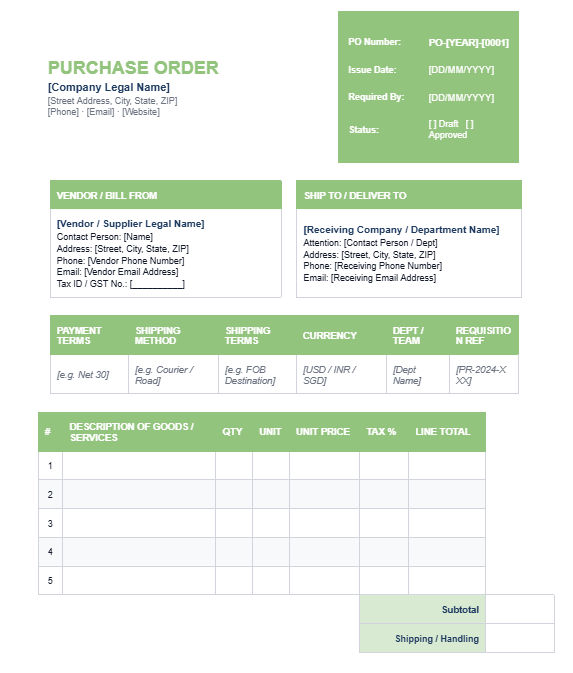
[Example Downloadable resource: PO Format]
The PO format will change according to the type of purchase order you’re using. With a purchase order system in place, you can create purchase orders as per your needs.
Purchase order vs invoice vs requisition
The entire process of purchase requires three main documents: the purchase requisition, purchase order, and invoice. Despite being used for the same purchase, each document is used for different purposes.
The difference between a purchase order, an invoice, and a purchase requisition includes:
[Table:1]
Pros and cons of issuing a purchase order
Issuing a purchase order has its advantages and disadvantages. While it helps keep your audit trails clean, the process adds one more step to your purchase journey.
[Table:2]
An automated invoice processing system will speed up the process by helping you auto-match your invoices with the purchase orders and delivery receipts to verify each purchase.
Benefits of digitizing the purchase order and invoice processing
Automating the PO generation speeds up the purchasing process. Opt for expense management platforms to manage your finance and accounts payable process.
Here’s how it will reduce overhead and speed up your PO and AP processes:
- Integrations: Using integrations like QuickBooks purchase order and Xero purchase order in the Aspire1 expense management system, generate purchase orders instantly.
- Automates AP invoicing: With automated AP, founders or their team can upload the PO, delivery receipts, and invoices. With the AP integrations, the system will flag any invoice that does not match the PO, reducing the need for manual 3-way checks.
- P-cards & additional features: Manage smaller purchases with smart p-cards offering 1.5% cashback^ on eligible spends.
Apart from these, you can use the expense management system for budgeting, daily expense management, optimization, and employee payroll.
End notes
A purchase order is a necessary document to communicate every large transaction between your company and the vendor. It helps protect you and the vendor by ensuring that every detail is written clearly on the document, leaving no room for assumptions or errors.
By setting up a PO system for your transactions, you can lock in the selling price, ensure the quality and the quantity of the goods or services received, and hold the vendor accountable for it, in case of any discrepancy.
Disclosure: AFT US LLC, d/b/a Aspire, is a financial technology company, not a bank. The Deposit Account and banking services are provided by Column N.A., Member FDIC. FDIC deposit insurance covers the failure of an insured depository institution. Deposits in the Deposit Account are FDIC-insured through Column N.A., Member FDIC and Column's Sweep Program Network Banks. Certain conditions must be satisfied for pass-through FDIC insurance to apply
FAQs
What are the 4 types of PO?
The 4 types of PO include the Standard PO, Contract PO, Planned PO, and Blanket PO. These vary depending on how often you require goods or services from a vendor. For a one-time order, a Standard PO is useful; for recurring purchases, choose Blanket PO. For confirmed future purchases, a Planned PO is useful, while for industry-sized purchases that span a longer time, a Contract PO is best.
What is a PO vs an invoice?
A PO is issued by the founder or buyer to authorize a purchase, highlighting the requirements like quantity, product specifications, payment terms, delivery date, and so on. An invoice is a document requesting payment that the vendor sends to the buyer once the order is delivered.
Which is first, a PR or a PO?
A purchase requisition (PR) comes first to request the purchase of goods or services from the internal management. After that, the PO is generated for the vendor.
Invoice number vs purchase order number: What’s the reason for having both?
A purchase order number is issued by the founder to authorize a purchase, while an invoice number is issued by the seller after completing and delivering the order. Having a PO number and the invoice number helps you track your orders, especially if the delivery is made in parts. How many goods are delivered, how many are pending, and how many have you already paid for? The PO and invoice help you answer all these questions.
When should you use PO?
Most founders generate a PO for bulk purchases or services that span a longer time. For smaller, one-time purchases, generating a PO can increase overhead, and smaller purchases can be easily managed with a purchasing card instead.

.jpeg)