



Bankruptcy vs Winding-Up in HK: Legal Distinction
In Hong Kong's legal framework, the term "bankruptcy" (破產) applies strictly to individuals — including sole proprietors and partners in a partnership. It is governed by the Bankruptcy Ordinance (Cap. 6). Under that legislation, creditors may apply to the court for a bankruptcy order against an individual, enabling the Official Receiver to take control of and realise the debtor's personal assets for distribution to creditors in the prescribed order.
For limited companies incorporated under the Companies Ordinance (Cap. 622), the equivalent process is called "winding-up" or "liquidation" (清盤) — not bankruptcy. It is governed by the Companies (Winding Up and Miscellaneous Provisions) Ordinance (Cap. 32). These two regimes exist in entirely separate legislative frameworks, and the practical consequences of each differ substantially.
The distinction matters most when it comes to personal liability. In a personal bankruptcy, the individual's personal assets — including private savings, property, and other personal wealth — are all at risk. In a corporate winding-up, the company's assets are realised to meet the company's debts, without recourse to the personal assets of directors or shareholders. The exceptions to this protection are covered later in this guide.
Although "company bankruptcy" is commonly used in Hong Kong colloquially, the two regimes are legally distinct:
[Table:1]
When Does a Company in Hong Kong Need to Wind Up?
The circumstances that trigger winding-up differ depending on the legal structure of the business. It is useful to understand the threshold conditions that bring each type of business to this point before examining the specific procedures.
Unlimited Companies: Sole Proprietorships and Partnerships
An unlimited company — whether a sole proprietorship or a partnership — has no separate legal personality under Hong Kong law. The business and its owner or partners are legally one and the same. There is no corporate veil to pierce, and creditors may pursue the personal assets of the business owner directly.
The situations that commonly lead to a personal bankruptcy application for an unlimited business owner include:
- The business cannot repay debts as they fall due, and the owner's resources are insufficient to cover the shortfall
- A creditor serves a Statutory Demand for HK$10,000 or more, and the owner fails within 3 weeks to pay in full, provide reasonable security, or reach a settlement — creating a legal presumption of insolvency
- The owner's total personal assets are insufficient to cover all liabilities including contingent and prospective obligations
- A court judgment or enforcement order against the owner remains unsatisfied
- A dispute between partners results in one partner becoming unable to meet their share of partnership liabilities, potentially exposing remaining partners to joint and several unlimited liability for the full debt
The personal nature of unlimited liability is one of the primary reasons many business owners choose to incorporate as a private limited company. Understanding the differences between business entity types in Hong Kong is an important first step for any founder.
Limited Companies
A limited company has no personal bankruptcy mechanism. The primary legal process for a company that cannot pay its debts and must cease operations is winding-up.
Under the Companies (Winding Up and Miscellaneous Provisions) Ordinance, the court may order a company to be wound up on the following grounds:
Inability to pay debts (Section 178(1)). The company is presumed unable to pay its debts if a creditor's Statutory Demand for HK$10,000 or more remains unsatisfied within 3 weeks, if a court judgment against the company remains unsatisfied, or if the company's total assets are proven insufficient to cover its total liabilities.
Shareholders' special resolution. The shareholders pass a special resolution — by 75% majority or more — resolving that the company be wound up.
Just and equitable grounds. Even where the company remains solvent, the court may order winding-up where there is an irreconcilable deadlock between shareholders, the company has lost its founding purpose, or the affairs of the company are being conducted in a manner that unfairly prejudices some members.
Failure to commence business or prolonged suspension. The company has not commenced business within one year of incorporation, or has suspended all operations for a full year.
Once a winding-up order is made or a resolution is passed, the company's assets are realised by the liquidator and distributed to creditors in the statutory order of priority, after which the company is formally dissolved.
3 Types of Liquidation in Hong Kong
Liquidation in Hong Kong takes three principal forms, each governed by the Companies (Winding Up and Miscellaneous Provisions) Ordinance (Cap. 32). The appropriate route depends on whether the company is solvent, whether the process is driven by shareholders or creditors, and whether court involvement is required.
[Table:2]
1. Members' Voluntary Winding-Up
This procedure is available exclusively where the company is solvent — meaning it has sufficient assets to pay all its debts in full within 12 months. It is the most orderly form of voluntary dissolution and gives directors and shareholders the greatest degree of control over the process.
Step 1: Statutory Declaration of Solvency
Before any winding-up resolution is put to shareholders, a majority of the board must make a sworn Statutory Declaration of Solvency. This is a formal legal declaration confirming that the company will be able to pay its debts in full — with interest — within 12 months. The declaration must be delivered to the Companies Registry within 7 days of being made, and completed no more than 5 weeks before the shareholders' winding-up resolution is passed. Directors who make this declaration without reasonable grounds may face personal liability or criminal penalties.
Step 2: Shareholders' special resolution
The board gives written notice of the general meeting to all shareholders — minimum 14 days' notice, reducible to shorter with written consent from at least 95% of shareholders. At the meeting, winding-up must be approved by a special resolution (75% of votes cast). The same meeting also appoints the liquidator. Winding-up commences formally on the date the resolution is passed, and all director powers cease from that moment.
Step 3: Filing and Gazette notices
Within 15 days of passing the resolution, the company files the winding-up resolution and a notice of liquidator appointment with the Companies Registry. Three notices are then published in the Government Gazette: the winding-up resolution, the liquidator's appointment, and a call for creditors to submit claims. These publications are a statutory requirement.
Step 4: Liquidator completes the winding-up
The liquidator notifies all known creditors, reviews their claims, realises the company's assets at the best available price, and settles all liabilities in the statutory order of priority. Obtaining tax clearance from the Inland Revenue Department is typically the longest step — it can take from several weeks to several months. Once all debts are settled, any remaining assets are distributed to shareholders in proportion to their shareholdings.
Step 5: Final meeting and dissolution
When winding-up is complete, the liquidator convenes a final general meeting of shareholders, with notice published in the Government Gazette at least one month in advance. The liquidator files the final accounts, a report, and a notice of release with the Companies Registry. The company is formally dissolved approximately 3 months after those terminal documents are received by the Registry.
2. Creditors' Voluntary Winding-Up
This procedure applies where the company is insolvent but the shareholders take the initiative to pass a voluntary winding-up resolution rather than waiting for creditors to petition the court. This proactive approach can preserve some control over timing, demonstrate good faith to creditors, and reduce overall costs compared to a compulsory winding-up.
The key difference from a members' voluntary winding-up: no Statutory Declaration of Solvency is filed, and creditors — not shareholders — have the dominant voice in appointing the liquidator.
Step 1: Shareholders' special resolution
Directors convene a general meeting of shareholders, generally with at least 21 days' written notice (reducible with 95% shareholder agreement). Shareholders pass a special resolution to wind up voluntarily and nominate a liquidator. No Declaration of Solvency is filed. Winding-up commences on the date the resolution is passed.
Step 2: Creditors' meeting
Within 14 days of the shareholders' resolution, the company must convene a creditors' meeting. Notice is sent to all known creditors at least 7 days in advance, and must also be advertised in the Government Gazette and in at least one English-language and one Chinese-language daily newspaper. At the meeting, directors present a detailed Statement of Affairs covering the company's assets, liabilities, creditor list, and estimated claim amounts. Creditors may ask questions and nominate their own liquidator — the creditors' nominee takes precedence over the shareholders' nominee. Creditors may also appoint a Committee of Inspection (3–5 creditors) to oversee the winding-up.
Step 3: Liquidator takes control
The liquidator assumes full control of all company assets, records, and the company chop. All normal business operations cease. The liquidator realises assets at the best obtainable price, investigates the conduct of directors leading up to the winding-up, and identifies any transactions that may constitute fraudulent trading, unfair preference, or transactions at an undervalue. The proceeds are distributed to creditors in the statutory priority order.
Step 4: Ongoing reporting
Where the winding-up extends beyond one year, the liquidator must convene annual meetings of creditors and contributors to report on progress and account for receipts and payments. Interim reports and notifications must also be filed with the Companies Registry throughout the process.
Step 5: Final proceedings and dissolution
The liquidator prepares final accounts and a report, and convenes a final creditors' meeting. Notice is published in the Government Gazette at least one month before the meeting. Within 7 days of the meeting, the liquidator files the final accounts and report with the Companies Registry. The company is automatically dissolved 3 months after those documents are registered.
3. Compulsory Winding-Up by Court Order
Compulsory winding-up is initiated by a petition to the High Court — most commonly by a creditor owed HK$10,000 or more that has not been repaid within 21 days of a Statutory Demand. It is administered by the Official Receiver (Insolvency Services) and is the longest and most complex route.
Step 1: Statutory Demand
The creditor serves a written Statutory Demand on the company requiring repayment — or the provision of reasonable security or a settlement — within 21 days. If the company fails to comply, it is presumed unable to pay its debts under Section 178 of the Ordinance, providing grounds for a winding-up petition.
Step 2: Filing the petition
The creditor files the winding-up petition in the prescribed format and pays the required deposit to the Official Receiver and the court filing fee to the High Court Registry. Legal representation by a qualified Hong Kong solicitor is strongly recommended from this stage.
Step 3: Publication and service
The petitioner obtains a hearing date and publishes a notice of the petition in the Government Gazette at least 7 clear days before the hearing. The notice is also advertised in at least two local daily newspapers. A sealed copy of the petition is served on the company at its registered office, and a copy is delivered to the Official Receiver's office within 24 hours of filing.
Step 4: Verifying affidavit
Within 4 days of filing the petition, the petitioner files a verifying affidavit with the court confirming the truth of the statements made in the petition.
Step 5: Court hearing and winding-up order
The court considers the petition and any opposition. If satisfied, the court makes a winding-up order. Critically, this order takes retrospective effect from the date the petition was filed — meaning any disposal of company property or transfer of shares between the petition date and the order date is void, unless the court makes a validating order.
Step 6: Provisional liquidator appointed
The Official Receiver is appointed as provisional liquidator and takes immediate control of all company assets, records, books of account, and the company seal. All director powers are terminated immediately. Directors must cooperate fully and submit a Statement of Affairs within 28 days of the winding-up order.
Step 7: First meetings of creditors and contributors
The provisional liquidator convenes the first meetings of creditors and contributors within 3 months of the winding-up order. These meetings vote on the appointment of a formal liquidator and, if creditors resolve, a Committee of Inspection. In smaller cases where total assets are unlikely to exceed HK$200,000, a simplified procedure may dispense with these meetings.
Step 8: Realisation and distribution
The formal liquidator investigates the company's financial history, realises all company assets, recovers outstanding debts and receivables, and pursues claims arising from improper pre-liquidation transactions. Net proceeds are distributed to creditors in the statutory priority order.
Step 9: Dissolution
The liquidator provides notice of intention to apply for release, submits a full report to the court and the Companies Registry, and obtains a Certificate of Release. The company is generally dissolved approximately 2 years after the Certificate of Release is registered — significantly longer than voluntary winding-up due to court involvement at multiple stages.
Winding-Up for Unlimited Companies
An unlimited company — whether a sole proprietorship or a partnership — has no separate legal personality under Hong Kong law. Members bear unlimited personal liability for all business debts.
Solvent and No Longer Operating: Deregistration
Where a sole proprietorship or partnership has ceased operations and has no outstanding debts, the simplest route to dissolution is deregistration — not winding-up. Deregistration does not require a liquidator, the court, or the formal winding-up process.
The conditions for deregistration include: all members agree; the company has not been in operation for the 3 months immediately preceding the application; there are no outstanding liabilities; the company is not party to any legal proceedings; and the company's assets do not include any Hong Kong immovable property.
The company files Form NDR1 with the Companies Registry. After review and acceptance, the Registrar publishes a notice of proposed deregistration in the Government Gazette. If no objection is received within 3 months of that notice, the company is formally dissolved.
Insolvent: Personal Liability and Bankruptcy
Where an unlimited company is insolvent, creditors are not restricted to pursuing company-level assets — they may proceed directly against the personal assets of the business owner or partners. If the business owner cannot meet the resulting personal liabilities from their own resources, they may apply for — or have creditors petition for — their personal bankruptcy under the Bankruptcy Ordinance (Cap. 6).
If an unlimited company is persistently inactive and unresponsive to notices from the Companies Registry, the Registrar has the power to strike the company off the register. However, this administrative removal does not extinguish the personal unlimited liability of the company's members. Creditors may continue to pursue those individuals for outstanding debts after the company has been struck off.
When Can Directors Be Held Personally Liable?
The principle of limited liability protects directors and shareholders of a limited company from being personally responsible for the company's debts. However, this protection is not absolute. There are specific circumstances in which Hong Kong courts will disregard the corporate structure and impose personal liability on directors.
Personal guarantees
The most common pathway to personal liability in practice. Where a director has signed a personal guarantee in connection with banking facilities, a lease, or any other commercial contract, the beneficiary may enforce it against the director personally in the event the company cannot meet the underlying obligation on winding-up. The guarantee creates a direct personal contractual obligation that exists entirely independently of the company's limited liability status.
Fraudulent trading
Where it is established during a winding-up that the company carried on business with the intent to defraud creditors — for example, by continuing to accept customer prepayments or incur supplier liabilities while the directors knew the company was hopelessly insolvent — the court may declare those directors liable without limitation for the company's debts. In serious cases, this may also give rise to criminal prosecution.
Unfair preference
Where, within a specified period before winding-up commenced, a director caused the company to make payments or transfer assets to a particular creditor — especially a connected party such as a relative or related company — in circumstances that placed that creditor in a better position than they would otherwise have been in, the liquidator may apply to the court to have that transaction set aside and the funds recovered for creditors.
Breach of fiduciary duty or negligence
Where a director has failed to maintain proper accounting records as required by the Companies Ordinance, has misappropriated company assets, or has permitted the company to carry on business without reasonable belief in its ability to continue as a going concern, the liquidator may bring proceedings against that director to recover losses suffered by the company and its creditors.
Understanding these risks underscores why maintaining clean financial records throughout a company's life is a legal obligation — not merely an administrative courtesy. Our guide on what a company secretary in Hong Kong does outlines many of the compliance obligations directors must stay on top of.
Debt Repayment Priority in a Winding-Up
Once the liquidator has realised the company's available assets, those proceeds must be distributed to creditors and stakeholders in the strict statutory order prescribed by Section 265 of the Companies (Winding Up and Miscellaneous Provisions) Ordinance. No creditor can be paid ahead of their ranked position — this hierarchy is non-negotiable.
[Table:3]
In the majority of insolvent winding-up cases, ordinary unsecured creditors recover only a fraction of what they are owed, or nothing at all. Shareholders almost invariably receive no distribution.
This makes proactive financial management critical. Monitoring your company's cash position consistently, maintaining accurate records of all liabilities, and taking professional advice early when financial difficulty emerges are the most effective risk mitigation measures available. Our guide on cash flow forecasting for Hong Kong businesses provides a practical framework for maintaining the financial visibility needed to identify problems before they become critical.
Tax Obligations During Winding-Up
A common misconception is that tax obligations cease when a company enters winding-up. In fact, they continue in full until the point of formal dissolution — and the liquidator, not the former directors, assumes responsibility for managing them.
Notifying the Inland Revenue Department. As soon as practicable after winding-up commences, the liquidator must notify the Commissioner of Inland Revenue by submitting a Notice of Cessation of Business (Form IRC3113) together with a copy of the winding-up resolution or the court's order. Both the IRD and the Business Registration Office must be notified within one month of the cessation of business. Failure to notify promptly may complicate the tax clearance process later.
Filing profits tax returns during winding-up. If the company generates assessable profits during the winding-up period — through asset sales, interest income, rental income, or other investment gains — the liquidator must file the relevant profits tax returns for each such period. Companies in winding-up are not eligible for the bulk extension arrangements that apply to actively trading companies. Late filing may result in estimated assessments or penalties. Even where no assessable profits arise, a nil return may still be required.
Obtaining tax clearance confirmation. Before the liquidator can convene the final meeting and submit terminal documents to the Companies Registry, a formal tax clearance confirmation must be obtained from the IRD. This confirms that all outstanding profits tax liabilities, salaries tax employer obligations, business registration fees, penalties, and annual return filing requirements have been fully resolved.
Obtaining this clearance is consistently the most time-consuming step in the entire winding-up process — it can take from a few weeks in simple cases to several months where there are unresolved tax assessments or complex asset disposals. Directors who have maintained clean and complete accounting records throughout the company's operational life will typically experience a significantly shorter tax clearance process.
Winding-Up vs Deregistration: Choosing the Right Route
SME founders who wish to close a company sometimes confuse winding-up with deregistration. They are fundamentally different procedures suited to different circumstances.
Winding-up is the appropriate route where the company has outstanding debts it cannot pay in full, where there are unresolved disputes among shareholders or with third parties, where the company is a party to ongoing legal proceedings, or where the complexity or value of the company's assets requires a formal regulated process for their realisation and distribution. Winding-up involves the appointment of a licensed liquidator, statutory creditor notification procedures, Gazette publications, and — in the case of compulsory winding-up — court involvement at multiple stages.
Deregistration is a simpler and significantly less costly administrative procedure available only to companies that have fully ceased operations, have no outstanding liabilities of any kind, are not party to any legal proceedings, and meet all eligibility conditions prescribed under the Companies Ordinance. A company with any unresolved debt — including unpaid tax, outstanding supplier invoices, or government fees — cannot use the deregistration route. For a full comparison, our guide to deregistering a company in Hong Kong covers the full process in detail.
The practical rule: if your company is solvent, has no unresolved liabilities, and you simply wish to cease operations and dissolve the entity, deregistration is almost always faster, simpler, and less expensive than winding-up. If the company has debts it cannot pay, winding-up is the only legally appropriate route.
Early Warning Signs: When Should an SME Founder Take Action?
One of the most important lessons from Hong Kong insolvency practice is that outcomes for directors, creditors, and employees are almost always better when action is taken early — before the situation deteriorates to the point where a formal insolvency process becomes inevitable. By the time a winding-up petition lands at the High Court, the options available are significantly narrowed.
There are several financial indicators that SME founders should treat as serious warning signs requiring immediate professional attention.
- Deteriorating cash position. If the company is consistently drawing down its bank balance to meet operating costs — payroll, rent, supplier payments — without a corresponding replenishment from revenue, the underlying business model or cost structure requires immediate review. A company can be profitable on paper and still face an insolvency event if its cash conversion cycle is sufficiently extended. Maintaining a rolling cash flow forecast updated at least monthly is the minimum standard for any SME managing material financial risk.
- Creditor pressure escalating. When suppliers begin shortening credit terms, requiring advance payment, or placing accounts on hold, it is often a leading indicator that the market has formed a view of your company's creditworthiness. Escalating creditor pressure — especially from multiple counterparties simultaneously — should be treated as an urgent signal rather than a cash flow management challenge to be deferred.
- Banking relationship friction. A bank reducing or withdrawing a revolving credit facility, requiring additional security, or increasing monitoring requirements is a clear sign that the company's financial position has reached a threshold of concern for its lender. A deteriorating relationship with the company's bank often reflects a deteriorating underlying financial position.
- Inability to meet statutory obligations. When a company cannot meet payroll on time, remit MPF contributions, or pay tax on schedule, it has crossed a threshold that carries both operational and legal consequences. Employee statutory entitlements rank as preferential claims in a winding-up, but the reputational and legal damage of failing to meet them in the ordinary course of business is significant.
- Director loans increasing. Where a director has extended personal loans to the company to cover operating shortfalls, and those loan balances are growing rather than being repaid, it is often symptomatic of a company that is no longer commercially viable on its own terms. Directors should be cautious about continuing to fund an insolvent company — this can in some circumstances be treated as evidence of continued trading in circumstances where insolvency was or should have been apparent.
When any of these warning signs are present, seek advice immediately from a qualified Hong Kong solicitor with insolvency experience and a licensed accountant. The legal position of directors who act promptly and transparently is materially better than that of directors who delay.
Practical Steps Before a Formal Winding-Up Begins
Where a company is in financial difficulty but has not yet reached the point where winding-up is inevitable, there may be options available that allow the business to restructure, refinance, or reach a negotiated settlement with creditors. These options are most effective when pursued early.
- Negotiated settlement with creditors. Many creditors — particularly trade suppliers and commercial lenders — prefer a negotiated partial settlement to the time and cost of formal winding-up proceedings, in which they may recover less. A voluntary arrangement under which the company proposes to repay creditors over a defined period, or to settle claims at a percentage of face value, can sometimes be achieved through direct negotiation without court involvement.
- Sale of the business or assets. In some cases, the most commercially logical outcome is the sale of the company's business as a going concern — or the sale of specific assets — to generate proceeds for creditors. A solvent third-party purchaser may place greater value on the business as an operating entity than the liquidation value of individual assets, which can result in better recoveries for all stakeholders. This option requires early engagement and clean financial records to facilitate due diligence.
- Restructuring the company's cost base. Where the company is viable at a reduced scale, a structured cost reduction — including renegotiating leases, reducing headcount, or exiting non-core business lines — may allow the company to return to cash-flow positive territory and avoid a formal insolvency process altogether. This type of restructuring should be documented carefully and managed with professional advice to ensure it does not inadvertently trigger employment law obligations or create preferential payment issues that a future liquidator could challenge.
- Professional advice on the director's position. A director facing financial difficulty should take independent legal advice on their personal position as early as possible — including in relation to any personal guarantees given, any director's loans outstanding between them and the company, and any transactions that may be at risk of being challenged as unfair preferences. Understanding your personal legal exposure before a formal insolvency process begins is significantly more useful than attempting to address it afterwards.
Role of the Official Receiver in Hong Kong Insolvency
The Official Receiver (Insolvency Services), operating as a department under the Judiciary of Hong Kong, plays a central role in administering compulsory winding-up cases and personal bankruptcy proceedings.
In a compulsory winding-up, the Official Receiver is automatically appointed as the provisional liquidator immediately upon the making of the winding-up order. The Official Receiver's office takes immediate custody of all company property, business records, books of account, and the company seal. All directors are required by law to deliver up these items and cooperate fully in the investigation of the company's affairs.
The Official Receiver conducts a public examination of the company's affairs — including, where relevant, a formal examination of directors and officers — and prepares a report on the causes of the company's insolvency and the conduct of its management. This report may form the basis for applications to disqualify directors or impose personal liability for fraudulent or wrongful trading.
In smaller cases where the company's assets are limited, the Official Receiver may remain as the formal liquidator throughout the process. In larger or more complex cases, a private licensed insolvency practitioner — typically a senior accountant from a professional accounting firm — is appointed as formal liquidator at the first creditors' meeting.
How Long Does a Winding-Up Take in Hong Kong?
The duration of the winding-up process varies considerably depending on the type of winding-up, the complexity of the company's affairs, the number and value of creditor claims, and — critically — how long it takes to obtain tax clearance from the IRD.
As a general guide based on typical Hong Kong practice:
Members' voluntary winding-up: 6–12 months. This is the fastest route. Where the company's affairs are straightforward, all debts are settled promptly, and the IRD issues tax clearance without delay, the process can be completed in as little as 6 months from the winding-up resolution to formal dissolution. More complex cases — particularly those with asset disposals, overseas operations, or deferred tax assessments — may take considerably longer.
Creditors' voluntary winding-up: 12–24 months or more. The involvement of creditors and the need to realise assets to satisfy liabilities typically extends the timeline. The duration depends on the number and complexity of creditor claims, the realisable value of company assets, and the speed of the tax clearance process.
Compulsory winding-up: 2–5 years or more. This is the longest route by a significant margin. Court involvement at multiple stages, the Official Receiver's investigation, the public examination of directors and officers, and the extended creditor claims process mean that these cases frequently take several years from the winding-up order to formal dissolution. Cases involving fraud, asset tracing, or litigation by the liquidator against directors or third parties may take even longer.
Aspire: Built for Hong Kong Businesses at Every Stage
Whether your business is in a growth phase, going through a restructuring, or navigating a period of financial difficulty, having clear and real-time visibility over your company's finances is one of the most consequential tools available to any SME founder. The decisions that matter most — whether to seek additional financing, scale back operations, or take professional advice about insolvency — can only be made with confidence if you have accurate, up-to-date financial data to work from.
Aspire is built to give Hong Kong SMEs exactly that foundation, alongside the operational payment infrastructure to keep the business running efficiently at every stage of its life.
- Global reach, local simplicity. With Aspire multi-currency account, your business can send and receive payments across 130+ countries in 40+ currencies — with FX spreads from just 0.18%, up to 3x cheaper than a traditional bank wire. Where possible, Aspire routes transfers through local payment rails rather than multi-hop SWIFT chains, which means fewer intermediary fees, faster settlement, and less risk of funds being held at a correspondent bank for compliance review. This is particularly valuable when sending to markets like the UK, the US, or Southeast Asia, where local payment networks can significantly reduce costs and settlement times versus SWIFT.
- SWIFT transfers with instant confirmation. When SWIFT is the right rail for your payment, Aspire processes it with full SWIFT GPI tracking enabled. Once your transfer completes, you can download your payment confirmation instantly from the app — no calls to the bank, no admin fees, no waiting for an MT103 copy to be emailed over.
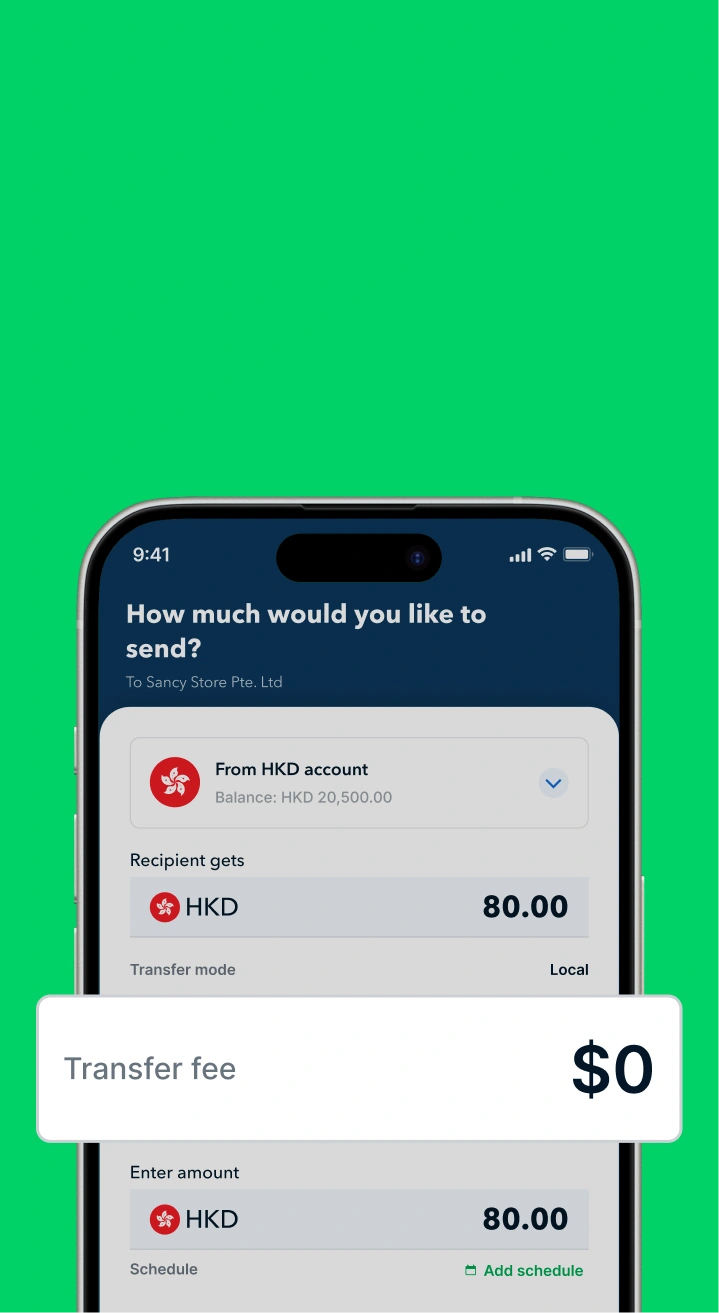
- Full financial control in one platform. Issue corporate cards with configurable spending limits, automate invoice and bill management, and sync every transaction with Xero or QuickBooks in real time. For Hong Kong SMEs managing payroll, free FPS and CHATS are both natively supported — ensuring domestic payments clear on time, every time.
- 1.2% unlimited cashback. Every eligible transaction on your Aspire corporate card earns 1.2% cashback. Combined with over USD 500,000 in partner rewards included with your account, Aspire turns your operating costs into working capital from day one.
Open your account free. Approved in as little as one business day. No branch visits, no stacks of paper forms, no waiting weeks for a relationship manager to call you back.
Frequently Asked Questions
What does a liquidator do during a winding-up?
A liquidator assumes complete control of the company in place of the directors. Their duties include conducting a full investigation into the company's financial position and history; identifying, taking custody of, and protecting all company assets; pursuing outstanding book debts and receivables; examining whether any assets have been improperly transferred or disposed of before winding-up commenced; reviewing and adjudicating on creditor claims; distributing the realised assets to creditors in the strict statutory order of priority; managing all tax obligations and obtaining tax clearance from the IRD; and completing all legal formalities required to dissolve the company.
In compulsory winding-up cases, the liquidator must also report to the court on the conduct of the company's directors and officers during their tenure.
Does company winding-up affect a director's personal life?
Generally, where the company is a private limited company and the director has not provided personal guarantees or engaged in fraudulent or negligent conduct, the winding-up of the company does not equate to personal bankruptcy and does not directly restrict the director's personal activities.
However, if the liquidator or the Official Receiver identifies misconduct, the court may issue a Disqualification Order prohibiting that person from acting as a director — or from being directly or indirectly involved in the management of any company — for up to 15 years. If a director has provided personal guarantees that they are unable to meet, they may face personal bankruptcy proceedings, which carry significant restrictions on personal financial life and activities.
What is the difference between company winding-up and deregistration?
Winding-up is a formal legal process — either voluntary or court-ordered — through which a company's assets are realised, its debts settled in the statutory order, and the company dissolved. It is used where there are outstanding liabilities, creditor disputes, or complex assets requiring regulated handling. Deregistration is a simpler administrative procedure available only to companies that have no outstanding liabilities, have ceased operations, and satisfy all eligibility criteria. It does not involve a liquidator or the court, and is significantly faster and less costly. Any company with unresolved debts — including tax obligations or government fees — cannot use the deregistration route.
Can a company be wound up even if it is not insolvent?
Yes. A solvent company may be wound up voluntarily by its members through a members' voluntary winding-up where the shareholders decide to cease operations. The court may also order the winding-up of a solvent company on just and equitable grounds — such as an irreconcilable deadlock between shareholders, the loss of the company's founding purpose, or serious prejudice to the interests of a section of the membership.

.jpeg)




.webp)