



What Is a Bank Statement?
A bank statement, sometimes called an account statement, is an official document issued by your bank that records every financial activity on a specific account during a set period, typically one calendar month.
It captures deposits, withdrawals, transfers, card transactions, bank fees, interest credits, and any other credits or debits during that window. Most Hong Kong banks issue statements monthly, with the statement period usually closing at month-end and the document arriving within the first few days of the following month.
Bank statements carry legal standing. They serve as the formal transaction record between you and your bank and are routinely required when applying for business loans, renewing leases, filing tax returns, processing visa applications, or opening additional accounts. For Hong Kong businesses specifically, the Inland Revenue Department (IRD) may request bank statements during a profits tax review, and they form part of your auditor's core documentation set.
That legal weight makes accuracy critical. If a statement contains an error, wrong address, wrong account number, incorrect currency, it may be rejected as a supporting document and you will need to correct it with your bank before resubmitting.
e-Statement vs Paper Statement: Which Should Your Business Choose?
Hong Kong banks primarily offer two statement formats. The right choice depends on your workflow but for most businesses, the answer is straightforward.
[Table:1]
For most businesses, e-statements are the better default. They're free, immediately available, searchable, and accepted by the vast majority of banks, telecoms, landlords, and government agencies in Hong Kong.
Printed e-statements, PDFs you download and print yourself are treated as equivalent to original documents in most situations.
The exception: certain overseas embassies, foreign law firms, and some mainland China institutions still require a stamped original. If you're processing a visa application or a cross-border transaction that demands physical proof, call ahead and confirm the format requirement before requesting your statement.
One note on cost: If your business is still receiving paper statements and hasn't opted in to e-statements, that's a quick win. At HKD 20 per account per month, that's HKD 240 per account per year for zero additional value if you're already downloading PDFs to reconcile your books.
How to Read a Bank Statement: Breaking Down Every Section
Opening a bank statement for the first time can feel like reading a foreign language with rows of abbreviations, amounts, and running balances. Once you understand the structure, it becomes intuitive. Here's what each section actually means.
Account Information (Top Section)
The header of every bank statement contains the reference details that confirm the statement belongs to your account:
- Account holder name / company name: For business accounts, this must show your company's registered full name, not a trading name or the director's personal name.
- Account number: If you hold multiple accounts, verify each statement against the correct account number before reconciling.
- Statement period: The specific date range the statement covers, e.g. "1 May 2025 – 31 May 2025."
- Bank name and branch details: The issuing institution and branch contact.
- Currency: HKD, USD, EUR, RMB, or whichever currency the account operates in.
If any of these details contain an error, especially the company name or account number, contact your bank immediately. A statement with incorrect information is not legally valid as a supporting document.
Transaction Records: Date, Description, Amount, Balance
The transaction table is the core of any bank statement. Each row represents one financial event, with four key columns:
[Table:2]
Practical note: If multiple transactions occur on the same date, each will appear as a separate line with its own post-transaction balance. This is how you trace exactly when and in what order funds moved.
Opening Balance vs Closing Balance
These are the two most strategically important numbers on your statement:
- Opening balance: Your account balance at the start of the statement period. This should match exactly the closing balance on your previous month's statement. If it doesn't, call your bank, the discrepancy could indicate an unposted transaction or an administrative error.
- Closing balance: Your account balance at the end of the statement period. This becomes the opening balance for next month.
The difference tells you your net cash position for the month:
- Closing balance higher than opening balance → net cash inflow (more came in than went out)
- Closing balance lower than opening balance → net cash outflow (more went out than came in)
For finance managers, tracking this month-on-month delta without needing a full cash flow report is a fast way to maintain cash flow management discipline between formal reporting cycles.
Fees, Interest, and Periodic Charges
Bank statements also record recurring and one-off charges that many businesses overlook:
- Account maintenance fee: Charged when your account balance falls below a minimum threshold. The threshold and fee amount vary by bank and account type.
- Wire transfer fees: Charged per outbound international transfer. Traditional banks typically apply either a flat fee or a percentage of the transfer amount. Understanding these bank charges in Hong Kong across different providers can reveal significant savings opportunities.
- Interest credits: Interest earned on savings balances, credited monthly. Typically a small amount for current accounts but worth tracking.
- Service charges: Ad hoc fees for document requests, returned cheques, account queries, or other one-time services.
Review these line items every month. The total is often larger than expected and identifying unnecessary fees is one of the fastest ways to reduce your monthly banking cost.
Bank Transaction Code Glossary: Every Abbreviation Explained
The abbreviated codes in the transaction description column are one of the most confusing parts of reading a bank statement. Here's a comprehensive reference for codes commonly used by Hong Kong banks.
Deposit and Transfer Codes
[Table:3]
For a deeper understanding of the transfer rails behind these codes, particularly the difference between SWIFT international wires and local transfer networks, see our guide on what is a wire transfer and how the two compare on cost and speed.
Withdrawal and Payment Codes
[Table:4]
Fee, Interest, and Miscellaneous Codes
[Table:5]
Important: These are the most widely used codes across Hong Kong banks, but individual banks may use variations. If you see a code you don't recognise, log in to your online banking portal, the full transaction description is usually available there. If you still can't identify it, call your bank's customer service line before assuming it's correct.
How to Use Your Bank Statement Strategically as a Business
Bank statements are not just audit paperwork. For SMEs and growing businesses in Hong Kong, a carefully reviewed monthly statement is one of your most actionable finance tools.
1. Reconcile Regularly to Catch Errors Early
Assign someone to complete statement reconciliation within a week of each statement being issued. The process involves matching every line item on your statement against your internal records accounts payable logs, sales receipts, payment confirmations. Any discrepancy should be investigated immediately, not left to accumulate until year-end.
Delays are expensive. Undiscovered errors compound. And if you eventually need to dispute a transaction, most Hong Kong banks require you to raise a formal objection within 60 days of statement issuance after which they may not investigate. Prompt reconciliation is your best protection.
If you're still doing this manually, it's worth exploring accounting software for small business that integrates directly with your bank data dramatically reducing the time spent on each monthly close.
2. Track Cash Flow in Real Time
Your bank statement is the most straightforward cash flow analysis tool available. You don't need a spreadsheet model to tell you whether last month was a net inflow or outflow, the opening and closing balances tell you immediately.
More importantly, reviewing monthly patterns over 3 to 6 months reveals seasonal trends, payment timing mismatches between receivables and payables, and periods where cash gets tight. This is the data that informs a credible cash flow forecasting model and it costs you nothing extra to extract from statements you're already receiving.
3. Support Your Tax Filing
During profits tax season, your commercial bank statements are the primary document your accountant or auditor will reference to verify declared income and deductible expenses. Keep them filed by account and by year at minimum for seven years, to match the IRD's general records retention expectation for audits.
Well-organised statements also reduce the billable time your accountant spends on your file. The faster they can reconcile your records, the lower your annual audit fee.
4. Cut Unnecessary Banking Costs
This is where statement reviews pay for themselves. Line by line, most business owners find charges they had forgotten about: subscriptions that auto-renew, wire transfer fees on payments that could have gone via FPS for free, account maintenance fees triggered because a sub-account fell below its minimum balance.
Tracking your business expenses properly starting with the bank statement, is the most direct route to identifying costs that can be eliminated without affecting operations. Even HKD 500 a month in avoidable bank fees amounts to HKD 6,000 a year: real money for an early-stage business.
5. Use as a Financial Proof Document
Business bank statements are widely accepted as proof of financial standing for commercial lease applications, government tenders, trade credit applications, and cross-border business relationships. Many counterparties will ask for 3 to 6 months of bank statements before extending credit or entering a significant contract.
The statement must show: your company's registered legal name, the account number, the statement period, and ideally an average month-end balance that demonstrates financial stability. Make sure your company name on file with your bank matches your Companies Registry name exactly. Inconsistencies are a common reason statements get rejected. If you haven't yet opened a dedicated business account, see our guide on how to open a business bank account in Hong Kong.
How to Request a Bank Statement in Hong Kong
Requesting e-Statements (Recommended)
Most Hong Kong banks have fully rolled out e-statement services. Setting them up takes less than five minutes:
Step 1: Log in to online banking or your bank's mobile app. Navigate to "Account Settings," "Statement Preferences," or a similar section.
Step 2: Enable e-statements. Select the accounts you want to activate, confirm your registered email address is current, and accept the terms.
Step 3: Download monthly statements. Once issued, you'll typically receive an email or push notification. Log in and download the PDF directly.
Step 4: Back up regularly. Download and save each statement when it's issued. Many banks only retain online records for 3 to 7 years, once a statement ages off the portal, you'll need to submit a formal retrieval request (often paid).
Paper Statement Fees by Major Hong Kong Bank
If your counterparty specifically requires a stamped physical original, you'll need to request paper statements through your branch or customer service line. Representative fees (for reference; verify current rates with your bank):
[Table:6]
Note: Fees listed above are indicative only and subject to change. Always confirm current charges with your bank before requesting.
Requesting Historical Statements
If you need statements older than 3 months for an audit, a legal matter, or a tax review, you'll need to submit a written retrieval request to your bank. Most banks charge a fee that scales with the age of the records. Some banks allow self-service retrieval of up to 5 to 7 years of records directly through online banking at no cost.
The practical lesson: start downloading and archiving your statements from day one. Retroactive retrieval is inconvenient, slow, and often expensive. Building a simple folder structure by account, then by year, then by month, takes minutes to maintain and saves significant hassle later.
What to Do If Something Looks Wrong on Your Statement
Errors happen. Unauthorised charges happen. The process for dealing with both is the same: act quickly.
Step 1: Match Every Transaction to a Record
Go line by line. For each debit, you should be able to point to an invoice, a payment confirmation, or an expense report. For each credit, you should be able to match a customer payment or incoming transfer. If you're using any top expense tracking apps or cloud accounting software, this cross-check should be largely automated.
Step 2: Flag Anything That Doesn't Match
Pay close attention to:
- Unfamiliar merchant names or payees: particularly for POS or online charges you don't recognise
- Duplicate charges: the same amount debited twice within a short window
- Round-number anomalies: odd-amount charges in currencies you don't typically transact in
- Overseas POS charges during periods when no one from your company was travelling
Any of these warrants investigation before you assume it's legitimate.
Step 3: File a Formal Dispute with Your Bank
The Hong Kong Monetary Authority (HKMA) sets expectations for how banks handle transaction disputes. In practice, most Hong Kong banks require disputes to be raised within 60 days of the statement date. After that window closes, banks may decline to investigate.
When disputing, provide: the exact date, the amount, the transaction description on your statement, and your reasoning for the dispute. Supporting documentation, payment receipts, transfer confirmations, photos of card machine receipts strengthens your case.
Step 4: Report Suspected Fraud Immediately
If you believe your account has been compromised, unauthorized transactions, unfamiliar new payees, or a sudden drop in balance you can't explain — call your bank's 24-hour emergency line immediately and request an account freeze. Speed matters: the faster you act, the higher the probability of recovering funds.
After contacting your bank, consider filing a report with the Hong Kong Police Force's Cyber Security and Technology Crime Bureau. For guidance on staying safe with your online accounts, see our overview of online banking security best practices.
Recommended retention: Keep e-statements for at least seven years, organised by account and year. For businesses, designate a specific team member to own statement archiving and backup.
How Transparent is Your Business Bank Statement?
When choosing a financial provider, many SMEs and startups focus solely on account opening requirements and monthly subscription fees. However, they often overlook a critical factor: statement clarity. The transparency of your monthly statement directly impacts your ability to track cash flow accurately and control financial costs effectively.
Traditional business bank statements frequently present several major pain points:
- Vague and Cryptified Fees: Statements often show generic descriptors like "Service Charge" or "Transaction Fee" without explaining the specific service used or the frequency of the charges. This forces businesses to call the bank just to decipher their own statement.
In contrast, Aspire itemizes every fee by service type, making every line item fully traceable and removing the guesswork from reconciliation.
- Scattered Hidden Costs: Cross-border transfer fees, telegraphic transfer (TT) handling charges, and FX processing fees are often scattered across different sections of a traditional statement. Accumulated over time, these hidden costs can easily exceed your budget, making accurate financial forecasting incredibly difficult.
Aspire features a transparent fee structure—what you see is what you get, eliminating the need to hunt down hidden costs line by line.
- Inward FPS Charges: Some financial institutions charge a 0.3% fee on incoming Faster Payment System (FPS) transfers. For businesses processing a high volume of local customer payments daily, this quickly adds up to a significant expense.
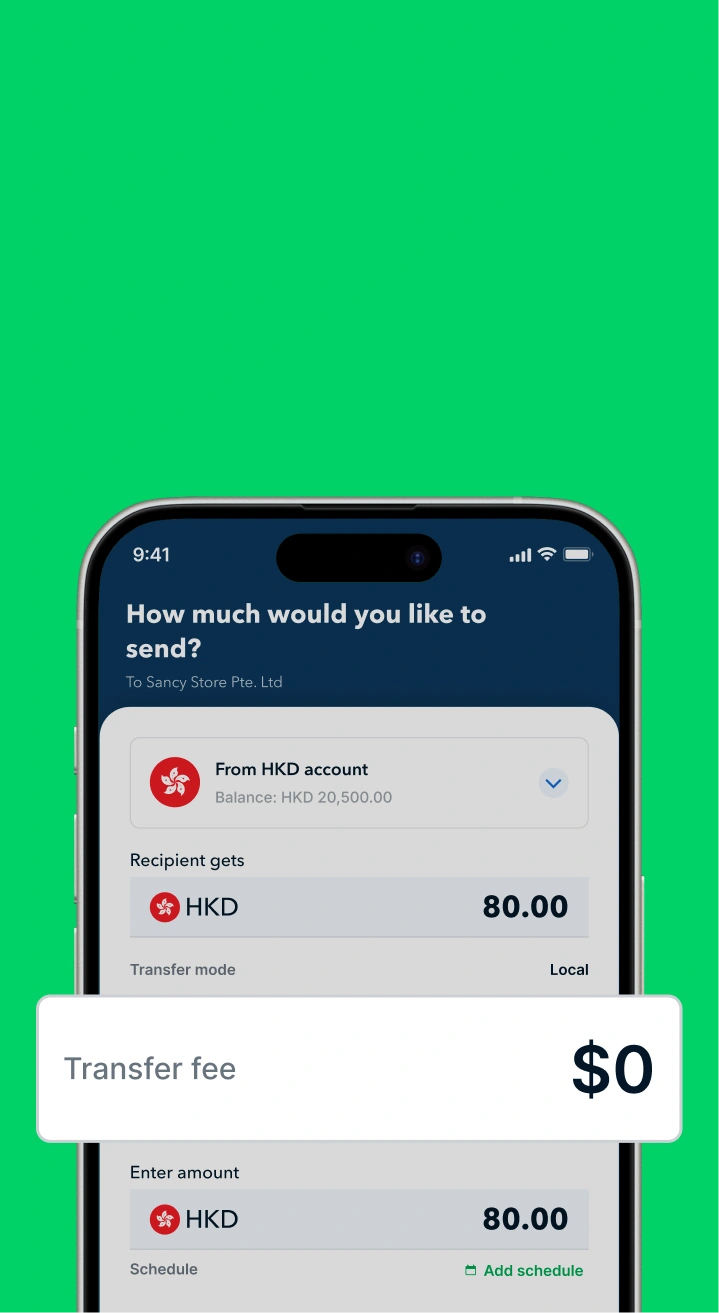
With an Aspire business account, incoming FPS transfers incur zero fees, ensuring no unexpected deductions appear on your monthly statement.
- Variable Inward Wire Fees: Traditional banks often charge a percentage-based fee for receiving international wires—meaning the more money your clients send you, the more the bank takes. This penalizes businesses that regularly receive large cross-border payments.
Aspire offers a flat USD $8 fee for incoming international wires, keeping your costs completely predictable no matter the transaction size.
How Aspire Supports Your Financial Compliance
Aspire is a fully integrated financial operating platform designed specifically for modern Hong Kong businesses:
- Global reach, local simplicity. With Aspire multi-currency account, your business can send and receive payments across 130+ countries in 40+ currencies — with FX spreads from just 0.18%, up to 3x cheaper than a traditional bank wire. Where possible, Aspire routes transfers through local payment rails rather than multi-hop SWIFT chains, which means fewer intermediary fees, faster settlement, and less risk of funds being held at a correspondent bank for compliance review. This is particularly valuable when sending to markets like the UK, the US, or Southeast Asia, where local payment networks can significantly reduce costs and settlement times versus SWIFT.
- SWIFT transfers with instant confirmation. When SWIFT is the right rail for your payment, Aspire processes it with full SWIFT GPI tracking enabled. Once your transfer completes, you can download your payment confirmation instantly from the app — no calls to the bank, no admin fees, no waiting for an MT103 copy to be emailed over.
- Full financial control in one platform. Issue corporate cards with configurable spending limits, automate invoice and bill management, and sync every transaction with Xero or QuickBooks in real time. For Hong Kong SMEs managing payroll, free FPS and CHATS are both natively supported — ensuring domestic payments clear on time, every time.
- 1.2% unlimited cashback. Every eligible transaction on your Aspire corporate card earns 1.2% cashback. Combined with over USD 500,000 in partner rewards included with your account, Aspire turns your operating costs into working capital from day one.
Open your account free. Approved in as little as one business day. No branch visits, no stacks of paper forms, no waiting weeks for a relationship manager to call you back.
Frequently Asked Questions
What is the difference between an e-statement and a paper statement?
An e-statement is a digital PDF version of your bank statement, available to download through online banking or a mobile app at no charge. A paper statement is physically mailed to your registered address and often incurs a monthly fee typically HKD 20 or more at major Hong Kong banks. For most purposes, a printed e-statement is accepted as equivalent to a paper original. The exception: some overseas embassies and foreign legal firms require a bank-stamped physical document, so check requirements with the receiving party before assuming either format will work.
How do I request a historical bank statement older than three months?
For statements beyond the self-service window on your online banking portal, you'll need to submit a written request directly to your bank — in person at a branch or through their official customer service channel. Most banks charge a retrieval fee that increases with the age of the records. To avoid this, download and archive each monthly statement as it's issued. Many banks retain online records for only three to seven years, after which older statements require a formal paid request.
What should I do if I see a transaction code I don't recognise?
First, refer to the transaction code glossary in this article, codes like FPS (Faster Payment System), TT (Telegraphic Transfer), DD (Direct Debit), SO (Standing Order), and CHATS cover the majority of transactions you'll see on a Hong Kong business account. If the code isn't in this list, log in to your online banking portal, the full transaction description there usually provides more detail than the printed statement. If you still can't identify it, call your bank's customer service team: they can trace a transaction by date and amount and tell you exactly what it represents.



.webp)