


What Is Mobile Payment?
Mobile payment — sometimes referred to as Mobile POS — describes a setup where a merchant uses a smartphone as the primary tool for accepting electronic payments from customers, without needing a traditional physical card terminal or full-scale cash register.
For Hong Kong SMEs, the rise of mobile payment addresses three persistent pain points: high hardware costs (traditional POS terminal rental and monthly fees), slow settlement (credit card settlement traditionally takes T+2 or longer), and the administrative burden of cash handling.
2 Core Technologies Behind Mobile Payment
QR Code Payments
QR code payment collection is currently the most widely adopted mobile payment method in Hong Kong, with an extremely low barrier to entry. The merchant generates a payment QR code within a supported app (FPS, AlipayHK, WeChat Pay HK, PayMe), and the customer scans it with their phone, enters or confirms the amount, and completes payment.
A static QR code can be printed and displayed at the checkout counter for fixed amounts or self-service scenarios. A dynamic QR code is generated by the merchant for each individual transaction, with the amount automatically populated — reducing the risk of manual entry errors.
The advantages of QR code collection are zero hardware cost and compatibility with nearly every major payment method in the market. The trade-off is a marginally longer checkout flow, since the customer must actively retrieve their phone and open the relevant app to scan. For high-footfall businesses that need to turn tables quickly — restaurants, for example — this extra step can introduce a noticeable amount of friction.
NFC Contactless Payments (Tap to Pay)
NFC contactless collection is the second major category, and one that has developed rapidly in recent years. The merchant uses their phone's NFC capability to let the customer simply tap their credit card, debit card, Apple Pay, or Google Pay against the merchant's device to complete payment — an experience close to a traditional POS card tap.
In late 2025, Apple officially launched Tap to Pay on iPhone in Hong Kong, enabling iPhone XS or later models to accept contactless payments with no additional hardware required. On the Android side, several fintech providers now offer comparable SoftPOS functionality.
The advantages of NFC collection are a faster checkout and a smoother customer experience. The trade-off is that the device must support NFC, and the payment methods currently accepted are largely limited to credit cards and major e-wallets — certain local QR-based methods, including FPS, do not currently support the NFC mode.
Mobile Payment Methods in Hong Kong: Which Is Right for Your Business?
Hong Kong's mobile payment ecosystem is built around four main components: FPS, the major e-wallets, Tap to Pay on iPhone, and traditional mobile POS. Each carries a distinct fee structure, settlement speed, and ideal use case.
FPS: Instant Settlement, the Most Widely Adopted
FPS (Faster Payment System, 轉數快) is the real-time payment infrastructure launched by the Hong Kong Monetary Authority in 2018. It connects virtually every major bank and stored value facility (SVF) operator in the city, runs 24/7, and supports both HKD and RMB transactions.
For merchants, FPS's defining advantage is instant settlement. Once a customer completes the transfer, funds land in the merchant's account almost immediately — there is no waiting for a settlement cycle. Compared to the typical T+2 settlement of credit cards, this matters enormously for SMEs that depend on frequent cash flow turnover.
Merchants can accept FPS payments in three ways:
- Sharing a registered mobile number, email address, or FPS ID for the customer to transfer to directly
- Generating a dynamic FPS QR code within an app for each transaction, with the amount auto-populated to reduce reconciliation errors
- Printing a static FPS QR code and displaying it at the checkout counter — suitable for fixed-amount or self-checkout scenarios
The hidden cost of FPS sits at the business account level. Personal P2P transfers in Hong Kong are almost universally free, but FPS collection fees on business accounts are set independently by each bank. Some traditional banks charge a percentage-based fee on incoming FPS payments — a cost that adds up meaningfully for businesses with high monthly collection volumes.
For a complete walkthrough of how to set up corporate FPS — including the application process and required documents — see our dedicated guide to setting up business FPS.
E-Wallets: AlipayHK, WeChat Pay HK, and PayMe
Hong Kong's three dominant e-wallets each serve a distinct user base and carry their own fee structure. Merchants should select based on their target customer demographic.
- AlipayHK
AlipayHK has over 4 million active users in Hong Kong, and interoperates with Mainland China's Alipay, enabling Mainland tourists to scan a Hong Kong merchant's QR code directly for payment. It is accepted at over 150,000 merchants. For businesses located in tourist hotspots — Tsim Sha Tsui, Mong Kok, Causeway Bay — or with a significant Mainland customer base, integrating AlipayHK is close to essential.
Fees can be as low as 0% for certain merchant categories, but specific rates should be confirmed directly with AlipayHK's merchant services team. Funds typically accumulate and are settled into the merchant's registered bank account on a defined settlement cycle — not via instant FPS settlement. For detailed setup steps, see our AlipayHK merchant guide.
- WeChat Pay HK
Also connected to a large Mainland customer base, WeChat Pay HK has, since 2023, supported HKD payments accepted from users across multiple Mainland cities. Merchant fees are generally around 1.2%, though under a measure introduced from 2025, SMEs enjoy a fee waiver on the first HK$500,000 of annual collections, and taxi drivers enjoy a 0% fee year-round. Settlement typically takes 2 to 5 working days, with some conditions allowing for faster settlement. For a complete setup walkthrough, see our WeChat Pay HK merchant guide.
- PayMe for Business
Launched by HSBC, PayMe has around 3 million users and is widely used across more than 90,000 merchants. Fees are 1.2% for collections via in-app PayCode, or 1.5% for API or POS-integrated collection. For small merchants with modest daily transaction volumes, PayMe is one of the lowest-barrier options to set up. For step-by-step setup instructions, see our PayMe for Business guide.
The three e-wallets each have distinct strengths and are not mutually exclusive. Most Hong Kong merchants integrate FPS alongside at least one or two e-wallets to cover the broadest possible range of customer payment preferences.
Tap to Pay on iPhone
Tap to Pay on iPhone officially launched in Hong Kong in late 2025, enabling iPhone XS and later models to accept contactless credit cards, debit cards, Apple Pay, and Google Pay directly via NFC — with no additional hardware or traditional POS terminal required.
For mobile merchants — food delivery, on-site service providers, market stall vendors — the significance of Tap to Pay on iPhone is that it completely removes the hardware barrier to accepting card payments. Previously, accepting card payments required at minimum a mobile card reader (with a monthly fee plus transaction fee). Now, all that is needed is an iPhone and a supported payment collection app.
To use this feature, merchants must connect through a Payment Service Provider that supports Tap to Pay on iPhone. Several Hong Kong-based payment providers currently support this functionality, and merchants should confirm the specific fee structure with their chosen provider before committing. On the security side, all transactions are processed and encrypted through the device's Secure Element, and Apple does not have access to any transaction content or buyer identity information.
Tap to Pay on iPhone currently applies mainly to contactless payments via international card networks such as Visa and Mastercard. FPS and certain local e-wallets do not currently support this collection method. Android device users can access comparable functionality through select fintech SoftPOS solutions.
Mobile POS (mPOS)
Traditional mobile POS (mPOS) pairs a smartphone or tablet with an external card reader to accept chip card or contactless payments. For businesses whose customer base still primarily uses physical cards, hardware-based mPOS remains relevant. However, as SoftPOS solutions like Tap to Pay on iPhone have entered the Hong Kong market, the space for pure hardware mPOS is narrowing — merchants no longer need an external card reader, and can accept contactless cards, Apple Pay, and other e-wallets directly through an iPhone 11 or later.
The mPOS cost model typically includes an upfront hardware fee (the card reader), a monthly or annual fee, and a per-transaction fee (generally 1.2% to 3%, depending on industry category and provider). For businesses with larger transaction values and a customer base that still favours physical cards — high-end retail or professional services, for example — hardware mPOS remains a solid choice. For businesses whose primary collection channels are local e-wallets and FPS, the flexibility and lower barrier of SoftPOS solutions are more attractive.
Full Fee Comparison: Mobile Payment in Hong Kong
Fees are the central consideration when choosing a mobile collection method. The following table compiles the fee structures of the main mobile payment methods available to Hong Kong merchants.
[Table:1]
Important note: The figures above are general reference points as of May 2026. Individual platforms may adjust fees based on merchant category, business scale, and contract terms. Confirm the latest fees directly with each platform before integration.
From Mobile Collection to Cash in the Bank: How a Modern Business Account Optimises Cash Flow
Many Hong Kong merchants, when setting up mobile payment collection, focus exclusively on choosing the front-end app — and overlook the most critical question: which account does the collected money ultimately flow into, and what is that account's fee structure?
Traditional bank business accounts commonly apply fees across different transaction types, including P2B (customer-to-merchant transfers) and B2B (business-to-business transfers). Some banks charge a flat fee per transaction, others charge a percentage of the transaction value. For merchants with higher monthly transaction volumes, these fees can easily total several hundred — or even over a thousand — Hong Kong dollars per month.
Improving the front-end collection process is only the first step in financial management. Choosing a transparent, full-featured business account is what fundamentally reduces overall operating costs.
Aspire: One-Stop Business Finance Beyond Traditional Banking
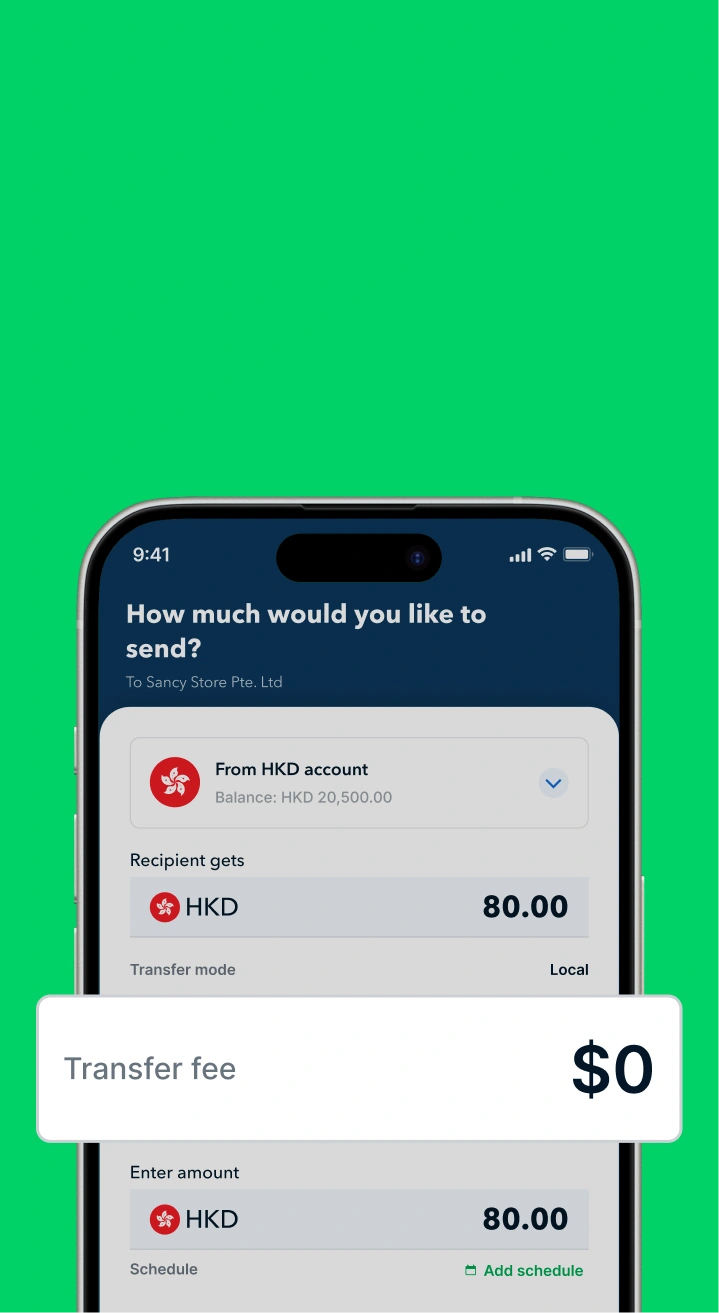
- One-stop global payments. Fully digital account opening, approved in as fast as one business day. Supports 130+ countries and 40+ currencies, with FX spreads as low as 0.18% (up to 3x cheaper than traditional banks). In addition to built-in FPS (free) and CHATS ensuring timely local collections, payments, and payroll, Aspire also offers a robust local payment network — letting you send and receive money overseas as if you were a local business. Compared to traditional SWIFT wire transfers, local transfers eliminate layered intermediary bank fees and significantly reduce settlement time, helping you save on remittance costs from the source.
- One-stop expense control. From creating invoices to paying bills, the entire process is fully automated. Issue corporate cards with configurable spending limits, capture receipts on mobile, and let employee expenses categorise automatically. All transaction data syncs seamlessly with Xero, QuickBooks, and NetSuite — from payroll to reconciliation, one platform resolves every administrative pain point.
- One-stop operational rewards. Turn your spending into rewards! Earn 1.2% unlimited cashback on eligible card spend, covering most operational and commercial expenses. Your account also comes with over USD 500,000 in partner rewards, covering tools like Google Workspace and Slack — rewarding your operating costs from the source.
Open your account free today, and experience a more flexible and intelligent business finance solution than traditional banking — built to accelerate your business growth.
Frequently Asked Questions
Do Hong Kong merchants need a licence to collect mobile payments?
Generally, merchants who connect directly to platforms such as AlipayHK, WeChat Pay HK, or PayMe to collect payments do not need to apply for a separate payment licence. The relevant licences are held by the payment platforms themselves; merchants simply need to complete the merchant registration and verification process required by each platform. However, if a merchant plans to build their own payment collection system or use a payment intermediary, they should be aware of the HKMA's requirements for Stored Value Facility (SVF) licensing. For businesses involving large or complex payment arrangements, consulting a professional adviser is recommended.
How quickly does money from mobile payment collection reach my account?
Settlement speed depends on the collection method. FPS settles instantly — typically within seconds. E-wallet payments (AlipayHK, WeChat Pay HK, PayMe) generally accumulate on the platform first and are transferred to the merchant's bank account on a settlement cycle, typically 2 to 5 working days. Credit card collection (via mPOS or Tap to Pay) typically takes T+2 or longer. Businesses with demanding cash flow requirements should prioritise FPS collection to minimise the time funds take to land.
Can small merchants or sole proprietors use business FPS?
Yes, but note the following: business FPS must be linked to a valid business bank account — a personal account cannot be substituted. Personal FPS collection is typically free, but constitutes a P2P transfer in nature; using it for sustained business collection may violate the bank's account terms of use, and is also unhelpful for separating personal and business finances. It is advisable to open a business account and set up business FPS as early as possible — this protects business compliance and makes future reconciliation and tax filing significantly easier.
Is it complicated to manage multiple mobile payment platforms at once?
This is a genuine concern for many SMEs. The recommended approach is to direct the settlement account for every collection platform to the same business account, and choose an account service that supports consolidated transaction records across multiple channels. Fintech business accounts such as Aspire can consolidate FPS and other channel collection records into a single platform and automatically sync with accounting software, significantly reducing the monthly reconciliation workload.


.webp)
.webp)


.webp)