



With its robust legal system, free monetary policy, and low tax rate advantages, Hong Kong has always been a global hotspot for capital convergence. Understanding the specific needs behind remittances helps us choose the most suitable transfer tools.
Personal Remittance
For individual users, overseas transfers to Hong Kong usually involve significant life scenarios:
- Study Fees & Living Expenses: Many overseas Chinese or expatriates send their children to Hong Kong universities (e.g., HKU, HKUST) and need to remit funds regularly to cover tuition and living costs.
- Immigration & Property Purchase: With the promotion of talent attraction schemes (like the Top Talent Pass Scheme), more overseas professionals are moving to HK. This involves large-scale capital transfers for down payments, stamp duties, or rent.
- Supporting Family: Many Hongkongers working abroad remit part of their salary monthly to support their parents or repay loans in Hong Kong.
Corporate Remittance
For business users, especially SMEs and cross-border e-commerce, efficient capital flow is the key to survival:
- Paying Suppliers: Hong Kong houses many procurement offices and logistics centers; overseas buyers need to pay HK suppliers regularly.
- Employee Salary Management: Multinational companies with HK branches must transfer funds from headquarters to pay salaries and Mandatory Provident Fund (MPF).
- Cross-border E-commerce Revenue: Sellers on platforms like Amazon and Shopify often need to convert USD or EUR income and remit it back to HK business bank accounts for fund aggregation.
What are the Challenges of Traditional Remittance
Despite the high demand, many are still trapped by the pain points of traditional remittance models:
- High Handling Fees: Beyond the sending bank's charges, Intermediary Banks deduct fees at multiple layers.
- Opaque Exchange Rates: Bank rates often include a high markup, differing significantly from the mid-market rate you see on Google.
- Slow Arrival Speed: Traditional wire transfers may take a full week if they hit weekends or public holidays, severely affecting cash flow.
4 Main Channels for Transferring to HK
Channel 1: Traditional Banks (e.g., HSBC, Hang Seng Bank)
The most familiar method, suitable for those handling large sums who prioritize trust in established institutions.
- Mechanism: Wire transfers via the SWIFT network (Telegraphic Transfer, TT).
- Pros: High security and strict regulation; high brand credibility; supports almost all countries; in-branch service available for the elderly.
- Cons: Complex fee structure (Sending fee + Intermediary fee + Receiving fee); high exchange rate markup (1.5% - 3% off mid-market); slow processing (1–5 business days).
Channel 2: Modern FinTech Platforms (e.g., Wise, Aspire, Revolut)
FinTech platforms have revolutionized the market by utilizing local payment networks rather than solely relying on SWIFT.
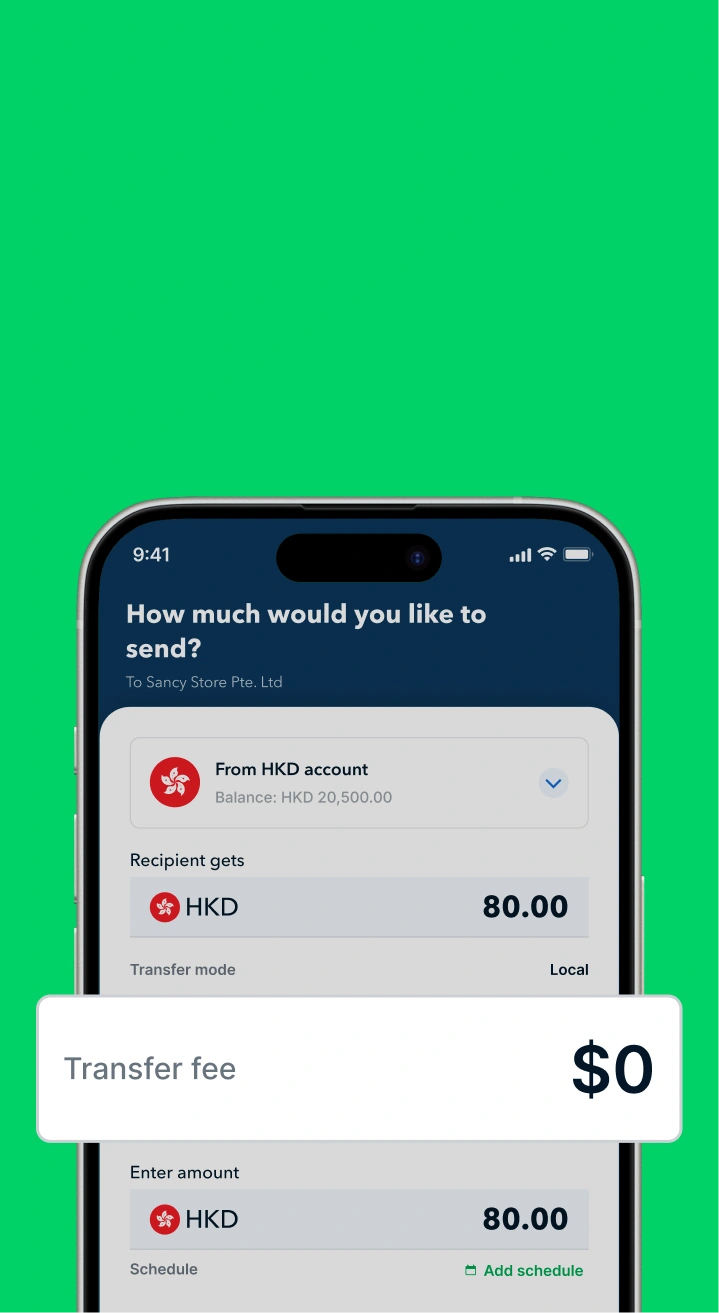
- Pros: Low and transparent fees; exchange rates close to the mid-market rate; fast arrival (same-day or even instant).
- Cons: Purely online operation with no physical branches; customer service is handled via chat/email.
Channel 3: Professional Remittance Companies (e.g., Western Union, MoneyGram)
- Pros: Fees are locked at the time of transfer; supports cash pickup, which is unique if the recipient lacks a bank account.
- Cons: Exchange rates may not be the best (hidden profit in the rate); lower transfer limits due to anti-money laundering regulations.
Channel 4: Internal Global Transfers (e.g., HSBC Global Transfer)
- Pros: Instant arrival between Global View accounts; zero handling fees for Premier-level customers or above.
- Cons: High entry barrier; restricted to "same-name" or linked accounts within the same bank group.
Deep Dive into Transfer Costs
To remit smartly, you must understand these three cost components:
- Remittance Bank Fee: The direct fee paid to your bank. Online/App transfers are usually significantly cheaper (HKD 50-65) than counter services (HKD 200+).
- Correspondent/Intermediary Bank Fees: The "hidden cost" of SWIFT. Every bank the money passes through may deduct a "Lifting Fee" (USD 15–50). FinTech platforms bypass this by using local-to-local settlement.
- Exchange Rate Markup: Often the highest invisible cost. A 2% markup on a USD 10,000 transfer can result in a loss of over HKD 1,500 compared to the mid-market rate.
Fee Payment Options: OUR / BEN / SHA
- OUR: Sender pays all costs. Recipient receives the exact full amount. Best for tuition or property deposits.
- BEN: Beneficiary pays all costs. Fees are deducted from the transferred amount.
- SHA: Shared costs. The most common in international trade, but the final amount received will be lower than sent.
What are the Steps Required for Transferring to HK
To avoid refunds or extra charges due to errors, prepare the following:
- Recipient’s Full English Name: Must match the bank account exactly.
- Recipient’s Bank Name & Address: e.g., HSBC Hong Kong (1 Queen's Road Central).
- Recipient’s Account Number: Includes the 3-digit branch code + the 6–9 digit account number.
- SWIFT/BIC Code: Essential for identification (e.g., HSBCHKHH for HSBC, HASEHKHH for Hang Seng).
- Overseas Requirements: US transfers may need an ABA Routing Number; EU transfers may request an IBAN.
How Long Does it Take to Reach Hong Kong?
- SWIFT Wire Transfer: 1 to 5 business days. Factors include cut-off times, time zone differences, and intermediary bank volume.
- FinTech Platforms: Often Instant to T+1 (next business day) because funds move within local pools.
- HSBC Global Transfer: Real-time (Instant) for linked accounts.
Choosing the Best Method for Your Scenario
- Lowest Cost & Speed (Small/Frequent): Best for students or family support. Choose FinTech (Wise, Aspire).
- Security & Large Amounts: Best for property or investment. Choose Traditional Banks via online banking (SHA or OUR mode).
- Overseas HSBC Holders: Always use HSBC Global Transfer for zero fees and instant speed.
- Business Users: Evaluate B2B platforms like Aspire for multi-currency management and accounting integration.
How Aspire Business Account Improves Efficiency
For businesses, a simple transfer tool isn't enough. Aspire provides an all-in-one financial OS:
- Multi-Currency Accounts: Open virtual accounts in HKD, USD, EUR, etc. Receive local currency directly without forced conversion.
- Competitive Rates: Save significantly on FX when remitting revenue back to HK or paying suppliers.
- Batch Payments: Pay multiple suppliers or handle payroll in one click, saving manual labor.
- Accounting Integration: Connect directly to Xero or QuickBooks; every overseas transfer is automatically synced.
Open an account for free now to experience a smarter financial solution and accelerate your business growth!

.jpeg)




.webp)