


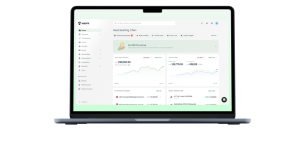
What is a cash budget?
A cash budget is a plan that estimates the cash moving into and out of your business over a set period, so you can see your closing position before the period starts. Take your opening balance, add what you expect to collect, subtract what you expect to pay, and what's left is your expected closing cash balance for that week, month, or quarter. It answers one question: will there be enough on hand to cover what's due?
Timing is what separates it from a regular budget, and the definition of a cash budget really turns on that. A standard budget asks whether revenue beats expenses over the year. A cash budget asks about the exact weeks when money comes in and goes out. You'll also hear it called a cash flow budget or a cash flow forecast, and the terms do overlap, but they aren't always the same thing. A cash budget usually lays out expected receipts, payments, and balances in a structured format, while a cash flow forecast tends to run broader or get updated more often.
Here's how it plays out. Say $120,000 in customer payments is due to you this month. Payroll of $55,000 clears on the 1st. Another $30,000 in vendor invoices comes due mid-month, and taxes and software take $10,000 more before you close out. The yearly math looks healthy. Whether the money's sitting there on each date it's needed is a separate question, and that's the one a cash budget answers.
To keep the three terms straight, here's how they line up:
The short version: a cash budget and a forecast both look ahead at cash you expect, while a cash flow statement looks back at cash that has already moved.
Why is a cash budget important?
A cash budget matters because it turns cash flow from guesswork into something you can plan around. It shows when money will be available, when it won't, and how much room you have before the next major payment falls due. Its purpose isn't record-keeping. It's spotting a shortage while there's still time to act on it.
Five benefits do most of the work, and each one answers a different decision:
None of these point to a single fix. If a shortfall shows up, moving a payment or drawing on a short-term line are options to weigh against their cost, not defaults, and often the cheaper move is accelerating a collection or deferring a discretionary spend.
How does a cash budget work?
A cash budget works by carrying one period into the next. You start with your opening cash balance, add the receipts you expect to collect, subtract the payments you expect to make, and you reach the closing balance for that period. That closing balance becomes the next period's opening balance, and the pattern repeats.
Three parts sit in the middle of that:
- Receipts. The cash you expect in, mostly customer payments. It helps to keep everyday operating receipts separate from one-off inflows like a loan or investor funding, since a balance that looks healthy only because you borrowed is different from one your operations paid for.
- Payments. The cash you're committed to send out. Payroll, rent, vendor bills, taxes, subscriptions, and one-off purchases.
- Net cash flow. Receipts minus payments. Positive leaves you with extra, negative leaves you short.
The reason timing matters is that a monthly total can look fine on its own. Your receipts might be higher than your payments for the month, and you can still run short partway through, when a large bill is due before the money meant to cover it arrives. Setting the dates side by side is what shows that shortfall early, while there's still time to weigh your options.
What are the types of cash budgets?
There are a few kinds, and what sets them apart is how far ahead you're looking. Most businesses use a short-term or a long-term version. A rolling one works better if your numbers move around a lot. Each protects your cash, but each answers a different question.
Short-term cash budget
This is the one you'll open most days. It covers weeks or a couple of months, and its job is to make sure payroll, vendor bills, subscriptions, and the rest of your running costs are all covered. How should you run it? Depends on how tight things are. Very tight cash cycles need a daily or weekly view. For normal operating decisions, weekly or monthly is usually enough, and you rarely need to look more than a few months out. When a collection needs chasing or a payment can wait a couple of days, this is the budget that tells you.
Long-term cash budget
A quarter, a year, sometimes more. This one is for the bigger decisions, the ones you plan around well in advance. Loan repayments. A round of equipment. An expansion you've been weighing. It keeps you from spending cash now that you'll want later, before the bill or the opportunity actually arrives. One caveat worth remembering: the further out you go, the softer the numbers get, because a long horizon leans on assumptions rather than payments you can already see.
Rolling cash budget
A rolling cash budget never really ends. Each time one period closes, you add another at the far end, so your view always reaches the same distance ahead instead of running down as the year goes on. It fits businesses where sales, payment timing, or costs keep shifting, the kind of situation where a fixed annual budget would be stale within a few weeks.
Key components of a cash budget
What's included in a cash budget comes down to a handful of parts that work together. Leave one out, and the projection drifts. Here's each one, what belongs in it, and the mistake that most often trips people up.
The two that founders most often skip are the last two. A closing balance can be positive and still fall short of what the next few weeks demand, which is exactly what the minimum cash balance is there to catch. And when a gap does show up, keeping any financing on its own line, rather than mixed into normal receipts, is what stops a borrowed cushion from reading like real operating cash.
Cash budget formula
The cash budget formula is built from three calculations that stack on top of each other. Here they are as clean display lines:
Net cash flow = Total cash inflows - Total cash outflows
Closing cash balance = Opening cash balance + Net cash flow
Closing cash balance = Opening cash balance + Total cash inflows - Total cash outflows
The first gives you net cash flow, the difference between what comes in and what goes out. Add that to your opening balance, and you get the closing balance for the period, which then carries forward as the opening figure for the next one. The third line is just the first two combined, which is why you'll see the formula written either way.
Here's the quick version in numbers. Open at $10,000, bring in $25,000, pay out $23,000. Net cash flow works out to $2,000, so you close at $12,000. Run it weekly, monthly, or quarterly, and the math is the same. The shorter the window, the sooner a shortfall turns up.
One more step matters if you hold a minimum cash balance, the floor you've decided not to drop below. The closing figure you calculate first is really a preliminary closing balance. If it sits above your minimum, you're fine.
If it falls below, the shortfall is the financing you'd need to arrange: Financing required = Minimum cash balance - Preliminary closing cash balance
So a period can post a positive closing balance and still leave you short, if that balance lands under the floor your operations actually need.
How to create a cash budget: step-by-step guide
Learning how to prepare a cash budget is mostly a matter of putting what you already know in order. You're not tracking every penny. You're mapping the weeks ahead closely enough that nothing catches you off guard.
Step 1: Choose your period and minimum cash balance
Decide how often you'll run the budget, weekly, monthly, or quarterly, and how far ahead you want to see. Then set the minimum cash balance you won't let the business drop below. That floor is what later steps measure against, so it's worth fixing up front.
Step 2: Confirm opening cash and pull your history
Start with the actual cash you have available right now, and be clear about which accounts count. Leave out anything restricted or not truly spendable. Then pull three to six months of statements and invoices to see where money usually spikes and dips.
Step 3: Forecast your cash receipts
List the cash you expect in, and date each item by when you'll realistically be paid, not when you invoiced or booked the revenue. Customer payments, loans, investor capital. The collection date is the part people get wrong, and it's the part that matters most.
Step 4: Forecast your cash payments
List everything going out and pin each item to its due date. Payroll, rent, vendors, taxes, subscriptions. Pull the irregular and one-off costs onto their own line too, since those are the ones that quietly throw a forecast off.
Step 5: Calculate the closing balance, then test it
Add net cash flow to your opening balance to get each period's closing figure, which becomes the opening balance for the next one. Then run it more than once, because a single forecast assumes everything goes to plan:
- Base case. Collections and payments land roughly when you expect.
- Downside case. A key payment comes in late or lighter than planned.
- Upside case. Collections arrive early, or sales run ahead of the base case.
Seeing all three tells you how much cushion you actually have if timing slips.
Step 6: Compare against actuals and update
The budget isn't a set-and-forget document. Payments come early, collections slip, something unplanned lands. Set a review rhythm, weekly or monthly, decide who owns it, and update it against what really happened so the assumptions stay honest.
Cash budget example
Here's a simple monthly cash budget running January through March. It shows how the same formula plays out as inflows and outflows shift, and how a tight month shows up well before it arrives. Assume this business has set an $8,000 minimum cash balance, the floor it doesn't want to drop below.
Reading it month by month: January opens at $10,000, nets $2,000, and closes at $12,000, comfortably above the floor. February is where it turns. Payroll rises, collections soften, and the month nets -$6,000, closing at $6,000. That's still a positive balance, but it's $2,000 under the $8,000 minimum, so it counts as a shortfall even though the account isn't empty. March recovers to $14,500, though part of that comes from $5,000 in financing rather than customer collections, which is worth noticing, since a recovery funded by borrowing is not the same as one your operations paid for.
The point is that February was visible back in January, with weeks to spare. Rather than defaulting to one fix, the business could weigh a few: accelerate a collection, hold back discretionary spend, renegotiate a payment date, or look at short-term financing, each with its own cost.
Common challenges in cash budgeting
Even a well-built cash budget slips sometimes. A handful of problems come up again and again.
- Inflows you can't count on. One client drags a payment out by a couple of weeks and a comfortable position turns tight. Keep a buffer, watch each customer's payment history, and chase what's overdue before you schedule money going out.
- Assuming everything gets paid on time. Forecasting each invoice as paid on the dot quietly overstates the cash you'll have. Date your receipts off how each customer actually pays, and keep a downside version of the forecast for when collections run late.
- Missing the irregular payments. Quarterly taxes, an annual renewal, a one-off repair. The costs that don't recur monthly are the ones most likely to get left out, and they're often the largest.
- Dates that don't line up. A profitable month can still feel tight when a large payment falls due ahead of the revenue meant to cover it. Line your payments up deliberately, and look at collection timing and payment terms first when a gap appears. If you do consider a short-term line to bridge it, weigh the cost, the repayment, and what it does to next month's cash before you lean on it.
- Reading borrowed cash as performance. A closing balance propped up by a loan or new investment isn't the same as one your operations earned. Keep financing on its own line so a healthy-looking month is easy to read for what it really is.
- Errors from manual tracking. Copy numbers between a few spreadsheets and small mistakes pile up quietly, right up until they don't. One maintained source beats a scatter of notes.
- A budget that's gone stale. A new hire, a surprise bill, one delayed payment, and last month's plan is already off. Treat it as a living document, update it against actuals, and don't rely on a single forecast when timing could go either way.
- Cross-border timing, if you operate in more than one currency. Exchange moves and transfer delays can shift what actually lands in your account versus what you forecast. If that's you, budget the currency the cash arrives in, and leave room for conversion timing.
Cash budget vs operating budget vs cash flow statement
A cash budget gets confused with two other tools that sound similar but do different jobs: the operating budget and the cash flow statement. Here's how the three compare.
The short way to hold them apart: a cash budget tracks when actual cash moves, an operating budget tracks whether you're profitable, and a cash flow statement reports what already happened. A business can look healthy on an operating budget and still hit a cash-timing problem, which is exactly what a cash budget is built to catch.
Conclusion
A cash budget helps you see when cash is about to fall below what you owe, or below the minimum buffer you've set, in time to do something about it. The budgets that actually earn their keep are the ones kept current, updated against real receipts and payments so you can adjust the assumptions before a tight month turns into an urgent one.
The practical next step is a review rhythm: check the forecast against what actually landed, weekly or monthly, and update it. That habit matters more than the tool you build it in. A well-maintained spreadsheet does the job.
As cash starts moving across more accounts, cards, and currencies, keeping that forecast lined up with actual transactions gets harder. Aspire¹ helps eligible US businesses bring account activity, card2 spend, and payment workflows into one view, so it's easier to compare what you planned against what's actually moving. Where multi-currency accounts* are available, you can hold and spend funds in the currencies you earn, which keeps that comparison closer to real availability. It won't build the budget for you, but it gives you a clearer, current picture to build it from.