

What is an invoice
An invoice is a formal document issued by a seller requesting payment for goods or services. Legally, an invoice establishes a receivable. It documents that a customer owes your business money.
If a client fails to pay, the invoice becomes your primary evidence in a collection effort or legal claim. It proves that a financial obligation was created.
An invoice is more than just a billing document; it’s revenue control.
For founders running B2B operations, construction firms, consulting practices, or service-based businesses, invoicing discipline directly affects cash flow stability.
How to write an invoice
A strong invoice removes ambiguity and speeds up payment. A professional invoice should include:
- Your business name, contact details, and branding
- The client’s legal name and billing information
- A unique invoice number
- Issue date and service date
- Itemized description of goods or services
- Quantity, rate, subtotal, and applicable sales tax
- Payment terms such as Net 15 or Net 30
- Due date
Note: Make sure to avoid vague line items like “services rendered."
Here’s a sample B2B invoice illustrating itemized services, payment terms, and total amount due.
[IMAGE_PLACEHOLDER_1]
What is a receipt
A receipt is proof that payment has been received.
Unlike an invoice, a receipt is issued after money changes hands. It confirms that a transaction is complete. Receipts are essential for substantiating deductible business expenses.
If the IRS audits your company, receipts are your defense.
How to write a receipt
At minimum, a proper business receipt should include:
- Your business name and contact information
- Transaction or order number
- Itemized list of goods or services
- Total amount paid (including taxes and fees)
- Date of payment
- Payment method
For IRS purposes, receipts over $75 and all lodging expenses require documentation with sufficient detail. Digital copies are fully valid as long as they’re legible and complete.
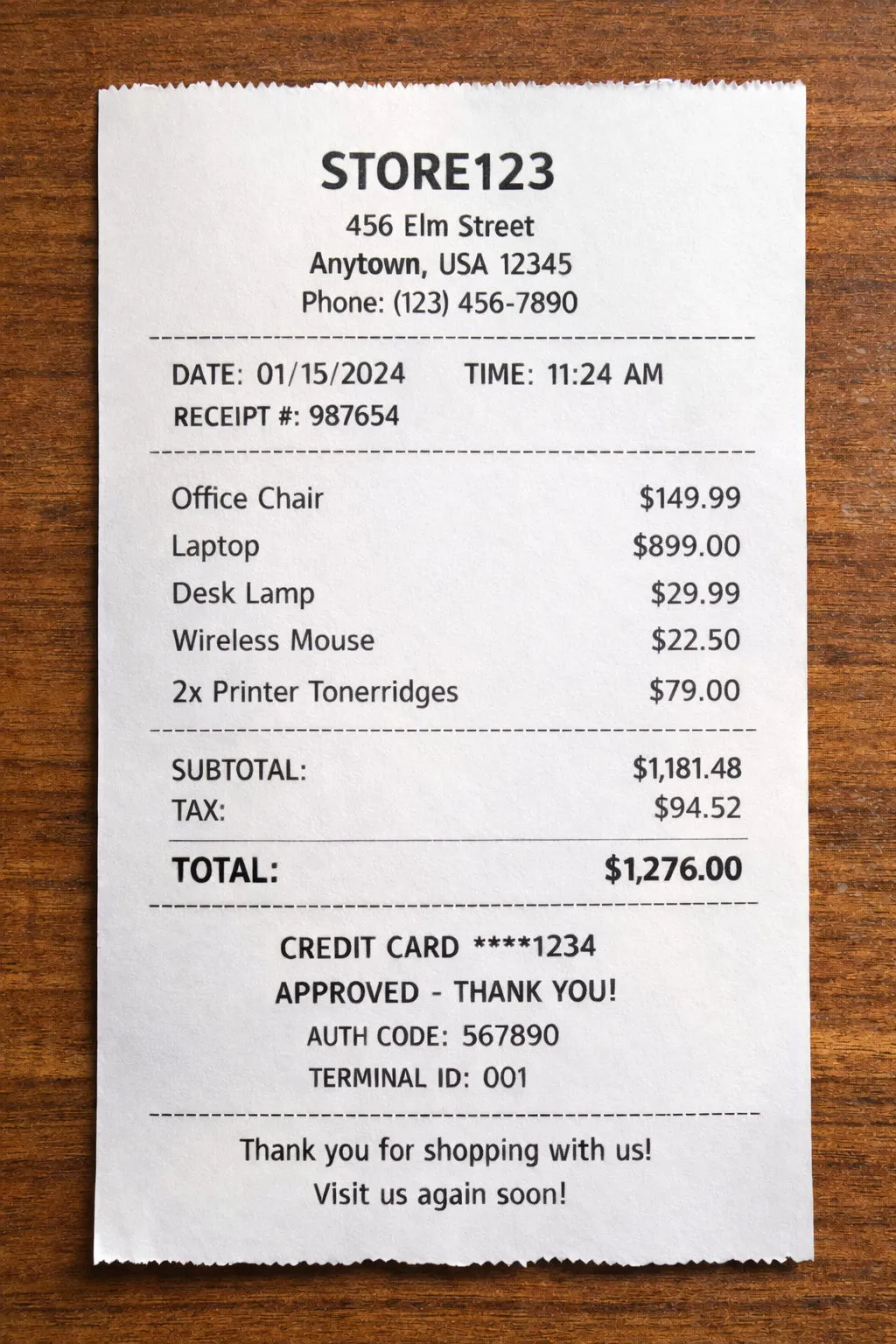
Example of a retail point-of-sale receipt showing itemized purchases, tax breakdown, and payment confirmation.
What is the difference between receipt and invoice: side-by-side comparison
Invoice = request for payment. Receipt = proof of payment.
[Table:1]
The invoice vs. receipt distinction directly answers common questions:
- An invoice is not a receipt
- A receipt is not an invoice
- They’re complementary, not interchangeable
When do you issue an invoice vs. a receipt
An invoice is issued when payment is expected later.
Issue an invoice when you need to:
- Request payment before funds are received
- Outline costs, quantities, and payment terms
- Create a formal record of money owed
- Protect your position with documented sale terms
If you close a $10,000 consulting engagement with Net 30 terms (payment is due within 30 days of the invoice date), you send an invoice, and the payment follows later. Until it’s paid, that amount is outstanding.
A receipt is issued once payment is complete.
Issue a receipt when you need to:
- Confirm payment after the transaction
- Provide proof of completed payment
- Summarize what was purchased
- Create a record that supports tax or audit documentation
Say you purchased equipment, such as a $2,000 laptop for a new hire; in that case, you retain the receipt to support a tax deduction.
If a customer purchases a subscription on your website and pays immediately, your system generates an invoice and receipt at the same time. In many cases, this appears as a “Paid Invoice.”
Can an invoice be used as a receipt
Yes, in many US jurisdictions, an invoice marked “PAID” with the date, payment method, and transaction reference can function as both an invoice and a receipt.
However, the paid invoice document must clearly confirm payment. An unpaid invoice can’t serve as proof of settlement.
Using a properly marked paid invoice can simplify recordkeeping and reduce admin work. But it must clearly show payment confirmation. In an audit, the IRS requires proof that payment was made, not just that it was requested.
Invoice vs. receipt: understanding IRS receipt requirements
Under IRS guidelines, itemized receipts are generally required for expenses over $75. However, lodging expenses require receipts regardless of amount.
A valid receipt must clearly show vendor, date, itemization, and total paid.
Record retention typically follows a 3-year federal standard, though some states, such as California, may effectively require longer retention.
For growing companies, setting automated receipt submission rules and matching transactions in real time reduces year-end stress and audit exposure.
Sales tax and compliance for invoice and receipt
One practical difference between an invoice and a receipt appears in sales tax reporting.
In most US states like Florida and Washington, sales tax must be listed as a separate line item on invoices. The invoice documents how much tax was charged, and the receipt confirms that tax was actually paid.
However, 5 states — Oregon, Montana, Alaska, New Hampshire, and Delaware — don’t impose statewide sales tax.
If you’re operating across multiple jurisdictions, invoice structure must reflect where the transaction occurs.
Invoice vs. receipt: common misconceptions
When discussing invoice vs. receipt, misunderstanding these documents creates risk. Here are the most common mistakes businesses make:
- An invoice guarantees payment
An invoice is a formal request for payment, not a confirmation that payment will be made. Until funds are collected, the amount remains outstanding. Treating issued invoices as secured revenue distorts cash flow visibility.
- Receipts are optional, especially for digital payments
Even when customers pay online, documentation is still required. A payment confirmation from a bank or payment processor is not a substitute for a properly itemized receipt. Clear documentation protects both accounting accuracy and audit defense.
- Invoices and receipts only benefit the seller
Invoices and receipts serve both sides of a transaction. An invoice defines scope and pricing expectations. A receipt confirms that payment obligations were met. When disputes arise, clarity benefits everyone.
- A receipt ends all risk
A receipt confirms that payment was made, but it doesn't eliminate the possibility of refunds, chargebacks, or adjustments. Financial controls must account for post-payment changes.
- Small businesses don’t need formal invoices or receipts
Informal billing and undocumented payments increase risk regardless of company size. Small operators, contractors, and growing startups all rely on invoices and receipts to maintain credibility, tax compliance, and financial control.
Invoice vs. receipt at scale: from billing to cash flow
As your revenue grows, documentation volume grows with it.
What starts as a handful of invoices and emailed receipts turns into hundreds of transactions across billing, subscriptions, reimbursements, and vendor payments. Without structure, reconciliation gaps widen and cash flow visibility weakens.
At that point, the difference between issuing an invoice and actually collecting cash becomes operationally significant.
With Aspire, you can turn outstanding invoices into cash in your account¹ through branded, professional invoicing and frictionless payment options. You generate invoices in USD and other major currencies, add your logo and business details, and send them instantly.
Your customers pay the way they prefer, ACH, wire, and other digital methods, using one-click payment links that remove delay.
On the backend, Aspire automatically matches payments to invoices and categorizes transactions in real time. Your dashboard shows what’s paid, pending, or overdue at a glance, giving you immediate visibility into revenue status and cash flow.
When billing, payment collection, and reconciliation live inside one financial stack, you gain control as transaction volume increases.