



What is Wise and why do businesses use it?
Wise (formerly TransferWise) is a UK-based financial technology company focused on low-cost international money transfers. It offers multi-currency accounts, local bank details in major currencies, and transparent FX rates that sit close to the mid-market rate.
Its core strengths are:
1. Low FX costs
Wise charges roughly 0.5% to 0.7% above mid-market rates, which is considerably cheaper than most traditional banks.
2. Multi-currency accounts
Businesses can hold, receive, and send funds in 40+ currencies using one account.
3. Ease of use
Wise is very intuitive and works well for small teams or individual operators who don't need approval workflows or spend controls.
Typical use cases
Freelancers receiving payments internationally, early-stage startups paying overseas contractors, founders making occasional cross-border transfers.
Wise is a well-built product for what it does. The question is whether what it does is enough as your business grows.
Why would you need to consider Wise alternatives
Founders scaling globally look for alternatives to Wise when they need more than just cross-border money transfer. Many Wise alternatives offer teams a capable finance OS, expense management systems and much more.
Where Wise starts to fall short
Wise is strong for transfers. Outside of that, the toolset is limited, and that gap becomes more visible as operations scale.
1. Limited spend management
Wise offers limited spend control beyond basic card usage. There are no per-card limits, category-level restrictions, or budget management tools built into the platform. For a team of 2 sending the occasional wire, this doesn't matter. For a team of 20 managing distributed spend across markets, it does.
2. No built-in approval workflows
Businesses with finance teams typically need multi-level payment approvals before money goes out. Wise doesn't offer this natively, which means founders end up building workarounds or managing approvals manually.
3. Not designed for multi-entity operations
If your business operates across multiple legal entities or regional subsidiaries, Wise's account structure makes it difficult to manage consolidated financial visibility.
4. Costs add up with volume
The per-transaction FX markup is competitive for low-frequency transfers, but at high volume, the cost compounds. Businesses sending large amounts regularly across currencies will often find better rates or more favorable structures elsewhere.
5. Inconsistent corporate card availability in the US
Wise's US business card offering has seen pauses and limitations, which creates friction for teams that need a reliable card product for day-to-day operations.
None of this makes Wise an inferior product. It makes it a product built for a specific use case, and businesses that have grown past that use case need different tools.
Best Wise competitors and their detailed breakdown
Here are the best replacements for Wise built for founders:
1. Aspire — best overall Wise alternative for global expansion
Aspire is a financial operating system built for founders and growing businesses. Where Wise stops at transfers and multi-currency accounts, Aspire keeps going: corporate cards2 with spend controls, expense management, budget tracking, and accounting integrations, all in a single platform.

Key strengths of Aspire over Wise:
Here’s why Wise users often switch to Aspire:
1. Multi-currency* global accounts
Aspire gives businesses local account details in USD, EUR, GBP, HKD, CNY, AUD, CAD, CHF, JPY, and more, at no cost. You can hold multiple currencies and convert only when rates work in your favor.
2. Competitive FX rates
Aspire charges from just 0.22% above mid-market rates on international transfers, which is sharper than Wise's typical 0.5% to 0.7% range. Transfers are available to 98+ currencies across 130+ countries with full upfront fee transparency.
3. Global payments at speed
Same-day local transfers to 40+ currencies, with 24/7 human support for businesses operating across time zones.
4. Smart corporate cards2 with 1.5% cashback^
Physical and virtual Mastercard corporate cards for teams, with per-card spend limits, category controls, and real-time visibility. Every eligible purchase earns 1.5% unlimited cashback.
5. Expense and budget management
Built-in expense tracking, budget controls, and receipt capture mean your finance team isn't chasing records manually.
Why it's better than Wise for scaling businesses:
Wise is a transfer tool. Aspire is a finance stack. Aspire replaces that entire fragmented setup with one platform, and does so at FX rates that are competitive with or better than Wise on transfers.
Best for: US startups and growing businesses expanding internationally, teams managing distributed spend across multiple markets, founders who want one platform instead of stitching together separate tools for payments, cards, and expense management.
2. Airwallex — best for global financial infrastructure
Airwallex is a global financial platform with strong international coverage and deep API capabilities. It's a serious option for businesses that need programmable financial infrastructure, not just an account to send money from others.[IMAGE_PLACEHOLDER_2]
Key strengths:
- International transfers to 150+ countries with local rail coverage in 120+ countries, resulting in near-zero transfer fees for most corridors.
- Currency conversions at 0.5% to 1% above interbank rates. Multi-currency business accounts supporting 20+ currencies.
- Corporate cards, expense management, and bill pay.
- Robust API and embedded finance capabilities for platforms and marketplaces.
Limitations:
- Airwallex is enterprise-focused and the onboarding process reflects that.
- It's more complex to set up as compared to Wise.
- The breadth of the product may be too much for small startups of 10 people.
- Monthly costs will depend on the plan and amount used.
Best for: Mid-to-large companies with a lot of transfers, SaaS businesses looking to integrate financial functionality, enterprises that need to integrate their APIs.
3. Payoneer — best for marketplace and contractor payouts
Payoneer is created specifically for gig economy, marketplace sellers, and freelancer networks. They have one of the largest payout networks worldwide and work directly with such marketplaces as Amazon, Upwork, Fiverr, among others.[IMAGE_PLACEHOLDER_3]
Key strengths:
- Global payout network covering 190+ countries.
- Deep marketplace integrations for receiving platform payouts.
- Competitive rates for Payoneer-to-Payoneer transfers (free between users).
- Reasonable for freelancers and small contractors receiving international payments.
Limitations:
- Payoneer-to-non-Payoneer transfers carry a 3% fee, which is expensive compared to Wise.
- FX conversion rates run at approximately 3% above interbank, which is among the most expensive on this list.
- The platform is designed for payouts, not for broader financial operations.
- Expense management, budget controls, and team financial workflows are largely absent.
Best for: Businesses that primarily pay contractors or marketplace sellers at scale, eCommerce operators receiving payouts from global platforms.
4. Revolut Business — best for broad feature access
Revolut Business offers a wide feature set including multi-currency accounts, corporate cards, expense tracking, and international transfers under one roof. It's used widely in Europe and has expanded to the US market.[IMAGE_PLACEHOLDER_4]
Key strengths:
- Multi-currency accounts with support for 25+ currencies.
- Corporate cards with spend controls and real-time notifications.
- Competitive FX rates within plan allowances, with a markup of around 0.6% above plan limits.
- Broad feature set covering transfers, cards, and basic expense management.
Limitations:
- Revolut's features vary meaningfully by region, and the US product is not as fully featured as its European equivalent.
- Monthly fees range from free (Basic) to USD 149.99 (Scale), and the number of free transfers allowed per month is capped by plan tier.
- The platform is not specifically optimized for US businesses managing global expansion.
- The customer support quality has been a point of friction for business users.
Best for: Businesses already familiar with the Revolut ecosystem, founders who want broad feature access at a relatively low entry cost.
5. Brex — best for US-based startups focused on domestic spend
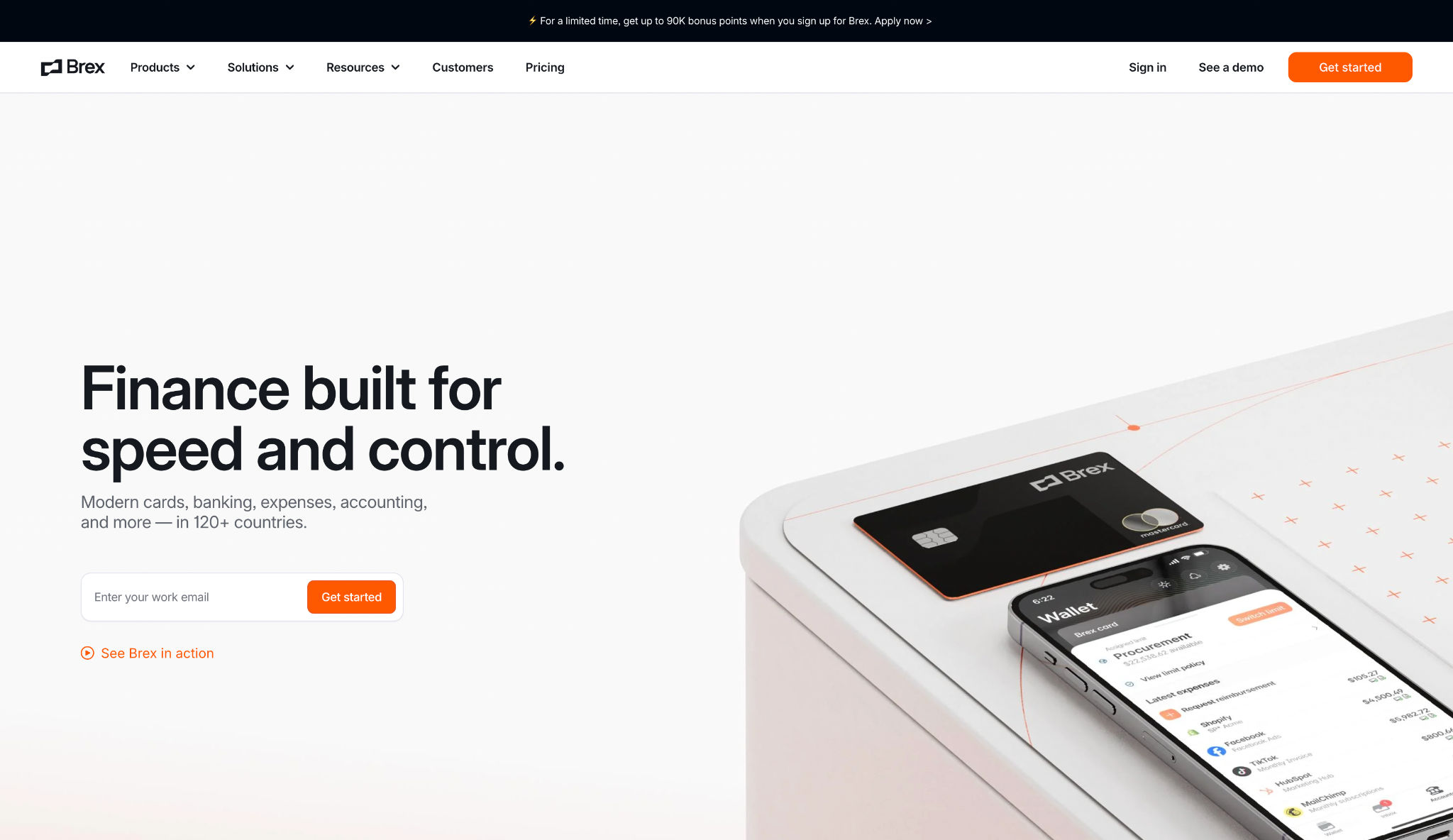
Brex is a US-first corporate card and spend management platform with strong tooling for startup expense management, bill pay, and budget controls. It's backed by a robust US banking infrastructure and integrates well with accounting tools.
Key strengths:
- Strong corporate card product with customizable spend controls.
- Built-in expense management, receipt capture, and accounting integrations.
- Competitive for US-based companies managing domestic spend.
- No personal guarantee required for card approval (for qualifying startups).
Limitations:
- Brex's international capabilities are limited compared to Aspire, Airwallex, or Wise.
- Multi-currency account functionality and global payment coverage are not its primary strengths.
- For businesses with significant international payment volume, Brex alone won't cover the need.
- It's also primarily designed for VC-backed startups, which means the onboarding and approval process may not suit every business type.
Best for: US-based startups focused primarily on domestic spend management, VC-backed companies looking for a strong card and expense product without heavy international payment needs.
Wise vs alternatives: A comparison table
Here’s a closer look to help you decide what’s best for your business:
[Table:1]
How to choose the right Wise alternative
The right alternative to Wise depends less on features and more on how your business operates as you expand globally. Here’s a simple way to think about it:
If you're still mainly sending money across borders
If your team is small and your primary need is low-cost international bank transfers, Wise may still be enough. It’s fast, transparent, and does one thing very well.
If you're building a global team and need financial control
Once you start hiring internationally, issuing cards, and managing budgets across teams, you need more than a payment tool. This is where Aspire stands out. It combines global payments, corporate cards and expense and budget management into a single system built for scaling operations.
If you need infrastructure, not just a product
If you're operating at a higher scale or building a platform that embeds financial services, then Airwallex is a better fit. It offers a robust API, and deeper control over financial infrastructure.
If your model relies heavily on freelancers or contractors
If your payment is made to a network of contractors or sellers on the market, Payoneer would be the optimal platform to use due to high transaction volumes across borders.
Revolut Business and Brex may prove beneficial in some circumstances as well, although they are better as secondary means of payment because of their limited reach.