



What Is a Stablecoin?
A stablecoin is a type of cryptocurrency designed to maintain a stable value by pegging its price 1:1 to a fiat currency — most commonly the US dollar or Hong Kong dollar. The design goal is to eliminate the extreme price volatility associated with conventional cryptocurrencies like Bitcoin, while preserving the technical advantages of blockchain-based asset transfer: speed, borderlessness, and low transaction costs.
For business finance purposes, a stablecoin is most usefully understood as a payment rail — a mechanism for transferring value — rather than as an investment or a speculative asset. The commercial case for stablecoins rests on the cost and speed advantages they can provide in cross-border payment contexts, not on any expectation of price appreciation.
The two stablecoins with the largest global market circulation are:
- USDT (Tether): Issued by Tether Holdings, pegged to the US dollar. The largest stablecoin by market capitalisation globally.
- USDC (USD Coin): Issued by Circle, also pegged to the US dollar. Distinguished by monthly reserve attestation reports, which provide greater transparency than USDT regarding the composition of the backing assets.
In Hong Kong, the newly licensed category of fiat-referenced stablecoins (FRS) also includes HKD-pegged instruments, most notably HKDR, issued by RD InnoTech, which targets local and cross-border HKD-denominated settlement.
Stablecoins vs Cryptocurrencies vs Fiat Currency: Core Differences for Businesses
Before evaluating whether stablecoins are appropriate for a particular business use case, it is important to understand the fundamental differences between the three forms of value transfer — and why each occupies a distinct position in the commercial payment landscape.
- Fiat Currency
Issued by central banks or designated institutions, fiat currency carries legal tender status in its jurisdiction of issue. Its value is underpinned by the sovereign credit of the issuing state. In Hong Kong, the Hong Kong dollar (HKD) is settled domestically through CHATS (for large-value transactions) and FPS (Faster Payment System, for real-time retail and B2B transfers). Fiat currency benefits from a mature regulatory framework and high institutional familiarity. Its primary limitation in an international context is that cross-border SWIFT wire transfers typically take one to five working days to settle and involve layered intermediary bank charges that can represent 1% to 3% of the transfer amount.
- Cryptocurrency
Cryptocurrencies such as Bitcoin (BTC) and Ether (ETH) operate on decentralised blockchain networks without reliance on any central institution. They can be transferred across borders without intermediaries and can settle within minutes. However, their price volatility — single-day movements of 10% to 20% are not uncommon for Bitcoin — makes them unsuitable as a standard commercial settlement tool. Pricing contracts in Bitcoin, paying suppliers in Bitcoin, or holding Bitcoin on a corporate balance sheet all introduce material financial risk that most businesses are not in a position to manage.
- Stablecoin
A stablecoin is designed to combine the settlement speed and low cost of blockchain transfer with the price stability of fiat currency. By maintaining a 1:1 peg to a fiat currency through a reserve of backing assets, a stablecoin aims to provide the operational utility of a payment rail without the volatility risk of an unpegged cryptocurrency. For most business use cases, the stablecoin retains its value sufficiently consistently that it can be treated as equivalent to fiat currency for the duration of a transaction — received, held briefly if necessary, and converted to HKD for accounting and operational purposes.
[Table:1]
The critical framing for most Hong Kong SMEs is this: the commercial case for stablecoins is concentrated in cross-border settlement efficiency, not investment return. A business that regularly makes or receives international payments faces meaningful costs and delays with conventional wire transfers. Stablecoins offer a potentially significant improvement in both dimensions — but with a set of compliance, operational, and counterparty risks that require assessment before adoption.
Hong Kong's Stablecoin Regulatory Framework
- The Stablecoins Ordinance (Chapter 656)
The Stablecoins Ordinance (《穩定幣條例》) was enacted on 21 May 2025 and came into effect on 1 August 2025. It establishes a licensing regime for fiat-referenced stablecoin (FRS) issuers operating in or targeting Hong Kong, administered by the Hong Kong Monetary Authority (HKMA).
The most important distinction for business users is who the Ordinance regulates:
The Ordinance regulates stablecoin issuers — not businesses that use stablecoins for payments.
A general Hong Kong company that accepts USDT, USDC, or HKDR as payment for goods or services, or that uses stablecoins to pay overseas suppliers, is not required to obtain any licence under the Stablecoins Ordinance. The compliance and licensing obligations attach to the entities that create and issue stablecoins, not to the commercial end users.
Business users do, however, have indirect compliance obligations: they must use compliant platforms (licensed virtual asset exchanges) to deposit and withdraw stablecoins, must comply with those platforms' KYC (Know Your Customer) and AML (Anti-Money Laundering) requirements, and must maintain proper financial records of all stablecoin transactions.
- First Licensed Issuers (As of May 2026)
In April 2026, the HKMA issued the first stablecoin issuer licences under the new Ordinance to:
- Anchorpoint Financial Limited — a joint venture established by Standard Chartered Bank (Hong Kong), Animoca Brands, and HKT
- The Hongkong and Shanghai Banking Corporation Limited (HSBC)
Two additional institutions are in the process of formal licence applications following their participation in the HKMA's earlier sandbox programme: JD Coinlink Technology (Hong Kong) Limited and RD InnoTech Limited (the issuer of HKDR, an HKD-pegged stablecoin).
- USDT and USDC: Current Compliance Status
Tether (USDT) and Circle (USDC) are both operating in Hong Kong during a transitional period. Under the Stablecoins Ordinance's transitional arrangements, existing stablecoin issuers that submit a licence application within the prescribed period are permitted to continue operating while their application is under review. As a result, commercial use of USDT and USDC in Hong Kong for business payment purposes is currently within the permitted range.
However, several conditions apply for business users:
- Platform selection: All stablecoin deposits and withdrawals should be conducted through platforms holding relevant licences in Hong Kong, such as licensed virtual asset service providers (VASPs) approved by the Securities and Futures Commission (SFC) — for example, HashKey Exchange and OSL
- KYC and AML compliance: Corporate users of licensed platforms must complete institutional KYC verification, including providing business registration documentation, company articles, and ultimate beneficial owner information
- Record-keeping: All stablecoin transactions must be fully documented for accounting and potential regulatory review
Given the evolving regulatory environment, businesses considering significant adoption of stablecoins for commercial purposes should seek legal advice to confirm the current compliance position before proceeding, particularly for large-value cross-border transactions. The stablecoin landscape in Hong Kong is developing rapidly, and the position of specific instruments and platforms may change as the licensing regime matures.
Which Hong Kong Businesses Are Best Positioned to Benefit?
Stablecoins are not a universally applicable solution. The cost and operational advantages are most pronounced in specific business contexts. The following assessment framework helps business owners identify whether stablecoin adoption is worth the operational investment.
Quick Assessment: Does Your Business Profile Match?
Consider whether your business meets two or more of these conditions:
- Monthly cross-border payment volumes (incoming or outgoing) exceed HK$50,000
- Your clients or suppliers are located in Asia, the Middle East, Africa, Europe, or the US
- Current SWIFT wire transfer fees and settlement times are creating cash flow constraints or supplier relationship friction
- Your counterparties already accept or actively request stablecoin settlement
- Your business operates in the Web3, digital content, or technology sectors
If two or more of these apply, stablecoins warrant serious evaluation. If none apply — for example, if your business is a purely domestic Hong Kong retail or service operation — the existing FPS and CHATS infrastructure already provides fast and low-cost local payment settlement, and stablecoins add complexity without proportionate benefit.
Business Type Assessment
[Table:2]
4 Key Business Use Cases
Use Case 1: Cross-Border B2B Settlement
This is the most directly applicable use case for Hong Kong SMEs considering stablecoin adoption. The cost comparison is significant:
[Table:3]
The stablecoin advantage is most pronounced where: (a) both parties already maintain compliant virtual asset accounts; (b) transaction amounts are large enough that the near-zero gas fee represents a meaningful saving relative to the SWIFT percentage cost; and (c) settlement speed is operationally important to both parties.
Where the counterparty has not yet adopted stablecoins, the Aspire local payment network provides an immediately available low-cost alternative for cross-border payments without requiring either party to interact with virtual asset infrastructure.
Use Case 2: Supply Chain Payments With Smart Contract Automation
Stablecoins combined with smart contracts have the potential to materially change supply chain payment workflows. In a traditional supply chain payment process, confirmation of goods receipt, finance department approval, bank mandate signing, and settlement through the banking system can collectively take 7 to 30 days — creating accounts receivable pressure for suppliers and a source of ongoing commercial disputes.
A smart contract approach encodes payment release conditions directly into the blockchain transaction: when the logistics system confirms that goods have arrived at the designated warehouse, or when a bill of lading or acceptance document is uploaded to the chain, the stablecoin payment is automatically released without manual intervention. The transaction is transparent and auditable by both parties in real time.
For Hong Kong companies managing multiple Asian suppliers, this is a medium-to-long-term investment in operational efficiency that merits evaluation alongside the shorter-term cross-border settlement cost savings.
Use Case 3: Overseas Contractor and Freelancer Payments
For Hong Kong companies with staff or contractors in multiple countries — particularly in Southeast Asia, Eastern Europe, or emerging markets where conventional wire transfer costs are disproportionately high relative to payment amounts — stablecoins provide a cost-effective settlement mechanism. A contractor in Vietnam or Indonesia receiving USDT can convert it to local currency on a compliant local exchange at minimal cost, and the total cross-border transfer cost is negligible compared with a SWIFT wire.
Businesses using this approach should ensure that the employment or service arrangement complies with the applicable law of the contractor's country of residence, that the contract clearly specifies the stablecoin and FX conversion basis for any foreign currency pricing, and that payroll records are maintained in local currency equivalent for tax reporting. Our guide to managing employee expense reimbursements provides useful context on the broader payroll documentation framework.
Use Case 4: Web3 and SaaS Revenue Collection
For subscription-based SaaS companies, digital content platforms, NFT marketplaces, or gaming businesses targeting a global user base, accepting stablecoin payments opens revenue collection to user segments that prefer to pay in USDC or USDT rather than credit cards. A meaningful proportion of the global Web3 user base transacts primarily in stablecoins rather than through traditional payment rails.
Companies implementing stablecoin collection should configure their institutional digital wallet to generate a unique receiving address per transaction (rather than reusing a single static address), to facilitate reconciliation and prevent attribution errors. All incoming stablecoin receipts should be matched to the corresponding invoice and converted to HKD promptly to minimise the period of stablecoin holding and reduce compliance complexity.
How to Implement a Stablecoin Payment Workflow: Step-by-Step
Step 1: Decision Framework — Should Your Business Accept Stablecoins?
Before opening any virtual asset account or modifying payment processes, work through four foundational questions:
Do your counterparties actually want to use stablecoins? The premise of stablecoin acceptance is that counterparties prefer or require it. If your primary customer base continues to pay by bank transfer or credit card, introducing stablecoin infrastructure adds operational complexity without addressing a real need. Survey your existing client base and assess whether competitors in your sector are already accepting stablecoins.
Can your team manage digital wallet security? Accepting stablecoins requires managing an institutional digital wallet. Self-custodial wallets (where your company holds the private keys) place the full responsibility for key security on your organisation — lost or stolen keys mean permanent, unrecoverable loss of assets. Most Hong Kong SMEs should use custodial wallets provided by licensed platforms, where the platform holds the private keys and the company manages the account through a web interface similar to online banking.
Can you convert stablecoins to HKD within an acceptable timeframe? Test the end-to-end process: open an institutional account at a licensed exchange → complete KYC → conduct a small-scale test conversion → confirm HKD credit to your bank account. If the complete process takes more than 48 hours, assess the cash flow implications before opening the channel to live client payments.
Does your finance team have the knowledge to handle stablecoin accounting and compliance? The accounting treatment, tax reporting, and AML compliance for stablecoin transactions require knowledge that most traditional finance teams have not previously needed. Internal training or external professional advisory should precede adoption, not follow it.
Step 2: Opening an Institutional Digital Wallet Account
Open an institutional (corporate) account at a licensed virtual asset exchange operating in Hong Kong — for example, HashKey Exchange or OSL's institutional services. The KYC documentation required for corporate account opening typically includes:
- Business Registration Certificate
- Certificate of Incorporation (for limited companies)
- Company Articles of Association
- Identity documents for all directors and ultimate beneficial owners (UBOs)
- Proof of business address
- Company bank account details
A single institutional account typically supports multiple stablecoin types (USDT, USDC, and others), enabling unified management.
Step 3: Configuring the Receiving Address and Confirmation Process
For each client or each transaction, generate a unique receiving wallet address. Avoid assigning the same static address to multiple clients, as this makes reconciliation significantly more difficult — incoming transfers cannot be attributed to specific invoices without individual addressing.
For each stablecoin receipt, the following information should be automatically recorded and retained:
[Table:4]
Step 4: Conversion Strategy — Immediate or Periodic?
The timing of stablecoin-to-HKD conversion is a key operational and risk management decision:
Immediate conversion (receive and convert): Each incoming stablecoin transfer is converted to HKD as soon as it is received. This eliminates holding risk entirely and simplifies accounting — the stablecoin is never held as a balance and can be treated as a cash equivalent for accounting purposes. The trade-off is higher operational frequency and potentially higher transaction costs for small amounts if the exchange charges a per-transaction fee.
Periodic batch conversion: All stablecoins received during a defined period (daily or weekly) are converted to HKD in a single batch operation. This reduces operational frequency and may qualify for more favourable conversion rates on larger volumes. The trade-off is a brief holding period during which a de-pegging event, however unlikely, could affect the HKD equivalent received.
For most SMEs, end-of-business-day batch conversion represents a reasonable balance: all stablecoins received during the day are converted to HKD at the close of each business day, limiting holding exposure to a maximum of approximately 24 hours while reducing the operational burden of per-transaction conversion.
Step 5: Withdrawing HKD to the Corporate Bank Account
After conversion, withdraw HKD to the company's commercial bank account via the exchange's standard withdrawal function. Processing times vary by exchange and receiving bank — typically one to three working days. Maintaining a clear record of each withdrawal, matched to the relevant stablecoin receipts and conversion transactions, is essential for monthly reconciliation.
Accounting Treatment Under HKFRS: Full HKICPA Guidance (January 2026)
The HKICPA (Hong Kong Institute of Certified Public Accountants) updated its guidance on crypto assets and stablecoins in January 2026, following the commencement of the Stablecoins Ordinance. The guidance applies the existing HKFRS framework to digital assets, distinguishing between different asset types and holding purposes.
Accounting for Cryptocurrencies (BTC, ETH)
For conventional cryptocurrencies, the HKICPA guidance confirms that no specific HKFRS standard currently addresses crypto assets. Companies must apply judgment in selecting the most appropriate standard:
- If held for sale (e.g. virtual asset trading businesses): Apply HKAS 2 (Inventories) — measure at the lower of cost and net realisable value.
- In all other cases (general holding or as a payment medium): Apply HKAS 38 (Intangible Assets) — measure at cost or under the revaluation model. Because cryptocurrencies have an indefinite useful life, they are not amortised, but must be tested annually for impairment.
Accounting for Fiat-Referenced Stablecoins (USDT, USDC, HKDR)
The accounting treatment for stablecoins is more nuanced than for conventional cryptocurrencies, because stablecoins may qualify as financial assets under HKAS 32 depending on the contractual rights they confer on the holder.
The HKICPA guidance sets out the following framework:
- If the holder has a contractual right to redeem the stablecoin for an equivalent amount of fiat currency from the issuer (as applies to USDC under Circle's redemption terms): The stablecoin may meet the definition of a financial asset under HKAS 32 and should be accounted for under HKFRS 9 (Financial Instruments) — at amortised cost or fair value, depending on the business model and contractual cash flow characteristics.
- If the stablecoin is used primarily as an immediate payment medium and can be converted to near-equivalent fiat currency at any time: It may be treated as a cash equivalent under HKAS 7 (Statement of Cash Flows), provided the conditions for cash equivalent classification are met: short-term in nature, highly liquid, and redeemable at a known amount with insignificant risk of value change.
- If held as a longer-term asset for purposes other than immediate payment: Apply HKAS 38 (Intangible Assets), measure at cost, and conduct annual impairment testing.
HKFRS Classification Table
[Table:5]
Practical Accounting Entries for Stablecoin Receipts
For the most common SME use case — accepting USDT or USDC as payment for goods or services, and converting to HKD promptly:
On receipt of stablecoin payment:
- Debit: Stablecoin Wallet (HKD equivalent at spot rate)
- Credit: Accounts Receivable
On conversion to HKD:
- Debit: Bank Account (HKD)
- Credit: Stablecoin Wallet
- Any difference between HKD equivalent at receipt and HKD proceeds from conversion: recognised in Foreign Exchange Gains/Losses
HKICPA's Key Recommendations
The HKICPA guidance emphasises several practical requirements:
- Disclosure: Companies holding stablecoins or cryptocurrencies must disclose their accounting policy choice in the financial statement notes, including the standard applied, the measurement basis, and the rationale for the classification.
- Consistency: Once an accounting policy is selected for a particular category of digital asset, it must be applied consistently across periods. Changes in accounting policy require the disclosure and restatement procedures applicable under HKAS 8.
- Professional advice: Given the judgment involved in applying existing HKFRS standards to novel asset types, the HKICPA recommends that companies consult their auditors before finalising accounting policies for stablecoins. This applies particularly to companies considering treating stablecoins as cash equivalents, as this classification requires a high standard of evidence that the relevant conditions are met.
- Looking ahead: The International Accounting Standards Board (IASB) has included crypto assets in its 2026 work plan, with a review of IAS 38 (corresponding to HKAS 38) underway. Research on whether stablecoins should be classified as cash equivalents under IAS 7 is also in progress. HKICPA guidance will be updated to align with any IASB developments as they emerge.
Hong Kong Profits Tax Treatment
Hong Kong taxes on a territorial basis — only profits arising in or derived from Hong Kong are subject to profits tax. The IRD's formal guidance on the tax treatment of stablecoin transactions is still developing, but the following principles can be applied with reasonable confidence:
- FX conversion gains and losses: If a business converts stablecoins to HKD at a rate that differs from the rate at which the stablecoins were received, the difference is an FX gain or loss. If the stablecoins were received and held in the course of business, the FX outcome is likely taxable (gain) or deductible (loss) under general principles.
- Capital vs trading character: Hong Kong has no capital gains tax. However, the characterisation of a stablecoin holding as capital (a single investment held outside the ordinary course of business) versus trading (held in the ordinary course of a trading or financial services business) affects whether any gains are chargeable to profits tax. For most commercial users receiving stablecoins as payment for goods and services, the stablecoin proceeds form part of ordinary business income.
- Record retention: The IRD requires that business records be retained for at least seven years. All stablecoin transaction records — including blockchain transaction hashes, exchange conversion records, and HKD bank credits — must be included in the company's tax records.
For a comprehensive guide to how bookkeeping and accounting obligations apply to Hong Kong businesses more broadly, our guide covers the standard requirements that underpin all financial record-keeping.
Integrating Stablecoin Records With Existing Accounting Systems
Major accounting platforms including Xero and QuickBooks now support manual or API-based import of virtual asset transaction records. A practical integration workflow for stablecoin-using businesses:
- Create a dedicated Stablecoin Wallet account in the chart of accounts, separate from standard bank accounts
- At end of each business day, export the day's transaction records from the exchange platform (CSV format) and import into the accounting software
- Configure rules to auto-categorise stablecoin transactions by type (e.g. USDT received = Foreign Currency Revenue; USDT paid = Supplier Payment in Foreign Currency)
- Conduct monthly stablecoin wallet reconciliation — verifying that the blockchain record matches the accounting ledger balance
- At year end, ensure all stablecoin holdings are valued at the appropriate rate and any impairment assessed in accordance with the applicable HKFRS standard
For businesses using Xero or QuickBooks, our setup guides cover the chart of accounts configuration that supports effective multi-currency and digital asset tracking.
Aspire: The Business Account Built for Modern Cross-Border Payment Needs
For Hong Kong SMEs whose primary goal is reducing the cost and friction of cross-border payments, Aspire provides an immediately available solution that does not require any engagement with virtual asset infrastructure.
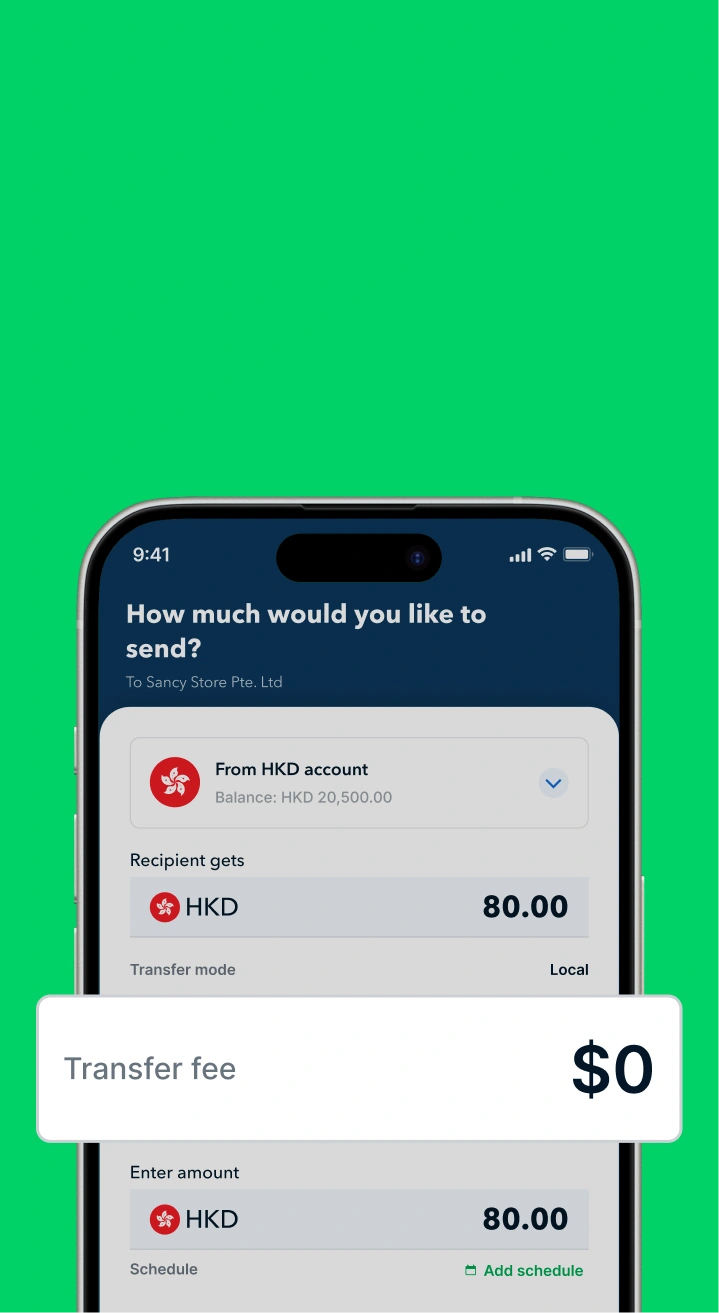
One account for everything. Open fully digitally — approved in as little as one business day. Send and receive in 40+ currencies across 130+ countries, with FX spreads from 0.18% — up to 3x cheaper than a traditional SWIFT wire. Aspire's local payment network routes transfers through domestic payment rails in the destination country where available, bypassing the layered intermediary bank fees that drive up conventional wire transfer costs. FPS and CHATS are built in for domestic HKD transfers and payroll. For context on how international payments work for Hong Kong businesses — including when SWIFT, local rails, and alternative methods apply — our comprehensive guide covers the full landscape.
Accounting integration from day one. Every Aspire transaction syncs automatically with Xero and QuickBooks in real time. For businesses managing foreign exchange risk across multiple currencies, Aspire's multi-currency account structure and automatic categorisation provide the clean, structured financial data that makes monthly reconciliation and annual audit straightforward.
Stablecoin integration coming. Aspire has fully deployed its infrastructure for the crypto ecosystem, and stablecoin payment functionality is expected to launch later this year — enabling businesses to seamlessly connect traditional finance and Web3 treasury flows from a single platform.
1.2% unlimited cashback on eligible business spend. Every eligible transaction earns 1.2% cashback with no cap, plus over USD 500,000 in partner rewards including Google Workspace and Slack.
Open your Aspire business account free. Approved in as little as one business day.
Frequently Asked Questions
Do Hong Kong businesses need a licence to use stablecoins?
No. The Stablecoins Ordinance (Chapter 656) imposes licensing requirements on stablecoin issuers — the entities that create and issue stablecoins — not on businesses that use stablecoins as a payment tool. A general Hong Kong company using USDT, USDC, or HKDR to make or receive payments does not need to obtain any licence under the Ordinance. Business users are, however, required to use compliant platforms (licensed VASPs) for stablecoin deposits and withdrawals, and must meet those platforms' KYC and AML requirements.
Are USDT and USDC currently legal to use for business in Hong Kong?
Yes, within the permitted parameters. Both USDT and USDC are operating under transitional arrangements following the commencement of the Stablecoins Ordinance on 1 August 2025. Use through licensed or regulated virtual asset platforms is permitted. Businesses should keep complete transaction records and ensure counterparty compliance. Given the evolving regulatory environment, legal advice is recommended before significant adoption.
How much cheaper is stablecoin cross-border settlement compared to SWIFT?
The cost difference is material. A conventional SWIFT wire transfer typically costs 1% to 3% of the transfer amount when all sending bank, intermediary bank, and receiving bank fees are included. Stablecoin on-chain transfer fees (gas fees) typically amount to less than USD 1 per transaction, regardless of amount. For a business making HK$500,000 in monthly cross-border payments, the annual saving can be tens of thousands of dollars — though this assumes both parties maintain compliant virtual asset accounts, and there are operational and compliance costs to factor in.
How do Hong Kong businesses convert stablecoins to HKD?
The primary route is through a licensed Hong Kong virtual asset exchange's institutional deposit and withdrawal service. The business sells stablecoins on the platform (receiving HKD at the current exchange rate) and withdraws HKD to its corporate bank account. For large-volume conversions, some licensed OTC (over-the-counter) service providers offer more favourable rates on block trades. All conversions must be documented for accounting and tax purposes.


.jpeg)



.webp)