



Hiring Overseas Employees: Relocation to Hong Kong vs Remote Work
The first step in hiring an overseas employee is not filling out a form — it is determining the hiring model. This decision shapes every compliance action that follows. Many employers ask "how do I apply for the visa?" before clarifying the scenario, and end up heading in entirely the wrong direction.
The table below sets out the core differences between the two models:
[Table:1]
The compliance cost, administrative process, and legal risk differ substantially between the two paths. Only once the scenario is confirmed can each step be properly arranged.
Scenario 1: Hiring an Overseas Employee to Work in Hong Kong
If you intend to have an overseas employee relocate to and work in Hong Kong, the work visa application must be completed before their arrival. The Hong Kong Immigration Department has a clear rule: any non-Hong Kong permanent resident taking up paid employment in Hong Kong must hold a valid work visa or entry permit.
The core process in this scenario is: the employer first confirms the employee's eligibility, then submits an application to the Immigration Department on the company's behalf, the Immigration Department reviews and issues approval, and only then can the employee legally take up employment in Hong Kong.
Work Visa Eligibility Conditions and Process
The primary route for a Hong Kong work visa is the General Employment Policy (GEP), applicable to most foreign professionals and non-Mainland Chinese residents. Mainland Chinese residents apply instead through the Admission Scheme for Mainland Talents and Professionals.
Applicants must satisfy all of the following conditions to be approved:
- A confirmed job offer: A written offer letter or employment contract must already exist before applying, confirming the position, remuneration, and term
- Relevant skills or qualifications: The applicant's professional background must address a genuine skills gap in the local Hong Kong talent market; the Immigration Department reviews the nature of the role against market supply and demand
- Market-aligned remuneration: Salary and benefits package (including wages, housing, medical coverage) must be broadly in line with market rates for comparable Hong Kong roles
- Qualifications or experience matching the role: Generally requires a relevant bachelor's degree, or equivalent professional qualifications
The application is submitted by the employer on the employee's behalf, with processing typically taking 4 to 8 weeks. If documentation is complete and no follow-up is required, the timeline may be shorter; if the Immigration Department requests additional materials, it may be extended. Once approved, the employee typically receives a 2-year work visa, renewable upon expiry.
Key Steps From Pre-Screening to Formal Submission
To help your new hire arrive on schedule, the company must prepare carefully before submitting a GEP application. Following these steps in order improves approval efficiency and avoids delays caused by incomplete documentation or procedural errors:
- Eligibility pre-screening: Confirm the role and salary level meet GEP approval standards (typically, a genuine local skills shortage and a salary above the average starting salary for local graduates).
- Sign the contract: Execute a formal written employment contract with the employee, clearly stating the job title, remuneration structure, benefits, and contract term.
- Prepare documentation: Based on Immigration Department requirements, prepare proof of company business, financial standing, and records of local hiring (see the document checklist below).
- Complete the forms: Via the Immigration Department's electronic services platform, complete and submit the employer-specific application form (ID 990B), and ensure the employee completes their individual portion (ID 990A).
- Submit and follow up: Submit the application via the Immigration Department's online system and follow the approval progress closely (this can also be delegated to a professional agent or secretarial company).
- Arrange arrival: Once the visa is approved, assist the employee in arranging their arrival, and book an appointment for them to obtain a Hong Kong ID card within 30 days of arrival.
- MPF: If the employee's expected work term in Hong Kong exceeds 13 months, the employer must register them in an MPF scheme within the first 60 days of employment — do not delay this step.
Document Checklist for Employers
The Immigration Department requires documentation covering both the company's background and its financial standing. The standard requirements are as follows:
From the employee:
- Copy of a valid travel document (passport)
- Personal résumé and proof of academic qualifications
- Signed employment contract or offer letter
- Recent photograph (meeting specifications)
From the employer (company):
- Copy of the Business Registration Certificate
- The company's most recent audited financial report or profits tax return
- A company background statement (business activities, operating model, headcount)
- If the company has been incorporated for less than 12 months, a detailed business plan must additionally be submitted
Exemption from submitting company documents: If the employer has had a non-local employee successfully approved for a work visa within the 24 months immediately preceding the application, the requirement to submit the Business Registration Certificate and company financial documents may be waived — substantially simplifying the process.
Common Approval Issues to Watch For
Based on Immigration Department approval patterns, the following are common reasons applications are rejected or asked to provide additional documents:
- Difficulty demonstrating a local talent shortage: The application must clearly explain why a suitable candidate could not be recruited locally, supported by local recruitment records (such as job advertisements) as evidence. If the role is relatively generic in nature, approval risk is higher.
- Salary below market level: The Immigration Department benchmarks against market salaries for comparable roles. If the salary is noticeably below market, it may raise questions. It is advisable to reference salary survey data from the Hong Kong Census and Statistics Department to ensure the offered salary is reasonable.
- Incomplete or outdated company financial documents: Financial documents must be the most recent version available. If the company is newly established or its financial position does not adequately reflect business substance, the approval process may be extended.
- The employee cannot work in Hong Kong before approval: Before the work visa is approved, the employee cannot perform any paid work in Hong Kong in any form — doing so constitutes a breach of the law. This is a red line that many SME employers overlook.
Scenario 2: Hiring an Overseas Employee to Work Remotely (Staying in Place)
Remote hiring is another path increasingly adopted by Hong Kong businesses. The employee continues working from their existing location, no Hong Kong work visa is required, and the employer does not need to manage relocation or housing arrangements. This model carries lower administrative cost, but there are still several details to manage around tax filing, MPF, and contract structure.
Full-Time Employee vs Independent Contractor: Choosing the Contract Form
The first decision in remote hiring is determining the contract form. This choice affects tax filing, MPF obligations, and legal liability, and should not be made casually.
- Full-Time Employee Model
The individual is employed full-time by the Hong Kong company, which assumes employer responsibilities — including reporting remuneration, providing statutory benefits, and where applicable, arranging MPF contributions. The contract should clearly state the employee's work location (their country of residence) and specify whether Hong Kong law or the employee's local labour law applies.
Recommended clauses to include in the employment contract: currency and method of salary payment, working hours and time zone arrangements, intellectual property ownership, confidentiality provisions, and termination notice periods.
- Independent Contractor Model
The company engages an overseas individual via a service agreement, with the individual providing services in a self-employed capacity, handling their own local tax and social security matters. This model places a lighter administrative burden on the Hong Kong company, but carries the legal risk of misclassification: if the actual working arrangement is indistinguishable from a full-time employment relationship, local regulators may recharacterise it as employment, triggering back taxes or penalties.
Recommendation: If the work is fixed in nature, follows a regular schedule, and is entirely directed by the company, the full-time employee model is advisable to avoid legal risk. If the work is project-based and outcome-driven, the contractor model offers greater flexibility.
Tax Filing Obligations for Remote Employees (IR56B)
Many Hong Kong employers mistakenly believe that because an overseas remote employee does not work in Hong Kong, no tax filing is required. This is incorrect.
Under Hong Kong Inland Revenue Department rules: any person employed by a Hong Kong company — regardless of whether their duties are performed in Hong Kong or elsewhere — requires the employer to file Form IR56B annually, reporting that employee's remuneration to the IRD.
This means that even if an employee works entirely from Singapore, Thailand, or the UK, as long as they are employed by a Hong Kong company, the employer has a filing obligation.
Whether the employee personally needs to pay salaries tax depends on their work location and tax arrangements:
- If the employee's employment is considered to have a Hong Kong source (i.e. the contract was signed in Hong Kong and remuneration is paid by the Hong Kong company), their full income is in principle subject to salaries tax
- However, the employee may apply annually for a tax exemption to exclude remuneration relating to work performed outside Hong Kong
- If the employee's country of residence has a double taxation agreement with Hong Kong, their tax burden may be further reduced
Employer Compliance Checklist
When hiring a remote employee or contractor based long-term overseas, follow these steps to ensure cross-border collaboration complies with both Hong Kong and local laws and tax regulations:
- Clarify the employment relationship: Clearly distinguish whether the individual's status is Employee or Independent Contractor/Freelancer, and document this formally in writing — this directly affects tax and labour benefit responsibilities in both jurisdictions.
- Strengthen cross-border clauses: Clearly specify in the contract the actual place of work, the applicable jurisdiction, the currency of payment, and the adjustment mechanism for exchange rate fluctuations.
- Verify Hong Kong tax filing requirements: Confirm whether the overseas employee has Hong Kong-sourced employment. If the employee provides services entirely outside Hong Kong, they generally fall outside the scope of Hong Kong salaries tax, and the company should reassess whether IR56B filing is required.
- Review MPF exemption eligibility: Per MPFA guidance, if the overseas employee is not based long-term in Hong Kong, does not hold a Hong Kong ID card, or is covered by an overseas social security scheme, they generally meet MPF exemption conditions.
- Assess local tax and Permanent Establishment (PE) risk: Understand the labour law and tax system of the employee's country of residence thoroughly, to avoid inadvertently triggering a "Permanent Establishment" provision through hiring an overseas full-time employee, which could result in the company being pursued for overseas corporate tax.
- Deploy a cross-border payroll solution: Set up an efficient international payment channel (such as an Aspire cross-border business account) supporting low-FX-cost, multi-currency salary disbursement, ensuring overseas teams are paid in full and on time, while streamlining the company's currency exchange costs.
MPF Exemptions for Overseas Employees: When Is No Contribution Required?
The scope of MPF (Mandatory Provident Fund) applicability is one of the most frequently asked questions among Hong Kong SME employers.
Per Mandatory Provident Fund Schemes Authority (MPFA) guidance, the MPF system in principle only covers employees employed in or from Hong Kong. Whether an overseas remote employee needs to contribute depends on their "degree of connection" to Hong Kong:
- Generally Exempt (No MPF Contribution Required)
- The overseas employee is employed and paid by a Hong Kong company, but works long-term outside Hong Kong with insufficient connection to Hong Kong.
- The employee already participates in a retirement or provident fund scheme established in their place of residence.
- MPF Contribution Required
- The employee holds a Hong Kong work visa and works in Hong Kong for more than 13 months (exempt within the first 13 months; registration required from the 14th month onward)
- A Hong Kong resident posted overseas for a limited period is considered to retain sufficient connection to Hong Kong, and the employer must still contribute
Practical recommendation: If you are uncertain whether an employee falls within MPF coverage, it is advisable to consult the MPFA directly or seek HR advisory guidance, to avoid retrospective contribution demands or penalties later.
Setting Up Low-Cost, Efficient Cross-Border Payroll
Once compliance matters are resolved, the next practical challenge is: how to pay overseas employees on time and at low cost.
Cross-border payroll pain points typically arise at two levels: first, compliance and legal structure — how to legally hire and manage overseas employees without an established overseas entity; second, the actual cost of payroll itself — exchange rate fluctuations, wire transfer fees, and unpredictable settlement times, which frustrate employees and make financial planning difficult.
No Overseas Entity Yet? Solve the Compliance Problem First
Many Hong Kong businesses, in the early stages of expansion, want to hire local employees in a target market without having established a legal entity there. In this situation, an Employer of Record (EOR) service is the most direct solution.
Aspire EOR is supported by Deel's global compliance infrastructure, covering 150+ countries, allowing you to legally hire full-time employees or contractors without setting up an overseas company. Key Aspire EOR features include:
- Compliant hiring: Employment contracts are automatically generated according to local labour regulations, with built-in compliance checks to ensure correct worker classification.
- Global payroll management: Multi-currency salary payment, automated tax calculation, and deep integration with your Aspire account.
- Employee benefits: Medical insurance, retirement plans, and statutory benefits across jurisdictions, managed from a single platform.
- Onboarding and offboarding: Most onboarding processes can be completed within 5 days; offboarding automatically calculates final salary and unused leave, in strict compliance with each country's labour regulations.
Pricing starts from USD 399 per employee per month. Compared to the legal fees and administrative costs of establishing an overseas entity yourself, an EOR solution is particularly suited to SMEs in the early stages of expansion who need the flexibility to test new markets.
What Are the Practical Advantages of Aspire's Multi-Currency Account?
Hiring overseas employees from different countries means you may need to pay salaries in HKD, USD, GBP, and other currencies simultaneously. Aspire's multi-currency account lets businesses manage 40+ currencies on a single platform, and supports bulk upload of payroll data — completing multiple cross-border payroll runs in one batch, without processing each transfer individually.
Local FPS Payroll: Zero Fees
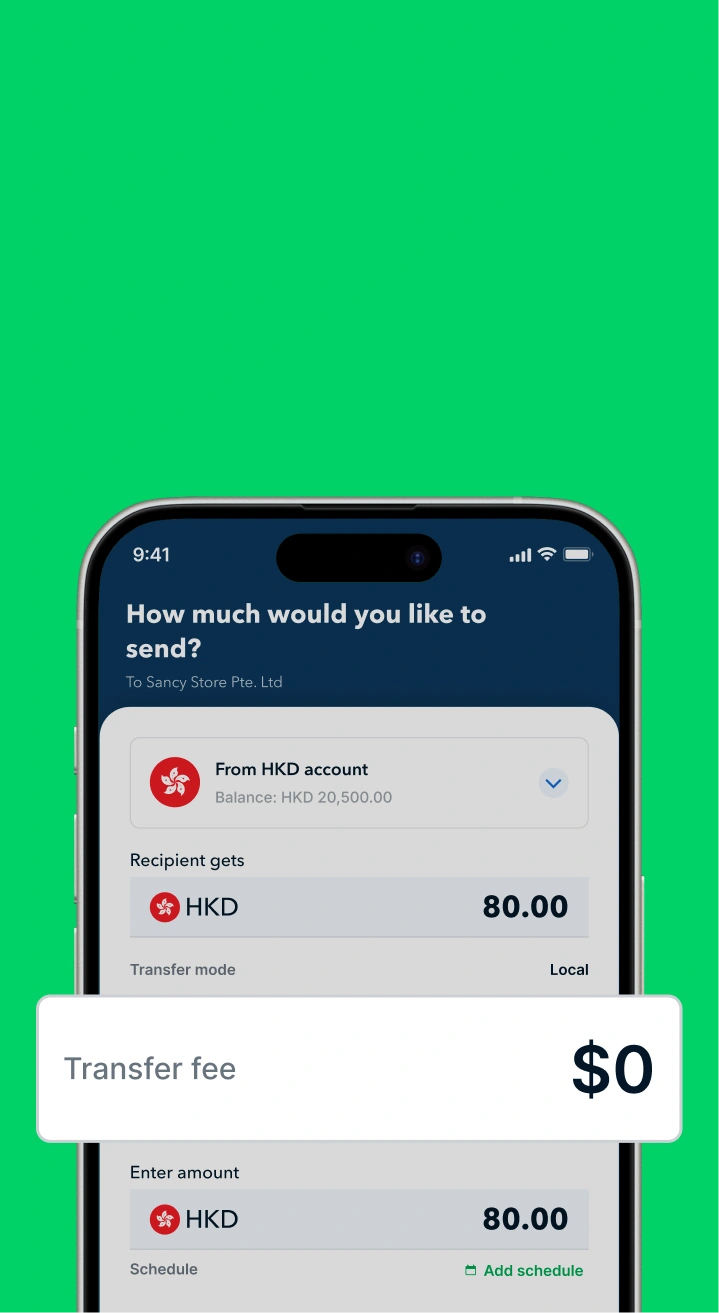
For overseas employees relocated to Hong Kong, local FPS transfer is the most commonly used payroll method. Aspire's FPS transfers are completely free, compared to some competitors charging USD 3 per outgoing FPS transfer — paying 10 employees monthly already saves over HK$2,800 per year.
For a complete overview of payroll management in Hong Kong, including tax filing schedules and MPF contribution calculations, see our detailed payroll guide.
Aspire: One-Stop Business Finance Beyond Traditional Banking
Aspire is built to eliminate exactly these friction points for Hong Kong SMEs.
- Global reach, local simplicity. With Aspire multi-currency account, your business can send and receive payments across 130+ countries in 40+ currencies — with FX spreads from just 0.18%, up to 3x cheaper than a traditional bank wire. Where possible, Aspire routes transfers through local payment rails rather than multi-hop SWIFT chains, which means fewer intermediary fees, faster settlement, and less risk of funds being held at a correspondent bank for compliance review. This is particularly valuable when sending to markets like the UK, the US, or Southeast Asia, where local payment networks can significantly reduce costs and settlement times versus SWIFT.
- SWIFT transfers with instant confirmation. When SWIFT is the right rail for your payment, Aspire processes it with full SWIFT GPI tracking enabled. Once your transfer completes, you can download your payment confirmation instantly from the app — no calls to the bank, no admin fees, no waiting for an MT103 copy to be emailed over.
- Full financial control in one platform. Issue corporate cards with configurable spending limits, automate invoice and bill management, and sync every transaction with Xero or QuickBooks in real time. For Hong Kong SMEs managing payroll, free FPS and CHATS are both natively supported — ensuring domestic payments clear on time, every time.
- 1.2% unlimited cashback. Every eligible transaction on your Aspire corporate card earns 1.2% cashback. Combined with over USD 500,000 in partner rewards included with your account, Aspire turns your operating costs into working capital from day one.
Open your account free. Approved in as little as one business day. No branch visits, no stacks of paper forms, no waiting weeks for a relationship manager to call you back.
Frequently Asked Questions
Can a Hong Kong company hire multiple overseas employees from different countries simultaneously?
Yes. Hong Kong law places no limit on the number of overseas employees of different nationalities an employer can hire. Each employee's visa, MPF, and tax filing must be handled individually according to their personal circumstances — different nationalities may have slightly different visa categories and document requirements, so it is advisable to verify each case individually. For a larger headcount, consider engaging an HR services firm to handle this centrally, or adopting payroll software that consolidates payment and filing processes across multiple jurisdictions to reduce the administrative burden.
What are an employer's obligations when an overseas employee working in Hong Kong resigns?
When an overseas employee working in Hong Kong leaves the company, the employer must fulfil the following legal obligations: pay notice period salary or payment in lieu of notice as specified in the contract; settle all outstanding salary, annual leave pay, and statutory benefits; and submit Form IR56G (Notification of an Employee Who Is About to Depart from Hong Kong or Cease to Be Employed) to the IRD. In addition, if the employee holds a work visa, the employer is responsible for notifying the Immigration Department of the termination of employment, so the Immigration Department can update the visa status. It is advisable to begin these procedures at least one month before the employee's departure to avoid administrative delays that could result in penalties.
Can the family members of an overseas employee holding a Hong Kong work visa accompany them to Hong Kong?
Yes, but a separate application is required. The spouse and minor children of an employee holding a Hong Kong work visa may apply for a Dependant Visa to accompany them to Hong Kong. The dependant visa application is made by the employee themselves, and they must demonstrate that their salary level is sufficient to support their family's living expenses. Dependants are generally permitted to work in Hong Kong during their stay without needing a separate work visa — this is one of the key policy advantages Hong Kong offers to attract overseas talent. Employers can use the dependant visa policy as a recruitment selling point to enhance their competitiveness in attracting overseas talent.
How is salaries tax handled if an employee splits their time between Hong Kong and overseas?
Where an employee performs some duties in Hong Kong and some duties overseas under a Hong Kong employment contract, their full income is in principle taxable under Hong Kong salaries tax, but the employee may apply for a partial exemption to exclude the portion of remuneration attributable to overseas work, provided certain conditions relating to time spent and tax paid in the other jurisdiction are met. This determination depends heavily on individual facts, including the number of days worked in each location and whether tax has already been paid overseas on the same income, and is best confirmed with a tax adviser on a case-by-case basis.


.jpeg)



.webp)