



Before You Transfer: Why TWD Can't Be Sent Directly Overseas
Most first-time senders learn this fact at the bank counter, not before they arrive. You attempt to wire New Taiwan Dollars to a Hong Kong account, and the bank declines not because of anything wrong with your account, but because of national monetary law.
The New Taiwan Dollar is classified as a restricted currency by Taiwan's Central Bank (CBC). Unlike the Hong Kong Dollar, US Dollar, or Euro, all of which flow freely across borders, TWD cannot be transmitted cross-border in its original form. The CBC controls the currency's international movement to manage Taiwan's foreign exchange reserves and monetary policy stability.
What this means practically: every cross-border transfer from Taiwan requires a prior step called foreign exchange settlement (外匯結清). This is the process of converting your TWD into an internationally accepted currency typically HKD, USD, or EUR at the bank's published exchange rate. The bank files a corresponding declaration with the CBC. Without completing this step, the transfer cannot proceed.
The reassuring part: at most major Taiwanese banks, the foreign exchange settlement and the SWIFT wire initiation are handled in a single online banking workflow. You navigate to "International Remittance," select your destination currency, confirm the exchange rate, and the bank converts and wires within the same operation. You are not running two separate errands, it's one workflow that combines both steps.
Understanding this upfront prevents the single most common frustration for first-time Taiwan-to-HK senders. Every method covered in this guide, bank wire, neobank, money changer, passes through this mandatory conversion. There are no shortcuts around it. The only variable is who executes it, at what exchange rate, and with what fee attached.
3 Ways to Send Money from Taiwan to Hong Kong
Before comparing the methods, one important framing point: the total cost of a Taiwan-to-HK transfer has two sides. The Taiwan outbound side covers the fees and FX rate applied by the sending institution. The Hong Kong inbound side covers whatever the receiving bank charges the recipient. Most guides cover only one side. Optimising both is how you actually minimise costs end-to-end.
Here's how each method works.
Method 1: Taiwan Bank SWIFT Wire Transfer (Most Common)
A bank wire transfer via the SWIFT network is the most widely used method for moving money from Taiwan to Hong Kong. Every major Taiwanese institution, Bank of Taiwan, CTBC, Cathay United Bank, E.SUN Bank, Chunghwa Post, and others supports it via online banking or at the counter. For businesses and high-value transfers, it's the default because of its legal paper trail, regulatory compliance framework, and international accountability.
Sometimes also called a telegraphic transfer (TT), this method routes your converted funds through the SWIFT global messaging network to the recipient's Hong Kong account.
What you need from your Hong Kong recipient before starting:
- Full legal name must match exactly what's registered at the HK bank (English or Chinese as registered)
- SWIFT / BIC code of the Hong Kong bank (e.g., for Aspire: available in the app under Account Settings → Receive Funds; or search the SWIFT code guide for major HK banks)
- Hong Kong bank name and full branch address in English
- Account number at the HK bank
- Transfer currency HKD or USD recommended; avoid introducing an unnecessary conversion step
- Agreed purpose of transfer confirm with your recipient so both sides describe it consistently (e.g., "supplier invoice payment," "consulting service fee")
The 3-part cost structure, what you're actually paying:
The most common mistake senders make is treating the wire fee as the total cost. It isn't.
Wire fee: The base fee charged by your Taiwanese bank. This is a fixed or percentage-based charge typically ranging from TWD 100 to TWD 900 depending on the bank and channel. Online banking is consistently 30–50% cheaper than the counter for the same transfer.
FX spread (exchange rate markup): When your bank converts TWD into HKD or USD, it applies a rate that sits above the interbank mid-market rate. The gap, typically 1%–3% is the bank's foreign exchange margin. This doesn't appear as a line item on your fee receipt. It's embedded in the exchange rate you're quoted. On a large transfer, this is often the biggest cost component and the one that most senders overlook. Understanding how foreign transaction fees and FX spreads work together is essential for calculating your true total cost.
Correspondent bank fee: Some transfer routes pass through an intermediary bank before reaching the recipient's HK account. That third-party institution typically deducts USD 10–25 from the payment. Whether this applies depends on the specific routing path, which neither you nor your bank can always predict in advance.
OUR vs SHA vs BEN, the most important decision in the process:
When you initiate a SWIFT payment, you'll choose a fee-bearing mode. This determines who pays any correspondent bank charges along the route:
[Table:1]
For business payments, supplier invoices, or any transfer where a precise amount must land, always select OUR. It eliminates mid-route deductions and prevents underpayment disputes. For personal transfers where the recipient understands a small deduction may occur, SHA is acceptable. BEN is rarely appropriate.
Best for: Large transfers, formal business payments, situations requiring full documentation and audit trails.Limitation: The FX spread is the primary cost on large sums. Some banks require an initial in-branch visit to set up international wire capabilities.
Method 2: Taiwanese Neobanks (LINE Bank, Next Bank)
Taiwan's digital-first banks have improved significantly in the international payments space. For users already holding accounts at LINE Bank or Next Bank (將來銀行), international wires to Hong Kong are handled entirely within the app at fees that are meaningfully lower than most traditional banks.
LINE Bank, for example, charges a flat wire fee that is well below the traditional bank benchmark. The full process runs through the LINE app: no branch visit, no physical forms, and the foreign exchange settlement is built into the same workflow. Next Bank similarly offers online international wires post-account-upgrade, with a single-transaction cap of TWD 2,000,000 equivalent.
The underlying mechanics remain the same: neobanks still route transfers via SWIFT. Arrival times are comparable to traditional bank wires typically 1–3 business days. The advantage is purely cost and user experience, not infrastructure.
What to keep in mind:
- Per-transaction limits apply. If your transfer exceeds the neobank's cap (e.g., TWD 2M at Next Bank), you'll need to split across multiple transactions or switch to a traditional bank. For large one-off payments, traditional banks are the only viable option.
- Promotional fee rates are time-limited. Neobank international wire discounts are often introductory offers, not permanent pricing. Confirm the current rate on the bank's official fee schedule before initiating not from a third-party article including this one.
- CBC declaration applies equally. The mandatory foreign exchange declaration is not optional just because you're using a neobank. It's built into the app workflow but the legal obligation is the same.
- FX spread still applies. Even with lower wire fees, check the exchange rate the neobank quotes against the mid-market rate. A lower wire fee can still be offset by a wider spread.
Best for: Digitally native users, mid-size transfers within the bank's single-transaction cap, people who prefer a fully app-based process.
Method 3: Licensed Money Changers and Remittance Operators
Licensed money changers offer a key advantage over bank channels: speed. Same-day or next-business-day transfers to Hong Kong are achievable through operators with established banking network connections. The typical process involves bringing cash or arranging a bank deposit, providing the HK recipient's account details, and the operator processing the payment through their own corresponding bank accounts.
This is where the tradeoffs become significant.
Transparency is lower. Exchange rates are typically quoted at the counter or via phone inquiry — there's no published real-time rate to compare in advance. You only know the exact cost when you're ready to transact. Foreign exchange risk from rate volatility is harder to manage on a channel where you can't lock a rate before arrival.
Traceability is limited. Unlike a bank SWIFT transfer which generates a reference number you can use to track and trace the payment, money changer transfers typically don't come with a formal SWIFT trail. If funds are delayed or misrouted, resolution is more complicated.
Regulatory standing varies. Legitimate operators hold a Money Service Operator (MSO) licence issued by Hong Kong Customs and are subject to AML/CTF compliance obligations. They are regulated, but not to the same standard as licensed banking institutions. For large sums, the risk differential matters.
Experienced users who have built a track record with a specific, well-established operator may find this channel workable for smaller transfers.
Best for: Experienced users, urgent small transfers with a vetted operator.Not recommended for: Large transfers, business payments, first-time senders, or situations requiring a formal payment trail.
Fee & Speed Comparison: All 3 Methods at a Glance
[Table:2]
Important notes:
- All figures above represent Taiwan outbound costs only. HK inbound receiving fees are separate and depend entirely on the recipient's Hong Kong bank.
- Correspondent bank fees (USD 10–25) may apply on any of the above routes depending on the payment path. They are not always disclosed in advance and are additional to the fees above.
- Neobank promotional rates are time-limited. Verify before transferring.
- Transfers submitted near or after your Taiwan bank's daily cutoff time may be processed on the next business day. Delayed bank transfers are more common around public holidays, a factor in both Taiwan's and Hong Kong's holiday calendars.
Taiwan Bank Wire Transfer Fees
Taiwan's major banks each apply their own fee structure for SWIFT international wires. The table below is a reference overview based on publicly available information at the time of writing. Fees are subject to change, always verify the current schedule directly with your bank before initiating a transfer.
[Table:3]
Practical tips for selecting a bank:
Go online, not to the counter. Across every major Taiwan bank, online banking reduces the wire fee by 30–50% on the same transfer. If you can avoid the counter, do it consistently.
Look past the wire fee. The FX spread is where the real cost difference between banks shows up on large transfers. A bank with a higher flat wire fee but a tighter exchange rate margin often works out cheaper on amounts above TWD 500,000. Compare total cost, wire fee plus exchange rate differential not just the headline fee.
Pre-convert when the rate is right. If your bank offers a foreign currency savings account, you can exchange TWD into HKD or USD on a day when the rate is favourable, hold it, and initiate the wire when your payment is due. This separates the FX timing decision from your payment deadline and gives you control over one of the biggest cost variables.
Call ahead for large transfers. For any significant cross-border payment, confirm required documents and expected processing timelines with your bank before the day. A missing document can delay a transfer by one to three business days.
Taiwan's Foreign Exchange Reporting Rules
Taiwan's Central Bank imposes clear regulatory requirements on outbound international remittances. Non-compliance, even inadvertent, can result in transfer delays, processing refusals, or penalties. Here are the five rules every sender must understand before initiating a transfer to Hong Kong.
1. TWD Cannot Leave Taiwan Directly: Foreign Exchange Settlement Is Mandatory
This applies to every sender, regardless of amount or transfer method. The New Taiwan Dollar cannot be transmitted cross-border in its original form. The foreign exchange settlement step converting TWD into HKD, USD, or another accepted currency is a legal requirement, not a bank policy. The declaration that accompanies this conversion must accurately state the source of the funds and the purpose of the transfer. Banks are legally required to file this with the CBC.¹
There are no exceptions based on amount, relationship between parties, or transfer frequency. Whether you're sending TWD 10,000 or TWD 10,000,000, the settlement step is mandatory.
2. Individual Annual FX Settlement Limit: USD 5 Million Equivalent
Taiwan residents can cumulatively settle (convert and remit outbound) up to USD 5 million equivalent per calendar year. This limit resets on 1 January. For corporate accounts and registered businesses, the annual limit is USD 100 million equivalent. Outbound settlement (purchasing foreign currency to send abroad) and inbound settlement (receiving foreign currency) are tracked separately, they do not offset each other.¹
The majority of individual and business transfers are well within this threshold. However, if you anticipate multiple large transfers across a year, major supplier payments, property transactions, investment funding tracking your cumulative settlement amount is prudent. Approaching the limit unexpectedly can create operational delays at a critical payment moment.
3. Single Transfers of USD 500,000 or More Require Supporting Documents
Any single foreign exchange settlement of USD 500,000 or more (approximately TWD 15 million at current rates) triggers a document review requirement. The bank must verify the purpose of the transfer before processing. Acceptable documentation includes signed commercial contracts, purchase orders, service agreements, commercial invoices, or approval letters from relevant authorities.¹
If you're arranging a large payment for a supplier, a business acquisition, an investment, or a property transaction, prepare these documents before your intended transfer date. Contact your bank's foreign exchange desk in advance to confirm their specific requirements. Incomplete documentation is the most common cause of processing delays on large remittances, and those delays can carry real financial consequences if payment deadlines are missed.
4. Declaring the Purpose of Transfer Is a Legal Requirement
Every foreign exchange settlement regardless of amount, requires completing a Declaration of Foreign Exchange Receipts and Disbursements or Transactions. This form must include a specific, accurate statement of the fund's source and its intended purpose: for example, "payment for manufacturing services under Contract No. XYZ," "personal remittance to family," "SaaS subscription invoice settlement."
Generic entries, blank fields, or vague category codes are not acceptable. Under Taiwan's Statute for Foreign Exchange Management (Article 20), failure to declare, submitting a false declaration, or failing to respond to follow-up inquiries can result in fines ranging from TWD 30,000 to TWD 600,000.² Accurate declaration is not optional formality, it has enforceable legal consequences.
5. Large Inbound Transfers Trigger KYC Review on the Hong Kong Side
Hong Kong does not cap inbound transfer amounts, but large incoming wires routinely trigger compliance review on the HK bank's end. This is standard Know Your Customer (KYC) and AML practice, the receiving bank may request the recipient to document the source of funds, the relationship between parties, and the commercial basis for the payment.
If you know a large transfer is incoming, prepare proactively. Having ready a formal remittance advice, the original commercial invoice, and a proof of payment document from the Taiwan bank will speed up the HK compliance review. Funds that trigger a review without supporting documents on hand can be held pending investigation — sometimes for several business days.
Understanding the full range of payment methods in Hong Kong and how inbound SWIFT wires are treated by HK banks will help you prepare your recipient for what to expect.
Beyond Banking: Scaling Your HK Business with Aspire's All-in-One Finance OS
Aspire provides a one-stop solution for Hong Kong enterprises, perfectly integrating global transfers, expense management, and accounting automation into a single platform. With just one Aspire business account, you can fully control your corporate finances:
- Global Payment: Fully digital account opening with approval as fast as the same day. Supports 130+ countries and 40+ currencies, with FX spreads as low as 0.18% (costs are up to 3x lower than banks).
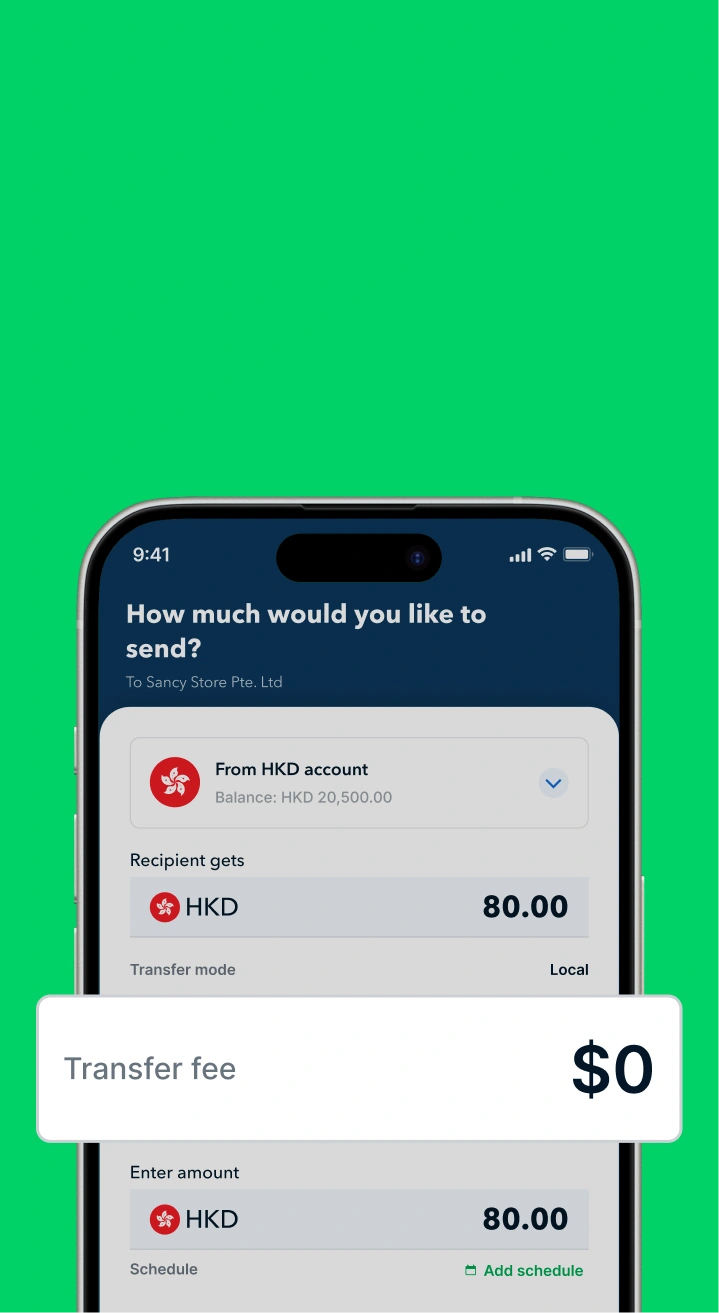
- Transfer Network: In addition to built-in FPS (Free) and CHATS to ensure local payments and payroll arrive on time, Aspire features a powerful local transfer network—allowing you to directly receive and send money overseas like a local. Compared to traditional SWIFT wire transfers, local transfers eliminate layers of intermediary bank fees and significantly shorten arrival times, helping you save on transfer expenses at the source.
- Spending Control: From Invoicing to paying Bills, the process is fully automated. You can instantly issue controllable corporate cards and pair them with "snap-and-claim" features to automatically categorize employee expenses. All transaction data syncs seamlessly with Xero, QuickBooks, and NetSuite, solving all administrative pain points from payroll to reconciliation on one platform.
- Operational Rewards: Turn your spending into returns! Earn 1.2% unlimited cashback on major business expenses, e.g. marketing and SaaS subscriptions. Your account also comes with over USD 500,000 in business rewards, covering tools like Google Workspace and Slack, rebating your operating costs from the start.
Open an account for free now to experience a smarter, more flexible business financial solution and accelerate your business growth!
Frequently Asked Questions
How long does a wire transfer from Taiwan to Hong Kong take?
Standard SWIFT wire transfers from Taiwan to Hong Kong take 1–3 business days. If the Taiwan bank receives a complete and correct application before their daily cutoff time, most routes process by the following business day. Public holidays in either jurisdiction extend the timeline, factoring in both Taiwan's and Hong Kong's banking calendars when planning payment dates. Licensed money changers can sometimes offer same-day or next-day processing for smaller amounts, but with lower fee transparency and no formal SWIFT trace available. Transfer timing also depends on whether the payment routes through an intermediary bank and how quickly the HK receiving bank processes the incoming credit.
Can I send New Taiwan Dollars (TWD) directly from Taiwan to Hong Kong?
No. TWD is classified as a restricted currency by Taiwan's Central Bank (CBC). It cannot be transmitted cross-border in its original form. Before any transfer leaves Taiwan, you must complete a foreign exchange settlement converting TWD into an internationally accepted currency such as HKD or USD. This is a mandatory legal step under the CBC's Regulations Governing the Declaration of Foreign Exchange Receipts and Disbursements or Transactions, and it applies regardless of the amount being transferred.¹ At most Taiwanese banks, this conversion is integrated into the international remittance workflow, you complete it as part of the same transaction rather than separately.
How do I make sure my Hong Kong recipient receives the full declared amount?
Select the OUR fee-bearing mode when initiating the wire transfer. OUR means you the sender absorb all bank and correspondent bank charges along the transfer route. The amount you declare as the transfer amount is what your HK recipient receives in full. If you select SHA (fees shared between parties) or BEN (beneficiary bears all fees), correspondent bank charges are deducted from the payment mid-route, and your HK recipient receives less than the stated amount. For business payments where invoice totals must match exactly, OUR is the only appropriate choice. For a deeper breakdown of how intermediary bank charges work, see our dedicated guide.
Are there taxes on money sent from Taiwan to Hong Kong?
Sending money from Taiwan to Hong Kong is not itself a taxable event in most cases. The nature of the funds, however, determines whether other tax obligations arise. Business payments, supplier invoices, service fees, salaries are subject to normal corporate income tax treatment in Taiwan for the entity making the payment. If the transfer constitutes a gift, Taiwan provides an annual gift tax exemption of TWD 2.44 million per donor; amounts above this must be declared for Gift Tax.
On the Hong Kong side, there is no capital gains tax or remittance tax. Large inbound transfers may trigger a KYC review by the receiving HK bank, requiring documentation of fund source and purpose. For situations involving significant sums, cross-border business structures, or recurring large transfers, consult a qualified tax professional in the relevant jurisdiction before proceeding.






.webp)